& Construction

Integrated BIM tools, including Revit, AutoCAD, and Civil 3D
& Manufacturing

Professional CAD/CAM tools built on Inventor and AutoCAD
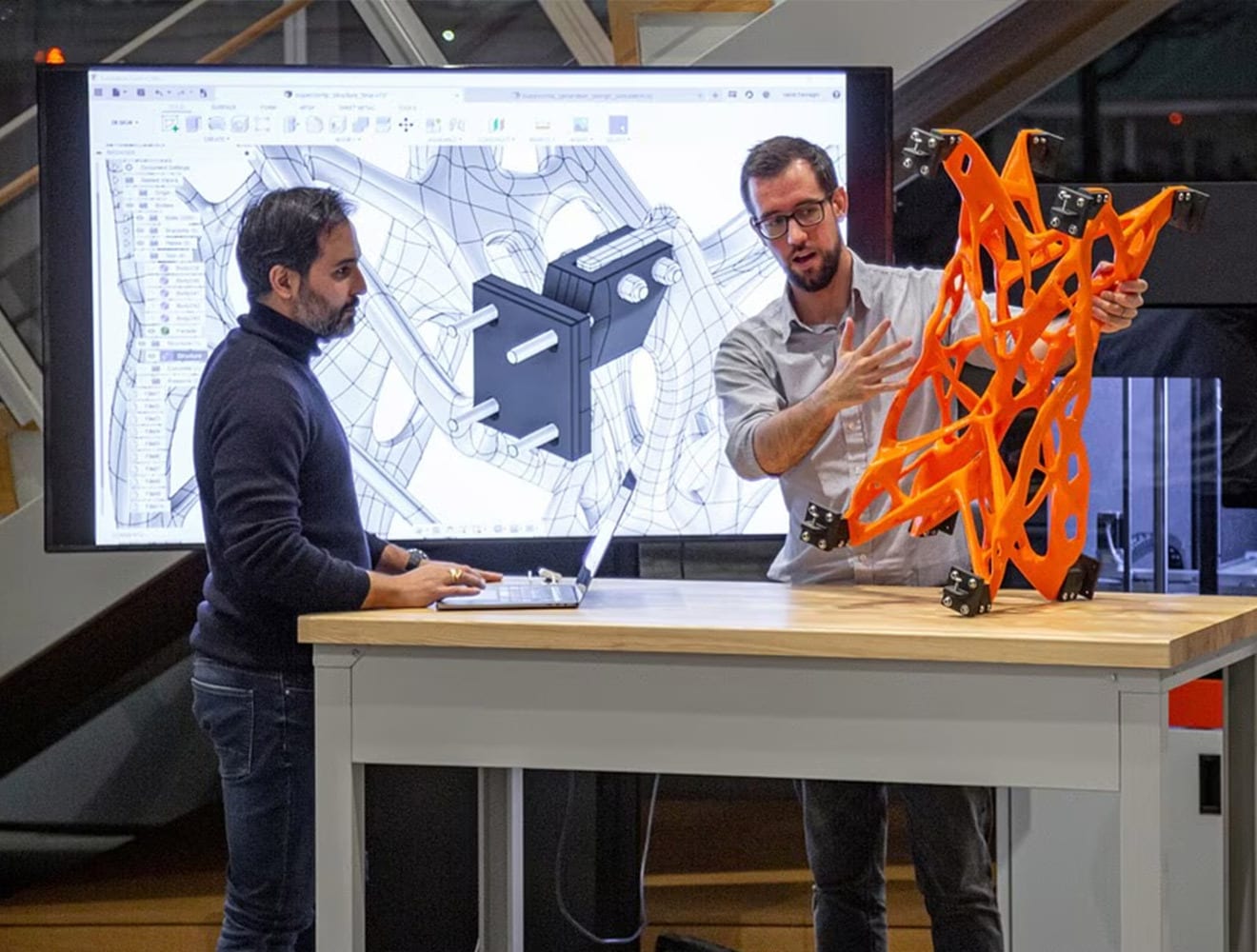
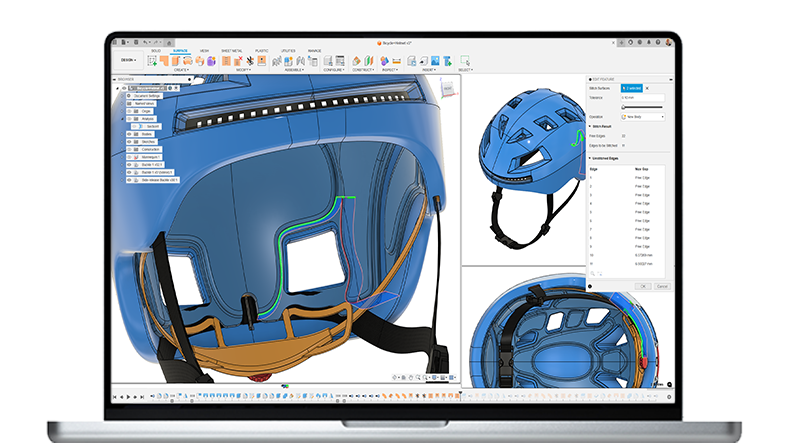
Autodesk Fusion is your all-in-one solution for rapid prototyping, CNC machining, sheet metal fabrication, and design for manufacturing, offering tools to streamline workflows and accelerate innovation in product development.
Transform ideas into reality with precision and efficiency using Autodesk Fusion's advanced capabilities.
Automatically detect and program holes across the entire part in seconds. Apply intelligent whole-part strategies to eliminate repetitive programming and dramatically reduce manual input.
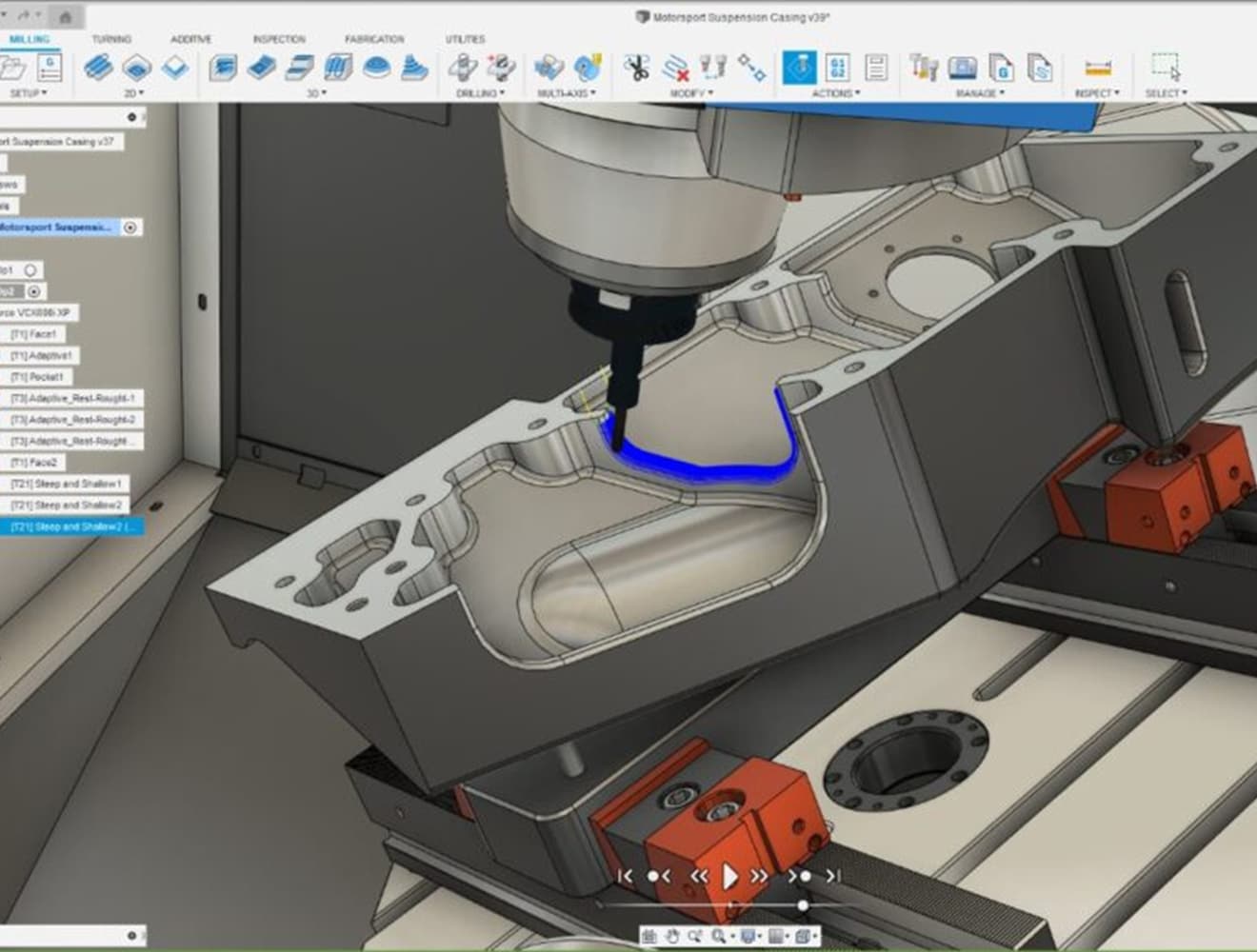
Boost your precision with advanced multi-axis capabilities and integrated probing. Achieve tighter tolerances with fewer setups while reducing scrap and rework through in-process verification.
Adjust feeds, speeds, stepovers, and boundaries without regenerating large toolpaths. Quickly realign updated geometry or stock conditions and keep production moving.
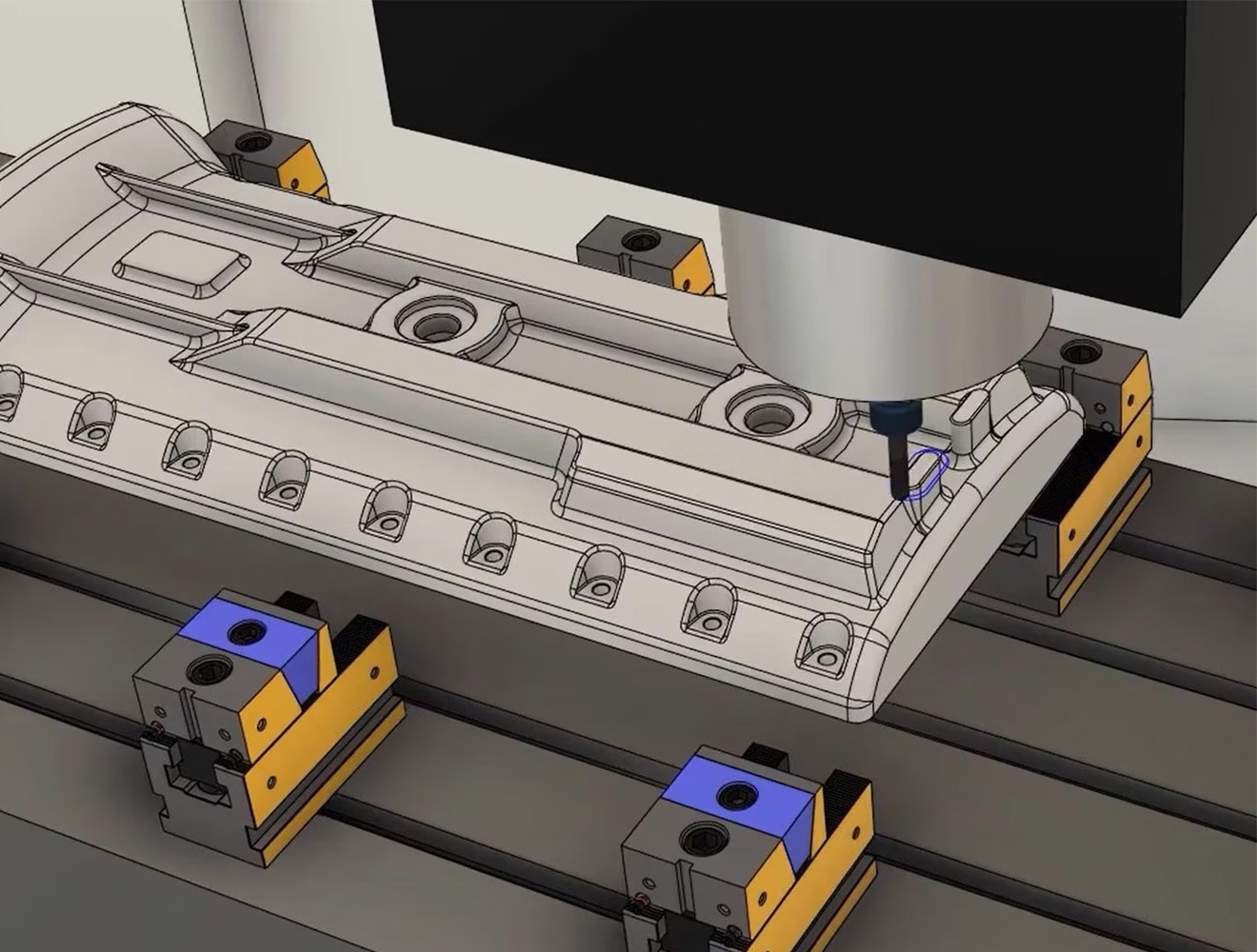
With 2-axis milling, the cutting tool moves across two axes, X and Y, while 3-axis milling adds the Z axis, where the tool head moves up and down.
Upgrading your CNC software to offer 3-axis toolpaths can accomplish the same milling jobs with fewer setups—leading to less machine time and corresponding cost savings. With 4-axis milling, one rotational axis is added.
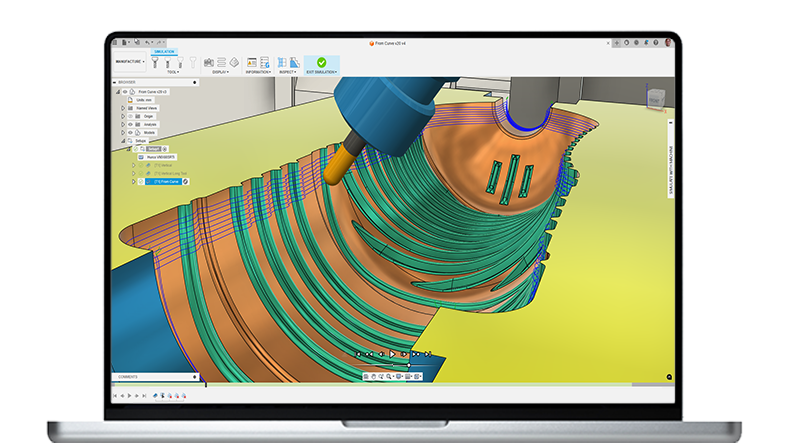
With 3+2-axis machining, also called positional 5-axis machining, the cutting tool moves across three linear axes (X, Y, and Z) and can tilt to different angles along two rotational axes (A or B, plus C). By contrast, simultaneous 5-axis machining, also called true 5-axis machining, moves both the cutting tool and the workpiece along X, Y, Z, as well as A/B and C axes simultaneously.
3+2-axis machining has the advantages of reducing setups, avoiding collisions, and using shorter, more rigid tools without the level of complex CNC software and hardware programming that simultaneous 5-axis machining requires. However, simultaneous 5-axis machining can achieve more complex organic shapes and contours, as well as reduce machining time and waste.
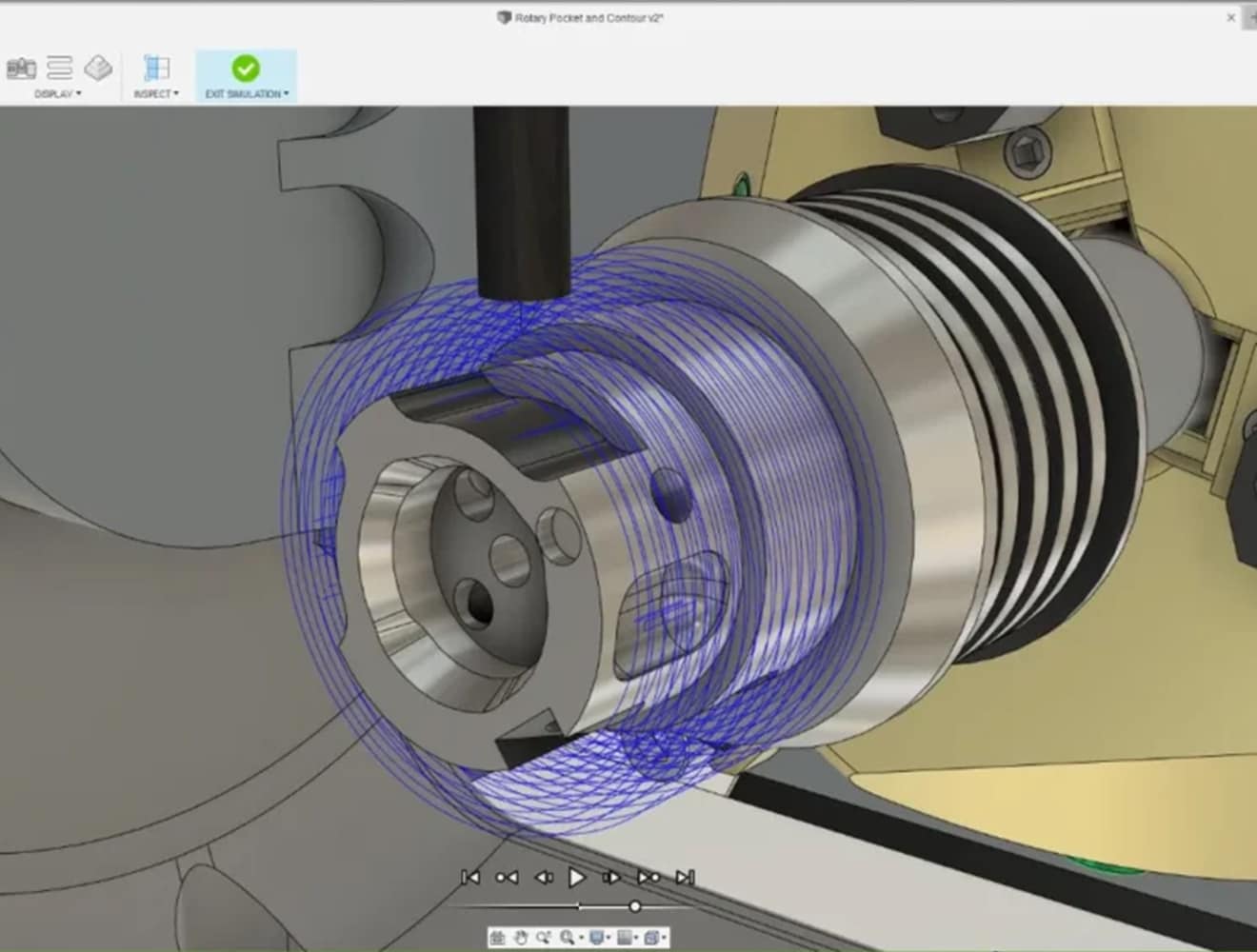
CNC turning typically involves lathe machines that spin the stock along a stationary cutting tool. Turning operations include removing material from the front of the stock or from the outside of the part; adding threads to the part; and boring, or creating holes, in the part.
Turning does certain jobs more efficiently than milling, but “mill-turning” operations can combine both turning and milling when your CNC software and machinery can support it.
Sheet metal fabrication is a process that involves creating metal structures and components by cutting, bending, and assembling sheet metal. The process usually begins with cutting, which is acheived through various methods such as shearing, laser cutting, waterjet cutting, or plasma cutting, to shape the metal into the desired dimensions.
After cutting, the metal is bent into the necessary shapes using tools such as press brakes, rollers, or other bending equipment to form angles and curves as specified by the design. The final stage involves assembling the cut and bent pieces using techniques such as welding, riveting, or adhesive bonding to construct the final structure or component.
3D printing is the process of adding material to a structure using an extruder or printhead that adds material by heating, melting, or applying pressure, building an object one layer at a time. It is a type of additive manufacturing.
Autodesk Fusion provides comprehensive tools for 3D printing, enabling users to design, simulate, and prepare models for additive manufacturing. With Fusion, users can easily create complex geometries, optimize designs for printing, and seamlessly collaborate across teams to bring innovative products to life.
THE INTEGRATED MFG. SOLUTION FOR PROFESSIONAL SHOPS & PRODUCTION TEAMS
Best for teams moving beyond standalone CAM tools — unify advanced CAM automation, high-precision machining, and robust CAD tools in one environment.
Why teams switch from legacy CAD/CAM stacks:
Includes all Fusion features, plus advanced manufacturing capabilities:
THE FOUNDATION FOR MODERN PRODUCT DEVELOPMENT
Integrated CAD, CAM, CAE, PCB, and PDM essentials for design and collaboration in a single, unified workspace.
Includes:
Best for: Early-stage teams and makers
Autodesk Fusion connects your entire product development processes by integrating design, manufacturing, data and operations into a single platform.
Connect with our dedicated sales team to find the best solution that fits with your company's needs by simply completing this form.