& Construction

Integrated BIM tools, including Revit, AutoCAD, and Civil 3D
& Manufacturing

Professional CAD/CAM tools built on Inventor and AutoCAD
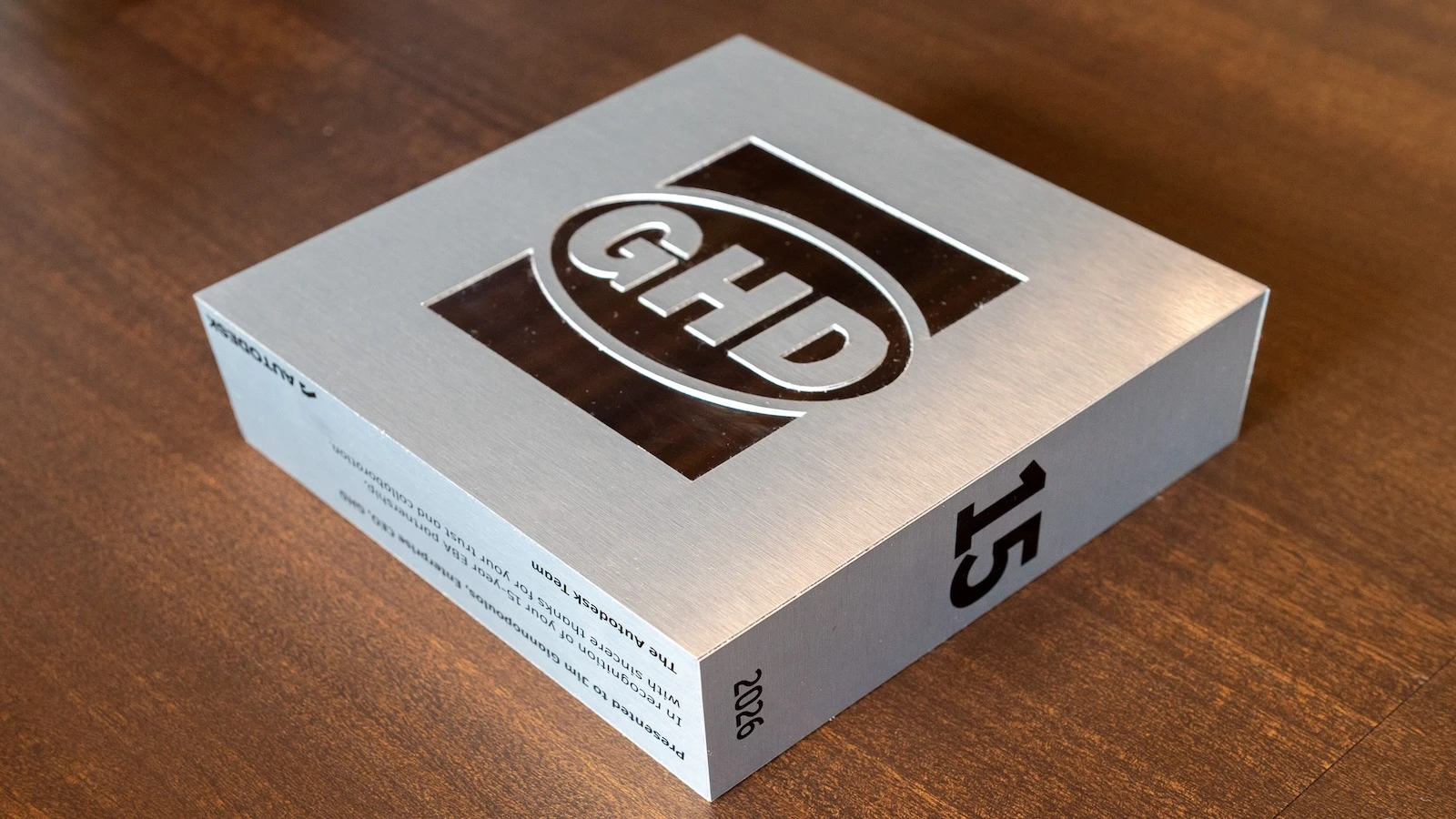
Fifteen years ago, GHD and Autodesk began a journey intended to push the boundaries of infrastructure delivery through digital design. What started as a licensing agreement has evolved into a strategic partnership focused on innovation, trust, and reimagining design with the power of data and AI. GHD, one of the world’s leading engineering and professional services firms, partnered with Autodesk to move from desktop tools to cloud collaboration – and now, to a platform-powered, AI-augmented design future with people at the forefront.
GHD is a global, multidisciplinary professional services network providing clients with integrated solutions across advisory, digital, engineering, architecture, environmental and construction services. With more than 12,000 employees across 160 offices worldwide, GHD is committed to addressing the world’s biggest challenges in the areas of water, energy and communities through a future-focused, innovative lens.
“When we started working with Autodesk, we were 100% desktop,” recalls Paul Murphy, GHD’s Chief Information Officer. “Our initial enterprise agreement helped us scale Autodesk tools across our organisation. But our relationship has always been about more than access – it’s about evolving how we work to create additional value for our clients and our teams.”
This evolution has taken GHD through cloud adoption, enabling real-time collaboration across geographies, and into the platform era. Now, GHD is exploring how Autodesk Forma and connected data environments can power AI-enabled workflows.
“The real shift we’re excited about is moving from managing files to managing data,” Murphy says. “That unlocks enormous potential for AI to identify patterns across projects, driving value we couldn’t previously access.”
GHD’s approach is grounded in augmentation – not automation. The company sees AI as a tool to enhance, not replace human expertise.
“We see our people as custodians of critical decisions,” Murphy says. “AI helps accelerate insight and frees up time for higher-value work.” By unlocking data previously trapped in disconnected files and automating workflows, GHD people can dedicate more time towards sustainability, constructability, and direct client impact.
This pivot is supported by long-term investment in Autodesk’s platform and alignment with its roadmap, enabling GHD to explore the future of AI with confidence.
GHD’s collaboration with Autodesk is built on shared values, not just transactions. “There are plenty of good products in the market,” Murphy notes. “But Autodesk stands out through a commitment to co-develop and reimagine how work gets done, delivering mutual benefits to our organisations, clients, and the industry.”
This spirit of innovation is clear in GHD’s engagement with Autodesk Research, exploring how AI can transform design. Strategic alignment at the executive level ensures Autodesk’s platform vision reflects GHD’s enterprise goals, supporting ongoing improvements in deployment, governance, and integration.
The partnership’s value is visible in standout projects like the Medlow Bath Pedestrian Bridge in Australia – hailed by the local community as “the best bridge in the Blue Mountains.” Using Civil 3D and Revit, and GHD-developed Dynamo automation tools, the team delivered a complex, data-rich design with over 5,400 model elements. This integrated workflow enabled accurate, fabrication-ready output and demonstrated how AI and automation enhance quality, speed, and constructability.
GHD has also applied Autodesk tools in rail projects, transforming delivery with a custom Revit Family Library and Dynamo scripts. These tools enabled precise, repeatable compliance checks and automated the placement of key assets. This approach has now been standardised into a workflow that combines Revit and Civil 3D.
Megan Stanley, GHD’s Technical Applications Manager, says, “Through foundational tools like Revit and Civil 3D, our teams have turned innovation into everyday practice - streamlining coordination and documentation to lift quality and speed.”
Randy Brook, Civil Engineering Technologist at GHD, adds, “Working within ACC has increased productivity and reduced omissions. It supports interdisciplinary workflows, helping both modelers and project stakeholders.”
GHD sees a future where projects are no longer defined by discrete files, but by integrated datasets that flow seamlessly across teams, tools, and time zones. This approach aligns with global standards like ISO19650 and supports a more connected ecosystem of clients, partners, and contractors.
“With Forma, files become inputs or outputs – not the core medium of work,” Murphy explains. “That opens the door to smarter, faster, and more adaptive design processes.”
The end goal? Faster iteration cycles, better design outcomes, reduced waste, and greater clarity for clients.
As the partnership enters its next phase, both GHD and Autodesk remain focused on the innovation, platform integration, and AI capability development. “I’m optimistic about the future of the partnership,” Murphy says. “Together, we’re shaping how work gets done for our clients, our industry, and our communities.”
Amy Bunszel, Executive Vice President, Architecture, Engineering and Construction Solutions at Autodesk, agrees. “Our 15-year partnership with GHD is grounded in trust, shared values, and a clear vision for the future of the built environment. GHD is more than a customer. They are a true co-innovator, helping shape our platform and our AI strategy. Together, we’ve shown how connected data and design workflows drive faster delivery, higher quality, and more sustainable outcomes. AI is now accelerating that progress by helping GHD’s teams automate routine work and gain deeper insight. This is about empowering people to do their best work. Looking ahead, Autodesk and GHD are aligned in shaping the next era of infrastructure and design.”
“There’s always a choice in partnerships,” Murphy concludes. “You can treat your tech providers as vendors – or you can choose to engage, to influence, to innovate together. We’ve chosen the latter. And that’s what has made this 15-year journey so valuable.”
With a shared commitment to innovation, sustainability, and digital transformation, GHD and Autodesk are building the foundation for what’s next in their partnership, the industry, and the future of design itself.