& Construction

Integrated BIM tools, including Revit, AutoCAD, and Civil 3D
& Manufacturing

Professional CAD/CAM tools built on Inventor and AutoCAD
Life-critical stakes: NV5 designed new utility infrastructure across a 16-acre campus while maintaining uninterrupted service to a fully operational cancer hospital with an emergency room and hundreds of inpatient beds.
Invisible complexity made visible: Using 3D modeling, site grading, and conflict analysis tools in Autodesk Civil 3D, NV5 identified and resolved 59 subsurface utility crossings and conflicts during design, including 14 gravity sewer crossings. Four occurred within or immediately adjacent to the site’s primary steam, chilled water, and medical gas corridor, where service continuity was critical.
Accelerated delivery under pressure: The team delivered a construction-ready design from first submittal to approval in approximately 10 months—faster than typical for healthcare campus projects of this scale.
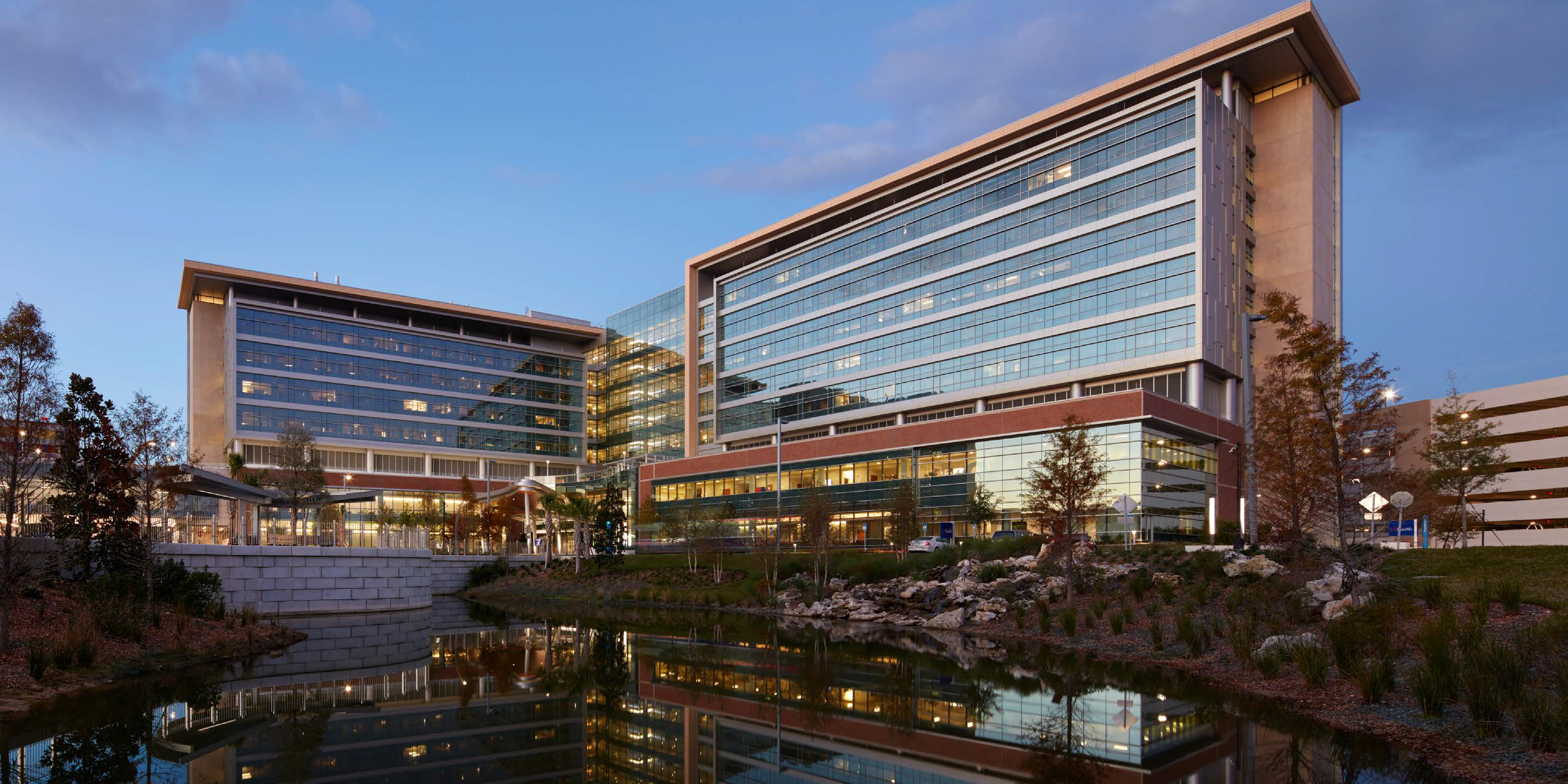
UF Health is one of the fastest-growing health systems in southeastern United States. One of its newest additions, Heart & Vascular and Neuromedicine Hospital in Gainesville, Florida is a 240-bed, 538,000-square-foot facility built on a 16-acre site adjacent to an existing cancer hospital. The two buildings share a central energy plant, roadway access, and pedestrian infrastructure.
That shared infrastructure created an uncommon constraint.
The cancer hospital operates 24/7, with hundreds of inpatient beds and an emergency room. It remained fully operational throughout design and construction.
“Disrupting power, water, or access was not an option,” says Travis Hastay, PE, Director of Infrastructure Engineering at NV5. “It’s a 24-hour hospital with hundreds of patients. Any outage would have had serious consequences.”
NV5 was responsible for land planning, surveying, landscape architecture, and civil, utility, and geotechnical engineering—not only for the hospital, but also for a parking garage, modified roadway networks, stormwater systems including the Garden of Hope facility, and expansion of the Southeast Energy Center. Beneath all of it lay a dense network of existing utilities, some over a decade old, some poorly documented, all essential.
Reliability and precision were nonnegotiable.
Utility coordination on complex campuses has long relied on 2D drawings and manually adjusted profiles. Spatial relationships were open to interpretation, and conflicts often surfaced during construction, when they were most costly to resolve.
NV5 shifted to a model-based process. Engineers built coordinated 3D representations of existing utilities alongside proposed infrastructure, with grading and roadway geometry in the same environment. Deliverables were generated directly from the model.
Travis Hastay, PE, Director of Infrastructure Engineering at NV5
With existing and proposed systems modeled together, NV5 ran systematic conflict analysis to identify every crossing and clearance issue. Dozens of conflicts surfaced early and were resolved during design.
One critical example involved a proposed gravity sewer crossing over existing gas, water, and storm infrastructure in a tightly constrained area. Resolving this in design reduced both construction risk and uncertainty in the field.
This approach was especially important for the Southeast Energy Center expansion. Integrating new MEP connections while maintaining live service to the cancer hospital required precise understanding of subsurface geometry. Engineers could cut sections anywhere on site and immediately verify how systems interact.
Travis Hastay, PE, Director of Infrastructure Engineering at NV5
Because grading, utilities, and roadway corridors were coordinated in a single model, the team could evaluate changes quickly and reduce rework. Quantity takeoffs and cost estimates came directly from the model, eliminating manual calculations.
“The schedule was tighter than you’d normally expect for this scope,” says Hastay. “Having everything coordinated in one place meant we weren’t losing time reconciling between separate deliverables.”
While large healthcare projects inevitably generate RFIs, comparatively few on this project were tied to site utility conflicts—reflecting the level of upfront coordination.
On complex projects, coordination often breaks down at discipline boundaries. Civil meets MEP. Grading meets structure. Utilities meet architecture.
NV5 shared coordinated site models with architects and MEP teams, who referenced them within their own tools. Subsurface conditions could be reviewed alongside building systems, grounding coordination discussions in measurable geometry rather than interpretation.
That clarity shaped coordination with both consultants and the owner. Early alignment sessions supported collaboration, but the model itself became the common reference point everyone relied on.
Travis Hastay, PE, Director of Infrastructure Engineering at NV5
The cancer hospital’s utilities remained uninterrupted throughout construction. By resolving 59 crossings during design—including four within the campus’s most critical utility corridor—NV5 minimized subsurface risk and delivered a predictable, constructible solution.
More broadly, the team achieved greater control over the project. Subsurface conditions were understood earlier, conflicts were resolved before construction, and documentation reflected coordinated geometry rather than reconciled drawings.
This reduced exposure to field changes and late-stage revisions while strengthening confidence among architects, contractors, and the owner.
On a campus where infrastructure reliability supports patient care, that level of control matters.
NV5 has supported UF Health’s Gainesville campus for more than 15 years and now contributes to ongoing master planning and expansion. The workflows refined on this project—conflict analysis, integrated grading, and coordinated utility modeling—are becoming standard practice across the firm’s portfolio.
For engineers working in constrained environments, the takeaway is straightforward: the ability to model subsurface conditions and resolve conflicts before construction is no longer a differentiator. On projects where a missed crossing could disrupt patient care, it is the baseline for responsible delivery.
Travis Hastay, PE, Director of Infrastructure Engineering at NV5