 Eric Suesz
Digital transformation is often associated with adopting new technology, but for Scottish Water, it began with a much simpler question: How can we free engineers to spend more time engineering?
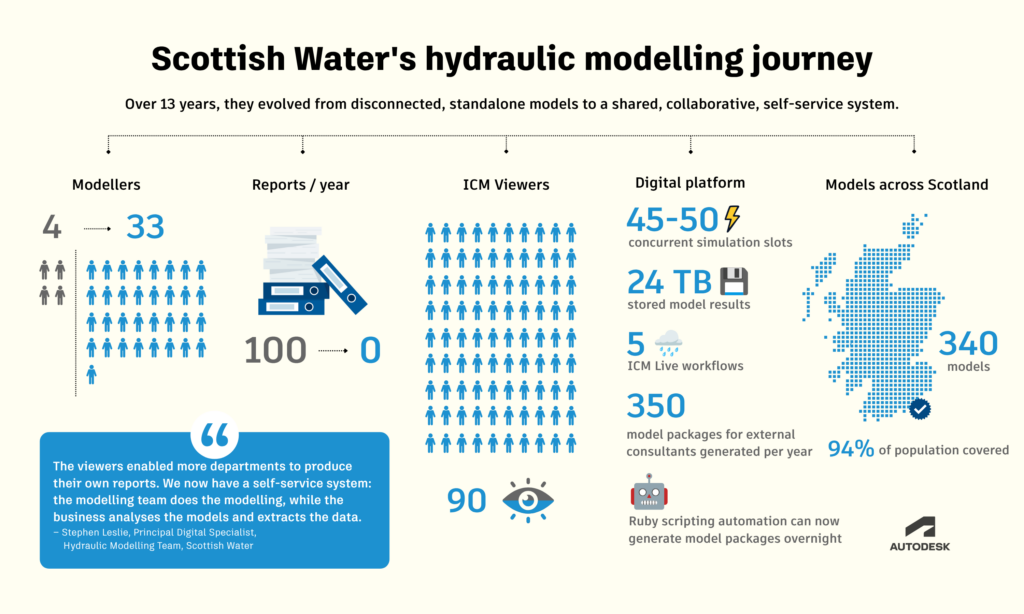
Just over a decade ago, Scottish Water’s hydraulic modellers were producing more than 100 flooding reports every year. Today – remarkably – they produce none. Instead, engineers across the organisation can access hydraulic model results directly, allowing modellers to focus on engineering rather than administration.
In a recent presentation, Stephen Leslie, Principal Digital Specialist at Scottish Water, shares the organisation’s journey from standalone hydraulic models and manual reporting to a collaborative modelling environment built around Autodesk InfoWorks ICM that supports around 340 network models across Scotland. Along the way, he explains how standardising workflows, expanding access to model information and gradually embracing cloud technologies has transformed the way hydraulic modelling supports the wider business.
Rather than being a story about software alone, this is a practical example of how incremental change can deliver long-term organisational benefits.
From standalone hydraulic models to an enterprise platform
When Scottish Water established its in-house hydraulic modelling team around thirteen years ago, the team consisted of just four or five modellers. Like many organisations at the time, models were stored locally on individual workstations, making collaboration difficult.
The consequences were familiar. Work was duplicated, models could become out of date, and engineers often spent valuable time trying to locate the correct version before analysis could even begin.
As demand for hydraulic modelling increased across the business, another challenge emerged. The flooding team relied heavily on specialist modellers to update models, run simulations, prepare reports and attend stakeholder meetings to explain the results.
Instead of focusing on hydraulic analysis, experienced modellers were spending a significant portion of their time producing reports.
Democratizing hydraulic model access across Scottish Water
One of the most refreshing aspects of Scottish Water’s story is that there was no “big bang” implementation.
The journey started with a single laptop and a handful of shared network models. Once the benefits became clear, that evolved into a dedicated high-specification server. As demand increased, additional computational servers were added until the platform eventually grew into today’s enterprise environment.
Stephen is keen to stress that the system wasn’t built overnight. The modelling team continued delivering business-as-usual work while expanding the platform in stages, adding investment only as the wider organisation recognised its value.
That gradual approach also meant the platform evolved around real business requirements rather than technology for technology’s sake.
Today, Scottish Water is one of the UK’s largest water utilities, managing approximately 340 network models that serve around 94% of Scotland’s population, supported by dedicated computational infrastructure capable of running around 45–50 simulations simultaneously. Baseline simulation results are retained for every model, allowing teams across the organisation to access information without rerunning analyses.
Giving more people access to engineering insight
Perhaps the biggest cultural shift has been making hydraulic model information available beyond the modelling team. They figured out how to successfully collaborate, both across the team and the organisation.
By introducing InfoWorks ICM Viewer and later Autodesk cloud simulations, Scottish Water has enabled flooding teams, catchment planners and other stakeholders to explore models independently, review simulation results and investigate scenarios without waiting for a modeller to prepare a report.
Rather than acting as gatekeepers to model information, hydraulic modellers now provide the engineering expertise while other teams carry out much of the interpretation themselves.
Stephen highlighted another unexpected benefit of this approach. With more people reviewing models, more issues are identified, additional survey information is fed back into the modelling team, and overall model quality continues to improve.
As he put it, there are now simply “more eyes on the model.”
Letting modellers focus on modelling
Scottish Water previously produced more than 100 flooding reports every year, with hydraulic modellers being responsible for preparing each of those reports. Today, that figure has fallen to zero.
Instead, flooding teams access simulation results directly through ICM Viewer, produce their own reports and return to the modelling team only when new scenarios or additional analysis are required.
The result is exactly what Stephen set out to achieve: “Modellers can now concentrate on doing modelling.”
That shift has also supported the remarkable growth of the hydraulic modelling team itself—from just four people to 33 specialists serving the wider organisation.
Continuing to evolve
Scottish Water’s transformation hasn’t stopped with shared models.
The organisation continues to expand its use of Autodesk technologies, including cloud projects for collaboration, ICM Live to support operational forecasting and incident response, and InfoAsset Manager to help centralise flood risk information and asset intelligence. Together, these technologies are helping Scottish Water move beyond project delivery towards more proactive operational decision making.
Their team of modellers continues to break new ground and pursue new innovations. Workflow automation is becoming an increasingly important part of Scottish Water’s hydraulic modelling practice. Ruby scripting now generates hundreds of ICMT packages for consultants, reducing manual effort and allowing routine tasks to run overnight.
Meanwhile, cloud projects are opening new opportunities for collaboration with local authorities and external partners while maintaining appropriate levels of access.
Lessons for other utilities
Stephen closed the session by reflecting on the lessons learned over more than a decade of continuous improvement. Perhaps the biggest takeaway is that successful digital transformation doesn’t have to happen all at once. Scottish Water started small, proved value, expanded where it made sense and continually adapted the platform to meet changing business needs.
The technology undoubtedly played an important role, but the real transformation came from changing how people worked with hydraulic models:
- Instead of creating more reports, Scottish Water created better access to engineering knowledge.
- Instead of adding more bottlenecks, it removed them.
- Instead of limiting hydraulic models to a specialist team, it turned them into a shared organisational resource.
Go deeper with our webinar
If you’re interested in enterprise hydraulic modelling, digital transformation for water utilities, or collaborative modelling with Autodesk InfoWorks ICM, go deeper with Scottish Water Hydraulic Principal Digital Specialist Stephen Leslie and InfoWorks ICM Product Manager Samer Muhandes in a recent webinar hosted by Smart Water Magazine, Hydraulic Modelling in the Cloud with InfoWorks ICM & InfoWorks WS Pro. Lessons from Scottish Water’s Early Adoption Experience.