Get help with Account management
Account management for admins
Manage user role policy
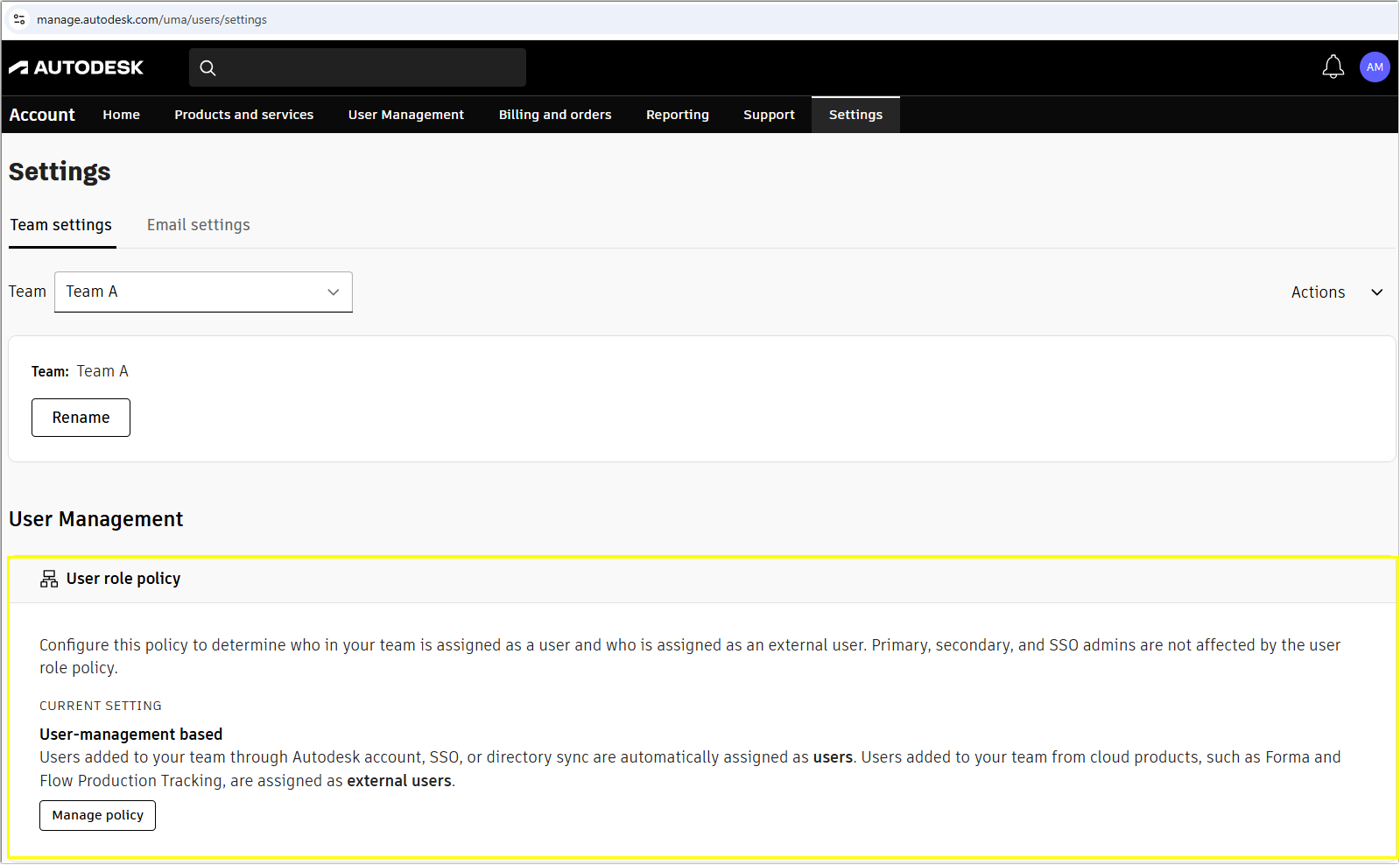
The user role policy lets you designate users as either an external user or a user.
An external user is someone outside your organization, such as a contractor or vendor, who needs access to Autodesk products or services. Previously referred to as a guest user, this role ensures secure collaboration without exposing sensitive internal resources.
You can decide which policy applies to your external users, either the default settings in user management or by rules based on domain names. This helps you control whether someone is treated as an external user or a standard user, making it simpler to manage access securely and transparently.
Choose your path
If this sounds like you… | Start here | This path is for… |
Someone from my company is showing as an external user. | Why someone may be classified as an external user | Understanding how the team's current policy classified the person. |
I want people from our company to be recognised automatically. | Use Domain based user role policy | Automatically classifying people as user instead of external user by approved email domain. |
We're restricting external users and I want to make sure the right people are affected. | Understand how user role policy works with Subscription usage policy | Reviewing role classification before applying subscription restrictions based on user role. |
This person's role doesn't match our domain rule. | Review user role policy exceptions | Reviewing people whose existing role differs from the role expected by the current domain policy. |
Understand your user role policy options
User management based
With User-management baseduser role policy, people added to your team through an integrated Autodesk cloud collaboration product, such as Forma Design Collaboration, Forma Build, or Forma Takeoff, are automatically set as an external user in your Autodesk account.
User-management basedpolicy can be appropriate when your organisation already has a reliable process for making sure people are correctly classified as users or external users.
Domain based
With Domain based user role policy, you create a list of approved email domains for your team.
This allows you to automatically manage who is considered a user or external user, regardless of whether they are added through an Autodesk account or an integrated cloud collaboration product. Anyone added with an email from an approved domain will be assigned as a user, while users with emails from other domains will automatically be set as external users.
Domain based policy can be useful when people are frequently added through cloud collaboration products because it lets Autodesk classify them automatically based on their email domain.
For some newer teams, Domain based policy may already be selected and the primary admin's email domain may already appear as the first domain.
Selecting the domain based policy doesn't change the roles of existing users. The policy applies only to new users. To update existing users' roles, use the options in User management.
Note: Include your organisation's domain for single sign-on (SSO) or directory sync in your domain based rules. This ensures that team members using SSO are automatically recognised as standard users.
Why someone may be classified as an external user
How a person is classified depends on the user role policy for the team.
With User-management basedpolicy, someone added through an integrated Autodesk cloud collaboration product can be classified as an external user even if they're an employee or otherwise part of your organisation.
With Domain based policy, the person's email domain is used to determine their role. A person whose email domain matches an approved domain is classified as a user. A person whose domain does not match is classified as an external user.
If someone from your organisation is unexpectedly classified as an external user:
Go to Settings > Team settingsin your Autodesk account.
Select the appropriate team.
Review User management policies to see whether the team uses User-management based or Domain basedpolicy.
If the team uses Domain based policy, check whether the person's email domain is included.
If the person was already on the team before the current Domain based policy applied to them, check View exceptionsin Manage policies.
Changing someone's role classification doesn't change the organisation they work for, their project role, or their product assignment.
Understand how user role policy works with Subscription usage policy
User role policyand Subscription usage policy control different things.
Setting | What it controls |
User role policy | Whether someone is classified as a user or external user on the Autodesk account team. |
Subscription usage policy | Whether applicable subscriptions assigned by the team can be used on projects associated with another team. Some Subscription usage policy settings treat users and external users differently. |
When Subscription usage policy is set to Restricted for external users, a person's classification matters because the restriction applies to people classified as external users.
Before relying on this setting, it is advisable to review your team's user roles and ensure that individuals are classified in accordance with your organisation's requirements.
This is especially important for people added through cloud collaboration products. With User-management based policy, those people can be classified as external users. Domain based policy can reduce unintended classification by automatically recognising people whose email addresses match your organisation's approved domains.
You do not have to change toDomain based policysolely because you useSubscription usage policy. If your organisation already has another reliable process for keeping user and external user roles accurate, you can continue using that process.
For information about whether an applicable subscription can be used on another team's project, see Manage subscription usage for external Forma projects.
To add domains
Go to settings > team settings in your Autodesk account.
Select the team you want to apply the policy to.
Go to user role policy and select manage policy.
Select domain based.
Here you can add new domains. Use add new to add as many domains as you need.
Select apply changes.
Confirm your policy update.
Your user role policy is now changed to domain based. New users added to the team will have their roles assigned based on their domain. Primary, secondary, and single sign-on (SSO) admins will not be affected by the domain rule.
Note: If you set up a domain rule, existing users on your team will keep their existing roles. If any existing users don’t meet the domain policy, they’ll be marked as exceptions. See View user role policy exceptions.
Add domains
You can add multiple domains to your Domain based user role policy.
Add a domain when people using that email domain should normally be classified as users on the team.
Make sure you include all relevant organisational domains, including domains used with SSO or directory sync when applicable.
To add a domain:
Go to Settings > Team settings in your Autodesk account.
Select the appropriate team.
Under User management policies, select Manage policies.
Select Add domainto add as many domains as you need.
Select Apply Changes at the bottom of the screen.
Confirmyour policy update.
New users whose email addresses match a listed domain are classified as users. New users with email addresses from other domains are classified as external users.
Remove domains
You can remove domains from a Domain based user role policy. At least one domain must remain.
To remove a domain:
Go to Settings > Team settings in your Autodesk account.
Select the appropriate team.
Under User management policies, select Manage policies.
Review the domains in the policy.
Select Remove for the domain you want to remove.
Select Remove to confirm the removal.
New users whose email addresses use the removed domain are classified as external users.
Note:Existing users keep their current roles. If their roles no longer match the domain policy, they appear as exceptions.
Review user role policy exceptions
An exception is a user whose current role does not match the role that the team's Domain based policy would assign.
For example, someone who was already on the team before their email domain was added to the policy keeps their existing role. If that role doesn't match the current domain rule, the person appears as an exception.
An exception isn't necessarily an error. It means the person's role differs from the role expected by the current domain policy. Review the person's relationship to your organisation before deciding whether their role should change.
To review exceptions:
Go to Settings > Team settings in your Autodesk account.
Select the team you want to manage.
Under User management policies, select Manage policies.
Select View Exceptions in the Approved email domains section.
Compare each user's current role with the role expected by the domain policy.
You can filter the list to review all roles, users, or external users.
Reviewing exceptions is particularly important if your Subscription usage policy treats external users differently.
Change roles for exceptions
To change the role of a user listed as an exception:
Go to Settings > Team settings in your Autodesk account.
Select the appropriate team.
Under User management policies, select Manage policies.
Select View Exceptions in the Approved email domains section.
Select the user whose role you want to change. You can select multiple people.
Select
Change roles
.
Choose the appropriate role.
Select
Change role
to save your changes.
When you select multiple people, the same new role is applied to everyone selected.
You don't have to remove every exception. The team admin should decide which role is appropriate for each person based on the organization's requirements.
Exceptions to the user role policy
You will see alerts in your account whenever a user does not follow your domain based rules.
User details alert: This user’s role is currently an exception to the user role policy
You will see a warning sign in a user’s details if their role does not follow your domain based rules. This means the domain based rule is on, and the user is an exception. To change a user’s role, click change role or go to your team settings to see all your user role exceptions.
Change role alert: This user’s role is currently an exception from the user role policy
When you change a user's role to match your domain rule, you'll see a message letting you know their role is currently an exception. If you want this user to follow your domain rules, select Undo exception.
Changing this user’s role will create an exception in the user role policy.
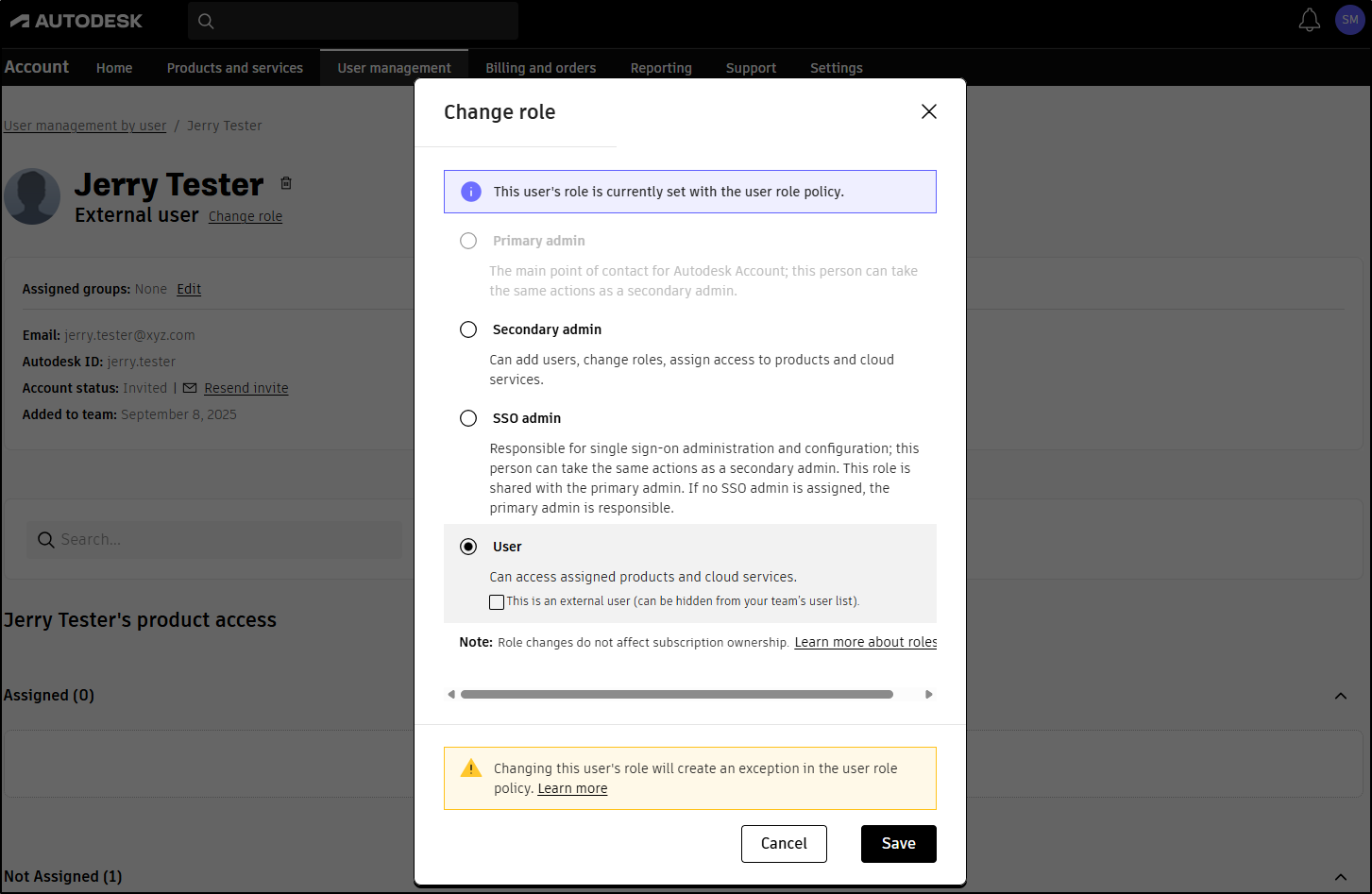
You may see this message when changing the role of someone whose current role matches the Domain based policy.
Continue with the change if you intentionally want the person to have a different role from the one assigned by the domain rule.
You can review this person later in View exceptions.
Frequently asked questions (FAQs)
prop://question
prop://question
prop://question
prop://question
prop://question
prop://question
What happens to my existing users when I set up a domain through the manage user role policy?
You won’t see any changes to existing user roles. Users whose roles don't align with your domain-based policy appear as exceptions. Go to your team settings to view exceptions.
How are the email domains I list in Manage user role policy related to the SSO domains I have set up in my team?
If you apply the default user-management based policy, the system adds users from single sign-on (SSO) or active directory (AD) sync as standard users. If you turn on the domain based policy, the system adds SSO or AD sync users as standard users only if their domain matches your policy. If their domain doesn’t match, the system adds them as external users.
Example: If you turn on the domain based external user rule and only include domain cba.net, but your SSO or AD domain is abc.net, the system adds users synced through SSO or AD as external users in your user management.
What happened to guest users?
We now call guest users "external users." You don’t need to change how you work, only the name has changed.
Will my default product assignments be affected by this change?
No, this change will not affect your default product assignments. We are only renaming guest users to external users. You will assign products the same way as before.
Will I be able to see whether a user is external in my usage reports?
Yes, you can see which users are external in your usage reports.
How do I manage an exception?
You can manage domain-based user role exceptions from the view exceptions menu or by updating the role on the user’s details page. For more information, go to Designate external users.
Related resources
Need help? Ask the Autodesk Assistant!
The Assistant can help you find answers or contact an agent.
What level of support do you have?
Different subscription plans provide distinct categories of support. Find out the level of support for your plan.
View levels of support