 Shannon McGarry
This post is also available in:
Explore why connected product development matters and how Autodesk Fusion unifies CAD, CAM, and CAE to improve data integrity and manufacturing agility.

Elevate your design and manufacturing processes with Autodesk Fusion
As product development cycles accelerate and product complexity continues to rise, manufacturers can no longer rely on disconnected engineering workflows. Siloed systems slow innovation, introduce costly errors, and limit an organization’s ability to respond to global competition. To stay competitive, manufacturers must adopt connected product development—a unified approach that aligns design, engineering, and manufacturing from concept through production.
Traditional product development environments often fragment critical data across separate CAD, simulation, and manufacturing tools. When teams operate in isolation, version-control issues, rework, and miscommunication become inevitable. A connected product development solution like Autodesk Fusion addresses these challenges by synchronizing every phase of the product lifecycle in a single, cloud-based environment—enabling faster decisions, higher-quality outcomes, and scalable manufacturing readiness.
Eliminating fragmentation with connected product development
Engineering teams face major bottlenecks when working in decentralized technical environments. In disconnected workflows, designers and manufacturing engineers frequently rely on incompatible software systems, forcing teams to translate files between tools. These translations often degrade geometry, strip essential metadata, and break parametric relationships—undermining data integrity across the development process.
Connected product development eliminates these risks by maintaining a single source of truth. Instead of recreating models or manually repairing files downstream, teams work from a shared data model that preserves geometry, parameters, and design intent. This consistency reduces human error, shortens development timelines, and ensures every stakeholder works with accurate, up-to-date information.
Enabling early validation through connected workflows
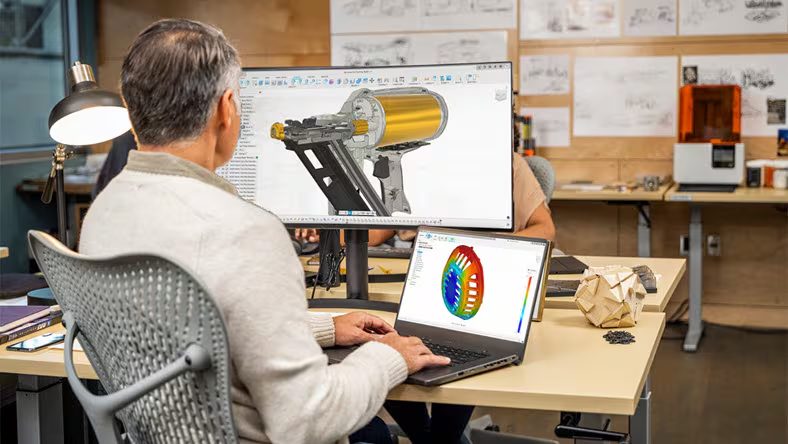
Stability and continuity are especially critical in high-performance product development, where early simulation and validation directly impact cost, safety, and performance. Engineers must assess structural integrity, thermal behavior, and manufacturability long before committing to physical prototypes.
In disconnected environments, exporting models to standalone simulation tools creates friction that discourages frequent testing. As a result, teams may overengineer parts or discover critical failures late in the production cycle. Connected product development removes this barrier by enabling seamless data flow between design and analysis. Engineers can iterate rapidly, validate assumptions earlier, and continuously refine designs without leaving the core development environment.
Simplifying data management across the product lifecycle
Data management remains a major constraint for organizations managing complex product portfolios and global supply chains. Traditional Product Data Management (PDM) systems often require significant IT overhead, on-premise infrastructure, and manual check-in/check-out processes—making them difficult to scale and inaccessible for distributed teams.
Connected product development depends on cloud-based data accessibility. By providing all stakeholders with secure access to the same models, specifications, and revision history, manufacturers can improve collaboration while reducing administrative overhead. This approach supports remote teams, external partners, and suppliers without compromising governance or traceability.
Scaling engineering capacity with Autodesk Fusion
Autodesk Fusion enables connected product development by integrating the entire product lifecycle into a single, cloud-enabled platform. CAD, CAM, CAE, and PCB design all reside within one associative data model, eliminating traditional file translations and disconnected workflows.
Any design change made in Fusion automatically propagates to manufacturing toolpaths and simulation studies. This full associativity ensures design intent remains intact from engineering through production, allowing teams to move faster with greater confidence. By removing manual exports and external PDM processes, Fusion streamlines collaboration between design and manufacturing teams.
Driving innovation with integrated design and simulation
During early concept development, Fusion’s integrated generative design and simulation capabilities allow engineers to explore thousands of optimized design iterations based on defined loads, materials, and manufacturing constraints. Because these tools operate directly within the connected product development environment, engineers can evaluate performance continuously rather than in isolated steps.
Fusion supports a wide range of analysis types—including linear static stress, modal analysis, and electronics cooling—within the same platform used for design. This close integration reduces reliance on physical testing, accelerates validation, and helps teams achieve higher performance targets with fewer iterations.
Accelerating production through connected manufacturing
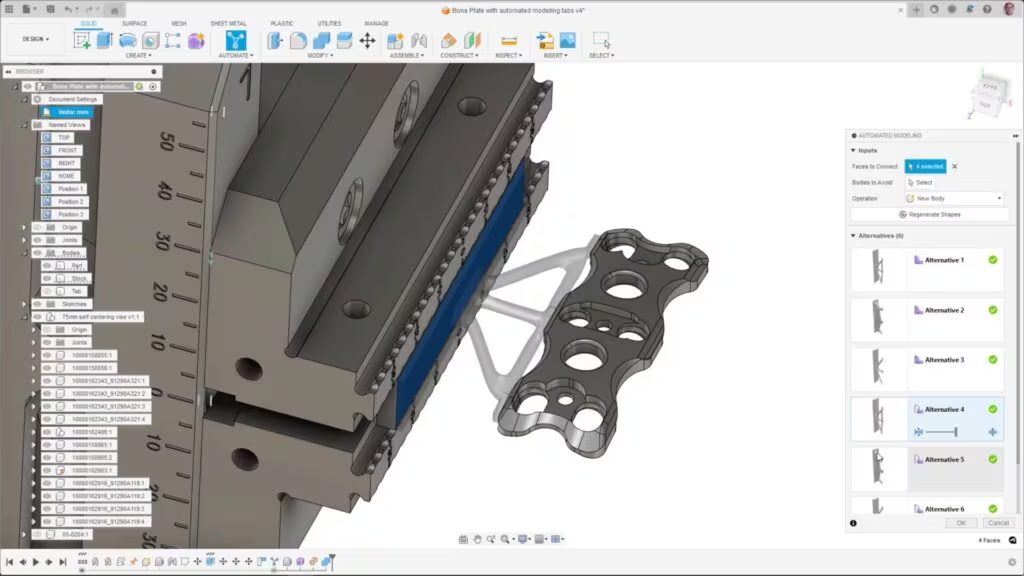
Connected product development extends beyond engineering into production. Fusion allows manufacturing teams to generate advanced CNC strategies, multi-axis machining paths, and additive manufacturing workflows directly from validated design data. Because manufacturing processes remain linked to the original design, updates flow automatically without manual rework.
Built-in collaboration and version control tools provide real-time visibility into project status, permissions, and revision history. Procurement, engineering, and production teams remain aligned—even across locations—ensuring manufacturing executes against the most current design intent.
The competitive advantage of connected product development
By eliminating the barriers between design, engineering, and manufacturing, connected product development enables a level of agility that disconnected systems simply cannot achieve. Manufacturers gain better decision-making, reduced data loss, faster time to market, and more resilient production workflows.
With Autodesk Fusion, organizations can move beyond managing files and focus on delivering innovative, high-quality products at scale—turning connected product development into a long-term competitive advantage.
Frequently asked questions – product development software
What are the most common types of product development?
How do companies measure the success of product development?
-Time to market
-Product adoption or usage
-Revenue or ROI
-Product quality (defects, rework, reliability)
-Customer satisfaction and retention
Teams also look at process efficiency, such as how quickly changes are approved and implemented, and how effectively cross-functional teams stay aligned.
Which product development software is best for manufacturing teams?
-CAD (design tools) for product creation
-PDM (product data management) for file control and versioning
-PLM (product lifecycle management) for workflows, BOMs, and change management
For example, Autodesk Fusion integrated approach that connects CAD, CAM, CAE, PCB, data management, and PLM all in a single product develpoment solution. These systems help ensure teams are working from the same data and following consistent release and approval processes.
Which 3D design software is best for professional product development?
-Parametric modeling
-Simulation and analysis
-Manufacturing readiness (CAM, generative design)
-Cloud collaboration
Tools like Autodesk Fusion are widely used because they combine design, simulation, and manufacturing workflows in one environment, which reduces handoffs and speeds up iteration. For many teams, the ability to move from concept to production in a single tool is more important than individual features.
How does product development software improve collaboration?
Key benefits include:
-Single source of truth for designs, BOMs, and revisions
-Real-time visibility into changes and approvals
-Role-based access across engineering, manufacturing, and suppliers
-Structured workflows for reviews, releases, and change management
Instead of relying on email or shared folders, teams can coordinate work directly in the system, reducing errors and miscommunication.
How does Autodesk Fusion help teams collaborate across design and manufacturing?
Is a connected product development solution suitable for small businesses?
-Limited resources and IT support
-Managing multiple disconnected tools
-Scaling processes as they grow
Cloud-based platforms like Autodesk Fusion are designed to address these constraints.
Fusion is well-suited for small businesses because it:
-Combines multiple tools (CAD, CAM, CAE, electronics, PDM) into one system
-Eliminates the need for expensive infrastructure or IT overhead
-Enables teams to work from anywhere
-Scales as the business grows
How does product development software help with collaboration?
Connected product development addresses this by providing a centralized source of truth, real-time updates, and support for cross-functional workflows.
Autodesk Fusion enables this with built-in cloud collaboration, allowing teams to work concurrently, track changes automatically, and access data from anywhere. The result is clearer communication, faster decision-making, and better alignment across the entire product lifecycle.
How does connected product development reduce time-to-market?
In traditional workflows, teams wait on file exchanges, rebuild models, or manually verify updates. These gaps create lag across the entire development cycle.
In a connected environment:
-Teams work concurrently on shared data
-Design changes are visible in real time
-Validation happens earlier and continuously
-Engineering handoffs are reduced or eliminated
This removes the “stop-start” nature of product development and enables true parallel workflows.
Tools, like Autodesk Fusion accelerate this by:
-Unifying design, simulation, and manufacturing in one system
-Enabling real-time collaboration on shared datasets
-Reducing handoff friction between teams
Why do manufacturers need connected product development?
Disconnected workflows often rely on file transfers (e.g., STEP files) and manual updates, which strip design intent and introduce inconsistencies between teams.
Connected product development solves this by bringing people, processes, and data into a single environment. It creates a shared source of truth where everyone works from the same, up-to-date information.
Autodesk Fusion is designed for exactly this. It connects CAD, CAM, CAE, electronics, and data management into one platform, so teams can move from concept through production without switching tools or losing context.
How does connected product development reduce time-to-market?
Autodesk Fusion accelerates this by unifying design, simulation, and manufacturing in one system and enabling real-time collaboration on shared datasets. The result is faster development cycles and quicker delivery to market—without compromising quality.