 Shannon McGarry
Scale your business with fewer bottlenecks. Discover how Fusion connects design, manufacturing, and data so teams can grow without added friction.

Elevate your design and manufacturing processes with Autodesk Fusion
Typically early-on with businesses, speed comes naturally. Decisions happen quickly. Teams sit close to the work. Products move from idea to prototype without much friction.
Then growth starts to introduce weight. More people, more tools, more handoffs. What used to feel fast begins to feel fragmented. Design lives in one system, manufacturing in another, and critical decisions get buried in threads, file versions, and rework.
Scaling the business starts to mean managing the process. How do you grow without slowing down?
The hidden cost of growth
Most teams don’t notice the shift immediately. It shows up gradually:
- Engineers spending time resolving version conflicts
- Teams recreating work because data isn’t shared cleanly
- IT overhead increasing just to keep systems running
- Delays between design and manufacturing that weren’t there before
These are small inefficiencies that compound over time, eventually becoming a constraint.
When the tools that support product development aren’t connected, growth amplifies the disconnect.
Why integration changes the trajectory
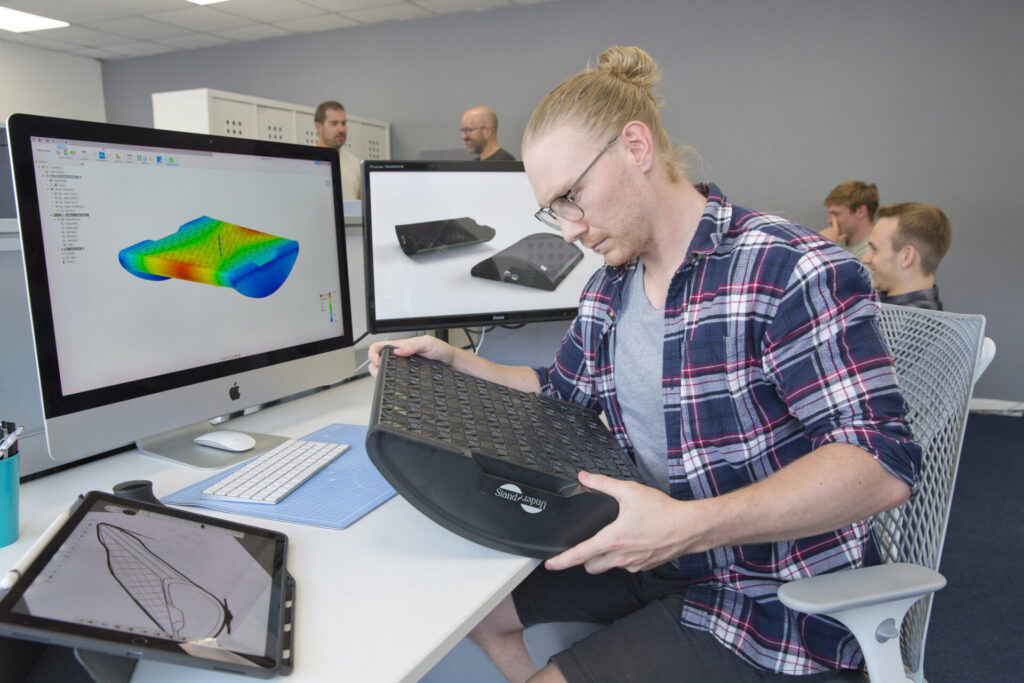
Design and manufacturing solutions, like Autodesk Fusion, weren’t built just to replace CAD or CAM tools. They were designed around a different premise: product development should happen within a connected system.
Instead of moving data between systems, the workflow exists in one place, with design, simulation, electronics, manufacturing, and data management working together as one.
Instead of coordinating across tools, teams operate within a shared environment. Instead of maintaining infrastructure, they rely on a managed platform. Instead of reconciling versions, they work from a single, continuously updated source of truth.
Scaling your business without adding friction
One of the patterns you see in growing companies is the tendency to layer complexity on top of success.
New tools solve immediate problems. New processes manage new risks. New systems support new teams.
Individually, each addition makes sense. Collectively, they slow everything down.
A cloud-based platform like Fusion removes a layer of that complexity by design. There’s no infrastructure to manage, no need to maintain multiple disconnected systems, and no requirement to orchestrate workflows across tools.
That doesn’t just reduce overhead. It preserves the speed companies had early on.
A different model for collaboration
As teams grow, across roles, locations, and functions, it becomes difficult to keep everyone working from the same context.
Fusion’s centralized workspace changes that dynamic by making collaboration inherent to the system:
- Teams access the same data
- Changes update in real time
- Work doesn’t need to be passed manually between roles
Instead of coordinating work, teams spend more time advancing it.
Growth that doesn’t require a reset
Another common inflection point in scaling businesses is the “replatforming moment”. The point where the current system no longer supports the scale of the organization.
Fusion takes a more incremental approach. Teams can start with the capabilities they need, then expand by adding users, workflows, or functionality without replacing the system itself.
What scaling your business actually looks like in practice
Scaling your business with a connected platform isn’t really about adding capability, it’s about removing friction.
- Fewer tools to manage
- Less handoffs between teams
- Fewer delays between design and production
- Less barriers to collaboration
The result is what most businesses are actually trying to achieve when they talk about scale: the ability to do more work, with more people, without slowing down the system itself.
The companies that scale well aren’t just hiring more people or building more products, they’re building systems that can absorb growth without becoming a bottleneck.
That’s where connected platforms like Fusion play a role.
Frequently asked questions about scaling your business
Scaling with Autodesk Fusion means expanding your team, workflows, and product output without adding significant operational complexity. Fusion supports this by connecting design, engineering, manufacturing, and data management in a single platform, reducing fragmentation as a business grows.
Fusion reduces complexity by eliminating the need for multiple disconnected tools and systems. It provides a centralized, cloud-based workspace where teams can collaborate, access shared data, and manage workflows without maintaining separate infrastructure.
A single source of truth ensures that all team members are working from the same data, reducing version conflicts, miscommunication, and rework. This is especially important as teams grow across locations and functions, where alignment becomes harder to maintain.
Fusion enables collaboration through a centralized cloud environment where teams can access, update, and share data in real time. This allows distributed teams to work together without relying on manual file transfers or disconnected workflows.
Fusion reduces overhead by removing the need for on-premise infrastructure, minimizing IT maintenance, and consolidating multiple tools into a single platform. This allows teams to focus more on product development and less on system management.
By connecting design, simulation, and manufacturing workflows in one system, Fusion helps teams move from concept to production faster, reducing delays caused by tool switching and manual handoffs.