 Markus Cueva
Learn how accurate factory simulations are, what ROI manufacturers can expect, how long simulation projects take, and when Autodesk FlexSim provides value beyond traditional layout planning.
FlexSim: 3D Discrete Event Simulation Software
Easy-to-use 3D simulation modeling and analysis software with high-end capabilities. Predict and optimize production processes with realistic 3D visuals and data-driven scenarios.
Factory simulation has become a valuable tool for manufacturers looking to reduce risk, improve throughput, and make smarter investment decisions. Yet despite growing adoption, many decision-makers still ask the same practical questions before investing in simulation software:
- How accurate are factory simulations?
- What return on investment can I expect?
- How long does it take to build a simulation model?
- When should simulation be used?
- When is layout planning enough on its own?
The answer to all of these questions comes down to one thing: reducing uncertainty before costly decisions are made.
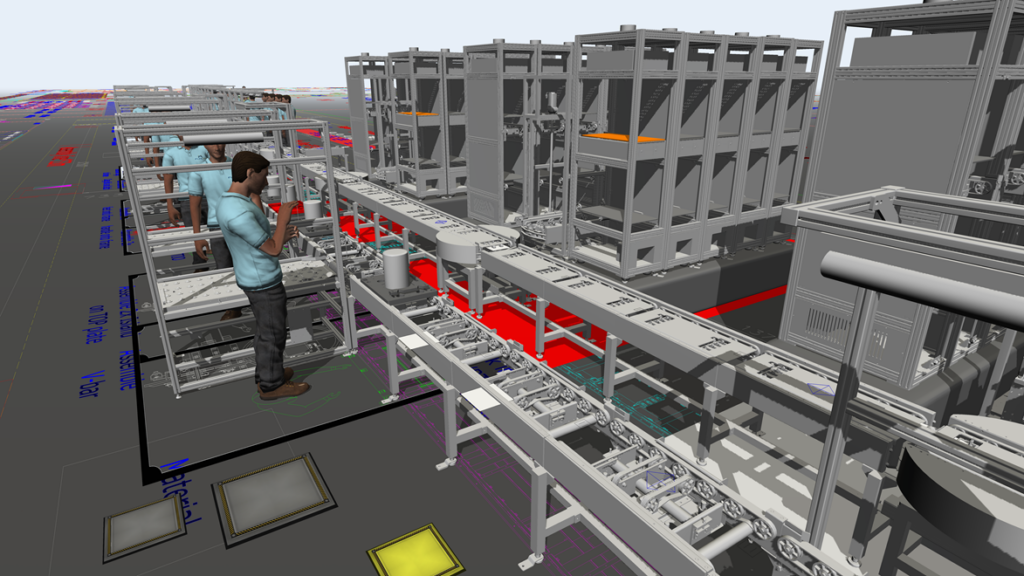
Modern factory simulation platforms such as Autodesk FlexSim allow manufacturers to evaluate layouts, staffing strategies, automation investments, production schedules, and material flow in a virtual environment before making changes on the shop floor. Rather than relying on assumptions, teams can test scenarios using operational data and understand the likely impact of decisions before capital is committed.
What is factory simulation actually designed to do?
One of the most common misconceptions about simulation is that it must perfectly predict future performance to be valuable.
In reality, factory simulation is not designed to forecast the future with absolute precision. Its primary purpose is to compare alternatives, identify constraints, reveal operational risk, and support better decision-making.
Manufacturing systems contain variability everywhere: machine breakdowns, staffing availability, demand fluctuations, material shortages, changeovers, and transportation delays. Traditional spreadsheets and static capacity analyses often struggle to capture how these factors interact over time. Simulation helps organizations understand these dynamic interactions and evaluate how a complete system behaves under realistic operating conditions.
The goal is not to answer, “Exactly what will happen?”
The goal is to answer, “Which option is most likely to deliver the best outcome?”
How accurate are factory simulations?
The accuracy of a simulation depends largely on the quality of the data used to build it.
A model based on current production rates, cycle times, downtime history, staffing levels, and routing logic will generally produce much more reliable results than one built with assumptions alone.
When simulation models are validated against actual production data, many organizations find that throughput estimates fall within 5 to 15 percent of observed performance. More importantly, simulation consistently helps teams identify relative differences between scenarios, allowing them to confidently rank alternatives and identify potential bottlenecks before implementation.
The real value comes from understanding how systems behave under different conditions.
For example:
- What happens if demand increases by 20%?
- What if an additional shift is added?
- What if an AGV fleet is expanded?
- What if a new automated packaging line replaces a manual process?
Simulation helps organizations answer these questions before equipment is purchased or facilities are modified.
Because FlexSim accounts for variability, resource interactions, queues, and time-based events, manufacturers gain a more realistic view of operational behavior than static calculations alone can provide.
What ROI can companies expect from factory simulation?
The economics of factory simulation are often surprisingly straightforward.
The cost of a simulation study is typically a small fraction of the cost of:
- Purchasing equipment
- Expanding a facility
- Reconfiguring a production line
- Hiring additional staff
- Implementing automation
As a result, avoiding just one significant mistake can often justify the investment.
One of the biggest sources of ROI comes from evaluating capital investments before purchase. Simulation helps determine whether proposed equipment will actually improve throughput or simply shift bottlenecks elsewhere in the process.
In many factories, the perceived bottleneck is not the true constraint. Simulation allows teams to test assumptions and validate improvement strategies before spending money on equipment that may not solve the underlying problem.
Simulation also delivers value by:
- Identifying bottlenecks before expansion projects
- Improving resource utilization
- Reducing commissioning risk
- Minimizing production disruptions
- Optimizing staffing levels
- Supporting better layout decisions
Organizations using FlexSim frequently leverage simulation to evaluate multiple investment scenarios, compare alternatives, and reduce the risk associated with major operational changes.
How long does it take to build a factory simulation model?
The timeline varies depending on model complexity and the availability of quality operational data.
A relatively simple model representing a single production line, warehouse process, or work cell can often be developed in a matter of days.
Larger initiatives may require additional time, particularly when they involve:
- Multiple production lines
- Complex routing rules
- Shared resources
- Workforce constraints
- Automation systems
- Multiple product families
Facility-wide simulations that model entire operations often take several weeks to build, validate, and refine.
Fortunately, modern simulation platforms have significantly reduced model development effort. FlexSim provides drag-and-drop modeling tools, prebuilt object libraries, and code-free logic capabilities that allow teams to build and iterate models more efficiently. Factory Simulation eBook.pdf [
The most significant factor influencing project duration is usually not the software. It is gathering and validating the operational data needed to accurately represent the system.
When should factory simulation be used?
Not every factory decision requires simulation. Simulation is most valuable when decisions are:
- Expensive
- Difficult to reverse
- Operationally complex
- High risk
Common use cases include:
New facility planning
Before construction begins, manufacturers can test layouts, material flow strategies, staffing models, and equipment placement to identify potential bottlenecks.
Factory expansions
Simulation helps organizations understand whether additional equipment, labor, or floor space will actually improve throughput.
Automation investments
Before purchasing robots, conveyors, AGVs, or automated storage systems, companies can evaluate performance impacts and identify unintended consequences.
Throughput improvement initiatives
Many factories know they have a bottleneck but struggle to identify its root cause. Simulation provides a data-driven method for locating constraints and evaluating solutions.
New product introductions
A simulation model can reveal how a new product mix may affect capacity, lead times, staffing requirements, and workflow efficiency before production begins.
When is layout planning alone sufficient?
Layout planning remains an essential part of factory design.
For relatively straightforward operations, a well-designed 2D or 3D layout may provide enough information to make informed decisions. Examples include:
- Small process changes
- Minor workstation relocations
- Low-cost equipment moves
- Simple manufacturing cells
However, layout planning alone cannot accurately account for variability, queue formation, resource contention, downtime events, staffing constraints, or dynamic production schedules.
As systems become more interconnected, the limitations of static layouts become increasingly apparent. Simulation becomes valuable when operations involve:
- Shared resources
- Multiple product paths
- Variable demand
- Complex scheduling rules
- Material handling systems
- Significant capital investment
A layout shows where things are. Simulation shows how they will perform.
The combination of both provides a much stronger foundation for decision-making, allowing teams to move from visualization to validation before committing resources.
Make better decisions before the shop floor changes
Every factory eventually faces decisions that carry significant financial and operational consequences. The challenge is not gathering more opinions. It is gathering better evidence.
Factory simulation helps manufacturers test ideas, compare alternatives, and identify risks before making physical changes. Whether evaluating a major automation investment, planning a facility expansion, or troubleshooting persistent throughput issues, simulation provides the insight needed to make decisions with greater confidence.
Autodesk FlexSim enables organizations to model real-world operations, analyze performance under varying conditions, and validate improvement strategies before implementation. Instead of discovering problems after a project launches, teams can find them while changes are still virtual, inexpensive, and easy to correct.
Frequently asked questions
Factory simulations can be highly accurate when built using validated operational data. Their primary purpose is not to predict the future exactly, but to reliably compare alternatives, identify bottlenecks, and evaluate risk before implementation.
ROI varies by project, but many organizations realize value by avoiding poor capital investments, preventing expensive rework, improving throughput, optimizing labor utilization, and identifying bottlenecks before costly operational changes.
Simple production-line models can often be built in days, while enterprise-scale facility models may require several weeks, depending on complexity and the availability of operational data.
Simulation becomes valuable when variability, resource interactions, scheduling rules, or capital investments make system behavior difficult to predict using spreadsheets alone.
Autodesk FlexSim is a 3D discrete-event simulation platform used to model manufacturing, warehousing, material handling, and operational processes. It helps organizations analyze alternatives, optimize throughput, reduce risk, and validate operational decisions before implementation.
When the operation is simple, well-understood, and changes can be reversed at low cost, a layout review may be sufficient. When the system involves multiple interacting resources, variable demand, shared equipment, or significant capital commitment, simulation adds information that layout tools cannot provide.