 Mahtab Barazandeh
Autodesk’s 2026 State of Design & Make: Spotlight on Water report reveals how water organizations are moving from digital investment to connected, data-driven operations — and what’s holding them back.
Digital maturity is the next test for water utilities. Years of investment in SCADA systems, connected sensors, hydraulic models, digital twins, and AI-powered analytics have helped organizations manage increasingly complex infrastructure. But adoption is only the beginning.
But adoption is only the beginning. Autodesk’s new 2026 State of Design & Make: Spotlight on Water report explores how water organizations are moving from digital adoption toward digital maturity: using technology and data in connected, trusted, and repeatable ways to create value across the water and asset lifecycles. The research draws on responses from 500 water leaders across 10 countries, along with interviews with six industry leaders.
As water organizations are investing more in digital tools, they see more value from it. According to the Spotlight on Water report, 85% of surveyed water organizations typically realize value from new digital investments within two years. Meanwhile, 83% report average or advanced adoption of digital tools.
But beneath this progress lies a more interesting question: Are water utilities creating more operational value from the investments, or simply becoming more digital?
The findings point to an important shift. Digital adoption is becoming widespread, but the operational value that comes with connecting systems, data, and workflows across the entire water lifecycle remains a challenge.
Here are three findings that stood out — and what they mean for the future of water management.
1. Data integration is the water industry’s real digital gap
One of the most revealing findings is the gap between digital adoption and systems integration.
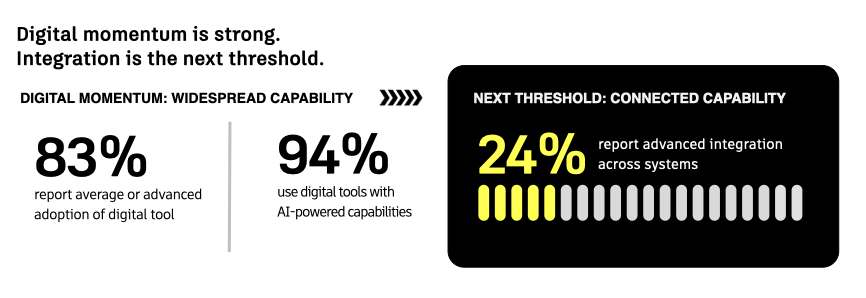
While 83% of water organizations report average or advanced digital tool adoption, only 24% report advanced data connectivity and integration across systems.
Consider a utility with sophisticated hydraulic models, thousands of connected sensors, an asset management platform, and real-time operational monitoring. Each system may provide valuable information, but if that information remains isolated, engineers, operators, and field crews may still be making decisions using different views of the same network.
This is where the distinction between digital adoption and digital maturity becomes important. Digital adoption is about implementing technology. Digital maturity is about making technology, data, and workflows work together to build a capability within an organization to support more reliable and predictive decisions consistently across the organization.
And the challenge goes beyond connecting systems. Although 57% of respondents report mature data governance, only 15% have reached automated, ecosystem-wide governance supporting real-time enterprise decision-making. Without reliable, accessible, and well-governed data, even the most sophisticated technologies have limited ability to deliver value across an organization.
This matters throughout the water lifecycle. Data generated during planning and design, including hydraulic models, demand forecasts, and network scenarios, should remain connected to the assets they represent. That information can then support construction, operations, maintenance, and future renewal decisions rather than being lost between project stages.
The next opportunity for utilities may not be acquiring more technology, but unlocking more value from the technology and data they already have.
We’re already seeing what that looks like in practice. At SA Water in Australia, a live hydraulic model connects real-time network information with operational decision-making. Operators can test shutdown strategies, evaluate alternative supply routes, and assess potential service impacts before making changes to the live system. The result is faster, more informed decisions, improved coordination between teams, and fewer supply interruptions.
It’s a practical example of how connected data and models can turn digital investment into everyday operational value.
2. AI in water utilities depends on digital maturity
Artificial intelligence is no longer just an emerging opportunity for the water industry. Our research finds that 94% of surveyed water organizations use digital tools that include AI-powered capabilities.
Utilities are already applying AI to identify unusual network behavior, anticipate equipment failures, optimize treatment processes, and prioritize field responses.
But having access to AI is not the same as being ready to use it effectively.
AI-supported decisions depend on reliable, connected, and contextualized data. Without those foundations, even advanced analytics may struggle to deliver meaningful operational insights.
Anglian Water offers a compelling example of AI in action.
“We have around 70,000 sensors in our sewer network,” says Matt Humphrey, Head of Asset Management at Anglian Water. “The technology uses machine learning to identify which alarms matter most and helps us prioritize where we send field resources. We now find blockages before customers call us because the system detects problems before sewage leaves the pipe.”
That’s a meaningful shift from reactive response toward proactive intervention.
Aguas de Alicante in Spain uses hydraulic digital twins to connect geographic, asset, weather, and consumption data across its integrated water cycle. Teams can compare water supply scenarios, evaluate different sources, and use rainfall forecasts to anticipate flooding risks.
The bigger lesson? AI and advanced digital technologies create the greatest opportunities when they’re supported by connected data and applied to real operational challenges across the water lifecycle.
3. Workforce skills, not technology, are the biggest barrier
Technology is advancing rapidly. But can water utilities build the workforce and organizational capabilities needed to keep pace?
Our research reveals an interesting tension. While 77% of respondents believe their organizations already have the skills needed to use digital tools effectively, 52% struggle to find qualified candidates with digital and data skills.
At the same time, workforce readiness and skills are the most frequently cited barriers to digital transformation, identified by 42% of respondents. The challenge isn’t necessarily a lack of technical expertise. It’s finding and developing people who can combine deep water industry knowledge with digital capabilities.
A water operator doesn’t need to become a data scientist to benefit from AI-powered analytics. But they do need to understand what the data means, recognize when an output doesn’t reflect real operating conditions, and know how to translate insights into appropriate action. The same applies to engineers, planners, and asset managers.
New technology delivers lasting value when it becomes part of everyday workflows — not when it creates additional administrative work or remains dependent on a small group of specialists.
Encouragingly, 79% of respondents say training in digital technologies is an organizational priority. But training alone isn’t enough. Organizations also need standardized processes, leadership support, sustainable funding, and the ability to scale successful initiatives beyond individual teams or pilots.
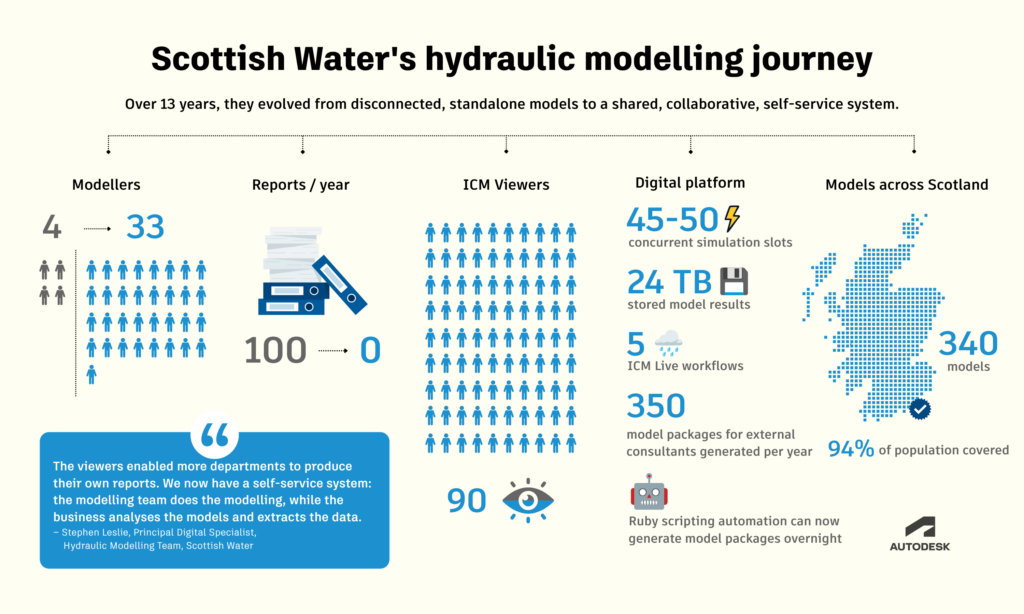
Scottish Water demonstrates what this can look like. The utility transformed hydraulic modeling from a specialist, report-heavy activity into a shared enterprise resource. Its platform now supports approximately 340 network models covering 94% of Scotland’s population and can run 45–50 simulations simultaneously.
By giving flooding teams and planners direct access to model results, Scottish Water eliminated the need for more than 100 annual flooding reports previously produced by hydraulic modelers. Instead of spending time preparing reports, specialists can focus more of their expertise on engineering and analysis.
That’s digital maturity in action: not simply introducing new tools, but changing how information is accessed, how teams collaborate, and how work gets done.
Digital maturity means making everything work together
There’s good reason for optimism about the future of digital water.
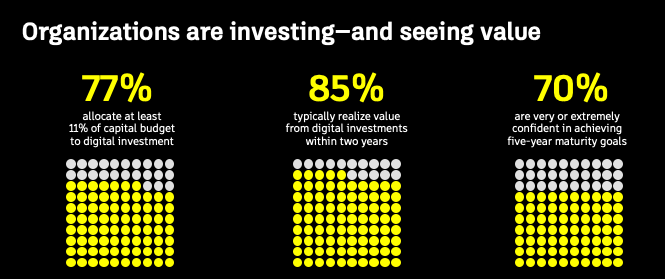
Our research shows that 77% of surveyed water organizations allocate at least 11% of their capital budgets to digital transformation, 85% typically realize value from their investments within two years, and an impressive 70% are very or extremely confident in achieving their digital maturity goals over the next five years.
Investment is happening. Digital tools are delivering value. And AI-powered capabilities are becoming increasingly common. But the next stage of progress will require more than technology adoption. It will require connecting information across systems, preserving data throughout the asset lifecycle, developing workforce capabilities, and making digital insights part of everyday decision-making.
Digital maturity isn’t measured by how many technologies a utility owns. It’s reflected in how effectively people, processes, data, and technology work together to deliver better outcomes. And it’s not a destination. It’s an ongoing journey toward more proactive, predictive, and resilient water operations.
Explore the full Spotlight on Water report
These are just three of the findings from Autodesk’s 2026 State of Design & Make: Spotlight on Water report. How would your organization answer the survey?
Explore the full research for deeper insights into digital investment, systems integration, AI, cybersecurity, workforce development, and digital maturity across the water lifecycle, along with real-world examples from utilities advancing their digital transformation journeys.