 Eric Suesz
Ofwat is being replaced, near real-time spill reporting is on the way, and AMP8 puts a record £104 billion on the table. At a London symposium, water leaders asked what UK water should build first, and many of them came back to the same idea: a digital spine.
The UK water sector is facing three big shifts at once: a new regulator, new reporting rules, and a record £104 billion of investment in a single five-year cycle. Ofwat’s functions will fold into a new “super-regulator” alongside the Environment Agency, Natural England, and the Drinking Water Inspectorate. Under open monitoring, companies will no longer be the sole source of environmental compliance data. They will also have to publish near real-time data on sewage spills and wastewater treatment.
Water companies can meet that requirement by bolting reporting tools onto the systems they already have. Or… they can use the reset opportunity to get their data in better order. The people we heard from in London made a case for the second option.
Who got together, and why
On February 26, 2026, Utility Week and Autodesk hosted the Digital Water Symposium at the IET’s Savoy Place in London. It was an invite-only day for UK and European water utilities, built around a single question: What would it take to build a digital spine for the UK water sector, embed it inside individual companies, and implement it at scale? A digital spine is a shared data layer that connects planning, design, delivery, and operations. It rests on common standards, clear data ownership, governance, and interoperability, so information can move across the asset lifecycle in a way that is structured, trusted, and auditable.
The room mixed asset managers, capital delivery specialists, operations managers, and modeling leads – the people who each hold one piece of a water company’s data and rarely sit at the same table. The day included a keynote from Sara Vaughan, chair of Elexon and a non-executive director at South Staffs Water, a panel on Stream, the open data platform launched in 2024 by a consortium of 11 water companies, and case studies from Severn Trent Water, Scottish Water, and Hera Group in Italy. Delegates also answered a poll on the biggest barrier to digitalization at their companies.
It starts with a digital spine
In the report’s foreword, Andrew Collier, director of water industry strategy at Autodesk, describes the digital spine as a metaphor with two meanings. The first is technical: data that stays connected across systems and organizations, so information can move across planning, design, delivery, operations, and regulation in a way that is structured, trusted, and auditable. “Without that foundation,” he says, “AI, digital twins, smart sensors, and advanced analytics remain limited by fragmented systems and inconsistent data.”
The second meaning is about people. A spine also takes “leadership courage”, meaning a willingness to rethink how work gets done in the age of AI. He believes the greatest value of AI “will not come from using technology to make today’s processes marginally faster.” He sees what is happening now – in the UK and around the world, for that matter – as hinging on how leadership approaches AI.
Energy went first
Water isn’t the first sector to ask for a digital spine. Energy got there first.
The UK is building a common data-sharing infrastructure so the grid, buildings, and energy markets can exchange data as millions of solar panels, heat pumps, and electric vehicles join the system. Sara Vaughan thinks water can learn a lot from how energy got there. She calls what energy is developing a “highway code for data.”
The more useful lesson isn’t what energy built, but how.
Different organizations are responsible for different pieces:
- Elexon handles market-wide settlement.
- The National Energy System Operator builds the data-sharing infrastructure.
- The Retail Energy Code Company builds the customer consent system.
What’s missing, critics say, is a single body responsible for making sure the pieces fit, which risks fragmented and misaligned systems. The think tank Energy Geeks has called for a unit with the authority to own the system architecture and coordinate delivery. Ofgem’s recent data architecture paper identified the same need, Vaughan says: “with various projects happening in various places there is the need to coordinate to ensure things match up.”
Then there’s the question of who’s steering. Vaughan contrasted the active role Ofgem has taken in driving energy digitalization with a “less hands-on” approach from Ofwat. Apart from the Ofwat Innovation Fund, the report says, water has largely left companies to build shared data solutions themselves.
Which brings us back to the new regulator. The report doesn’t say what it will do differently. But the question is now open: Who owns the architecture? And who makes sure the pieces fit?
Does the data have to be perfect first?
The data a digital spine would carry is already starting to arrive. The UK is targeting smart meters in around 65% to 76% of households in England by 2050, and the report says the meters provide the high-resolution data needed to find customer-side leaks. Underground, sensors in sewers monitor levels and detect blockages, while AI-powered visual sensors validate storm overflow events in real time. These are networks that used to be largely invisible.
And under open monitoring, utilities will have to publish near real-time data on sewage spills and wastewater treatment. That’s a lot to ask of a spreadsheet. Symposium delegates described what they’d rather have: reporting that eliminates manual intervention, with “one click reports” and “live dashboard-driven reports.”
Delegates were asked: “What is the biggest challenge facing digitalization in water utilities?” Data quality was the most common answer. So should utilities wait until it’s clean?
Stream’s experience suggests publishing early can work, provided the data is clearly defined and managed. The platform now offers over 200 data points covering water consumption, quality, leakage, and storm overflows. It made a deliberate choice to publish incomplete and operationally disregarded storm overflow data, using publication as a springboard to improve it. Today the regulator uses Stream’s open-license storm overflow data to monitor compliance.
Process does much of the work. “I’ve seen it with various software applications, when you impose the tool and you have the right process in place to manage that tool, very naturally, the quality improves,” says Carlos Campos, chairman of Aganova and former CEO of Suez.
Where AI fits into everyone’s plans
Severn Trent Water runs every decision past a simple test: “Does it make the AMP8 boat go faster?” That’s Jack Lomas, the company’s business lead for digital engineering, transformation, and AI. The company’s target behind the question is concrete: 50% faster and 30% cheaper across AMP8.
Here’s what that looks like in practice. Designing a new pipeline route can traditionally take up to 12 months. With AI route optimization, Severn Trent can identify optimal routes in weeks. For new wastewater treatment sites, generative AI has cut optioneering “from nine months down to one week,” Lomas says. He adds that this helps pay for the digital investment itself, because it reduces the need to outsource design work.
But the AI doesn’t come first. Severn Trent has been building on three objectives: better skills, better technology, and better data. The data piece comes down to strengthening data pipelines so information is structured, accessible, and reliable, ready for advanced AI.
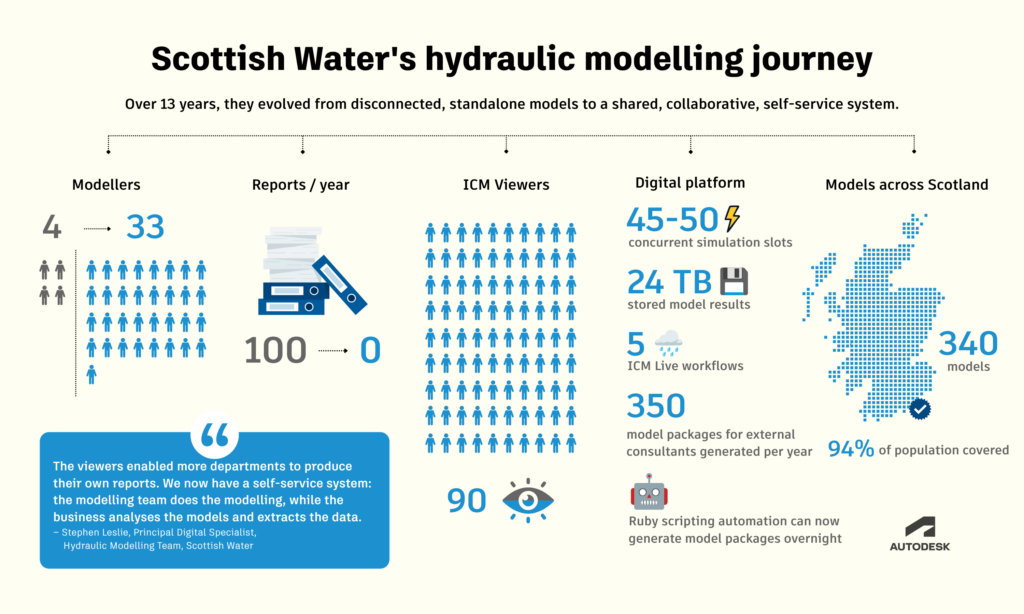
Stephen Leslie, Scottish Water’s hydraulic modelling principal digital specialist, gave the symposium’s final presentation. Scottish Water’s story isn’t really about AI at all. It’s about what has to happen before AI can help.
Moving InfoWorks WS Pro to the cloud let teams and outside consultants work together, he says. “The cloud allowed us to take on bigger projects within the business and split out workloads, significantly we were able to roll out viewers (allowing non-modellers to review, measure, and share model results) further across the business.”
The result: 92 people across Scottish Water can now access the company’s models using the viewer software, up from five specialists. Just over a decade ago, its hydraulic modelers were producing more than 100 flooding reports a year. Today they publish no reports, because engineers across the organization can open the models themselves.
How will UK water meet its new regulator?
The report doesn’t say what the new super-regulator will demand. It does say what kind of regulator it expects: one focused on tougher, proactive regulation and cutting pollution, arriving after the Water (Special Measures) Act 2025, which was widely seen as a crackdown on company performance, with far stricter penalties if environmental standards aren’t met. So how will utilities approach whatever comes next?
They have two options. They can wait for the rules and build whatever reporting each new requirement calls for. Or… they can build a foundation of shared standards, connected data, and AI with trusted inputs to work from. The second option can help them move toward digital maturity faster. Energy utilities offer a useful comparison, though water’s context is different.
Delegates at the symposium leaned toward the second. One participant perhaps said it best: “Can we afford not to do it?” The mantra “spend to save” was also widely endorsed.
Roi Otero, senior manager of water industry and business strategy at Autodesk, puts it plainly: “While the ambition is shared, the path to delivery remains fragmented.” The report’s conclusion frames the choice as no longer whether the industry moves toward a digital spine, but how quickly and effectively it can be realized.
When the new regulator arrives, what will it find? Will it find a sector still building reports one request at a time, or one that already knows where its data lives and who owns it?
Go deeper into the symposium delegates’ shared insights by watching the sessions and downloading the report.