 Eric Suesz
Flood models are used to make important decisions:
- Where to build
- What to protect
- How much risk is acceptable
That’s why one of the most common questions in hydraulic modelling is: How accurate is the model?
It’s a reasonable question. Engineers spend significant time calibrating models against observed water levels, flow rates, and flood extents. A model that cannot reproduce reality has limited value for planning, design, or risk assessment.
But accuracy is only part of the story. The real question isn’t, “Is the model accurate?” but “Is the model reliable enough to support the decision being made?”
Imagine two flood models…
By way of example, consider two models.
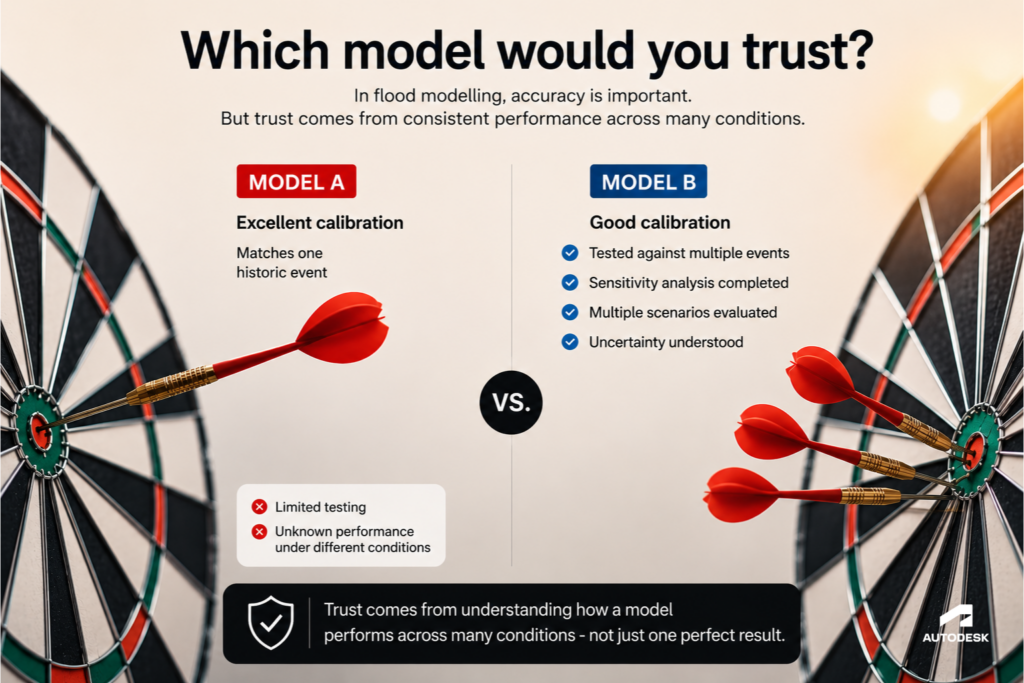
The first reproduces a historic flood almost perfectly. Water levels match observations. Flood extents align closely with surveyed data. The calibration report looks excellent.
The second model is slightly less accurate against that historical event, but it has been tested across multiple storms, different boundary conditions, alternative roughness assumptions, and even future climate scenarios.
Which model would you trust to support a major infrastructure investment? Most experienced engineers would choose the second.
That answer reveals an important distinction: A model can be accurate without being trustworthy. It can even sometimes give the right answer for the wrong reasons.
Accuracy, reliability, and uncertainty are not the same thing
The terms used to talk about hydraulic models are often used interchangeably, but they describe different ideas:
- Accuracy is about how closely model results match observed data.
- Reliability is about whether those results can be trusted across different conditions.
- Uncertainty is the range of possible outcomes that arise from imperfect inputs and assumptions.
Accuracy is conditional – and that’s why it can be misleading on its own.
In short: Trust comes not only from matching observations, but from understanding how a model behaves, where its limitations lie, and how confident we can be in its predictions.
📚 As discussed in our guide to Hydraulic modeling explained: A guide to 1D, 2D and integrated catchment modeling, the work isn’t just about reproducing reality. It’s about helping engineers make better decisions. Your professional challenge as a hydraulic modeller is knowing when a model is reliable enough to support your decisions.
Why calibration matters – and why a good calibration can still be misleading
Calibration is where a model is tested against reality. It is not just a technical step; it is the point where assumptions meet observed behavior.
A well-calibrated model should reproduce water levels, flow behavior, and flood extents using measured data such as:
- Gauge records
- Surveyed flood marks
- Rainfall inputs
- Real-world observations
In practice, calibration is iterative. Engineers adjust parameters, test scenarios, and compare results across multiple data sources. What matters is not just achieving a match but understanding why the model behaves the way it does.
But a calibration can still be misleading. A model can produce excellent calibration results and still contain weaknesses that only become visible when conditions change. One common reason this happens is that modellers sometimes introduce “compensating errors”.
Hydraulic modellers are familiar with the concept of compensating errors, even if they don’t always use that term. An incorrect assumption in one part of a model can be offset by another adjustment elsewhere. For example, a modeller may adjust roughness values to compensate for missing terrain detail. Boundary conditions may be modified to offset uncertainty in hydrologic inputs. Small inaccuracies in one part of the model can sometimes be balanced by adjustments elsewhere.
The end result may look convincing if your water levels match observations and flood extents align with historical records, but the apparent accuracy may depend on assumptions that don’t truly represent the physical system.
This becomes particularly important when a model is used to evaluate future conditions. A model calibrated against a historic event may perform well when reproducing the past but struggle when applied to future development, climate adaptation, or infrastructure planning scenarios.
This is one reason why experienced reviewers often look beyond calibration statistics. They want to understand not only whether the model matches observations, but whether the underlying assumptions make sense. A trustworthy model should be physically realistic, not simply well calibrated.
Calibration in practice: a real-world example
In real projects, calibration is rarely based on a single dataset. In fact, trust really can’t be built using a single calibration metric. But, it can be built by comparing models against multiple sources of evidence.
For example, we’ve written about the city of San Marcos’s Flash Flood Alley project, where engineers calibrated a city-wide digital twin hydraulic model with InfoWorks ICM using rainfall data, observed flood extents, and photographic evidence from real flood events.
This allowed the model to match real-world behavior across the entire watershed, not just at isolated points. The result was not just an accurate model but a trusted one that was capable of identifying risk and supporting planning decisions.
Not all calibration is equal. Strong calibration typically includes:
- Multiple events: smaller flows and larger flood events
- Multiple data types: gauge data, flood marks, visual evidence
- Consistent parameters: values that reflect physical reality
A common issue is parameter drift: adjusting values between events simply to improve fit. This often points to deeper problems in data quality, model structure, and system representation.
📚 Calibration is particularly important because it helps establish that a model is responding realistically to known conditions. As discussed in our article Hydraulic model calibration: A continuous dynamic method for water distribution systems, calibration helps build confidence that a model reflects real-world behavior rather than theoretical assumptions. In our example, we show how to create an automated calibration method.
Understanding uncertainty
Every flood model contains uncertainty. This is not a weakness of modelling. It is an unavoidable reality of representing complex physical systems. The question is not whether uncertainty exists. The question is whether it has been understood.
Hydraulic models depend on data that is inherently imperfect. Terrain surveys contain gaps and inaccuracies. Rainfall records are incomplete. Flow measurements carry uncertainty. Future conditions cannot be observed directly and must be estimated through assumptions and scenarios.
Some of the most common sources of uncertainty include:
- Terrain and survey data
- Rainfall and hydrologic inputs
- Roughness coefficients
- Boundary conditions
- Future climate and development scenarios
In practice, understanding uncertainty means testing how the model responds when assumptions change.
Engineers routinely ask questions such as:
- What happens if rainfall is higher than expected?
- How sensitive are results to Manning’s roughness values?
- Does a different boundary condition change flood extents?
- How does mesh resolution influence water levels?
- What happens if future development alters runoff patterns?
These questions help identify which assumptions have the greatest influence on results and where additional data collection may improve confidence. This is why uncertainty analysis is often paired with sensitivity analysis. Rather than relying on a single model run, engineers evaluate a range of plausible scenarios and compare the outcomes.
What engineers actually need to get from calibration to confidence
In many cases, the objective is not to reduce uncertainty entirely. That’s rarely possible. The objective is to understand it well enough to make informed decisions. This is where modern hydraulic modelling tools can help.
Managing dozens of scenarios, alternative assumptions, and future conditions can quickly become difficult using disconnected workflows. Integrated modelling environments make it easier to compare scenarios, test assumptions, and understand how changes in one part of a system affect results elsewhere.
This becomes particularly important when evaluating connected systems such as rivers, drainage networks, and surface flooding. As discussed in What is integrated catchment modeling? Connecting rivers, drainage and surface flow, flooding rarely comes from a single source, and uncertainty rarely comes from a single assumption. It emerges from the interaction of rainfall, terrain, drainage systems, rivers, and the choices engineers make when representing those systems in a model.
As hydraulic models increasingly evolve into digital twins, uncertainty analysis can also become an ongoing process rather than a one-time exercise. New monitoring data, rainfall observations, and operational information can provide additional evidence that helps engineers refine assumptions and improve confidence over time.
Perhaps most importantly, uncertainty analysis changes the conversation. Instead of asking whether a model is right or wrong, engineers can begin asking a more useful question: How confident are we in this result, and is that confidence sufficient for the decision we need to make?
Uncertainty doesn’t reduce trust. Hidden uncertainty does.
📚 Even the modelling approach itself introduces uncertainty. Decisions about model structure, mesh resolution, and whether to use 1D, 2D, or coupled modelling approaches can influence results. Our article on 1D vs 2D hydraulic modeling: When to use each approach explores some of these tradeoffs and why they matter.
A better way to think about model quality
Instead of asking, “How accurate is the model?“, a better question is: “Is this model fit for purpose?“
The answer depends on the decision being made.
A model used for preliminary planning may require a different level of confidence than a model supporting flood mitigation investments, regulatory approvals, or critical infrastructure design. That’s why model quality cannot be measured by a single calibration statistic or validation result. It requires understanding uncertainty, evaluating assumptions, and determining whether the model provides enough confidence to support the decision at hand.
Flood modelling accuracy matters. Calibration matters. Validation matters. But ultimately, engineers are not trying to build perfect models. They are trying to build models that are reliable enough to understand risk, evaluate alternatives, and support better decisions.
Because in real-world engineering, the goal isn’t to model everything perfectly. It’s to model the right level of detail – reliably enough to act with confidence.
Continue exploring hydraulic modelling
Trustworthy flood models don’t emerge from calibration alone. They depend on understanding how water moves through systems, how assumptions influence results, and how uncertainty affects decision-making.
We have many more helpful articles on hydraulic modeling:
- Hydraulic modeling explained: A guide to 1D, 2D and integrated catchment modeling: an overview of hydraulic modelling concepts, workflows, and applications.
- Integrated catchment modeling explained: How rivers, sewers and surface water interact: Learn how rivers, drainage networks, and surface flooding interact within a connected system.
- 1D vs 2D hydraulic modeling: What’s the difference? Pros and cons? How do you decide? Understand the strengths, limitations, and tradeoffs of different modelling techniques.
- Hydrology vs hydraulics: What’s the difference? Explore how rainfall, runoff, and flow modelling work together.