 Eric Suesz
Hydrology studies how water enters a system (rainfall and runoff), while hydraulics focuses on how water moves through that system (flow, velocity, flooding). The difference is very important when modeling.
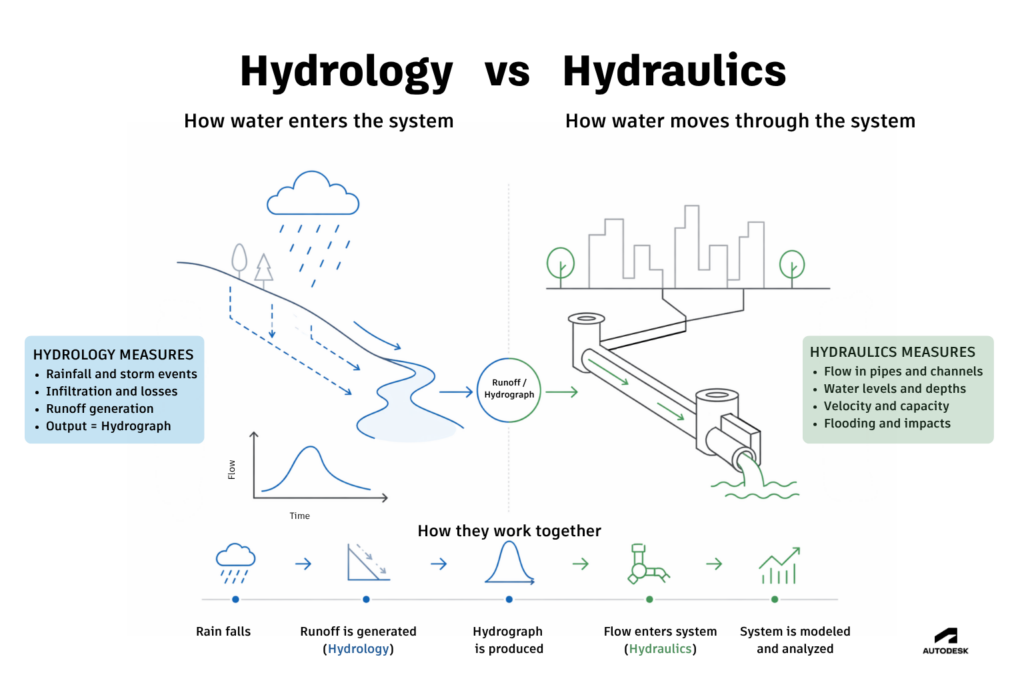
Hydrology and hydraulics are often used interchangeably — but they solve very different parts of the same problem:
- Hydrology focuses on how water enters and moves through the entire hydrologic cycle – including rainfall, evaporation, infiltration, and groundwater – before it ever reaches your system.
- Hydraulics, on the other hand, looks at how that water behaves once it’s moving — through pipes, channels, rivers, and other engineered systems.
In short:
- Hydrology = How much water (rainfall → runoff)
- Hydraulics = Where it goes and what it does (flow → behavior)
In other words, hydrology defines the input (what water you have), while hydraulics defines the response (what that water does).
Understanding the difference is essential for accurate modeling. If one is wrong, the entire analysis can break down.
📚 To see how these disciplines come together in practice, explore our Hydraulic Modelling guide.
What is hydrology?
Hydrology focuses on how water moves through the natural environment before it enters engineered systems. Hydrology often uses methods such as unit hydrographs, rational method, or rainfall-runoff models to estimate flow. This also includes processes like evaporation, infiltration, and groundwater movement that are part of the broader hydrologic cycle.
In practical modeling terms, hydrology answers:
- How much rain falls?
- How much of that becomes runoff?
- How quickly does it reach the system?
Key processes in that modeling include:
- Rainfall and storm events
- Infiltration into the ground
- Evaporation and losses
- Surface runoff
The output of hydrology is typically a hydrograph, a time-based curve showing how flow changes during a storm event. This hydrograph becomes the input for hydraulic models.
In the past, traditional tools often focused purely on runoff calculations, while modern solutions typically combine hydrology and hydraulics into a single workflow. For example, InfoDrainage integrates rainfall, runoff, and network design in one environment.
What is hydraulics?
Hydraulics focuses on how water behaves once it is inside a system. This includes:
- Drainage networks and pipes
- Rivers, channels, and culverts
- Storage assets like tanks or ponds
Hydraulic modeling answers questions like:
- Will pipes surcharge?
- Where will flooding occur?
- How fast is water moving?
- What are the water levels at different points?
It uses physical principles (flow, energy, and momentum) to simulate how water moves through infrastructure. This is rooted in fluid mechanics, which describes how water flows, how fast it moves, and how energy is lost through a system.
Autodesk tools like InfoWorks ICM, InfoWorks WS Pro, and InfoWater Pro are designed to simulate these hydraulic behaviors across stormwater, wastewater, and water distribution systems.
Hydraulic models can also vary in complexity, from simplified 1D representations to detailed 2D simulations. Learn more about 1D vs 2D hydraulic modeling and how to decide which one to model.
How hydrology feeds hydraulic models
Hydrology and hydraulics are distinct disciplines, but tightly connected in modeling workflows.
Step-by-step relationship:
- Rainfall is applied (hydrology)
- Runoff is calculated (hydrology)
- Flow enters the system (hydraulics)
- Water is routed and analyzed (hydraulics)
A simple way to think about it:
- Hydrology creates the input signal.
- Hydraulics determines the system response.
This connection between rainfall, runoff, and system behavior is at the core of modern hydraulic modelling workflows.
📚 In real-world projects, hydrology and hydraulics are often modeled together using integrated approaches. See how this works in this integrated hydrology and hydraulic modeling workflow.
Why confusing the two causes errors
One of the most common mistakes in water modeling is treating hydrology and hydraulics as interchangeable. But the “math”, so to speak, will be very different. Hydrology is inherently uncertain and depends on assumptions and data, while hydraulics produces a deterministic response to those inputs.
Here’s how that plays out in real scenarios…
Example 1: Undersized network from poor hydrology
Let’s say an engineer is designing a drainage system for a new residential development:
- Simplified runoff assumptions are used
- Peak flow is underestimated
The hydraulic model runs without issues – but shows no flooding. What happens in reality? During a storm, runoff exceeds expectations, pipes surcharge, and flooding occurs.
🧐 The issue wasn’t the hydraulic model; it was incorrect hydrology.
Example 2: Overdesigned (and overpriced) infrastructure
A team applies overly conservative rainfall inputs that go beyond the design requirements “just to be safe.” This is a common scenario that results in a lot of wasted materials:
- Hydrology overestimates flow
- The model suggests oversized pipes and storage
The result? Unnecessary construction costs.
🧐 Inaccurate hydrology leads to inefficient hydraulic design.
Example 3: Misdiagnosing flooding problems
A model shows flooding at a junction. The team assumes that:
- Pipes are undersized
But the real issue:
- Incorrect rainfall profile
- Poor runoff timing assumptions
Once corrected, the flooding is significantly reduced or eliminated.
🧐 The “hydraulic issue” was actually hydrology.
Example 4: Wasted time refining the wrong thing
An engineer spends hours refining:
- Pipe roughness
- Network geometry
But results remain inconsistent. The root cause:
- Incorrect catchment definition
- Faulty infiltration assumptions
🧐 Effort was focused on hydraulics instead of hydrology.
📚 Many of these issues are surprisingly common in practice; we’ve collected some more of these in our breakdown of 9 common hydraulic modeling mistakes.
Real-world example: Urban storm event
Let’s walk through a typical urban storm event…
Hydrology stage:
- Rainfall hits an urban catchment
- Impermeable areas generate rapid runoff
- A hydrograph shows peak flow over time
Hydraulics stage:
- Flow enters the drainage network
- Pipes convey water downstream
- Manholes may surcharge
- Flooding may occur if capacity is exceeded
What this shows:
- Hydrology determines how severe the event is
- Hydraulics determines how the system performs
In practice, site-level scenarios like this may be modeled in InfoDrainage, while larger network or floodplain impacts are explored using InfoWorks ICM.
Where this fits in hydraulic modelling
In practice, modern tools integrate both hydrology and hydraulics into a single workflow, allowing engineers to move from rainfall to system performance in one model.
This is a core part of hydraulic modelling, where catchment processes and network behavior are combined to simulate real-world conditions.
Autodesk Water solutions support this across different use cases:
- InfoDrainage: site-scale drainage design
- InfoWorks ICM: network and flood modeling
- InfoWorks WS Pro and InfoWater Pro: pressurized system modeling and hydraulic analysis
These concepts are also foundational to infrastructure planning; see our Fundamentals of Drainage Design video course and 8-step framework for site design.
Key takeaways
- Hydrology and hydraulics solve different problems
- Hydrology produces flow inputs; hydraulics simulates system behavior
- Errors in hydrology directly impact hydraulic results
- Both must be used together for reliable modeling
Continue learning
If you’re building or refining models, understanding this relationship is just one piece of the puzzle. Our Hydraulic Modelling guide breaks down the full workflow – from rainfall inputs to system analysis and design decisions.