 Jim Byrne
Explore a realistic path to move from 2D to 3D with AutoCAD and Inventor in PDMC. Keep your DWGs while gaining automation, precision, and manufacturing-ready data.

Autodesk Product Design & Manufacturing Collection
Solve interesting problems efficiently with the ultimate set of engineering apps.
Learn MoreFor many engineering and manufacturing teams, 2D drawings remain the backbone of daily work. AutoCAD has been a trusted standard for more than four decades, and many organizations have accumulated thousands of DWGs representing years of tribal knowledge, past projects, and proven designs. That legacy is valuable and for most teams, it’s not going away anytime soon.
At the same time, the pressure to improve speed, quality, and manufacturability is stronger than ever. Customers expect faster turnaround. Products are more complex. And downstream teams, from simulation to CAM, perform better when they can rely on a complete 3D model.
The path forward doesn’t require abandoning 2D overnight. Instead, the most successful organizations take a hybrid, pragmatic journey: keeping 2D where it makes sense, while adopting 3D modeling in Autodesk Inventor to gain automation, accuracy, and better collaboration.
The Autodesk Product Design & Manufacturing Collection (PDMC) supports exactly this kind of transition, offering AutoCAD and Inventor together in one toolkit—plus connected manufacturing and data tools when your processes are ready for them.
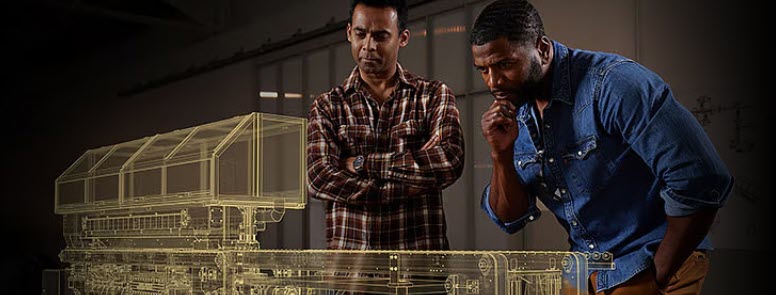
Why move to 3D without dropping 2D
Migrating from 2D to 3D CAD isn’t about replacing one tool with another. It’s about expanding what your team can do.
Inventor unlocks advantages that 2D drawings can’t match:
- Design intelligence: Parameters and relationships drive model behavior, letting changes ripple automatically through parts, assemblies, and drawings.
- Fewer errors: 3D reduces the misinterpretation risks inherent in manual 2D documentation.
- Better downstream workflows: 3D models feed into simulation, CAM toolpaths, sheet-metal flat patterns, and BOM creation.
- Reusability: Configurable assemblies, iLogic, and templates help teams avoid starting from scratch.
But 2D still has an important role. Many manufacturing partners require DWGs. Some early‑stage concept work is faster in a sketch or layout. And converting every legacy drawing to 3D isn’t realistic or necessary.
That’s why a hybrid approach is the most practical path.
When does moving from 2D to 3D make sense?
For most engineering teams, the shift from 2D to 3D isn’t an all-or-nothing decision. It’s about recognizing when 2D workflows start to break down—and where 3D adds real value.
A 2D + 3D hybrid approach is especially well suited for small and mid-sized teams. It allows teams to keep using familiar 2D drawings (like legacy AutoCAD DWGs) while gradually introducing 3D modeling where it improves outcomes.
This works because:
- Many teams have years of 2D drawings they can’t replace overnight
- Early-stage layouts or schematics are often faster to create in 2D
- Manufacturing, suppliers, or customers may still require 2D deliverables
At the same time, 3D becomes increasingly valuable as designs grow more complex or move closer to production. Modern workflows let teams reuse existing 2D data while adding 3D modeling for precision, validation, and downstream processes.
In practice, most successful teams use both:
- 2D for speed, documentation, and legacy compatibility
- 3D for accuracy, automation, and design validation
How does 3D modeling reduce errors compared to 2D drawings?
The biggest limitation of 2D CAD is that it requires interpretation. Engineers must mentally reconstruct a 3D object from multiple flat views, which increases the risk of miscommunication and mistakes.
3D modeling reduces these errors by making the design explicit and testable:
- Clear visualization: 3D models show height, depth, and relationships directly, reducing ambiguity and misinterpretation across teams.
- Early conflict detection: Engineers can identify interferences, misalignments, or design clashes before manufacturing begins.
- Single source of truth: Instead of updating multiple drawings manually, changes propagate through the model, reducing the risk of inconsistencies.
- Better collaboration: Cross-functional teams can work from the same model, improving communication and reducing costly rework.
In contrast, 2D workflows often rely on separate drawings that must be manually updated and interpreted—making them more prone to missed changes and coordination gaps.
What problems does moving to 3D actually solve?
Moving to 3D isn’t just about adding another tool, it addresses specific limitations in 2D workflows:
- Reduces design errors caused by interpretation and disconnected drawings
- Improves design validation with simulation and real-world testing
- Speeds up iteration by automating updates across parts and assemblies
- Enhances manufacturing readiness with data-rich models for CAM and production
- Minimizes rework and delays by catching issues earlier in the process
Moving from 2D to 3D with Inventor & AutoCAD
Step 1: Keep your 2D drawings but let Inventor use them
Autodesk intentionally designed Inventor and AutoCAD to work together. You can reuse your existing DWGs instead of rebuilding models from scratch.
Inventor can easily:
- Import AutoCAD 2D drawings directly
- Copy/paste geometry from AutoCAD to Inventor sketches
- Link DWG files as references, allowing updates to flow smoothly into 3D models when the 2D drawing changes
This capability is crucial for organizations with large 2D libraries. You can modernize your workflow incrementally, focusing conversion efforts only where 3D can provide measurable ROI.
Step 2: Build intelligence into your models from day one
One of the biggest wins in 3D CAD is design intent—parameters and formulas that turn geometry into a living system rather than static lines.
With Inventor, you can:
- Define key parameters (length, width, thickness) that drive the model
- Create relationships between dimensions
- Build assemblies that update automatically with skeletal modeling
- Use adaptive and top‑down techniques for flexible product families
When you build intelligence in early, every downstream benefit, including drawings, BOMs, and CAM toolpaths become more reliable.
Step 3: Let Inventor automate what 2D can’t
Once a design lives in 3D, Inventor can automate substantial portions of your workflow that 2D tools simply can’t.
For example, PDMC provides automation through:
- iLogic for rules‑based configuration
- Design accelerators for shafts, fasteners, belts, and gears
- Frame generator and tube/pipe tools
- Automated drawing updates—a single change to the 3D model updates every dependent document
And with PDMC’s integration of simulation and manufacturing tools, you can validate performance and manufacturability early in the process—something impossible with flat drawings alone.
Step 4: Use PDMC to bring manufacturing into the loop
Moving to 3D has the greatest impact when it enables better communication with the shop floor.
PDMC also includes Autodesk Fusion. Fusion gives you access to cloud‑enhanced CAM tools, simulation, and collaboration workflows. That means you can:
- Generate toolpaths directly from Inventor models
- Share models securely with suppliers
- Reduce rework caused by outdated 2D references
- Connect design data seamlessly into CNC programming
3D modeling isn’t just a design choice, it’s a manufacturing advantage.
Step 5: Transition at your own pace
The most important thing to remember: you don’t have to convert everything.
Pick high‑value areas first:
- Designs you modify frequently
- Parts or assemblies difficult to interpret in 2D
- Projects benefiting from simulation or automation
- Areas where change requests frequently cause errors
Then expand gradually as skills grow and workflows evolve.
A smarter, low‑friction path from 2D to 3D
Migrating from 2D to 3D doesn’t need to be disruptive. With AutoCAD and Inventor both included in the Product Design & Manufacturing Collection, you can modernize your workflow without abandoning the tools your team knows, and without rewriting years of design history.
Moving from 2D to 3D CAD – frequently asked questions
Moving from 2D to 3D helps manufacturers improve accuracy, reduce interpretation errors, and support downstream workflows like simulation, CAM, and BOM creation.
No. A hybrid approach is recommended where teams use AutoCAD for 2D drawings while introducing 3D modeling in Autodesk Inventor where it adds the most value. The transition does not require replacing 2D workflows overnight.
Yes. Inventor and AutoCAD are designed to work together, allowing teams to reuse existing DWG files rather than rebuilding designs from scratch. This helps preserve legacy design knowledge while enabling 3D workflows.
Key benefits include parametric design, reduced errors, improved manufacturability, better reuse of designs, and support for downstream processes such as simulation and CAM. Inventor complements AutoCAD by extending 2D drawings into manufacturing‑ready 3D models.
3D models reduce the risk of misinterpretation that occurs with manual evaluation of multiple 2D views. Inventor’s parametric relationships and design validation capabilities help ensure intent is clear and changes update consistently throughout the model.
Downstream workflows such as simulation, CAM toolpaths, sheet‑metal flat patterns, and BOM generation benefit significantly from having a complete 3D model instead of relying only on 2D documentation.
Yes. Hybrid 2D‑and‑3D workflows are a practical path for many organizations, including those with limited resources, by allowing gradual adoption of 3D without disrupting existing processes.
2D remains valuable for early‑stage concepts, certain layout work, and situations where manufacturing partners require DWG files. A balanced workflow allows teams to use each approach where it is most effective.