 Heather Miller
This post is also available in:
Proception is advancing physical AI with ProHand 1.0, a research-grade robotic hand designed for dexterous, adaptive manipulation in real-world environments. With Autodesk Fusion, Proception’s eight-person engineering team accelerates development through rapid prototyping and cloud collaboration. Using the Fusion API, they can now easily convert CAD models into URDF (Unified Robot Description Format), reducing a process that once took hours to under a minute.
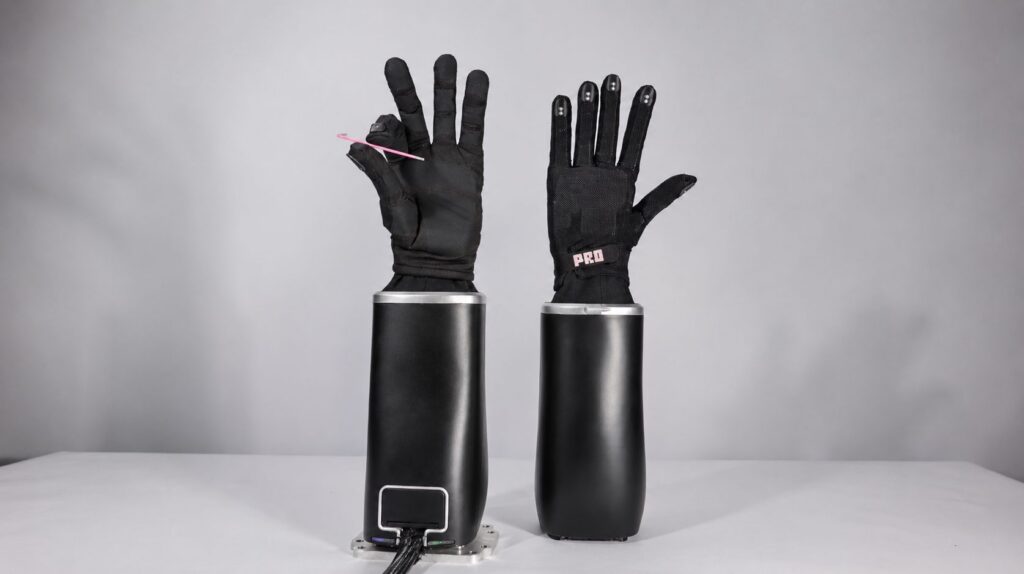
Physical AI is increasingly being discussed as a major frontier: systems that understand physics and operate in the real world beyond the screen, from humanoid robots to autonomous vehicles.
YC-backed startup Proception is focused on one of the most technically challenging components of physical AI: the robotic hand.
Proception’s flagship system, ProHand 1.0, is a research-grade robotic hand designed for dexterous manipulation through integrated sensing and learning. The system integrates tactile sensing and joint position awareness to enable compliant, adaptive grasping. It uses a tendon-driven architecture with more than 20 degrees of freedom, combined with distributed “skin” sensors that capture real-time contact and pressure data.

Elevate your design and manufacturing processes with Autodesk Fusion
Proception’s long-term goal is to achieve human-level dexterity in robotic hands, enabling general-purpose manipulation in real-world environments. In the near term, the team is focused on achieving reliable in-hand manipulation, including tasks such as object reorientation, grip adjustment, and fine contact interaction. These capabilities represent a foundational step toward more advanced manipulation tasks, forming the basis for progressively more capable robotic systems.
ProHand 1.0 has recently begun shipping to select AI research teams and institutions, marking the first phase of real-world deployment. These early deployments will enable Proception to collect real-world manipulation data and refine both its hardware and learning systems.
The company aims to iterate rapidly through these deployments, progressing toward a scalable platform for robotic manipulation across applications such as healthcare, manufacturing, and logistics. For the eight-person engineering team, Autodesk Fusion plays a key role in enabling this rapid design and iteration cycle.
Laying the groundwork
Proception began development of ProHand 1.0 in 2024, with a focus on rapid iteration of complex robotic assemblies. Early on, they switched from SolidWorks to Fusion, especially for the robotics design.
“Fusion handles high-degree-of-freedom robotic systems more effectively than traditional CAD tools,” says Jay Li, co-founder, Proception. “The cloud-based workflow improves collaboration, and the Python API enables tight integration with our internal tooling.”
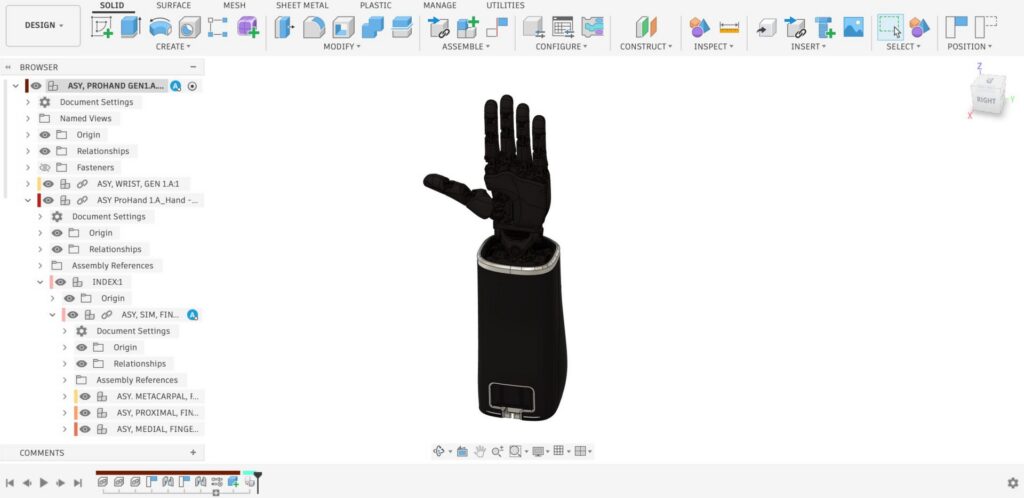
Rapid prototyping is central to Proception’s workflow. Designs move quickly from CAD assemblies to physical prototypes, often via 3D printing, followed by iterative testing and refinement before transitioning to production-grade components.
“Fusion enables efficient modeling of high-DOF systems and supports a flexible, iterative workflow. The Python API is critical for automating CAD-to-simulation pipelines.”
– Jay Li, Co-founder, Proception
Reducing hours of engineering work to less than a minute
A key advantage of Fusion in Proception’s workflow is the automation of simulation model generation. Traditionally, converting CAD models into URDF (Unified Robot Description Format) requires hours of manual work. Proception has automated this process using the Fusion API, reducing the workflow from hours to under a minute. What used to take an engineer the better part of an entire day now happens almost instantly.
“We can directly export CAD models into URDF using automated scripts,” Li explains. “What previously took up to 10 hours of manual work now takes less than a minute. This automatically generates a simulation that can be used for robotic simulation.“
Looking to the future
As Proception enters its next phase, the company is focused on scaling both its hardware platform and data-driven learning systems.
“We’re building in public and sharing our technical direction,” Li says. “Our goal is to accelerate progress across the industry while advancing toward general-purpose robotic manipulation.”