 Mouncey Ferguson
Thousands of AI agents working in parallel have settled a famous million-dollar math problem about fluid flow. If AI can do that, its effects on hydraulic modeling will reach well beyond math. Will these mathematical solvers change the important equations engineers use inside their hydraulic modeling software?
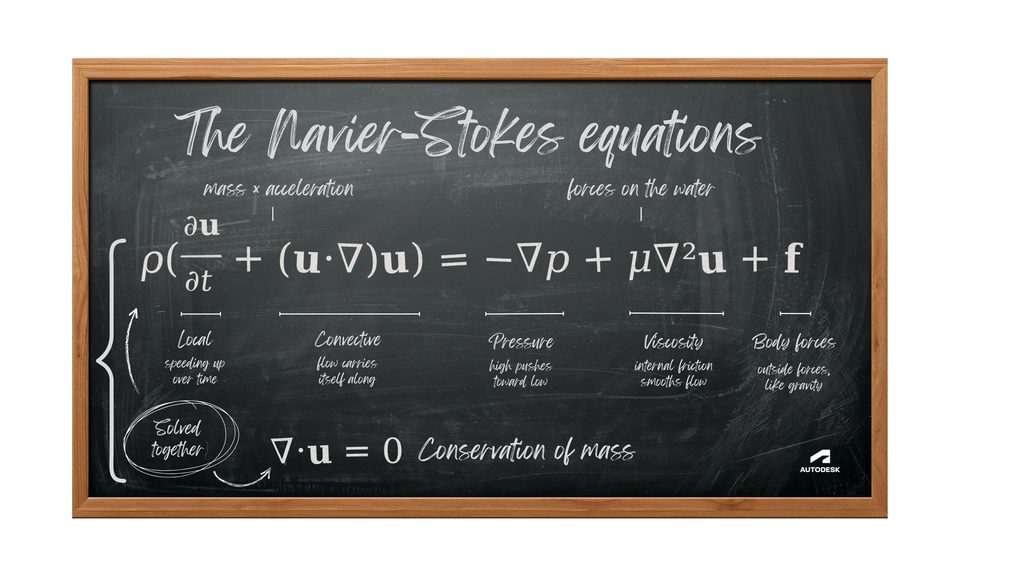
You may have seen in the news that new AI models have been solving mathematical problems that have stumped mathematicians for decades—sometimes centuries.
One of the biggest headlines came in September 2026, when OpenAI announced that it had “solved” the famous Navier-Stokes equations. These equations describe the motion of fluids and gases, from water flowing through a pipe to air moving around an airplane wing. For nearly two centuries, they have helped scientists and engineers understand and predict how fluids behave.
But there’s a catch. Although engineers have been using these equations–or simplified versions of them–with considerable success, mathematicians have long struggled to answer a fundamental question about their behavior.
That question became one of the most famous unsolved problems in mathematics, complete with a million-dollar prize for whoever could answer it. Now, AI appears to have done just that.
This is a big deal for mathematicians, and potentially an even bigger deal for the future of AI-assisted scientific discovery. But what does it mean for hydraulic modeling and the professionals who use software such as Autodesk InfoWorks ICM?
The short answer: Not much, at least not immediately. Hydraulic modeling software doesn’t suddenly need a new set of equations. What’s interesting is why.
A million-dollar mathematical mystery
In the world of pure mathematics, there are equations that we can write down but can’t completely solve. They describe our physical reality remarkably well, while also raising questions about what might be possible in an abstract mathematical world.
In 2000, the Clay Mathematics Institute (CMI) established seven Millennium Prize Problems to draw attention to some of mathematics’ most difficult unanswered questions. Each carried a $1 million prize for the mathematician(s) who could solve them. The Navier-Stokes problem was one of the challenges.
The equations themselves date to the 19th century, although their foundations go back further. In the 18th century, Swiss mathematician Leonhard Euler developed equations describing how fluids move, applying Newton’s laws of motion to substances that flow and deform rather than behaving like solid objects. But Euler’s equations left out an important characteristic of real fluids: viscosity.
In 1822, French civil engineer Claude-Louis Navier introduced the idea that internal friction affects fluid motion. Irish mathematical physicist George Stokes subsequently refined the mathematics. Their combined contributions produced the equations that bear their names.
Viscosity describes a fluid’s resistance to deformation and flow. When neighboring layers of fluid move at different speeds, internal stresses arise. Honey, for example, is much more viscous than water, while gasoline is less viscous than many crude oils.
Accounting for viscosity made the equations enormously useful. They became foundational to fluid mechanics, helping engineers design aircraft, analyze industrial processes, and understand the movement of water. But despite their success, a mathematical mystery remained.
Why is fluid motion so difficult to predict?
We interact with fluids every day, and their behavior often seems quite predictable. Turn on a faucet, and you know what’s going to happen. Pour water into a glass, and you can be reasonably confident about where it will go. Yet fluid motion can be extraordinarily complex.
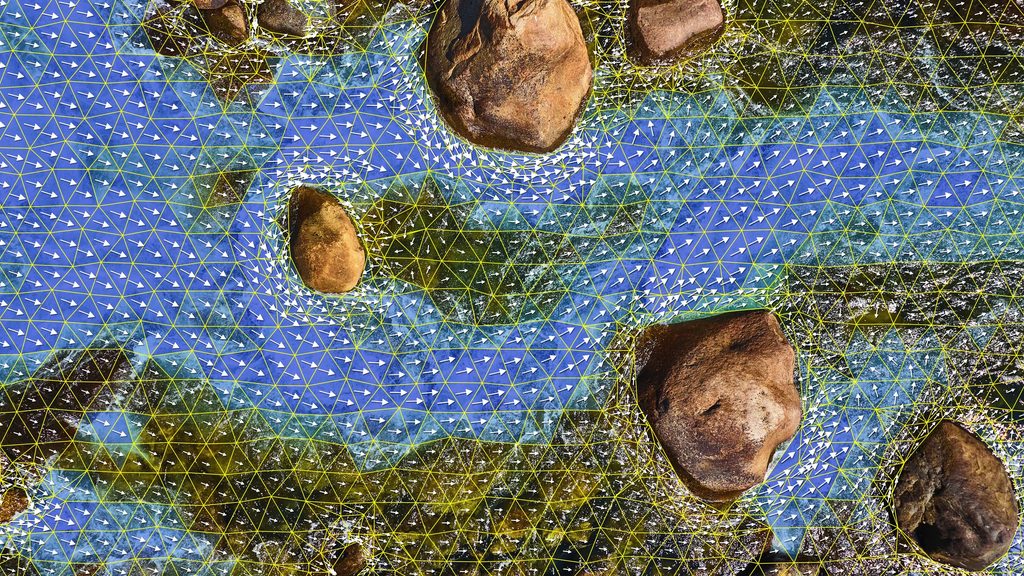
Consider a river flowing smoothly downstream. Now imagine the water encountering a large rock. The flow separates, swirls, and creates eddies. Those eddies interact with other eddies, sometimes breaking into smaller and smaller structures.
This is turbulence, and it’s one of the great challenges of physics. The Navier-Stokes equations are nonlinear, meaning that the relationship between their inputs and outputs isn’t proportional. In particular, the movement of the fluid affects the velocity field through which it moves. This creates complicated interactions that can make the resulting motion extremely sensitive to its initial conditions.
You’ve probably heard of “the butterfly effect,” the idea that a tiny disturbance in one place can eventually contribute to a much larger change somewhere else. It’s an illustration of chaos theory, which studies systems in which small differences in starting conditions can produce dramatically different outcomes, making prediction essentially impossible in the long term.
Weather is a familiar example. Even with sophisticated forecasting models, predicting detailed weather conditions more than a week or two into the future becomes increasingly unreliable.
Turbulent fluid motion can exhibit similar sensitivity. This doesn’t mean that all nonlinear flows are turbulent, or that turbulent flows are completely unpredictable. Engineers routinely predict important aspects of them. But their intricate, changing details can be extraordinarily difficult to calculate.
And that brings us to the million-dollar question: Could a fluid theoretically accelerate to an infinite speed?
The Navier-Stokes equations describe fluid motion using mathematical relationships involving velocity, pressure, viscosity, and external forces. But mathematicians couldn’t establish whether solutions to the three-dimensional equations would always remain sufficiently “smooth” and well-behaved.
In other words, could the equations predict something that seems physically impossible?
Imagine a swirling vortex that continually tightens, concentrating motion into an increasingly small region. Instead of remaining finite, its velocity grows without limits.
Mathematicians call this a singularity, or more colloquially, a “blowup.” In an ordinary turbulent flow, energy typically moves from large swirling structures to progressively smaller ones, where viscosity eventually converts it into heat. Think of a motorboat speeding across a calm lake: it briefly churns the water, leaving a frothy, turbulent wake, but the turbulence eventually dissipates and the lake becomes calm again. But in the theoretical world, mathematicians wanted to prove one way or another whether the equations could, under particular conditions, allow a cascade that concentrates motion so intensely that a mathematical quantity becomes infinite?
The Millennium Prize challenge asked mathematicians to establish whether smooth solutions must continue to exist for all time or whether a singularity could develop from acceptable starting conditions. Either answer would resolve a fundamental uncertainty about the equations.
For decades, mathematicians developed increasingly sophisticated techniques without settling the problem. Meanwhile, engineers continued using the equations successfully. That’s because finding a mathematical proof about every possible solution is a very different task from calculating useful predictions for a particular engineering problem.
What happened in September 2026?
The breakthrough grew out of years of work investigating whether fluid equations could produce singularities. Two mathematicians, Diego Córdoba and Luis Martínez-Zoroa, developed an unconventional technique involving an infinite sequence of interacting fluid flows. Their construction could produce a singularity, but it encountered a technical obstacle: the external forces required to produce the result didn’t satisfy the smoothness conditions of the Millennium Prize problem.
In 2026, mathematicians Tristan Buckmaster of New York University and Levent Alpöge, who works at Anthropic, used AI models to help overcome a related obstacle for the Euler equations.
Then, on September 8, OpenAI announced an apparent breakthrough involving Navier-Stokes itself. According to the company, approximately 10,000 autonomous AI agents, working in parallel with an advanced internal model, produced a mathematical construction in which a Navier-Stokes solution develops a singularity.
The agents reportedly worked for 88 hours and exchanged nearly five million messages, consuming several million dollars’ worth of computing resources to achieve this.
The resulting proof was also formalized using Lean, a system that checks mathematical reasoning through precise logical rules. This provides substantial confidence in the formal proof, although mathematicians must still ensure that the formalized statement corresponds exactly to the intended mathematical claim.
The announcement generated considerable excitement—and some controversy. Buckmaster and Alpöge had announced their closely related results shortly before OpenAI’s announcement. Both efforts drew on the earlier work of Córdoba and Martínez-Zoroa, and questions emerged about timing, attribution, and the role of competing AI systems.
The Clay Mathematics Institute responded by acknowledging that the problem appeared to have been “settled,” while emphasizing that the mathematical community would need time to examine the work and determine its significance.
Importantly, the reported breakthrough concerns a version of Navier-Stokes involving a smooth external force. It does not establish that singularities arise in every version of the equations, including the case without external forcing. Nor does it mean that someone has discovered a new equation that replaces Navier–Stokes. Rather, the breakthrough appears to answer a question about what the existing equations can mathematically permit.
What does this mean for hydraulic modeling in the real world?
For civil engineers and water modeling professionals, the practical implications are much less dramatic than the headlines might suggest. That’s because engineers generally aren’t trying to solve the unrestricted, three-dimensional Navier-Stokes equations in all their mathematical complexity.
They’re trying to answer practical hydraulic modeling questions, such as:
- How high will a river rise during a storm?
- Where will floodwater travel?
- Can a drainage network accommodate a particular rainfall event?
- What happens when a culvert becomes overwhelmed?
To answer questions like these, hydraulic engineers use mathematical models designed around the physical conditions that matter for a particular problem. Often, that means simplifying the equations.
Consider the shallow-water equations, which are widely used to model rivers, floodplains, and other situations where horizontal movement dominates the flow. These equations are derived from Navier-Stokes by making assumptions about how water moves. In particular, they represent horizontal velocity averaged over the water depth, rather than calculating its detailed variation from the surface to the bottom.
The result is a mathematical framework that retains essential principles, including conservation of mass and momentum, while avoiding much of the complexity of fully three-dimensional fluid motion.
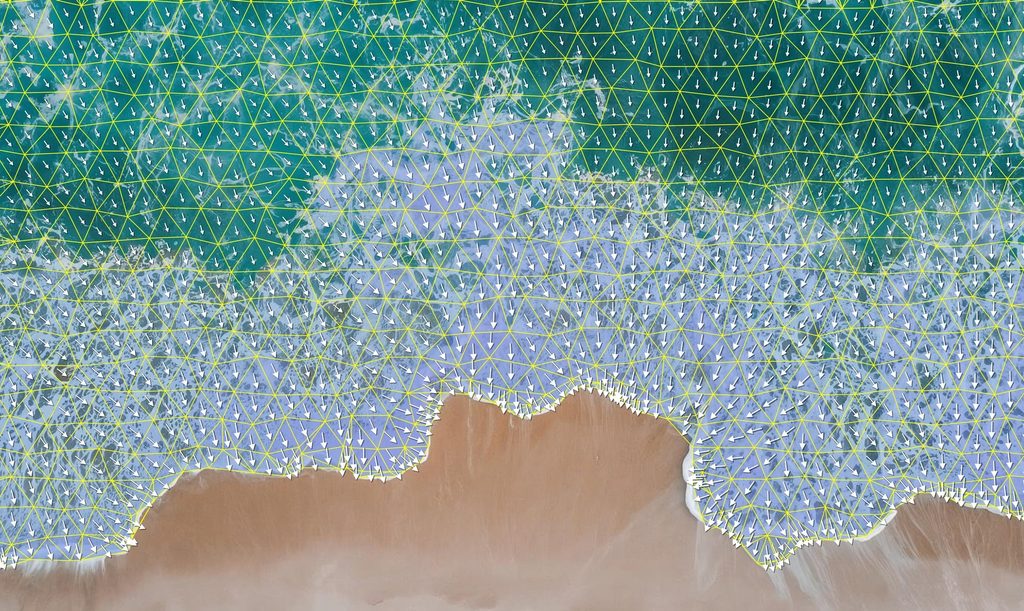
This is the foundation of the 2D hydraulic engine in Autodesk InfoWorks ICM. Rather than calculating every swirling motion within the water, the software divides the modeled area into a mesh of computational elements. It then calculates how water moves between those elements over time, using the shallow-water equations.
This numerical approach allows engineers to simulate flood depths, velocities, and flow patterns across complicated terrain. InfoWorks ICM also supports one-dimensional hydraulic modeling for rivers, pipes, and drainage networks, using equations appropriate to those systems. By connecting 1D networks with 2D surface models, engineers can analyze how water moves through infrastructure and across the surrounding landscape.
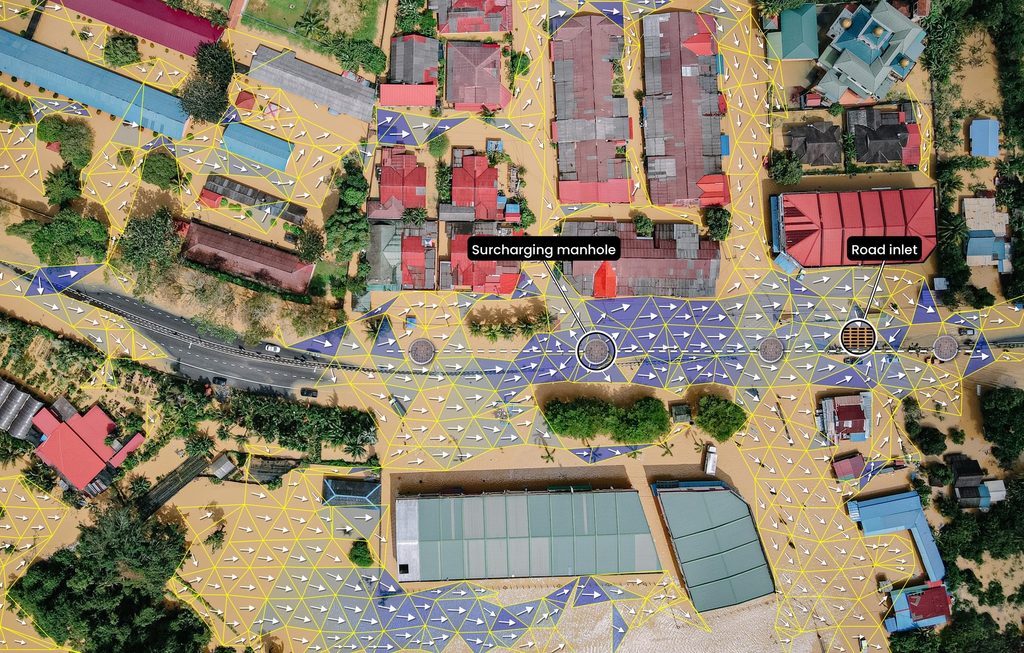
Autodesk InfoDrainage likewise uses the shallow-water equations for its 2D surface-flow calculations. None of these applications depends on proving that every mathematically conceivable Navier-Stokes solution remains smooth forever. Instead, they depend on selecting suitable physical assumptions, representing the modeled environment accurately, and using numerical methods that produce sufficiently reliable results.
Mathematics, physics, and engineering: Different questions, different answers
This distinction gets at something fundamental about mathematics, physics, and engineering.
Mathematics investigates what follows logically from a set of assumptions. Physics asks whether those assumptions and their consequences accurately describe nature. Engineering uses that understanding to solve practical problems.
These disciplines overlap enormously, but they don’t always ask the same questions. Consider the singularity described in the new proof: The Navier-Stokes equations treat a fluid as a continuous substance that can, mathematically, be examined at arbitrarily small scales.
But real fluids aren’t infinitely divisible. They’re made of molecules and atoms. At sufficiently small scales, the assumptions underlying the continuum model cease to apply.
A mathematical singularity thus doesn’t mean that an actual river could spontaneously accelerate to infinite velocity. It indicates that the mathematical model permits behavior that cannot be interpreted as ordinary physical fluid motion.
For engineers, this is hardly an unfamiliar concept. All models involve assumptions and approximations. A hydraulic model might represent a river channel using surveyed cross sections, approximate frictional resistance through roughness coefficients, or average velocities across a computational element. These simplifications don’t make the model useless. They make it practical.
And while increasingly powerful computers have allowed engineers to build larger, more detailed simulations, computing power alone doesn’t eliminate uncertainty. Model quality still depends on input data, appropriate assumptions, calibration, and an understanding of the physical system.
The new mathematical result doesn’t change those fundamentals. So, what changes for hydraulic engineers? Probably very little in the immediate future.
The shallow-water equations remain appropriate for the many applications in which their assumptions hold. Hydraulic modeling software such as InfoWorks ICM and InfoDrainage can continue using established numerical methods to help engineers understand flooding, drainage, and water movement.
The breakthrough doesn’t suddenly make existing simulations obsolete, nor does it provide a new way to predict every detail of turbulent flow. What it does provide is a potentially historic advance in our understanding of the mathematics underlying fluid mechanics—and a demonstration of how AI may accelerate mathematical discovery.
That could eventually lead to new insights and computational techniques. But the path from a theoretical proof to an engineering application is rarely direct.
For now, the practical lesson is that a mathematical model can be extraordinarily useful without providing a complete description of every conceivable behavior of the system it represents.
The next time you’re watching a river swirl around a rock, waves break on a beach, or smoke rise from a fire, consider this: Behind those familiar motions lies a mathematical world so complicated that it took nearly two centuries—and thousands of AI agents—to answer one of its most fundamental questions.
And even still, turbulence has plenty of mysteries left to reveal.
Put the equations to work
- See it: See how a 2D mesh represents real flow with the free InfoWorks ICM Viewer. You can open models and results without a license.
- Learn it: Learn InfoWorks ICM at your own pace with the free on-demand course, which takes about 10 hours and includes quizzes.
- Get it: Students and educators can get InfoWorks ICM for free through the Autodesk Education plan.