 Trevor English
Kansas City, Missouri, like many older US cities, has a big sewer challenge hiding beneath its streets. They’ve taken on the challenge of defeating sewer overflows using the power of hydraulic modeling.
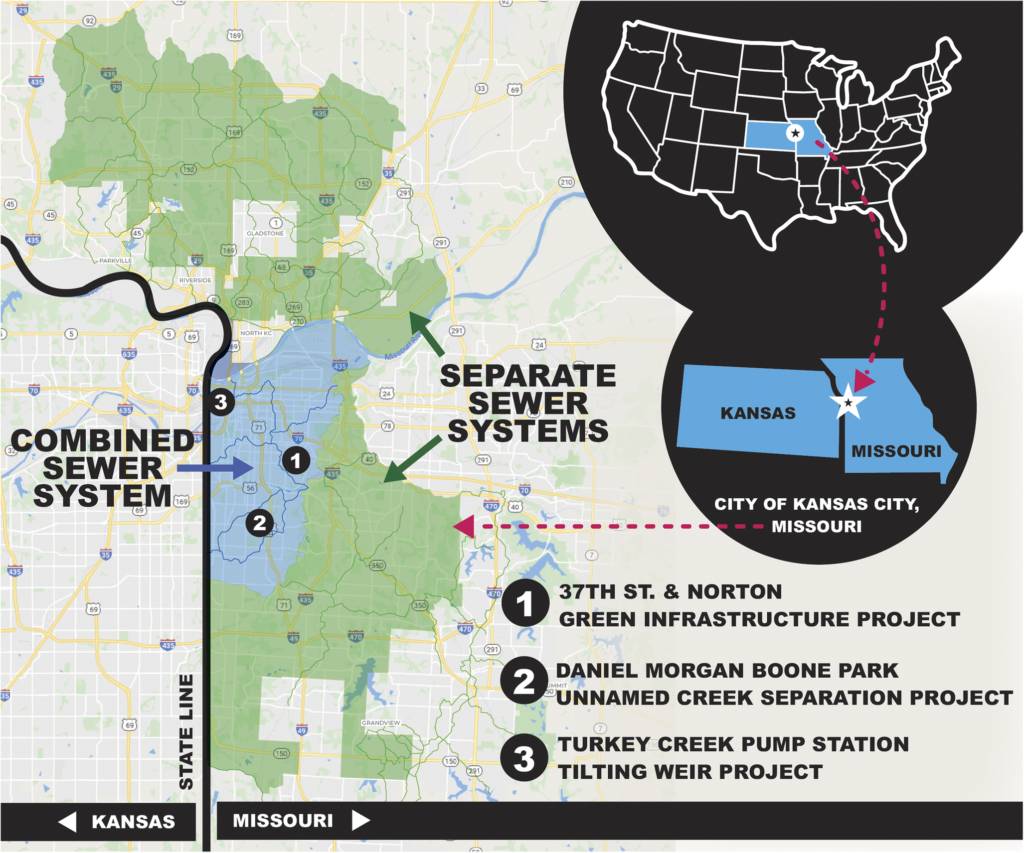
KC Water serves a growing metropolitan area with thousands of miles of sewer pipe, 40 sewer pump stations, 27 satellite communities, and one of the largest sewer systems in the country by square mileage. In some parts of the city, stormwater and wastewater flow through the same combined sewer system. During heavy rain, those pipes can fill beyond capacity, sending untreated overflow into nearby waterways.
To mitigate this, Kansas City entered into a federal consent decree in 2010 and began its Smart Sewer Program (SSP), a 30-year, multibillion-dollar effort to reduce sewer overflows, protect public health, improve water quality in receiving streams, and comply with federal requirements. KC Water’s long-term goal is to capture 85% of combined sewer overflow volume in a typical year by 2040.
But a 30-year plan is a long time to keep building from the same original assumptions.
Why KC Water adopted adaptive management
The original Overflow Control Plan was developed in 2009, before Kansas City had the benefit of today’s system-wide monitoring, updated hydraulic models, and a deeper understanding of how each project would affect the broader network. So KC Water and Burns & McDonnell took a more flexible route, supported by modeling in Autodesk InfoWorks ICM: adaptive management.
“Adaptive management is a framework designed to navigate information uncertainty through iterative system monitoring and structured decision-making,” says Andy Shively, KC Water Deputy Director, in a published article on the topic. “With adaptive management, consent decree compliance can be achieved on schedule at a lower cost than the original overflow control plan.”
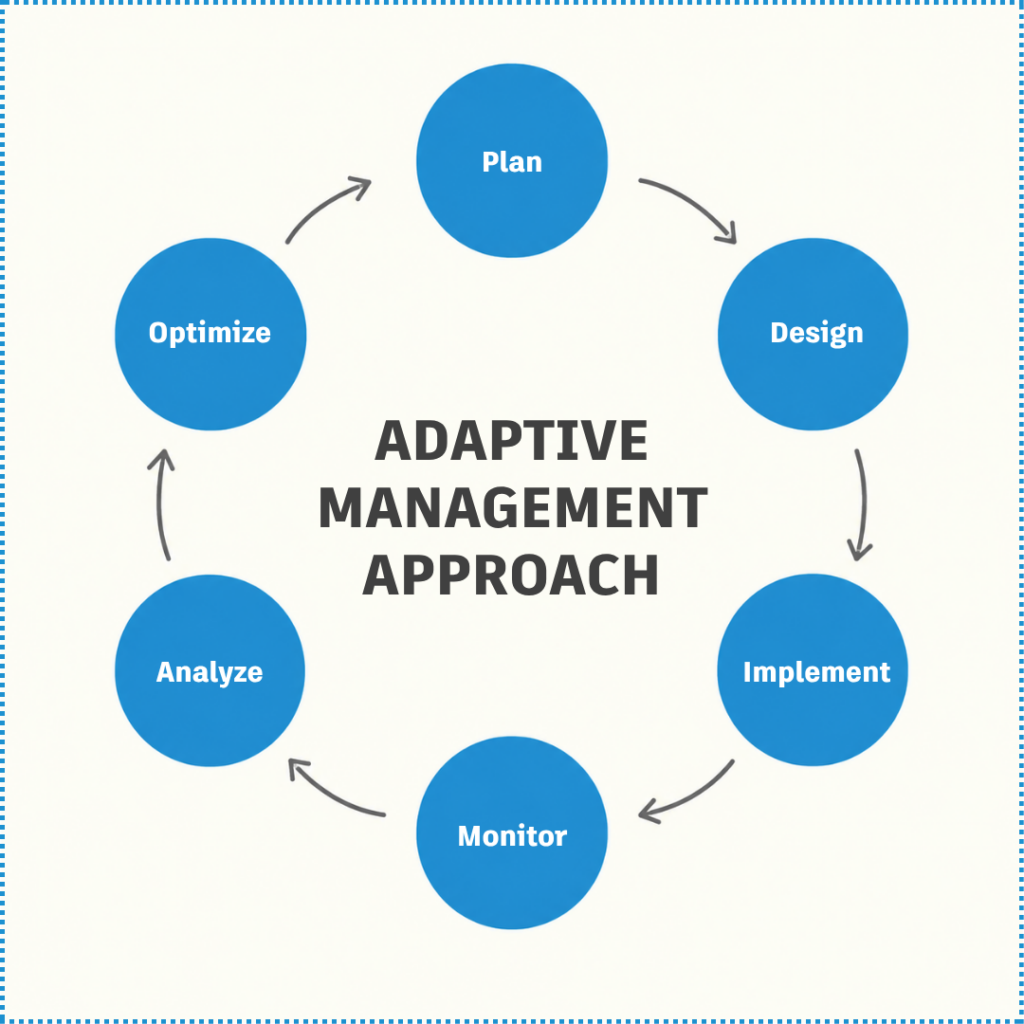
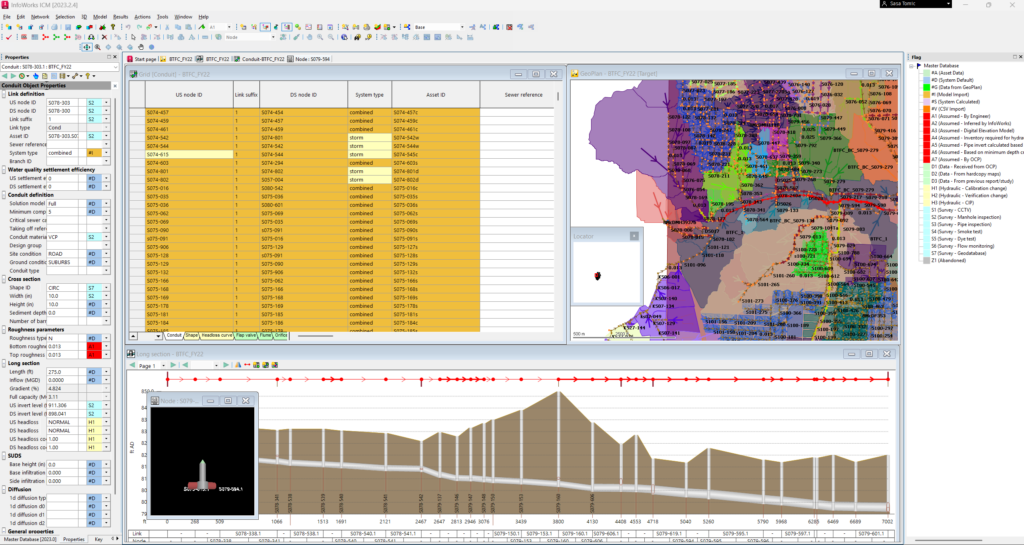
For KC Water, that philosophy became the foundation of a smarter approach to long-term sewer investment planning. Using Autodesk InfoWorks ICM to continuously update and evaluate system-wide hydraulic performance, KC Water and Burns & McDonnell were able to revisit assumptions, identify more effective alternatives, and optimize projects before construction dollars were spent.
How InfoWorks ICM improved system-wide sewer modeling
The following three projects show how that process unfolded in practice across different parts of Kansas City’s combined sewer system. In each case, InfoWorks ICM helped the team better understand system behavior, identify capacity constraints, and develop more cost-effective solutions that improved overflow reduction outcomes.
Better data makes for a better sewer plan
Adaptive management is not about abandoning the plan, it’s about making the plan smarter as more comprehensive information becomes available.
In Kansas City, the process follows a repeatable cycle: plan, design, implement, monitor, analyze, and optimize. The Smart Sewer Program updates its hydrology and hydraulic model annually, then reevaluates projects as they come up for design. That gives the team a chance to compare original consent-decree projects against alternatives that can deliver equal or greater overflow control, often at a much lower cost.
This is where InfoWorks ICM becomes especially valuable. The software allows engineers to move beyond isolated project analysis and test how proposed changes perform across the system. That matters because increasing capacity in one location can sometimes push more flow downstream, creating new problems somewhere else.
The Third Amended Consent Decree, approved in 2021, gave Kansas City more room to apply this data-driven approach. The US EPA described the modification as a way to provide flexibility for revised or alternative projects while ensuring overall performance would be met or exceeded.
For KC Water customers, that flexibility matters. The original program was expected to cost $4.5 billion to $5 billion and contributed to years of double-digit wastewater rate increases. The revised agreement reduced the scope and cost of the program through 2035, created more room for green infrastructure, and extended the final compliance date to 2040.
As Mr. Shively put it, “We recognize the financial impact the Smart Sewer program has had on our customers, and we don’t take that lightly.”
Replacing a relief sewer with green infrastructure
The first project sits within Kansas City’s Lower Blue River Basin, in the city’s combined sewer system that ultimately drains toward the Blue River Wastewater Treatment Plant. The basin contributes flow into the Blue River Interceptor Sewer, one of the city’s major conveyance interceptors. This project was one of the clearest examples of how adaptive management with InfoWorks ICM delivered stronger outcomes.
Originally, the Smart Sewer Program proposed a conventional gray infrastructure solution for this area: a large relief sewer intended to move more wet-weather flow away from a diversion structure in Vineyard Park. At the time, the approach was straightforward – increase conveyance capacity and overflows would decrease.
The original plan called for about 3,400 linear feet of relief sewer to convey additional wet-weather flow to the Blue River Interceptor Sewer. On paper, the project would reduce overflow at the local diversion structure by 18 million gallons in a typical year.
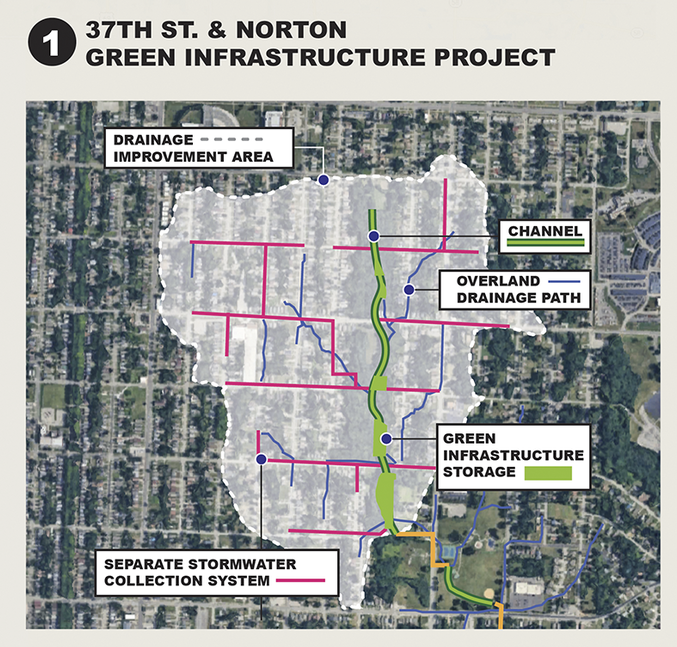
The 37th & Norton green infrastructure project includes sewer separation and a detention basin for peak runoff reduction. The control measure was proposed instead of an interceptor improvement project which reduced overflows locally but increased systemwide. Courtesy Smart Sewer Program.
But when the team reevaluated the project using the updated system-wide InfoWorks ICM model, the bigger picture changed. The receiving interceptor had limited capacity. Moving more flow into it would reduce overflow locally, but it would also increase overflow downstream. System-wide, the relief sewer was predicted to capture less than 1 million gallons annually. Looking at the project system-wide impact with InfoWorks ICM identified new ways to adjust the solution and improve the outcome.
“When the Smart Sewer Program significantly improved the system hydraulic models and integrated them into a system-wide model, the updated model showed that the receiving interceptor sewer had limited capacity,” says Saša Tomić, Digital Water Lead at Burns & McConnell. “It reiterated the importance of holistic system-wide project evaluation.”
KC Water and Burns & McDonnell used the model to evaluate an alternative: separating approximately 195 acres of combined sewer area and adding green infrastructure. The “green” alternative included about 76 green acres and roughly 1.8 million gallons of storage, with stormwater discharged downstream of the diversion structure.
The result was a robust project. The green infrastructure alternative was estimated at $17 million, compared with a lower initial cost for the relief sewer, but its cost effectiveness was far stronger. A Cambridge case study on the project reports a 50-year life-cycle cost of about $1.00 per gallon of annual overflow captured for the green infrastructure alternative, compared with $8.60 per gallon for the relief sewer.
Instead of simply increasing conveyance capacity, the modeling team reframed the problem entirely. By slowing, storing, and separating stormwater closer to where it entered the system, KC Water could reduce pressure on the downstream interceptor while achieving broader environmental benefits across the basin.
The project also brought benefits that don’t show up in a simple pipe-capacity calculation. The project area falls within the 95% to 100% range of EPA’s Demographic Index, meaning the investment supports communities with high proportions of low-income and minority residents. The alternative was approved by the EPA and moved into design.
“The flexibility provided by the adaptive management approach allows the Smart Sewer Program to respond to new circumstances that could not have been predicted when the Overflow Control Plan was originally developed,” Mr. Shively explains.
Unlocking overflow reduction in Town Fork Creek
The second project demonstrates that adaptive management is not only useful for replacing projects, but also for refining projects that are already moving forward.
Located in the Town Fork Creek basin, the Daniel Morgan Boone Park project was originally designed as a green infrastructure and sewer separation effort intended to reduce combined sewer overflows upstream of the Blue River Interceptor Sewer. Town Fork Creek itself is partially channelized within the combined sewer system before resurfacing in Daniel Morgan Boone Park, creating a complicated hydraulic environment that has evolved over decades.
The project was designed to reduce combined sewer overflow through sewer separation and green infrastructure, but the InfoWorks ICM model and field understanding revealed an additional opportunity. The review identified an unnamed surface creek flowing into a double-barrel overflow pipe about 500 feet upstream of the Town Fork Creek outfall. That creek conveyed flow from upstream sewer overflows, causing some overflow volume to be counted twice and adding stormwater into the combined system.
Rather than treating that as a fixed condition, KC Water and Burns & McDonnell refined the project.
“The Smart Sewer Program used an adaptive management approach to augment the Daniel Morgan Boone control measure and resolve this problem,” says Tomić.
The revised approach separated the unnamed creek from the combined flow path by using one barrel for creek and stormwater conveyance and the other for the combined sewer system, with emergency connections for extreme events. The modification was expected to eliminate about 20 million gallons of annual sewer overflow, or about 15% of the overflow at that location.
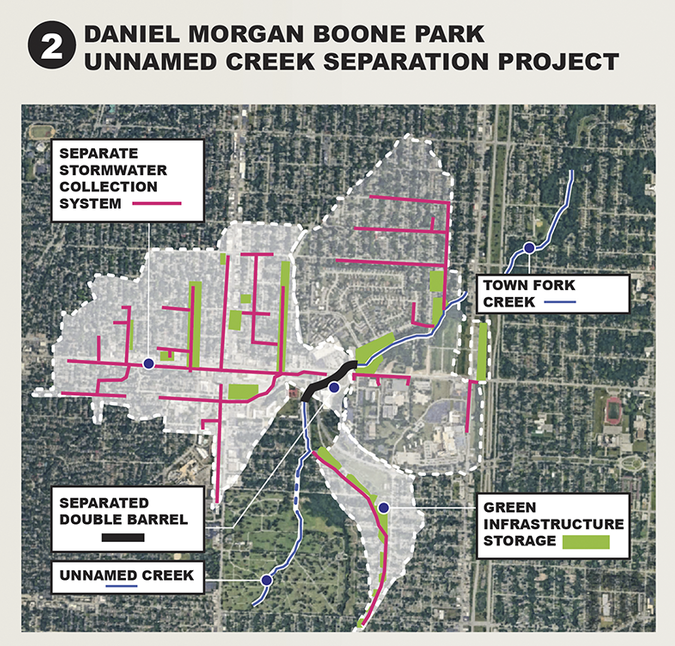
The Daniel Morgan Boone Park project is a sewer separation and green infrastructure project. The project was expanded to include the separation of an unnamed creek that previously discharged into the combined system. Courtesy Smart Sewer Program.
Because the team could evaluate the entire system dynamically in InfoWorks ICM, they were able to validate that relatively small infrastructure modifications could yield disproportionately large overflow reductions. Rather than adding major new infrastructure, the project improved performance by reconfiguring how existing infrastructure functioned during storm events.
The project became a strong example of how continuous model refinement and system-wide visibility can help utilities uncover opportunities that would likely remain invisible using traditional static planning methods alone.
Turning flood protection into 117 million gallons of overflow capture
The third example reflects how adaptive management enables utilities to adopt unexpected, high-impact solutions that emerge long after a program is underway.
Located near the confluence of the Kansas and Missouri Rivers, the Turkey Creek basin experiences significant hydraulic complexity during high river stages. The Turkey Creek Pump Station plays a critical role in moving flow toward the Westside Wastewater Treatment Plant.
The Turkey Creek Pump Station Gates project was not originally a consent-decree control measure. The original project focused primarily on resiliency and flood protection. Evaluating the system’s emergency level of service in InfoWorks ICM enabled them to identify a major opportunity to reduce overflows.
“Following Andy’s directive to fix what is broken but build new infrastructure only if it is necessary, the team used the adaptive management approach to suggest modifications to the project and improve the sewer overflow capture without increasing project costs,” says Tomić.
The existing river intrusion system included roller gates without an emergency bypass. The Turkey Creek Pump Station Gates project was examining alternatives for the emergency bypass. The alternative added after InfoWorks ICM analysis was a tilting weir upstream from the existing roller gate, creating additional inline storage upstream of the pump station while still allowing the system to release flow when needed. The configuration added more than 10 million gallons of inline storage and increased annual overflow capture by 117 million gallons.
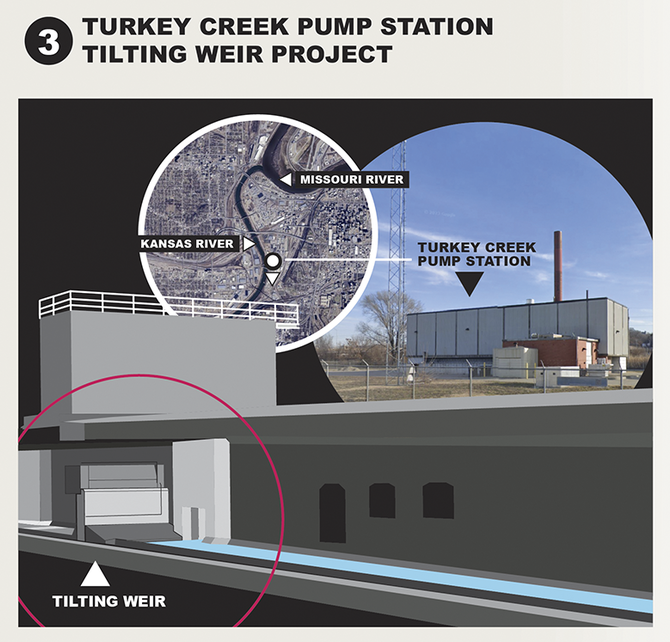
The Turkey Creek Pump Station Tilting Weir is an augmentation to an outside project. Instead of changes to existing gates, it includes a tilting weir, providing additional storage capacity upstream of the pump station and thereby reducing the overflows. Courtesy Smart Sewer Program.
The importance of that finding went far beyond the local pump station. By strategically increasing inline storage within the existing system, the project demonstrated that operational and hydraulic optimization could sometimes achieve benefits traditionally expected from far more expensive underground storage infrastructure.
The estimated project cost was about $2.2 million, with a capture cost of roughly $0.02 per gallon of annual overflow captured. Because the tilting weir was less expensive than the roller gate, the modification came at no additional cost to the city. More importantly, the added performance opened the possibility of eliminating a deep tunnel component estimated at $750 million.
“This project’s improved overflow capture performance also opened up the possibility of eliminating the deep tunnel component,” Mr. Shively noted.
How adaptive management reduced costs and improved outcomes
Adaptive management only works when modeling, monitoring, engineering, and regulatory coordination all move together.
KC Water’s Smart Sewer Program has already increased combined sewer overflow capture from 45% to 68.5%, exceeding the 2024 milestone of 66%, and the utility says it remains on track toward the 85% goal.
The lesson for other utilities is not simply to replace gray infrastructure with green infrastructure, or to rely on one type of solution over another. Kansas City’s success came from understanding how the entire system behaved together.
Using InfoWorks ICM, KC Water and Burns & McDonnell continuously updated hydraulic models, incorporated monitoring data, tested alternatives, and reevaluated projects as new information became available. That allowed the team to make decisions based on actual system performance rather than assumptions made in previous years.
“Predictive models, enhanced with the new knowledge obtained through monitoring, are periodically used to reevaluate proposed solutions and identify cost-effective alternatives,” says Mr. Shively.
What other utilities can learn from KC Water
For Kansas City, that approach has helped reduce program costs by hundreds of millions of dollars, improve environmental outcomes, support underserved communities, and give ratepayers a more cost-effective path toward consent-decree compliance.
It is also a strong example of what InfoWorks ICM can make possible. When utilities can see how each project behaves across the full system, they can move from project-by-project compliance toward smarter capital planning, better community outcomes, and more defensible decisions.
Some of the best outcomes:
- Increased combined sewer overflow capture from 45% to 68.5%
- Identified alternatives that reduced infrastructure costs
- Added 117 million gallons of annual overflow capture in one project
- Helped avoid a potential $750 million tunnel investment
- Used InfoWorks ICM to optimize system-wide hydraulic performance
- Improved environmental outcomes while supporting consent decree compliance
For KC Water, those better outcomes came from going deeper and pursuing a modification to their consent decree to help them implement their adaptive management approach, which enabled them to leverage updated data and better hydraulic modeling tools, such as InfoWorks ICM.
“By embracing adaptive management, this modification to the Kansas City Consent Decree delivers cost-effective and measurable solutions to address overflows in one of the nation’s largest sewer systems,” said EPA Assistant Administrator for the Office of Enforcement and Compliance Assurance Susan Bodine. “This consent decree can be a model for other communities.”