 Mahtab Barazandeh
 Trevor English
Houston has been flooding since it was founded in 1836.
Flat terrain, lots of concrete, coastal weather, and rainfall that keeps getting more intense make stormwater one of the city’s biggest infrastructure challenges. In 2017, Hurricane Harvey dropped more than 50 inches of rain on the region, the most significant rainfall event in US history since the USGS began keeping records in the 1880s.
Houston Public Works decided to meet that challenge with a plan built for the long haul.
A big city with a big water problem
It starts with scale.
“Houston is the fourth largest city in the country,” says Houston’s Director of Public Works Randall V. Macchi, JD. “We have a huge water utility as well. We’re talking about 7,000+ miles of pipeline that gets clean drinking water to people every single day – and nearly as much in terms of a sanitary sewer system.”
That size comes with a familiar problem.
“We’re known for whenever it rains, streets filling up with water and people getting stuck. And so flood resilience – the ability to make sure that people are safe on even a blue sky day – is part of our core mission.”
The city also wanted every resident to be able to see their own risk.
“We wanted to make sure that we had an interactive map for all Houstonians to understand everything that’s going on, but to really understand what their flood risk is,” says City Engineer Oluwole McFoy.



Choosing a flood mapping tool by critical criteria
Before building its Stormwater Master Plan, the city ran a formal, documented software evaluation.
McFoy explains, “There were 50 core things that we evaluated, 20 different service providers, and really InfoWorks ICM rose to the top because it truly allowed us to identify the above ground assets as well as our below ground assets and get them working together to form a true flood risk analysis.”
Their choice gave Houston a comprehensive, citywide stormwater model.
AI surrogate modeling: from 6 hours to 3 seconds
When asked why he chooses InfoWorks ICM, Managing Engineer Fazle Rabbi points to data management and speed.
He’s especially fond of InfoWorks ICM’s surrogate modeling* functionality. A surrogate model (aka emulator) is a simplified, data-driven stand-in for a more detailed simulation that is trained on the inputs and results of many full hydraulic model runs, giving it the ability to predict how a system will respond without needing to run the full solver each time.
“Data management in InfoWorks is very strong compared to the others. The AI surrogate model in InfoWorks ICM allows us to get the answer faster than running the full-scale model. Traditional hydraulic model used to take six hours to complete a model run. With a surrogate model, it takes three seconds to get the same results.”
His excitement goes beyond one tool.
“I am excited to see these applications of AI not only in InfoWorks but in all activities in all operations, planning, design, construction – to do things faster and more effective,” Rabbi adds.
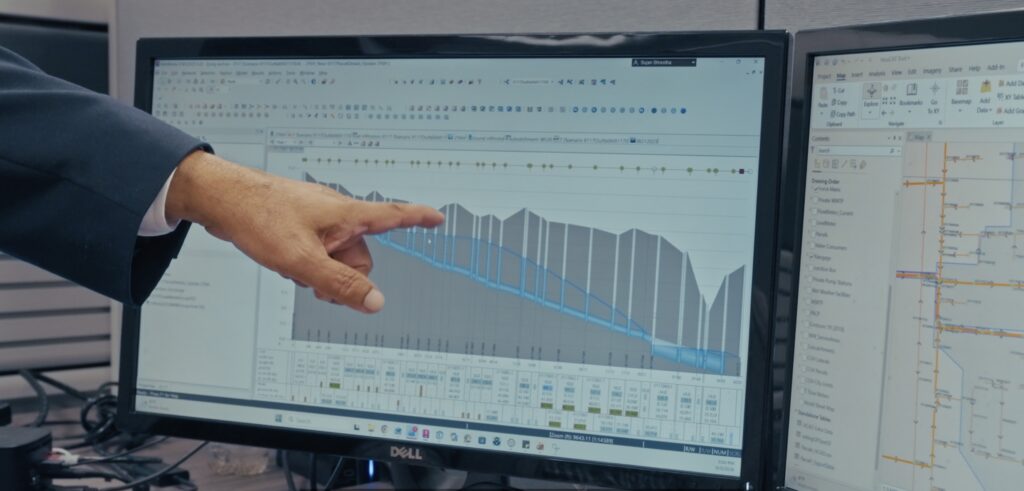
With surrogate modeling functionality in InfoWorks ICM, Houston Public Works can get regular, speedy hydraulic modeling results and feed that data into Info360 Asset for real-time management.


A living plan, not to be left on the shelf
The investment is meant to keep paying off.
“The biggest difference that this model has made for Houston is that we have a true trusted north star,” says McFoy. “It’s not enough that we spent and invested $11 million in developing this stormwater master plan if we let it sit on this shelf. So we are looking at an update cycle of every 3 years so that it becomes a living master plan protecting Houstonians for years to come.”
For Houston, everything comes down to moving from reacting to preventing.
“The more information you have the better decisions you make,” Macchi concludes. “Digital transformation helps us move from being in a response-generated mode all the time to being more proactive in solving problems before they start.”

Go deeper into the Lone Star state
- Best practices: See how they plan it all in our article on Houston’s Stormwater Master Plan: a modern approach to citywide modeling.
- Is the risk low, medium, or high? Houstonians now have a view into their city’s flood risk by consulting the Houston Flood Risk and Stormwater Planning Map.
- The power of prediction: Some of our customers use InfoWorks ICM to help plan worst-case scenarios: What if Hurricane Harvey had hit San Antonio?
- Modeling RDII: “Let’s say it’s been raining for two weeks. How big of a storm can our water treatment plant handle?” How Trinity River Authority uses their digital twin to model RDII in real time.
* Surrogate modeling is AI-based functionality currently under development, which is being tested and evaluated by InfoWorks ICM customers like Houston Public Works.