 Ike Nwabah
Managing water and wastewater infrastructure across five independently governed districts made long-term planning anything but simple. Platte Canyon Water and Sanitation District used Autodesk Info360 Asset to connect CCTV inspections, GIS, and risk data—turning disconnected information into defensible, risk-informed capital plans.
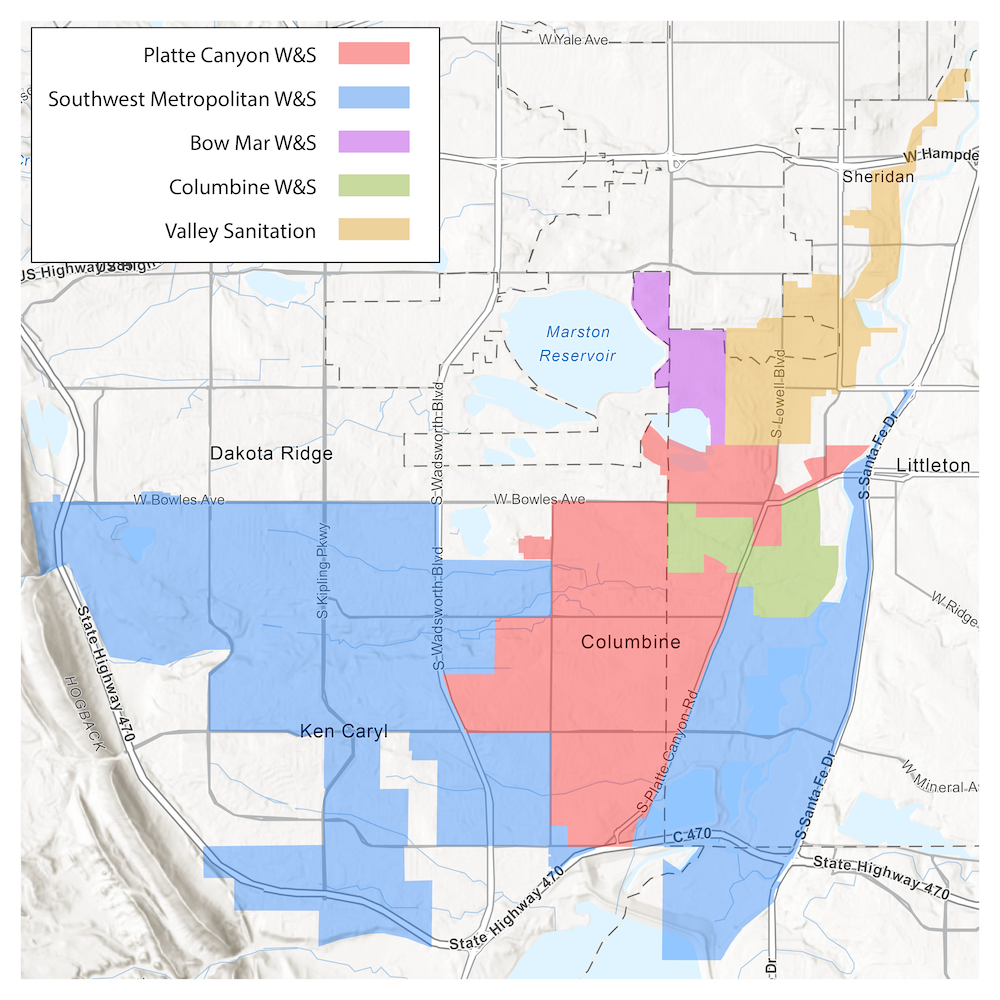
Platte Canyon Water and Sanitation District presents a unique governance model. While the district directly serves roughly 6,000 to 7,000 accounts (~18,000 residents) within its own borders, it contractually operates and manages four neighboring systems: Bow Mar (300 accounts), Columbine (850 accounts), Valley (2,250 accounts), and Southwest Metro (17,000 accounts).
Operationally, Platte Canyon manages water distribution and wastewater collection across the five districts as one coordinated utility operation serving 85,000 residents across 28,000 connections. Financially, however, each district is an independent local government entity with its own rate structure and governing board.
“We literally operate the system as one collective, but when I go in and do capital planning, I plan for each district specifically because they each fund their own projects and represent independent financial entities,” explains Cynthia Lane, General Manager of Platte Canyon. “We report to five separate boards who act as the ultimate decision-makers. On any given night, we take off our Platte Canyon hat and put on our Valley or Bow Mar hat.”
Managing this multi-board landscape falls on a lean team of 15 employees, with eight staff members dedicated to operations and two to construction. As General Manager, Lane directly handles all strategic capital planning for both water distribution and sewer collection across all five entities.
When spreadsheet-based CIP breaks down
For years, the wastewater collection side of the business relied on reactive planning. Without a formalized, documented process to feed field observations systematically into a multi-year CIP, capital improvement selection often depended on operational emergencies.
When something broke, they prioritized it.
But Platte Canyon was rich in raw field data. The operations crew had implemented closed-circuit television (CCTV) sewer lines on a strict four-year rotation using standardized NASSCO PACP defect codings. The team maintained comprehensive asset registries detailing pipe install dates, diameters, and materials. What they lacked was a holistic process for their wastewater system and a lack of connected system to convert field condition data into defensible, multi-year investment plans.
“We were moving from one event-driven responses to another. Our operators would come to us flagging an immediate failure, forcing us to scrounge for project budget,” Lane says. “For a small utility, rehabbing a half-mile to a mile of pipe can easily cost $400,000 to $500,000. When you fund capital work reactively, it shocks your financial reserves.”
Compounding this–on the water distribution side, five years earlier–the district’s long term asset management software provider suddenly went out of business, erasing years of custom planning configuration. Left with no fallback, the utility exported its raw asset model into a massive Microsoft Excel spreadsheet and operated in this environment for years.
While Lane could update basic Likelihood of Failure (LoF) parameters like pipe age or break history in the workbook, updating other parameters like Consequence of Failure (CoF) variables that track the proximity to critical facilities was functionally prohibitive.
“In Excel, I was completely unable to easily update our CoF scores,” Lane notes. “As new businesses moved in, valve configurations shifted, and critical customers changed, our model stayed frozen. To manually recalculate those weights across our sheets would require at least two solid weeks of our entire staff working on nothing else. We simply made the choice that it wasn’t worth the human cost, leaving us making multimillion-dollar decisions based on outdated data.”
The vulnerability of this reactive manual approach became a major issue when the district faced critical infrastructure failures within its fire hydrant system. Lane clearly recalls: “The board finally said: ‘Stop. Give us a clear five-year plan so we can budget appropriately, coordinate our expenditures, and communicate transparently with our residents.’ They demanded that we move away from emergency management into planned, documented capital schedules.”
Choosing asset management software for water utility CIP
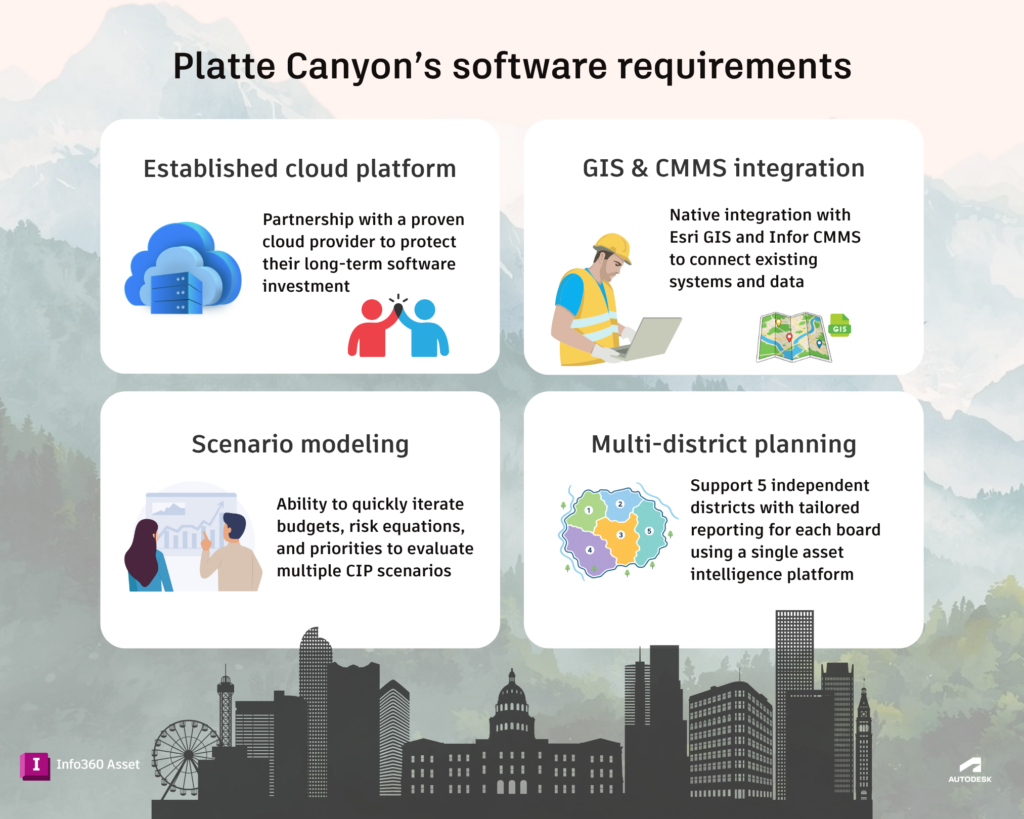
To eliminate static spreadsheet risk and update how capital decisions were made across their assets, Lane and her in-house IT lead initiated a market evaluation for a modern asset planning platform. Given their prior experience with a vendor suddenly exiting the business, product stability and established brand reputation were top priorities.
“Having been burned before when our software provider went out of business, our biggest concern was making sure we were talking with well-established software providers. We refused to invest taxpayer dollars into software that might be sunsetted in a few years,” explains Lane.
They had other requirements, too, like integrating easily with existing third-party systems. “We needed a platform that played nicely with our existing Esri GIS system of record and our CMMS asset management software.”
Beyond software longevity and an easy ramp-up, Lane, an engineer by training, required a solution capable of dynamic scenario planning.
“A spreadsheet is static. I cannot change costs at scale, I cannot adjust my risk equations, and I cannot easily move project variables around,” says Lane. “Governing boards ask detailed questions. I needed a platform where I could run multiple scenarios beforehand, demonstrate that I’ve evaluated every option, and present the most efficient capital recommendation.”
Platte Canyon selected Autodesk Info360 Asset. The district adopted an incremental deployment strategy, targeting its highest-priority assets, sewer collection first, with plans to ingest its Excel-based water distribution assets immediately following.
From static spreadsheets to cloud intelligence
Transitioning to Info360 Asset replaced outdated Excel data with a central system of record. By connecting CCTV condition data, PACP defect scores, and spatial attributes directly into cloud-based risk decision trees, Platte Canyon modernized its entire capital planning workflow and immediately began experiencing benefits:
1. Tailored multi-district profiling
Info360 Asset solved the administrative friction of managing five separate utility entities. Within the cloud platform, Lane created customized asset groups for each of the five districts. She can configure distinct Likelihood of Failure (LoF) and Consequence of Failure (CoF) parameters tailored to the localized priorities, critical customer density (such as tap counts), and budget capabilities of each individual district board.
2. Eliminating the 2-week data bottleneck
The manual penalty required to update Consequence of Failure (CoF) metrics was eliminated. Rather than committing two full weeks of staff time to re-code cell formulas in Excel, Lane can simply adjust consequence factors, such as proximity to critical businesses or shifting main configurations, and recalculate risk profiles across thousands of assets instantly within a web browser.
3. Connecting field operations to public policy
The implementation created an unexpected cultural shift by bridging the gap between field maintenance and executive decision-making. “Info360 Asset provided a way to connect our operators directly to our policy decisions,” Lane explains. “In the past, field crews doing PACP coding might feel like they were just checking a box on a work order. Now, we show them that when they code a fine root in the collection system, that data flows directly into Info360 Asset, informs our capital rehab plan, and goes all the way up to the board to determine customer rates. It demonstrates to our entire team that what they do every day really matters.”
Building a defensible capital improvement plan with risk-based asset management
By transitioning to Autodesk Info360 Asset, Platte Canyon achieved structural improvements in its operational, financial, and strategic workflows:
- Development of their first 40-year collection plan: The district successfully established its first comprehensive, 40-year capital rehabilitation schedule for the sewer collection network across all five managed districts, providing an authoritative baseline for 10-year financial planning.
- Protection of operating budgets: By moving from event-driven response to risk-indexed capital planning, Platte Canyon replaced unpredictable emergency repairs with scheduled and proactive plans.
- Operational labor optimization: Targeting “Sewer Problem Areas” (SPAs) through data-backed rehabilitation plans eliminated the need for field crews to perform repetitive root-cutting maintenance every three to six months on non-failing segments, freeing up labor hours for proactive system maintenance.
- Board defensibility and transparent governance: When presenting multi-million dollar capital plans to any of the district’s five governing boards, Lane uses data views from Info360 Asset to justify project selection.
“Governing boards want to know the appropriate level of spend. With Info360 Asset, I feel completely confident delivering a well-informed capital plan. If a board asks us to test a different expenditure constraint, I can adjust the parameters and run a new scenario easily. It gives us the exact backing we need to prove we are bringing forward the best option.”
Succession planning: a big win for a small utility
For Lane, one of the most vital outcomes of adopting cloud asset intelligence is securing the district’s institutional continuity. Lane’s predecessor served as district manager for 45 years before retiring, which required a four-year shadowing period to transfer decades of that unwritten institutional knowledge.
“In small utilities, knowledge is often trapped inside one person’s head or locked in a custom spreadsheet on someone’s desktop. If that person leaves, everything leaves with them,” laments Lane. “Info360 Asset serves as our digital system of record. The logic, decision trees, and capital models live in a shared cloud environment. It isn’t a hard platform to learn, and you don’t have to be a specialized asset management expert to use it. If I step away tomorrow, the next district manager can step right in, understand our capital history, and keep our critical infrastructure projects moving forward.”
Through its adoption of Info360 Asset, Platte Canyon is proving that smaller regional utilities can operate with the same analytical sophistication as major metropolitan agencies.
“In public sector industry discussions, smaller utilities sometimes get an unfair reputation for just checking boxes or lagging behind,” Lane says. “Our goal is to demonstrate that smaller utilities with compact budgets can be progressive, embrace modern software, and deliver enterprise-grade capital planning. Info360 Asset is an incredibly flexible and accessible platform. It helps us recognize the long-term needs of our community, meet those needs predictably, and ensure our infrastructure remains resilient for decades to come.”
Ready to build a more defensible capital plan?
Learn how water and wastewater utilities are moving beyond static spreadsheets and disconnected data to build living capital plans that evolve with their assets, support scenario planning, and stand up to scrutiny. Download the Strategic Guide to Living Capital Plans.