 Autodesk
Artificial intelligence (AI) is already making its mark on the water industry, powering intelligent operations using Machine Learning to optimize resource use and operational budgets for organizations. AI is a subfield of computer science focused on developing algorithms that enable machines to perform tasks traditionally requiring human intelligence. AI systems are designed to mimic human intelligence, such as learning, problem-solving, and decision-making, especially in the context of water management.
AI offers numerous benefits to the water sector like improved efficiency, optimized infrastructure, and enhanced decision-making. By harnessing the capabilities of AI systems – including Machine Learning and generative AI – water utilities, the consultants that serve them, and local governments can analyze data and vast amounts of information on usage, weather patterns, and population growth, to name just a few. This data-driven approach can help water professionals make better water management decisions, from predictive maintenance and leak detection to efficient water allocation across distribution networks. Many of these advances build on hydraulic modelling, which provides the underlying simulation of how water moves through systems before AI is applied.
The potential is vast! But how will these new AI applications and systems evolve? What’s happening now, at the beginning of this promised revolution in water? To help our customers see the potential in AI, we put together 9 ways we think that AI is already changing the water industry. These are the areas to watch for innovation.
1. Infrastructure investment
AI is driving a decade of technology investment in the water sector
In the most recent ASCE 2025 Infrastructure Report Card for America, the overall grade for America’s infrastructure ticked up from a C- to a C, despite the fact that none of the three main water categories – drinking water, wastewater, stormwater – saw grade improvements. Why did the grade go up, then?
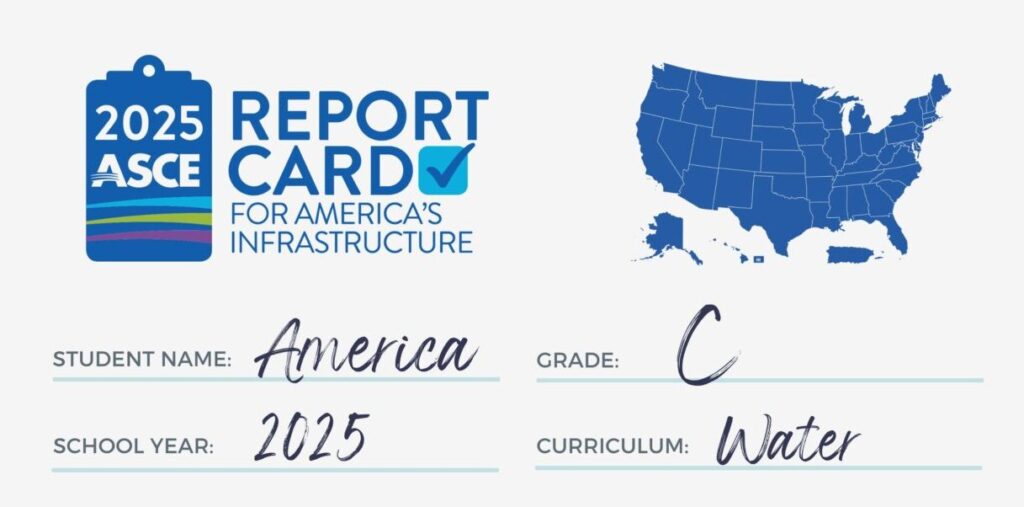
As we note in our analysis of the grades, the report says it very clearly: “This improvement was possible due to the government and private sector prioritizing investments in systems that historically had received little attention.” In other words, after 25 years of handing out poor grades, the Infrastructure Investment and Jobs Act (IIJA) finally gave ASCE hope that public investment in water infrastructure wasn’t completely dead. The ASCE essentially rewarded the US for not sliding further backwards in the nation’s decades-long decrease in infrastructure funding.
It’s doubtful that another big national investment of public funds will be coming anytime soon, but there is already a bump up in investment in the water sector – at least on the private side of the public-private equation. There is a growing appetite for AI-driven solutions, which are being rapidly developed by hardware and software vendors (like ourselves).
Whether you love AI or worry about it, the spirit of innovation is in the air, and next-generation applications are already rolling out that promise to help save water, shave off ever-more inefficiencies, and bring cutting-edge technology to an industry that has, frankly, sometimes avoided digital transformation.
The financial forecast for AI is rosy
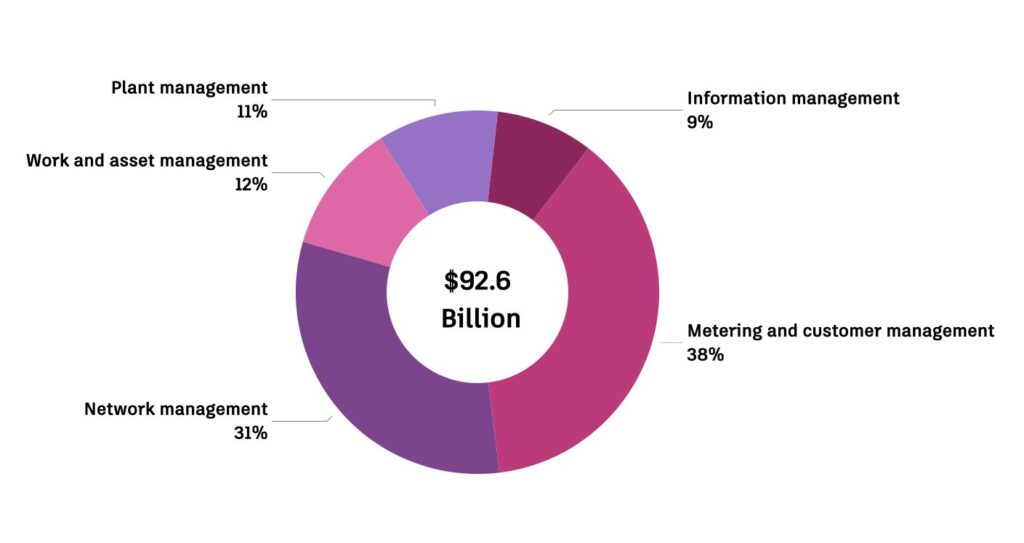
Bluefield Research forecasts $92 Billion of investment in AI solutions by the year 2030. Along that timeline, AI-driven digital water solutions are projected to grow at an 18.4% annual rate in the US and Canada alone, with a cumulative market of $8.5 billion by 2033. Europe too is projected to grow similarly at an 18.2% annual rate, with the total digital water market expected to double, reaching $27.2 billion by 2033.
AI has huge potential for digital laggards
Ultimately, this uptick in investment will be an increasingly attractive opportunity for technology laggards in water to finally “go digital” and adopt smarter infrastructure solutions. We see these AI-fueled investments as being built upon three basic pillars:
- Cloud: Cloud computing will be increasingly adopted to help support the use of real-time data analysis and the integration of AI models into water operations. There’s no denying that these AI-driven solutions require more “power”, which means cloud simulations will be essential for success. Some of our customers are already keenly interested in pushing the cloud envelope using scripting and cloud sims to create Generalized Multi-Runs, setting up simulations to run many, many times, each time modifying multiple values, allowing teams to visualize a great number of simulation possibilities.
- Applications: “Predictive” algorithms embedded in software interfaces will be the lens most water professionals look through to find efficiencies. It’s important to note that these “secret sauce” algorithms will not necessarily be realized as separate standalone applications. In many cases, they will be provided through API-driven services and integrations into products customers may already be using.
- Data: A much stronger focus on advanced data analytics will be fundamental to leveraging AI for improved water and wastewater management. Continuing to rely on Excel spreadsheets simply won’t cut it for AI-based solutions. AI will almost encourage many organizations to become more data-centric.
2. Operational expenses
AI will deliver significant OPEX savings
With some US utilities are spending over $300 per customer annually on water and wastewater operations, the potential for savings is significant. AI could save 20-30% on operational expenditures (OPEX) by reducing energy costs, optimizing chemical use for treatment, enabling proactive asset maintenance, and improving demand forecasting for better supply management. Additionally, AI can optimize resource usage in water treatment and distribution systems by defining optimal conditions and conserving energy and materials. The list of potential efficiencies is long.
Realizing these savings, of course, will be the goal of many consultants who advise the water sector, and it’s likely that they will rely on a wide variety of water-specialized data-crunching tools that help process extensive datasets, identify patterns, and extract actionable insights to improve the resilience and efficiency of water-utility operations. A simple example of this is AI’s ability to optimize cost savings on the amount of chemicals used. There are similarly a lot of more general efficiencies to be realized by improving demand forecasting for better supply management. But the key to unlocking these optimizations will be applications that offer advanced data processing for more accurate analysis, pattern recognition, and model optimization.
… but it will require new investments in people
It’s clear that there will be a lot of new AI-powered tools to help model and realize these efficiencies, but it’s important to remember that these will also require new investments in technology and people power – coders, scripters, and data scientists who can safely and successfully use the new breed of AI tools. Yes, AI may cull some jobs (which will, presumably, contribute to the savings), but there’s no substitute for smart people with valuable institutional knowledge.
3. Water distribution
AI will help predict water demand
Water distribution may have the most to gain from AI. The most substantial benefit will be in forecasting demand. AI is good at analyzing historical data, weather patterns, population growth – and lots of other variables – to forecast future water demand. In addition, AI can optimize water distribution networks by using real-time data to monitor and adjust water flow, detect leaks, and make predictive adjustments that improve network performance. Applications that bring all of the many complex sub-systems that make up a typical water system into one easy-to-understand dashboard – that can be actually controlled in real-time – is the obvious dream. There are a few more of the many possible use cases.
Pump optimization on steroids?
Just as we noted in our section about energy consumption, water networks can be optimized to run more efficiently by adjusting pump operation. AI-driven pump optimization enables more energy efficient water distribution operations, reducing unnecessary energy use and supporting sustainability goals. In fact, even without AI, water utilities have typically seen huge gains when they work to optimize their pumps.
Predictive failure and maintenance
Using AI with hydraulic models and sensor data can help predict system failures and optimize maintenance schedules. By applying AI and digital twin technology to actual water systems, utilities can create dynamic digital representations of real infrastructure, improving maintenance and preventing failures.
You can already go very deep on surge analysis to identify vulnerable pipes without using AI tools, and we think AI has huge potential to model very complex water distribution systems down to the smallest details. AI is also increasingly used alongside approaches such as integrated catchment modelling, allowing engineers to simulate and optimise entire water systems rather than individual components.
Water quality
AI can be used to monitor and predict water quality. With advanced algorithms, AI enables water utilities to continuously monitor water quality in real time, ensuring rapid detection of contaminants and more effective management.
Water distribution is a big endeavor. It has to happen every day, all around the world, and the field needs many IA-powered tools to improve how it’s done. We believe AI will be able to significantly improve water distribution systems across the board, with the biggest gains coming from those who embrace very accurate and responsive digital twins.
4. Asset management
AI will predict water main breaks and revolutionize leak detection
Water main breaks are costly for utilities in both financial and social capital. As critical infrastructure, water mains are essential for public safety and environmental health, making it vital to safeguard them with AI solutions. These all-hands-on-deck emergency events almost always cause unexpected havoc on city infrastructure. Can they be predicted?
Bringing the past (historical data) with the future (predictive alerts)
AI and ML could “fingerprint” the data patterns that indicate a break event may be imminent and learn from these patterns so that alerts become more accurate over time. AI models have the potential to analyze historical pipe failures to predict and prevent future incidents, helping utilities optimize their asset management strategies.
Holistic asset management
AI can identify patterns that lead to equipment failures, enabling proactive maintenance scheduling and reducing unplanned downtime. Of course, this tool that predicts water main breaks does not yet exist. But getting there – to our minds – takes two things: AI-fueled CCTV pipe assessment and accurate hydraulic modeling to identify the biggest, baddest trouble spots.
CCTV is a standout area for early innovation
To our mind, VAPAR is already tackling the CCTV problem. They are an early AI water success story, and their solution may be one of the most clear and straightforward use cases for AI in the entire water industry. Who wouldn’t want a robot that automatically watches millions of linear feet of CCTV data that is captured in the field – so you don’t have to?
Solving the rest of the equation will be about modeling – using accurate data to model actual pipe networks – digital twin solutions. This will require a combination of asset management data and hydraulic modeling data. We already see some of our customers doing this. For example:
- Asset managers can utilize results from sewer hydraulic models to identify areas where the network capacity is insufficient, such as pipes and manholes that frequently reach capacity or experience surcharging.
- When evaluating Consequence of Failure (CoF), you can use hydraulic model metrics like flood volumes, where higher overflow volumes indicate a higher consequence.
- To determine likelihood of Failure (LoF), you can use your hydraulic model’s return period data to assess the likelihood of pipe surcharge and manhole flooding; lower return periods suggest higher risk events.
This nut has not yet been entirely cracked, but our next-generation Info360 Asset customers like GHD are already moving in this direction by putting an intense focus on advanced analytics, using risk calculations and decision trees to analyze their collected data, and continuously learning from new data to keep improving their predictive accuracy around pipe rehabilitation.
5. Energy consumption
AI will help optimize energy consumption for drinking water and wastewater treatment
According to the EPA, drinking water and wastewater plants are some of the largest energy consumers in municipalities, often accounting for 30 to 40 percent of the total energy consumed. That rolls up nationally to a very large amount, with drinking water and wastewater systems accounting for approximately 2 percent of all energy use in the United States. What’s driving all that usage?
First and foremost is pumps. We believe that optimizing energy consumption in pumping stations using AI will become a big cost-reduction win for early adopters. AI can optimize pump run times so that they are only using energy when needed. Additionally, AI can optimize treatment processes around monitoring and controlling aeration and other phases, which can further improve energy efficiency.
What are the barriers to getting there? Traditionally, pump optimization in water distribution networks has relied on static and rule-based control strategies, which can’t adapt to dynamic changes in demand, network conditions, and energy costs. To address these challenges, Autodesk researchers and engineers are exploring Reinforcement Learning (RL) techniques. RL is a branch of Machine Learning that focuses on training agents to make sequential decisions by learning from interactions with an environment. By applying RL techniques to water distribution networks, it becomes possible to develop intelligent systems that dynamically optimize pump operations, leading to significant improvements in efficiency, energy consumption, and overall system performance.
Beyond pumps, AI can help reduce electricity consumption in these facilities by optimizing operational schedules and improving overall energy management.
6. Water conservation
AI will help identify overconsumption of water and uncover ways to use less
The kind of efficiency artificial intelligence promises in water savings goes far beyond traditional utility operations and water distribution – even into the realm of water footprints for datacenter management. The water footprint of datacenters is significant, as they consume vast amounts of water both directly and indirectly through their operations.
Datacenters are becoming ever more pervasive and need ever-more energy to operate. They also need to build water cooling towers to cool the massive racks of servers they have set up in giant warehouses. Datacenters use billions of gallons of water annually for cooling and operations, highlighting the scale of their water consumption and contributing to the rising water demand driven by AI infrastructure and industrial growth. The worst-case scenario here is, of course, when datacenters start competing with local community needs for fresh water, creating additional challenges for sustainable resource management.

Currently, more than 30 percent of the datacenters in the world are located in the US, accounting for around 2% of national electricity usage. That’s as much energy as water and wastewater plants themselves use. It’s reasonable to assume that these operators know the amount of water they are using is too high and that they themselves want to find innovative ways related to AI to help reduce their usage, both to realize more cost savings and improve their optics around the issue of sustainability.
This is all perhaps a bit ironic, considering that AI and ML applications themselves require significant datacenter resources, both in terms of raw energy usage and water usage for water. Additionally, the production of raw materials like lithium for batteries used in AI infrastructure is highly water-intensive, further increasing the overall water footprint. In some sense, energy-hungry AI applications may need to fulfill their water efficiency promises simply to alleviate their own water usage.
Can AI help with datacenters? There are a few promising avenues for making them more sustainable…
Make the chips more efficient and optimize energy use
NVIDIA is focusing on both making its chips more efficient and moving compute-intensive tasks to GPUs. “We’re able to provide up to 30% data center power efficiency by offloading compute intensive tasks for networking, security and storage to GPUs,” says Sean Young, director of AECO, Geospatial, and AI Solutions at NVIDIA.
You also do not need to run datacenters at 100% power usage. You can “power cap” or limit the amount of power feeding GPUs, limiting them to 150-250 watts, which reduces energy consumption and the amount of heat generated. Other ways to conserve energy include off-peak scheduling, batch processing, and dynamic load balancing.
Build on-site water water-reclamation facilities (WRF)
Using drinking water for cooling datacenters feels wasteful on many levels, so the key may be to focusing on recycling water. Using reclaimed water becomes every efficient if you can build an WRF directly on-site. “Wastewater treatment plants are located in good spots for data centers, especially urban areas with a lot of utilities around,” says Jim Cooper, global director of water at Arcadis. “The heated water in the data center can improve the wastewater treatment process. It’s this remarkable cycle and isn’t rocket science. There are a lot of opportunities. We just need to think a little differently about how we use our resources for data centers.”
Power datacenters with renewable energy
It’s certainly possible to build datacenters with on-site electricity generation. You can install solar panels or a wind farm or build them next to geothermal or hydroelectric energy sources. Similarly, you could add battery storage to smooth out supply and demand by charging batteries when renewable energy is cheap. Regulations, standards, or incentives to encourage these approaches doesn’t yet exist, but it’s possible to regulate any industry if the political will exists.
Model datacenters as digital twins
We all know that looking more deeply into data will bring us more efficiencies, no matter the task at hand. Datacenters are closed systems, which means they actually can be hydraulically modeled as digital twins.
Whether you are using specially formulated liquids that cool more effectively, non-potable water that you recycle, or plop your datacenter in the sea and cool it with saltwater – you can wring out surprising efficiencies by building models of these systems, capturing data with sensors, and focusing in on water quality. But be warned: the liquids you use to cool datacenters need to be cleaned as part of the recycling process, which also uses energy.
It’s an admittedly tricky balancing equation, but the more control you have over these systems, the more efficiencies you can realize – and the more times you can reuse the same water again and again at the lowest possible energy usage. Or to put it another way: Water-cooled datacenters should be encouraged to blunt their outsized energy usage by relying on data, too.
7. Water quality
AI will help keep water clean – much more cost-effectively
There are many ways that AI can be used for water-quality management. You can use it to monitor real-time conditions, predict contamination events, and identify pollution sources by analyzing data from sensors and other sources. The key to unlocking these potentialities is all about those sensors and that data.
In the past, water utilities have sometimes struggled to monitor water quality by relying on infrequently collected water samples, which is labor intensive and leads to a lot of theorizing because of the data gaps. AI-based algorithms can help solve some of those data gaps, but it can do even more once you’ve committed to creating comprehensive sensor networks that employ IoT (Internet of Things) devices. Once you’ve got sensor-driven data, your water-quality monitoring efforts become significantly more effective and scalable. There are more AI-backed capabilities for water utilities that we think will become the norm….
Holy grail: real-time dashboards
AI-driven dashboards will collect, coordinate, and make data around pH levels, turbidity, and other quality parameters available in real time to more stakeholders across water organizations. This sounds simple, but it’s always been a challenge. That said, by training the algorithm on vast datasets, these systems can achieve much higher accuracy, reducing the need for lengthy lab-based microbial tests.
Contaminant alerts
AI-driven algorithms using ML are capable of rapidly identifying bacteria in water samples (eg, E. coli). These can be used to alert technicians about algal blooms or chemical spills as soon as they occur – and even predict situations where they are most likely to occur.
Effluent compliance
AI can learn from the unique characteristics of a site to ensure that effluent standards are met and that compliance fees are avoided. It can also help measure your effectiveness with effluent discharge and make recommendations for improving it.
8. Storm, sewer, flood
AI will help us better control the water that comes from the skies
AI should make it a very exciting time to be a hydraulic modeler. Tech-savvy modelers have always wanted more computing power to perform ever-more comprehensive and larger catchment flood models, and a switch to cloud computing and integrated APIs is already raising the possibilities quite high. Analyzing historical flood patterns is now essential for improving flood prediction and management, allowing modelers to better anticipate future risks and adapt to changing conditions.
AI models now incorporate a wide range of data inputs, including weather forecasts, to enhance flood prediction accuracy and optimize water management strategies. In the broader context of water management, understanding the water cycle and leveraging AI to monitor and manage its various stages is becoming increasingly important for sustainability and resilience.
Flood modeling: bigger maps with finer details
With AI, you can integrate more weather data and create more extensive 1D/2D integrated models to see both above and below ground. (FYI: There are key differences between 1D and 2D modeling, but they can also work together). AI will also help model extremely complex flows, particularly in the case of river flows through cities with extensive sewers. Obviously, flood modeling will become more and more important as the world experiences greater and greater climate change variations, so we see flood modeling as one of the prime use cases for AI in water management – and, of course, in the arena emergency preparedness.
AI for sewer modeling?
Floods don’t just happen above ground. They happen in a smaller scale in sewers all too often as SSOs (Sanitary Sewer Overflows) or CSOs (Combined Sewer Overflows). Can AI predict sewer flows? By training an AI model with thousands of examples using an LSTM (Long-Term-Short-Term Memory) model, the model can learn to predict the next flow value, without the need to know the exact processes.
Stormwater management
This is also a “smaller-scale” flooding use case, but it’s an extremely important one. AI-assisted drainage design will make a huge difference in urban areas. Unprepared municipalities are already struggling with regular, localized flooding. This will only intensify with the increasing amount of rain brought by climate change, and one of the answers is to implement smart site-specific sustainable drainage solutions in cities that utilizes more swales, infiltration trenches, cellular storage, ponds, soakaways, and porous pavement.
These SuDS/LiDS/BMPs/WSUDs are often viewed through the lens of sustainability, but in truth they aren’t just “nice to have” because they beautify urban environments. They actually end up funneling and cleaning massive amounts of polluted water, even if citizens don’t know what they are or how they work. They can be a real difference maker.
We’ve already seen innovators in this area, like Waternet in Amsterdam, who are modeling blue-green roofs to find new ways to move water in a controlled, consistent manner. Other sustainably-minded use cases include predicting rainfall runoff for solar farms and creating interconnected stormwater controls to create a system that truly responds to rainfall – and helps concrete-paved cities deal with the coming deluges.
9. AI-assisted design
The biggest impact of all?
We save this one for last, but it may be the most important way AI will affect the water industry – and all other Design and Make industries, for that matter. We’re talking about AI-assisted design. Autodesk has been studying AI and LLMs for many years, publishing more than 60 peer-reviewed research papers advancing the state of the art in AI and generative AI. Now, we are rapidly integrating Autodesk AI into our portfolio of software.
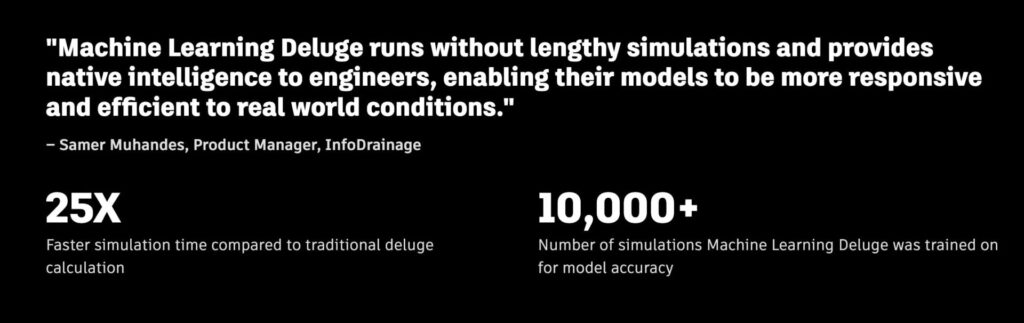
On the water infrastructure front, InfoDrainage was the first of our water software to integrate assisted design with its ML Deluge Tool. There will be many more AI features to come in other applications, which promises to shave off valuable time in the design process, whether that’s designing entire water treatment plants or just better highways.
But it’s not just about saving time. Everyone who designs the built world can benefit from AI-assisted tools that point out problems early in the design process and make suggestions. These tools will lead to cost savings and fewer compliance issues when it comes time for stakeholder approvals – and surely many more benefits as more tools emerge.
It won’t all happen immediately, but it’s clear that AI-assisted tools are an important part of the future of design itself. But they also need to be implemented ethically, which is why the Autodesk AI Lab has been collaborating with MIT, UC Berkeley, and Carnegie Mellon University to create new benchmarks for evaluating LLMs on engineering design tasks.
What’s next? Subscribe to our newsletter.
Want to follow along with the latest Autodesk Water Infrastructure AI and ML product updates? Subscribe to our LinkedIn OWB Newsletter. We know you’re busy, so we only send a newsletter when we have something to actually say, and you can unsubscribe at any time.