The age of AI: Moving toward data center sustainability
Efforts to increase data center sustainability are at the heart of addressing AI’s carbon footprint as the global demand skyrockets.

Shaelyn McHugh
September 11, 2025 • 10 min read
The resource needs of AI are exponential compared to traditional computing, with the electricity demand from AI-optimized data centers projected to more than quadruple by 2030—creating a large carbon footprint.
Efforts to support more sustainable data centers are emerging, focused on increasing efficiency in how the infrastructure is built and the application of AI itself.
Creative solutions are being offered, from reusing existing infrastructure to reducing wasteful computation, prioritizing community-informed development, and recycling water for cooling centers.
The term “data center” may seem innocuous enough. You might picture a plain, low-profile building often in a rural area. But there’s much more to it. It takes a tremendous amount of infrastructure to build and operate the data centers that power AI, handle massive datasets, and support the digital infrastructure of the future.
AI’s computational demands are reshaping the global data center landscape. To keep pace with demand for the compute power required, investment in data center construction has never been higher. There are currently more than 5,400 data centers in the United States alone, and companies will need to invest $5.2 trillion into data centers by 2030 to meet the growing worldwide demand for AI.
And the amount of power required is growing exponentially. According to the International Energy Agency (IEA)’s special report Energy and AI, “electricity demand from data centers worldwide is projected to more than double by 2030.” AI will be the most significant driver of this increase, with electricity demand from AI-optimized data centers projected to more than quadruple by 2030.
To keep data centers from overheating, many owners rely on evaporative cooling systems, which use water to remove heat through evaporation. While effective, this method consumes vast amounts of water—up to 200 million gallons per year for a single facility or about 550,000 gallons each day. In regions already experiencing water scarcity, this level of consumption is placing increasing pressure on local communities.
As the exponential growth of AI marches forward, is it possible to help mitigate this tremendous drain on resources? In a word: Yes. Owners can prioritize their own data center sustainability goals and innovative research and development to offset the impact. And, by applying sustainable design principles and even harnessing AI itself to drive efficiency, architecture, engineering, construction, and operations (AECO) professionals have a unique opportunity to shape how data centers are designed, built, and operated.
To better understand how the industry is addressing AI’s carbon footprint, Autodesk spoke with leaders from across the data center ecosystem including NVIDIA, Arcadis, and ArtifexAI. Their efforts span the infrastructure powering AI, including data centers, and the efficiency of AI applications themselves.
Moving from CPUs to energy-efficient AI
To help address AI’s carbon footprint, companies like NVIDIA are rethinking the entire data center stack—from silicon to systems, software, and sustainability. Their approach has led to a new generation of AI infrastructure designed to maximize performance per watt while significantly reducing environmental impact.
As AI models grow in complexity and size, running them efficiently requires architectural and software advances. Traditional data centers, built around general-purpose CPUs, are no longer sufficient for modern AI workloads. CPUs process tasks sequentially and consume significant power for limited throughput.
Unlike CPUs, GPUs execute thousands of operations in parallel, making them ideal for the intensive demands of AI workloads. NVIDIA’s full-stack approach includes distributed inference software that intelligently balances compute across GPU clusters, reducing idle time and enabling real-time AI responsiveness at lower energy costs.
Compared to CPU-only systems, AI infrastructure accelerated by NVIDIA GPUs processes data faster and with far lower energy consumption per task. Over the past decade, NVIDIA has achieved a 100,000x increase in AI energy efficiency, reducing wasteful computation.
“We’re able to provide up to 30% data center power efficiency by offloading compute intensive tasks for networking, security and storage to GPUs,” says Sean Young, director of AECO, Geospatial, and AI Solutions at NVIDIA.
There’s also the opportunity to make the data center building, GPU, and racks interdependent for a sustainable gain. “The density factor is tremendous and that helps us make smaller data centers with less cooling and reduced energy,” Young says. “With the NVIDIA GB200 NVL72, for example, everything is designed to be power-cooled with cold water coming in to cool the system and then the hot water going out to help heat the building. This enables up to 25 times greater energy efficiency and 300 times greater water efficiency for AI than traditional air-cooled architectures.”
By maximizing performance per watt and improving system-wide efficiency, NVIDIA is advancing the capabilities of AI and setting a benchmark for sustainable innovation in the compute-intensive era ahead.

Leveraging the power of existing infrastructure
As the demand for data centers accelerates, so does the need for massive amounts of energy, water, building materials, and land. Instead of starting from scratch, many forward-looking organizations are finding opportunities in what already exists by repurposing or co-locating with infrastructure built for other purposes.
Water availability is a key factor in where and how data centers are built, influencing decisions around cooling strategies, seasonal supply variability, and water quality. Traditionally, water-cooled data centers rely on vast quantities of water, putting a strain on local systems. But more sustainable models are emerging.
Jim Cooper, global director of water at Arcadis, shares how the company is creating the world’s most sustainable data centers with innovations in power and water. One example is utilizing “Co-Flow” technology with Tomorrow Water. In this concept, the construction and integration of data centers at water reclamation facilities (WRFs) supports the exchange of water and cooling capacities between the two facilities.
Co-Flow converts aging wastewater plants into advanced water recycling centers that produce water to be reused for the data center’s needs. For example, water from the plant can be repurposed as cooling water in the data center. The data center can then return its wastewater and heat directly to the Co-Flow plant for continued recycling.
This symbiotic relationship between the data center and water reclamation facility results in significantly reduced energy use and water waste. Both facilities benefit from a prime location, unlimited recycled water, and access to renewable energy. At the same time, the local communities can benefit from improved water infrastructure and additional recycled water, as well as jobs and tax revenue.
“Wastewater treatment plants are located in good spots for data centers, especially urban areas with a lot of utilities around,” Cooper says. “The heated water in the data center can improve the wastewater treatment process. It’s this remarkable cycle and isn’t rocket science. There are a lot of opportunities. We just need to think a little differently about how we use our resources for data centers.”
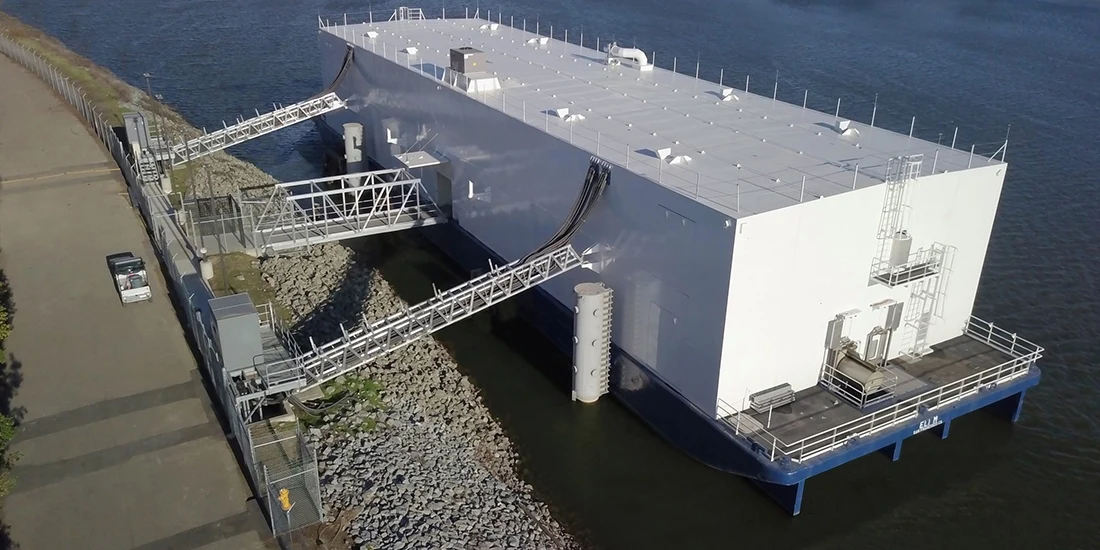
Other creative approaches are gaining traction, from floating data centers that use natural water bodies for cooling, to facilities co-located with hydropower sources to tap into carbon-neutral energy without new infrastructure.
Due to historic drought conditions in the western US, California-based Nautilus Data Technologies is introducing a modular facility layout informed by constant iteration through building information modeling (BIM) software. By tapping into the power of water-based cooling through closed cold-water loops, water consumption is eliminated and energy usage is lowered by 30%. The systems can be used on land near any body of water or can float on top of the water itself.

Keeping the community in mind
Every new data center must go through a complex approval process involving local regulators, elected officials, and community members. These stakeholders are often concerned with environmental impact, infrastructure strain, and long-term public benefit. Meaningful engagement with these concerns isn’t just a box to check—it's a foundation for responsible development.
One emerging solution is helping bridge the gap between developers and local communities. ArtifexAI, a growing AI start-up, is building AI tools to organize and analyze local policy, permitting requirements, and public sentiment. The company’s platform uses AI to extract insights from public municipal documents—like meeting minutes, zoning codes, and environmental assessments—that are often buried in PDFs or scattered across government websites. This helps developers better understand what matters to a specific community before submitting a proposal.
According to founder Russ Wilcox, the tools act like an “automated analyst,” using AI to offer risk assessments based on past meeting records and regulatory history. It can also map data center proposals across regions to visualize potential cumulative impacts to prioritize community concerns such as environmental effects, infrastructure limitations, and local quality of life.
“We’re providing a new insight to the global view in terms of sustainability,” Wilcox says. “With the need for environmentally stable conditions for data centers, we should know how many are being proposed and in what areas. Until now, those insights haven’t been available, but AI is changing that.”
By surfacing insights that are often overlooked or difficult to synthesize, this approach supports a more transparent and community-informed development process where sustainability and social license go hand in hand.

AI-embedded workflows for building data centers
It is becoming more common for companies to embed AI directly into design and make workflows to drive more sustainable outcomes. From enabling lifecycle assessments to simulating climate impacts and reducing material waste, AI is helping teams across industries identify lower-carbon alternatives and incorporate more sustainable decision-making.
In the 2025 Autodesk State of Design & Make report, AI solidified its place as the top sustainability enabler for Design and Make organizations, with applications from natural disaster mitigation to project lifecycle management.
By streamlining siloed processes, delivering insights at critical stages, and improving overall efficiency, Autodesk AI enables AECO customers to redefine what’s possible for a sustainable future—whether designing buildings or managing infrastructure.
Autodesk Forma can be leveraged by architects and engineers for AI-enabled rapid analysis of wind and noise for site designs and to estimate the embodied carbon impacts of materials in buildings. With InfoDrainage, engineers and designers can use machine learning–based workflows to manage stormwater or flooding on the site of a new development to support climate resilience.
Whether built into design platforms or connected through integrations, these tools help teams evaluate trade-offs, reduce emissions, and meet increasingly stringent embodied carbon requirements.

Taking a holistic approach at scale
Improving energy efficiency isn’t just about meeting sustainability goals—it's essential to performance, profitability, and long-term competitiveness. In a resource-intensive sector like AI, efficiency is a business advantage.
These shifts are reshaping how major players—from cloud providers to infrastructure firms—approach the challenges of scale and sustainability. As pressure mounts to reduce emissions and meet climate targets, data centers are undergoing scrutiny from regulators, investors, and the public.
Without accurate, transparent carbon data, operators risk falling behind emerging standards and losing the social license needed to expand. That’s why developers are turning to real-time carbon dashboards, Scope 1-3 emissions assessments, and lifecycle reporting to understand and reduce their impact.
For AECO professionals, the opportunity is to embed carbon modeling into early-stage design and material selection. This helps clients make informed trade-offs, stay ahead of regulations, and build with accountability from day one.
The policy environment around data center sustainability is evolving quickly. From the EU’s Energy Efficiency Directive to city- and state-level mandates in the US, developers face new reporting, efficiency, and transparency requirements. AECO teams must stay ahead of these shifts by designing to meet not just today’s codes, but tomorrow’s regulatory expectations.
Bringing solutions together to build a more sustainable future with AI
Building and operating data centers sustainably is a complex systems problem. While it can’t be solved by one solution, there are many opportunities to work in tandem to minimize the environmental impact of AI.
With unprecedented access to information and data, society is only on the cusp of its potential for driving better decision-making and greater sustainable outcomes with AI. From optimization to operations, data centers pose an opportunity for leaders to shape infrastructure and technology innovation on a global scale.
About the author

Shaelyn McHugh
Shaelyn McHugh is passionate about the positive impact technology can have on the world. With experience telling the stories of leaders across technology, construction, and architecture, she currently sits on Autodesk’s Impact team, helping scale global sustainability in the AECO industries.