 Yuji Fujimura
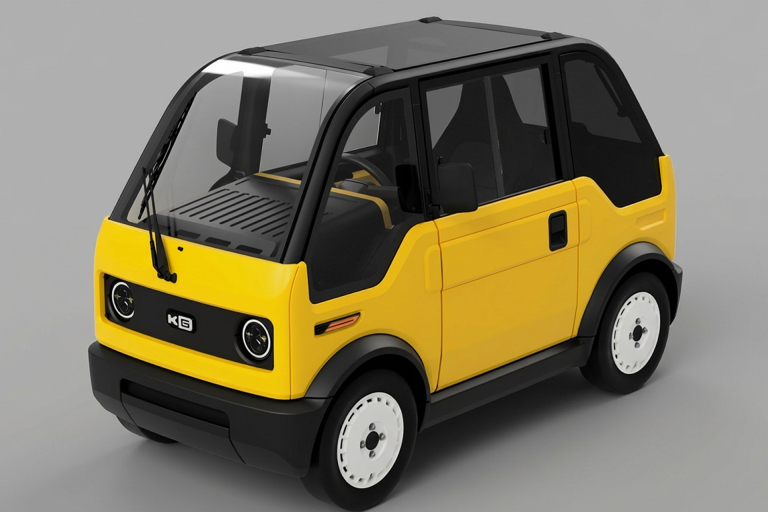
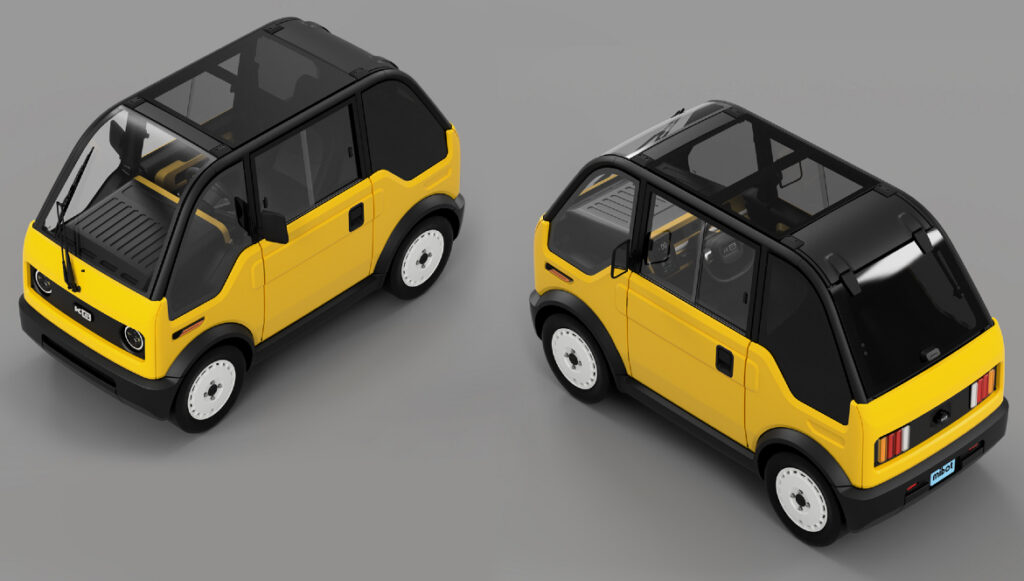
KG Motors’ mibot is an ultra-compact, single-seat EV designed for everyday short trips in Japan’s regional cities where declining public transit is increasing reliance on cars. Autodesk Fusion was used to design nearly 80% of its hundreds of in-house parts and helped the startup reduce part counts, minimize design time, run simulations, create assemblies, and collaborate across locations.
In regional cities across Japan, public transportation is in decline due to shrinking resident populations and the closure of small and medium-sized local shops. As a result, people have no choice but to rely increasingly on cars, which are a costly mode of transportation.
Elevate your design and manufacturing processes with Autodesk Fusion
According to Japan’s Ministry of Land, Infrastructure, Transport and Tourism, approximately 70% of local travel by car covers distances of 10 km (about 6.2 miles) or less. On weekdays, nearly 80% of trips are made by a single occupant. mibot is designed as an ultra-compact vehicle specifically tailored for these everyday “short trips.”
Founded in 2022, KG Motors envisions a future solving these challenges with mibot, their single-occupant, ultra-compact EV. The resulting specifications define it as a moped-class mini-car. It seats one person; has a range of 100 km (62 miles) and a top speed of 60 km (37.3 mph); and can be driven with a standard driver’s license. Since it can be charged using a standard 100-volt household outlet, no dedicated charging equipment is required. With a low price of 1.1 million yen (about 7,000 USD) and no need for vehicle inspections or certificates, both the initial purchase and ongoing maintenance costs are kept to a minimum.
“It all started because Kure City in Hiroshima Prefecture—the hometown of our president, Mr. Kusunoki—is a place with narrow roads and many steep hills where even kei cars struggle,” says Masayuki Kubo, manager of the Vehicle Development Team in mibot’s Development Department. “We wanted a vehicle that could be used freely there.”
“We focused on single-seaters, eliminating unnecessary features and keeping the price as low as possible to make them accessible to everyone,” he continues. “We decided that simply modifying the exterior of parts sourced from overseas wouldn’t meet our standards for quality or flexibility, so we decided to manufacture everything in-house.”
“We decided from the outset to go with a symmetrical design,” says Takashi Okamoto, a designer at KG Motors. “Given the need to create such a unique package and the cost considerations, we chose to build it from scratch. Since the dimensions and intended use were already set, we adopted an attractive design for this new form of mobility while taking into account factors such as the vehicle’s proportions, ease of driving, and ease of getting in and out.”
Designing hundreds of automotive parts with Fusion
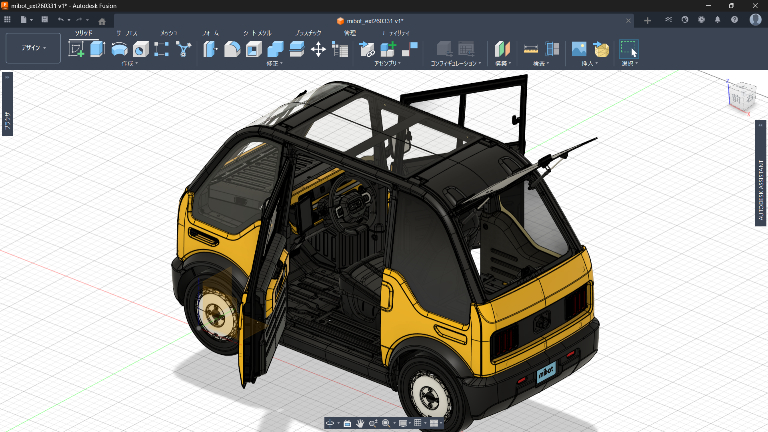
Nearly 80% of its hundreds of parts were designed in-house. Except for a few outsourced components and the frame, almost all of them were designed using Autodesk Fusion.
Okamoto had been using Autodesk software such as Alias and Maya at an automotive manufacturer and Fusion on his own for some time. Since KG Motors also used Fusion, he says it was a natural choice. He adds that it also aligned with the company’s strategy of reducing the number of parts and minimizing design hours to keep costs down.
Another unique aspect of this project is that updates on the development of the mibot are regularly shared on YouTube and social media, which is a departure from traditional automotive development. The team’s enthusiasm in these updates is generating excitement within the customer community. “Our YouTube channel had been attracting attention for some time,” Kubo says.
“Judging by customer feedback, people appreciate mibot’s cuteness and impact at first glance, as well as its price point,” Okamoto says. “I think our strength lies in the fact that we were able to position it as something with a different value proposition from other vehicles.”
Elevate your design and manufacturing processes with Autodesk Fusion
Rapid development made possible with the cloud
With any design of this magnitude, changes are always a reality. “Normally, the process is divided into stages such as planning, design, engineering, prototyping, and production, but here, everything is happening simultaneously,” says Okamoto. “Since everything—including marketing—is truly being carried out in parallel, requirements can change from one day to the next. There’s never a moment when we can just ‘lock things down.’”
“The biggest change we’ve seen recently was adjusting the angle of the instrument panel. We decided to raise it by 15 degrees, which required significant modifications,” Kybo says. “We’re constantly making updates as we go, keeping an eye on various factors and being flexible. This is a pace of development that would be impossible in a typical production line setting. I feel it’s something unique to a startup.”
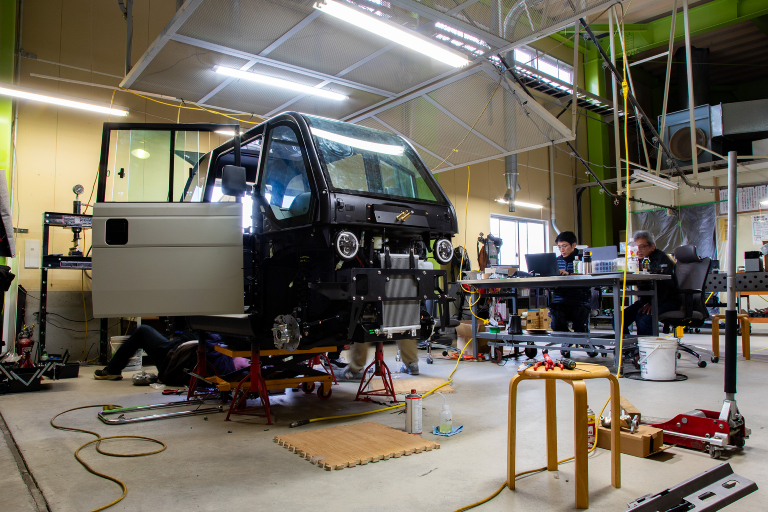
“In a large company, once each department gets up and running, I think it’s quite difficult to change course,” Okamoto adds. “Here, though, when we say ‘department,’ we’re talking about just one or two people. We can be very agile.”
Experiencing the benefits of Fusion
Currently, KG Motors employs a total of about 50 people, with 17 core staff members. In addition to the 6–7 members in the design department, approximately 22 employees—including those in manufacturing and manual authors—use Fusion. Cloud-based collaboration supports their work, which takes place in various locations such as the headquarters in Hiroshima, the development center in Hamamatsu, and their homes.
“As for data management, we started by establishing some general rules and have been refining them as we explore what Fusion can do, but the system is operating smoothly,” Kubo says.
“I think people tend to imagine that automakers use high-end CAD software, but with a startup’s budget, we simply can’t afford to spend that much money on it,” he continues. “Fusion is incredibly affordable with the features it offers, so I think that’s a major advantage. We also perform simulations such as static stress analysis in-house. Since it allows us to design, analyze, and assemble, it’s more than sufficient for a company of our size.”
KG Motors also uses Fusion as the basis for their work with partner companies and suppliers.
“If they’re using different software, we import the data into Fusion,” Kubo says. “Since overseas suppliers often handle tasks like mold manufacturing, we create the part geometries in Fusion and send them over. Sharing 3D data speeds up the process, keeps costs down, and ensures a high level of technical expertise.”
Fusion’s rendering capabilities are also being utilized in a variety of situations.
“Personally, I started using Fusion with its rendering features,” Okamoto says. “Fusion’s rendering produces very realistic results. We use it on the KG Motors website, and I think it’s more than sufficient for internal presentations as well. As long as you set up the HDR background images and lighting, I believe you can achieve quite impressive results.”
From prototyping to mass production
After the design of the prototype vehicle was completed in Phase T2, component assembly began in September. During this process, evaluations were conducted to verify that all issues identified up to Phase T1 had been properly resolved. Since all development goals regarding reliability and functionality were met, the development phase was completed, and preparations for mass production began.
Pre-orders for the mibot, which began in August 2024, surpassed 1,000 units in just one month. Last year, cumulative orders had exceeded 2,200 units, reflecting growing interest and demand for this commercial mobility solution. The vehicle has been designed with a strong focus on comfort and safety; while the ultimate goal is to achieve collision safety performance on par with the ultra-compact mobility category, which is a step above mini-cars. mibot is also scheduled to be equipped with air conditioning and heated seats.
Sales began in the fall of 2025, with 300 units produced by the end of that year using mass-production parts. In 2026, the production line at the Mibot Core Factory in Hiroshima—the company’s main base—is scheduled to begin operations, marking the start of full-scale mass production. Furthermore, production is set to expand to 10,000 units in 2027, and the company plans to continue its rapid evolution by developing autonomous driving capabilities for MaaS.
Developed as an SDV (Software-Defined Vehicle), the mibot is a connected car that continues to evolve through software updates even after it leaves the factory. It features a range of capabilities designed to transform personal mobility into an entirely new experience, such as learning from and optimizing based on user behavior.
“Our first goal is to establish a strong presence in Japan and effectively address the challenges faced by regional cities,” Kubo says. “Once we have established a successful track record here, we plan to expand overseas.”