 Andrew Collier
AI in water utilities is no longer a future concept – it is already influencing how infrastructure is managed, how investments are prioritized, and how operational decisions are made. But the biggest impact is not the technology itself. It is how organizations choose to redesign work around it.
Something stood out to me while I was attending a recent water industry event. It wasn’t excitement about AI among the crowd – it was a shift in how AI is being talked about.
It had taken me three days to get from the US to London – courtesy of a Northeast blizzard – and I was ready for some good conversation. The Digital Water Symposium in London brought together a room of operators, engineers, and leaders grappling with a shared reality: the challenges facing water utilities are no longer isolated – they’re converging.
The conversations in the room were grounded and pragmatic, which felt appropriate given the environment in which water utilities are operating today. The pressures are immediate and interconnected. AMP8 and PR24 are shaping delivery expectations and financial flexibility (see AMP8 period: An important inflection point for the UK water industry). Performance commitments are influencing investment decisions. Public trust is affecting regulatory posture. At the same time, workforce constraints and climate volatility continue to add strain.
AI is entering this landscape not as the primary challenge, but as something that is reshaping how utilities approach asset management, capital planning, and operational decision-making. The use of AI in water utilities is already being applied across areas like predictive maintenance, leak detection, and network optimization. It is influencing how decisions are made, how expertise is applied, and how oversight is maintained.
Framing it as just another technology upgrade doesn’t quite capture what’s happening. It is better understood as a shift in how work gets done. And importantly, that shift is not driven by technology alone. AI does not redesign work on its own. Leadership does – through how these capabilities are applied, governed, and embedded into everyday operations.
A consistent set of challenges
What stood out in London – and what continues to come up in conversations more broadly – is that while the regulatory context varies, the underlying challenges are remarkably consistent.
Utilities are navigating:
- Aging infrastructure and increasing capital demands
- Constrained budgets and regulatory scrutiny
- Workforce shortages driven by retirements and skills gaps
- Climate volatility and resilience requirements
In that context, the question isn’t whether AI matters. It’s how to begin.
For many organizations, the reality is limited budget, limited bandwidth, and no obvious place to start. That’s precisely why this is a leadership conversation. Progress depends less on access to technology and more on the ability to create space – organizationally and operationally – to start with something focused and build from there.
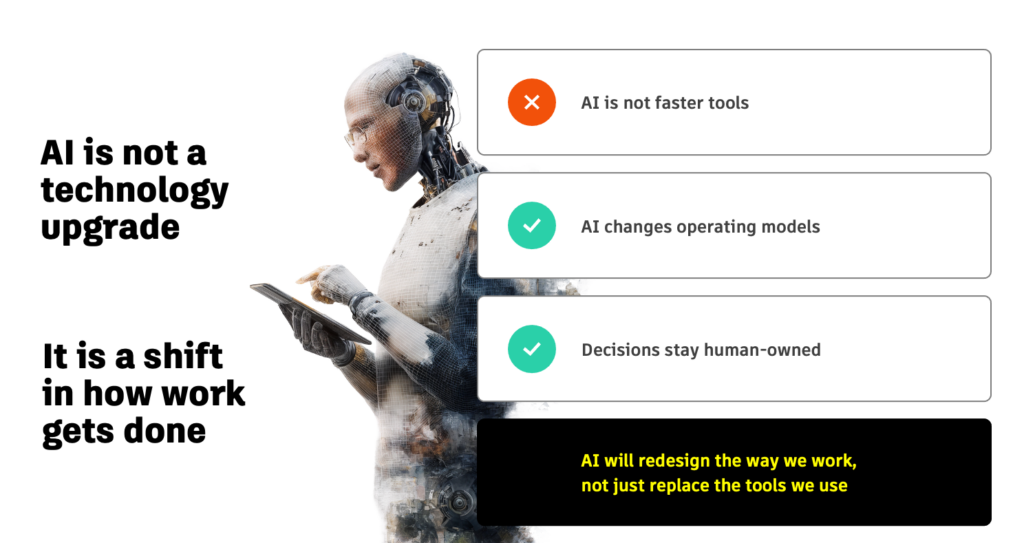
AI is changing operating models, not just tools
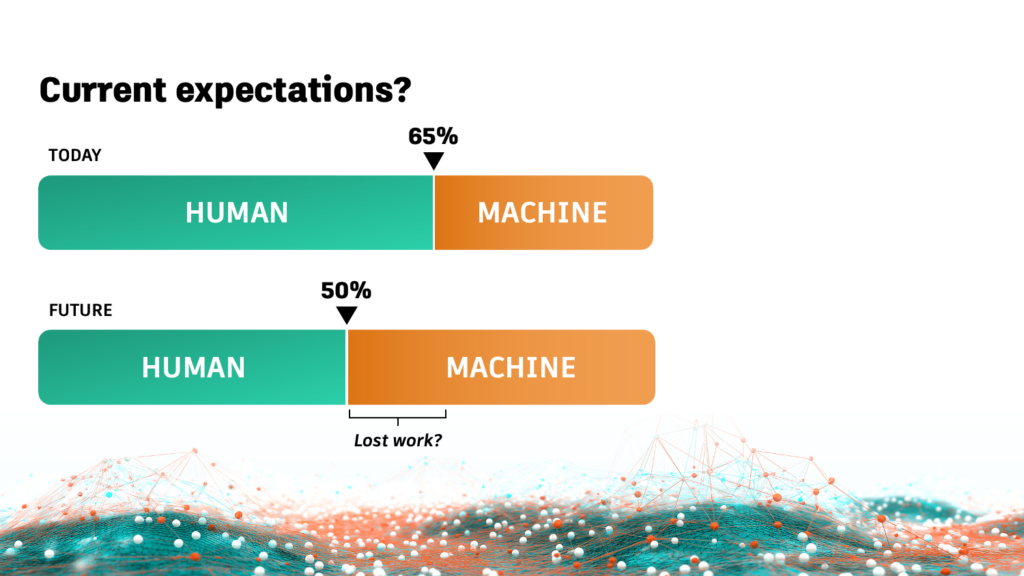
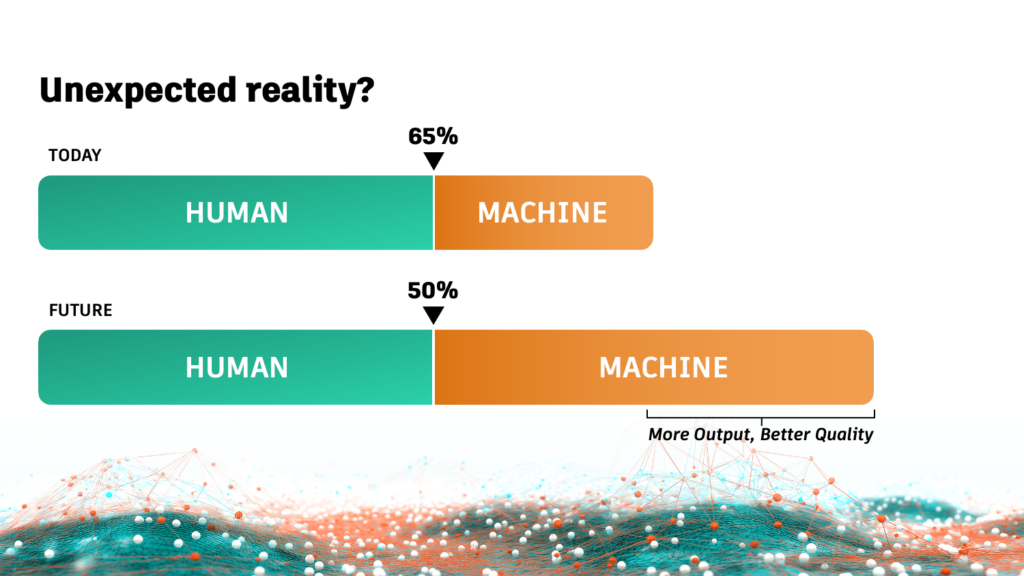
A useful way to think about this is through a familiar example. Not far from where the Symposium was held, the world’s first ATM was introduced in 1967. At the time, the expectation was that automating cash dispensing would reduce the need for bank tellers. Instead, teller employment increased. Banks opened more branches because they were cheaper to operate, and the role of the teller evolved toward customer advisory work.
The job didn’t disappear; it changed in ways that made it more valuable.
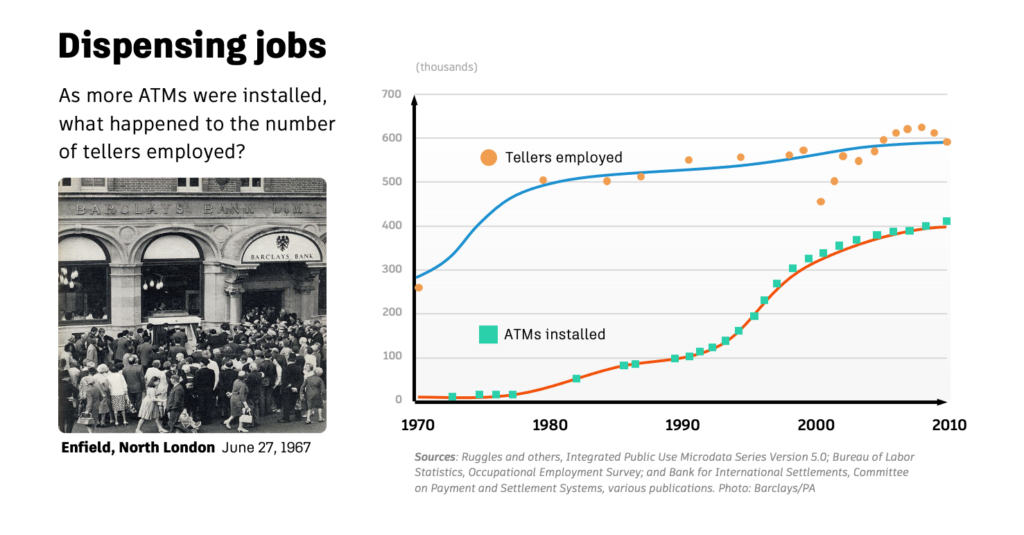
A similar pattern is starting to emerge in the water industry, although the outcome depends on how deliberately organizations approach it.
AI is not simply introducing faster tools. It is changing operating models – how decisions are made, how work is distributed, and how expertise is applied. Importantly, decisions remain human-owned, but they are increasingly supported by systems that can apply logic more consistently and at greater scale.
From escalation to judgement at scale
Take the role of a director of asset management. In many utilities, this is a person with deep institutional knowledge. They get pulled into complex, high-stakes decisions around asset rehabilitation, failure risk, and long-term investment planning. Today, much of that expertise is applied manually, case by case.
Over time, there is an opportunity to encode aspects of that judgment into agentic systems, applying it more consistently across an entire portfolio. That doesn’t replace the role. It shifts it.
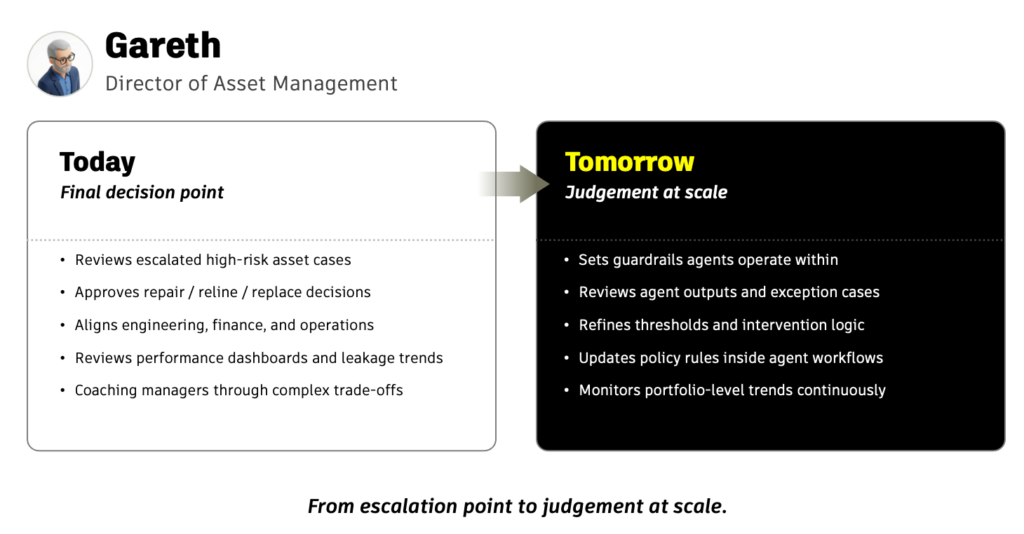
What we’re starting to see is a move:
- From escalation points to judgement at scale
- From reviewing every case to reviewing exceptions
- From making decisions individually to shaping how decisions are made
Fueled by AI, leaders will spend less time acting as the point of escalation and more time defining decision frameworks, setting guardrails, and focusing on longer-term priorities.
Reimagining how work gets done
This shift becomes clearer when you look across roles.
For a capital program manager, a significant portion of the job today is spent gathering and reconciling information across departmental silos:
- Asset history and condition data
- Cost estimates and financial inputs
- Engineering assessments and trade-offs
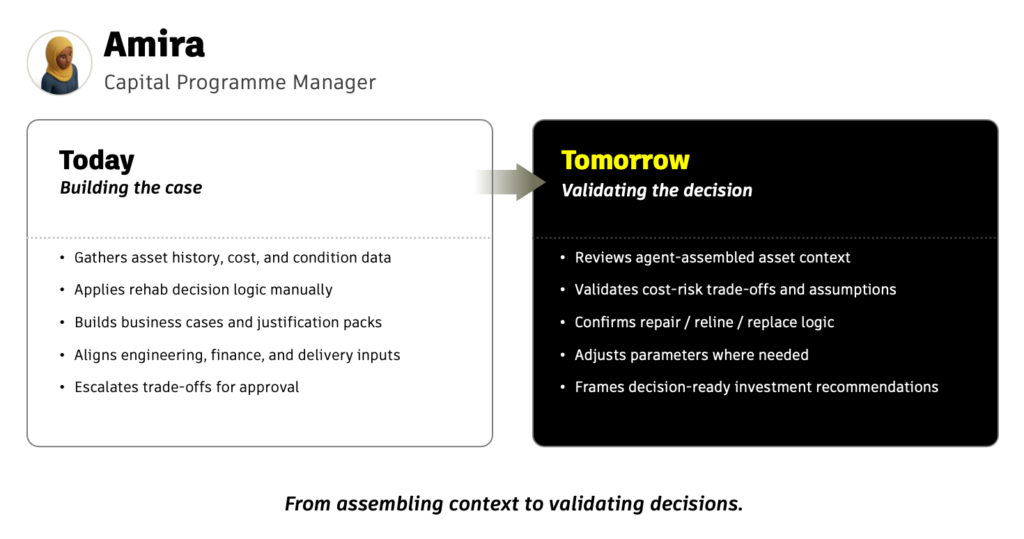
It’s necessary work, but often below the level of their capability. As that coordination becomes more automated, the focus moves toward:
- Validating insights and assumptions
- Testing cost-risk trade-offs
- Framing decision-ready recommendations
In this way, the role is elevated – like our bank teller – and moves from repetitive, tedious tasks to decision validation.
At the same time, external intelligence providers – such as IoT analytics partners – are also evolving. Instead of delivering standalone dashboards that teams must interpret and integrate manually, their insights are increasingly embedded directly into workflows. Data flows into the tools teams already use, becoming part of a continuous, decision-making process rather than a disconnected input.
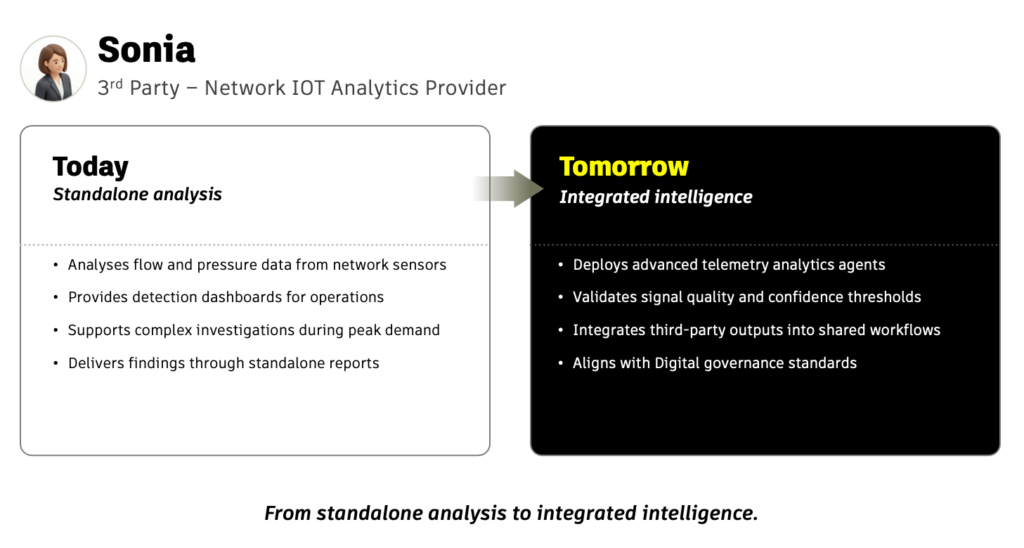
Taken together, this is what an agent-enabled operating model looks like: expertise scaled through systems, data flowing across silos, and humans focused on validation, exceptions, and accountability rather than aggregation.
Where this is already happening
This isn’t theoretical. Across the industry, utilities are already applying AI and machine learning to real operational challenges, from forecasting treatment plant performance to improving asset reliability using sensor data. Advances in hydraulic modeling and digital twins (as part of the broader shift toward digital transformation in water infrastructure), allow utilities to simulate network behavior and test interventions before acting in the field.
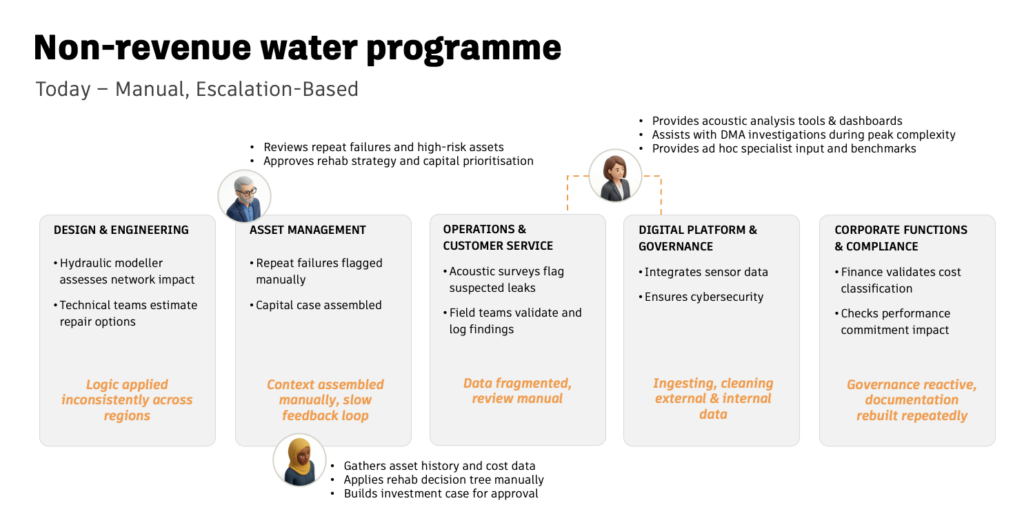
You can see it clearly in areas like non-revenue water (NRW).
Historically, this has been a fragmented and reactive process:
- Data assembled manually across systems
- Decisions escalated case by case
- Governance rebuilt repeatedly
- Limited consistency across regions
What’s emerging is more structured.
Data is connected across systems. Context is assembled automatically. Analytical tools help identify and prioritize interventions. And instead of reviewing every asset, teams focus on validating high-confidence recommendations and managing exceptions.
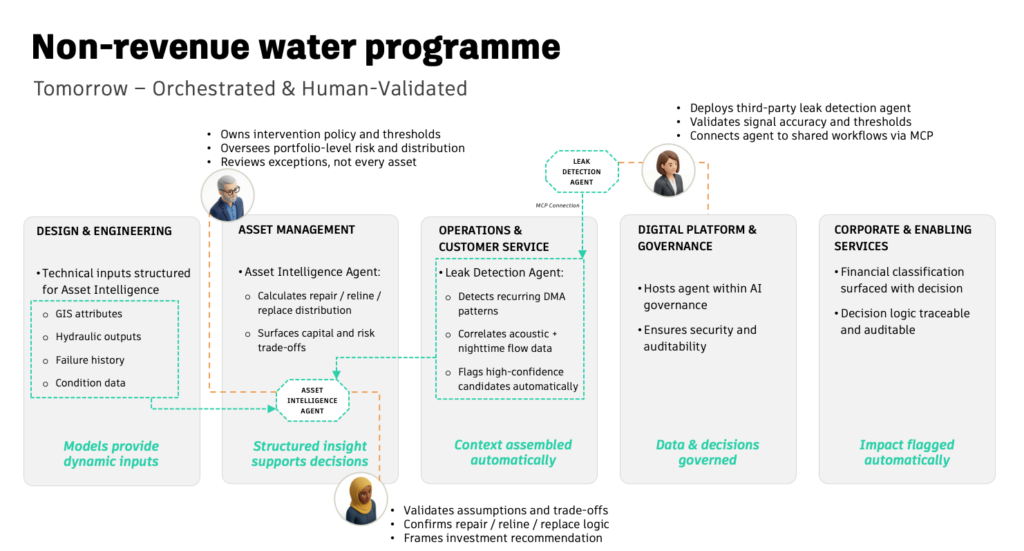
The shift is subtle but important: from manual, escalation-based work to orchestrated, agentic-driven workflows that are still human-led, but more consistent and scalable.
Why data and systems matter more than AI
These kinds of changes only work if the underlying systems support them.
AI layered on top of disconnected data and siloed workflows does not materially improve outcomes. For decision-making in areas like non-revenue water reduction, capital investment planning, or network reliability, data needs to move across planning, design, delivery, and operations in a way that is connected, traceable, and governed.
This is where many utilities are now focusing their efforts – not just on adopting AI, but on building the digital foundation that allows it to be applied meaningfully. More broadly, this aligns with the industry’s ongoing shift toward digital transformation in water infrastructure.
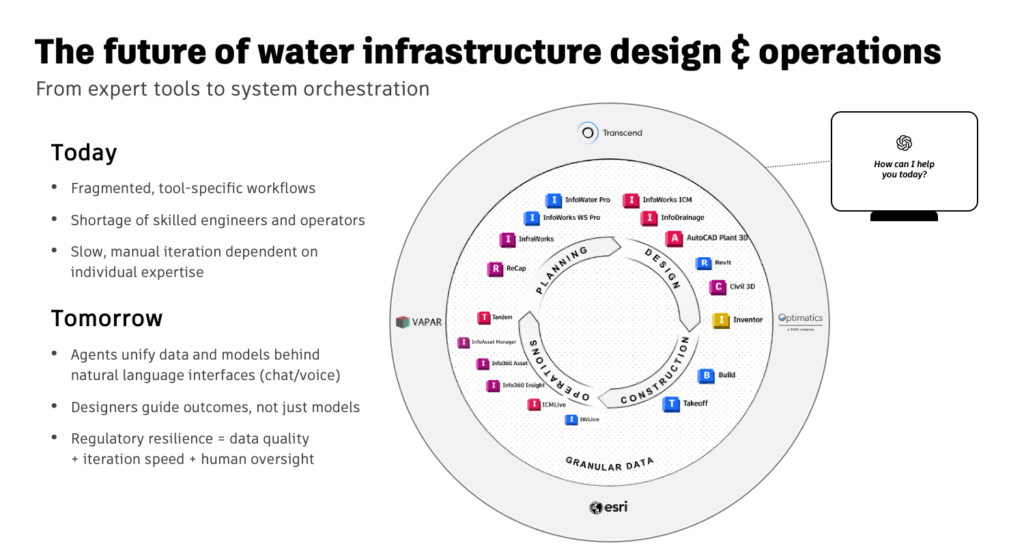
It also reflects a broader transition, away from collections of expert tools and toward more orchestrated workflows that connect data, models, and teams across the lifecycle.
Leadership in an AI-enabled utility
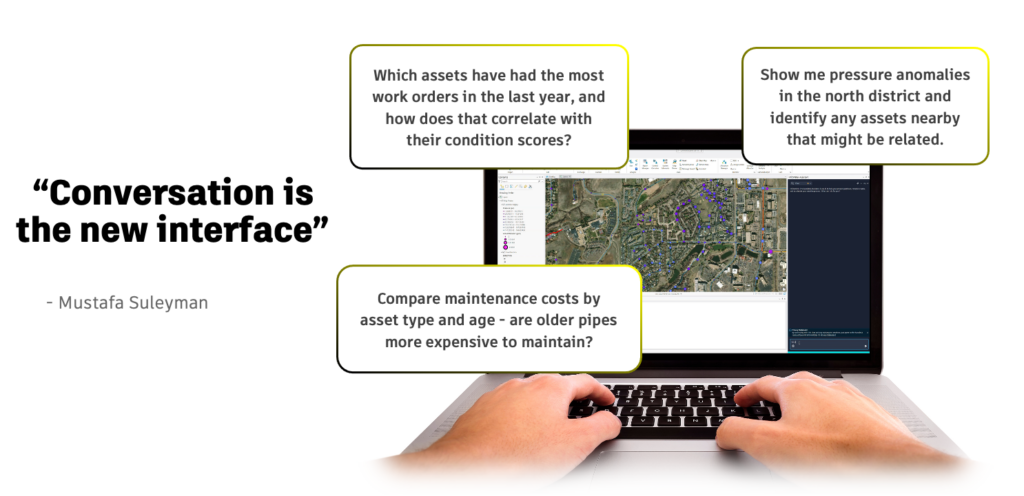
As systems become more connected, the way people interact with them begins to change. Instead of navigating multiple dashboards and files, interaction increasingly starts with a question and leads to structured, explainable outputs that draw from across the lifecycle.
In a regulated environment, that shift comes with clear requirements. It’s not enough for a system to provide an answer quickly; it needs to show how that answer was derived. In an AMP8 context, where performance is closely tied to funding, decisions need to be defensible as well as efficient. Transparency and auditability are not secondary considerations – they are fundamental.
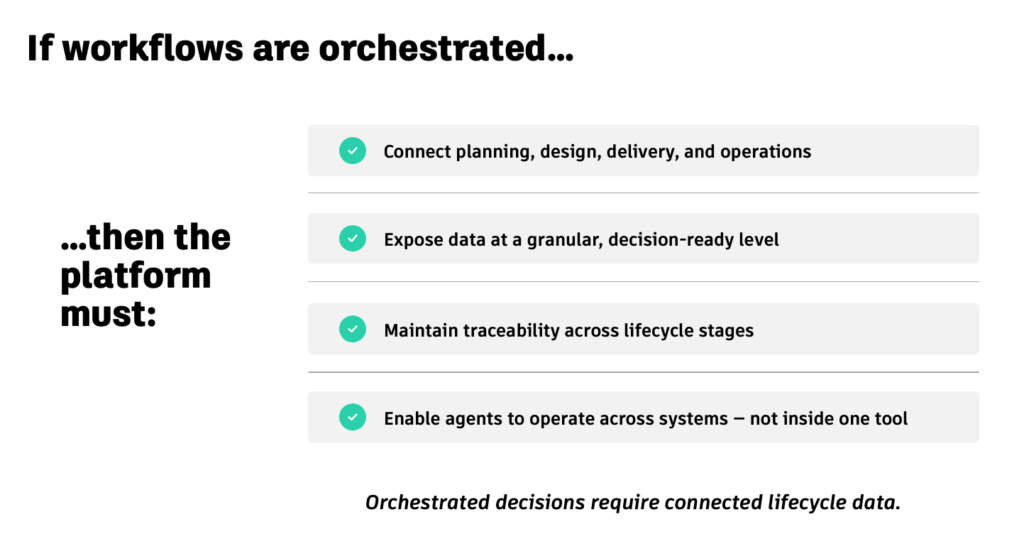
One of the clearest themes from the Symposium was that organizations making real progress are not starting with AI itself. They are investing in the conditions that allow it to work effectively:
- Integrated data environments
- Connected workflows
- Governance models that ensure trust
When those pieces are in place, AI becomes significantly more valuable because it operates within a system designed for consistency and accountability.
There is also a shift in what leadership looks like in this environment. Leaders are not only managing people but also shaping the agentic systems that carry decision logic. They are defining how those systems operate, validating outputs, and ensuring they remain aligned with organizational goals.
It’s not less work; it’s different work. And it requires a more intentional approach.
Where to start
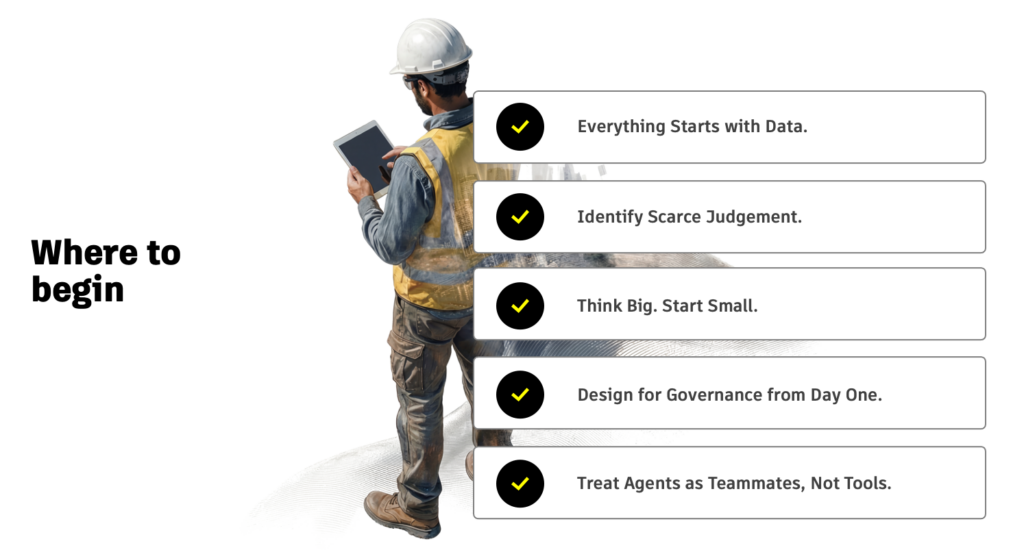
For utilities considering how to move forward, the starting point is not the technology itself. In practice, progress often begins with a few focused steps:
- Identifying where decisions depend on scarce expertise
- Starting with a specific workflow or use case
- Establishing a common data environment
- Designing governance in from the outset
For many organizations, the most important step right now is simply to begin the conversation, aligning around how work should evolve in an environment where AI is increasingly embedded.
The path forward
Stepping back, this is part of a longer evolution in how the industry uses technology. And reflects the multi-decadal transformations we’ve seen at Autodesk.
CAD digitized drawings. BIM introduced structured digital models. Connected BIM enabled collaboration across teams. The next phase builds on that foundation – where models are not just representations, but continuously updated decision systems.
AI accelerates that progression by helping surface trade-offs, risks, and options earlier in the process. That, in turn, changes how projects are approached – allowing organizations to evaluate options against outcomes like compliance, reliability, cost, and resilience earlier in the lifecycle.
Final thoughts
AI does not, on its own, redesign work. That responsibility sits with leadership.
The organizations that will benefit most are not necessarily those that adopt it first, but those that are deliberate in how they redesign work around it – using AI to extend human judgment while maintaining accountability for outcomes.
From what I saw at the Symposium, there is a clear recognition of that challenge, and a growing alignment around how to address it. That is what will ultimately shape how the sector moves forward – and where technology, when applied thoughtfully, can play a meaningful role.