 Trevor English
Across the GCC and wider MENA region, utilities, municipalities, and engineering consultancies are accelerating investment in hydraulic modeling, stormwater management, flood resilience, and wastewater infrastructure modernization. From Dubai and Riyadh to Doha and Jeddah, large-scale urban expansion and climate-driven rainfall events are increasing pressure on drainage networks, sewer systems, and water infrastructure. Integrated approaches can help.
Across the Middle East, water infrastructure teams are under growing pressure to deliver faster, more resilient drainage and wastewater systems.
But they have additional hurdles.
The region faces some of the world’s most acute water challenges:
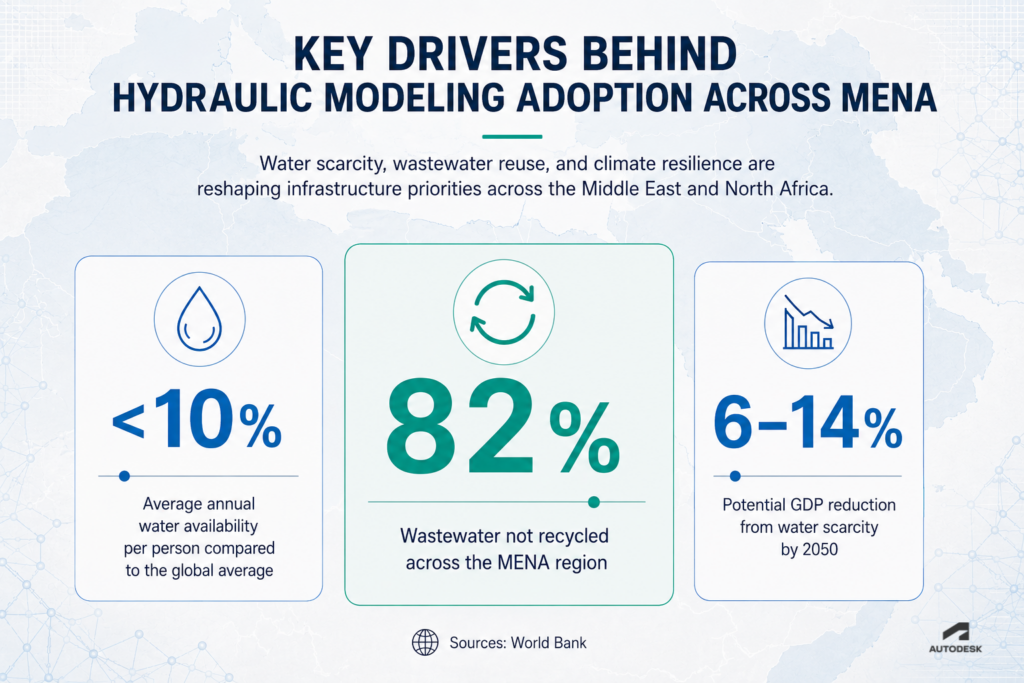
- The Middle East and North Africa has the world’s lowest average annual water availability per person, at less than 10% of the global average.
- According to the World Bank, 82% of wastewater in the MENA region is not recycled, representing a major opportunity for water reuse and resilience.
- The World Bank estimates climate-related water scarcity could reduce MENA GDP by 6–14% by 2050.
At the same time, infrastructure investment across the Middle East and North Africa has accelerated significantly in recent years, driven by mega projects, wastewater reuse initiatives, urban growth, and climate resilience programs.
With record levels of infrastructure investment flowing into the region, water engineers are finding that they need to work faster. Entire cities are being designed and delivered in years, not decades, often without existing systems to build from. That means networks need to work from day one, not just under typical conditions, but under increasingly intense rainfall events.
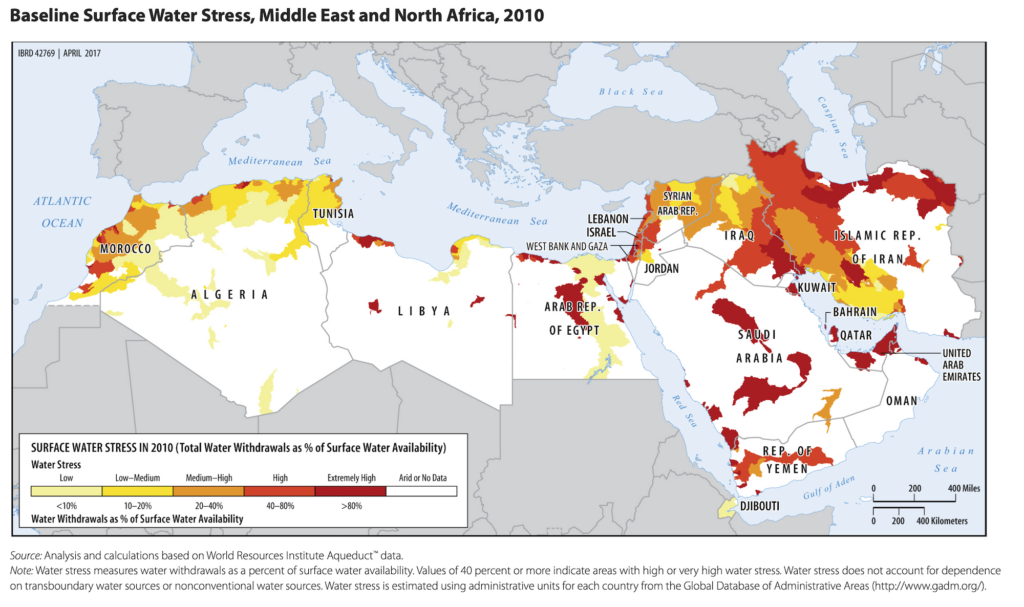
While the average person located outside of the Middle East might assume that this area is a land of constant drought, major cities like Dubai, Jeddah, Riyadh, and Doha are also dealing with flash floods and urban runoff that is far surpassing the abilities of their existing drainage systems.
These recent flooding events across the Gulf have increased attention on urban drainage resilience, flood modeling, integrated catchment management, and stormwater infrastructure performance. Cities that historically focused primarily on water scarcity are investing more heavily in hydraulic simulation and flood resilience planning to better understand how drainage systems behave during high-intensity rainfall events.
Water infrastructure modernization is accelerating digital transformation
With all that investment comes a boom for the firms who compete for the work.
In some areas, engineering teams are technologically leap-frogging older ways of working – moving away from disconnected spreadsheets and adopting cloud platforms, real-time monitoring, hydraulic modeling workflows, digital twins, and advanced analytics to improve predictive maintenance and long-term capital planning. Some are going even deeper by beginning to automate hydraulic modeling workflows using scripting, AI-assisted tooling, and cloud-connected simulation environments.
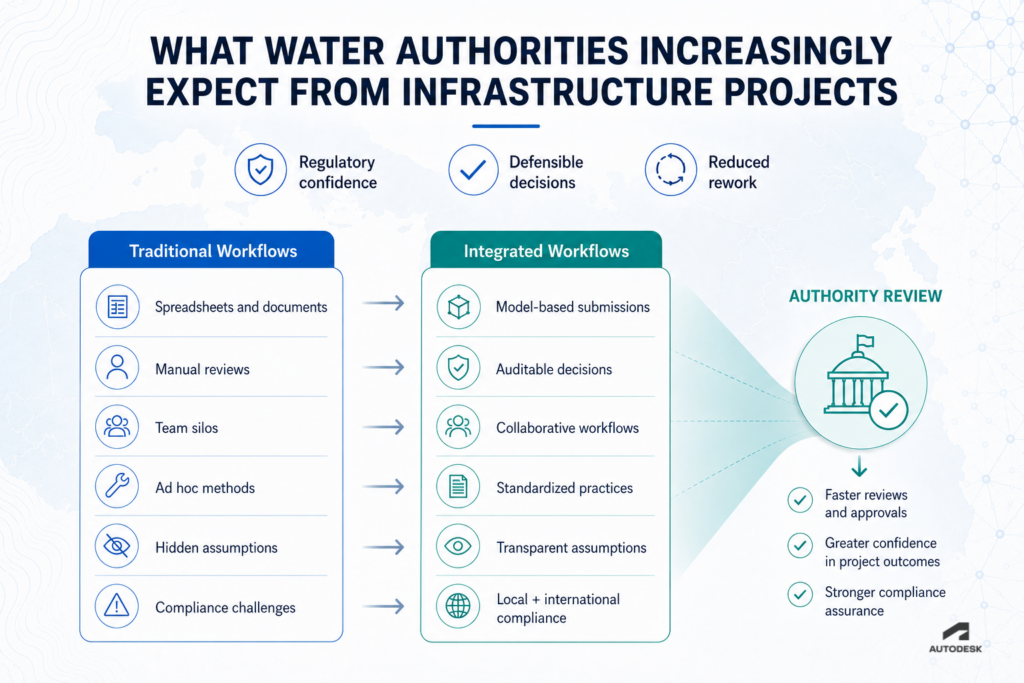
But some reasons for climbing the digital maturity ladder are more pragmatic. Namely, that water infrastructure builders need to comply with a lot of regulations.
Authorities increasingly want to see:
- Model-based submissions with clear hydraulic justifications
- Auditable engineering decisions
- Collaborative digital workflows
- Standardized hydraulic modeling practices
- Transparent design assumptions
- Compliance with local regulations layered on top of international standards
Why traditional drainage and hydraulic modeling workflows are struggling
In this up-leveled environment, traditional workflows begin to fall short.
Designing in one tool and validating in another introduces friction, slows iteration, and makes it harder to respond to change. This is especially true on large infrastructure projects, where a single change in road alignment, flood protection requirements, or network layout can trigger multiple rounds of redesign, hydraulic analysis, and authority resubmission.
For teams working in water network management, the challenge is less about whether a network can be designed and more about how efficiently and confidently it can be delivered. Balancing cost, performance, and resilience at scale requires more than disconnected processes – it calls for a more integrated, holistic approach.
Bringing design and hydraulic simulation closer together
One of the shifts we’re beginning to see is a move toward bringing design and simulation closer together, rather than treating them as separate steps.
With the addition of Network Design in InfoWorks ICM, that connection becomes more immediate, allowing modelers to explore how a network behaves while it’s still taking shape. Instead of designing first and validating later, this is an opportunity to iterate more fluidly. A network can be laid out, design logic applied, and its performance under different conditions explored within the same environment.
When something doesn’t behave as expected – whether that’s localized surcharging or capacity that isn’t being fully utilized – it can be revisited in context, without needing to step outside the workflow.
How Network Design in InfoWorks ICM supports integrated modeling workflows
At the center of this hydraulic modeling approach is a more structured method for preliminary network design.
Network Design applies a constraint-based method for sizing gravity drainage systems, determining pipe diameters and invert levels by evaluating multiple candidate configurations against hydraulic and geometric requirements.
Rather than relying on a single-pass “black box” design process, the workflow considers:
- Slope
- Velocity
- Cover depth
- Flow conditions
- Pipe sizing
- Geometric constraints
Putting all of this together allows you to arrive at a solution that reflects how the system is expected to behave.
Design flows can be orchestrated in different ways depending on the project. They may be derived from rainfall using IDF curves and the Rational Method or introduced directly where flows are already understood. That flexibility can be helpful on large developments, where parts of the network may be evolving at different stages or levels of detail.
Designing large-scale stormwater and wastewater networks with greater transparency
For large-scale sewer and flood networks, where interactions across the system matter as much as individual components, this kind of structured feedback becomes particularly useful. It allows teams to move beyond thinking about isolated elements – and spend more time understanding how the network performs as a whole.
This resonates in the Middle East, where challenges are rarely isolated. A network designed for a new development in Riyadh or Dubai, for example, isn’t just about moving water from one location to another. It’s about understanding how multiple catchments contribute flow during high-intensity events, and how the system responds when pushed beyond typical conditions.
There’s also the question of balance.
Oversizing networks can quietly increase capital costs, while under sizing introduces risks that are far more visible in extreme weather events. Finding that middle ground isn’t always straightforward, especially when working with limited data or evolving requirements. Being able to test assumptions, adjust designs, and quickly see the impact of those decisions can make that process feel more manageable. Within InfoWorks ICM, the network can be created, designed, and assessed within the same environment.
Imagine a new master-planned development on the edge of a growing city. The initial network begins as a concept, routes are defined, key connections established, and early sizing applied. In many workflows, that design would then move into a separate environment for validation, with iteration happening across multiple tools and teams.
Within InfoWorks ICM, that process can unfold differently. The network is created and assessed in the same place. Design logic is applied across the system from upstream to downstream, ensuring that upstream conditions inform what happens further along the network. Multiple pipe options are evaluated, feasible slope ranges are determined, and preferred configurations are selected based on defined constraints and priorities.
Hydraulic simulation then provides immediate insight into performance:
- Areas vulnerable during peak events
- Sections with excess capacity
- Bottlenecks within the system
- Impacts of changing assumptions
Adjustments can then be made and tested again, often without rebuilding or transferring the model between tools. What becomes clear through this process is not just the outcome, but how that outcome was reached.
Design reports capture:
- What options were evaluated
- Which constraints governed decisions
- Where tradeoffs occurred
- Why particular pipe sizes or slopes were selected
The design report captures the decisions behind each element: what options were considered, which constraints governed the result, and where trade-offs occurred. That level of explainability and auditability can make it easier to review, refine, and defend designs, particularly on large infrastructure projects involving multiple stakeholders and authority submissions.
Why integrated hydraulic modeling matters for the future of Middle East water infrastructure
Over time, the design evolves through a more continuous process of refinement, where decisions are informed by system behavior rather than assumptions alone. While this type of automated design is most impactful in early stages, it naturally feeds into more detailed simulation and validation as projects progress.
For teams used to working across separate design and hydraulic modeling environments, this more integrated approach brings several advantages:
- Shorter iteration cycles
- Fewer translation issues between tools
- Clearer links between design intent and network performance
- Faster response to changing project requirements
- More transparent engineering decisions
Bringing design and simulation together within InfoWorks ICM doesn’t necessarily remove the challenges that come with large-scale network design, but it does offer a different way of working through them. It allows decisions to be made with a clearer view of performance, and with fewer compromises introduced by fragmented workflows.
And in a region where scale, speed, and resilience all intersect – and where expectations around delivery continue to rise, that shift is starting to open up new possibilities for how water networks are designed and delivered.
Continue exploring integrated water infrastructure workflows
For many teams, adopting a more integrated approach to network design isn’t something that happens all at once. It often starts with exploring new workflows, testing capabilities on active projects, and gradually building familiarity with how design and simulation can work more closely together.
There are several ways to take that next step:
- Watch the webinar Discover the new game-changing Network Design in InfoWorks ICM to see how integrated hydraulic modeling, automated pipe network design, and simulation-driven workflows can support large-scale stormwater and wastewater infrastructure projects across the Middle East.
- The InfoWorks ICM help documentation provides a deeper look at how Network Design is structured and applied in practice, including the underlying design logic and configuration options.
- For those looking to go further, the InfoWorks ICM Technical Hub offers more detailed guidance, examples, and best practices drawn from real-world applications.
Whether it’s through documentation, technical resources, or conversations with peers working on similar projects, there’s a growing body of knowledge around how integrated network design can be applied effectively at scale.