 Mike Trabold

Asset information has always been critical to successful project delivery and operations. As capital projects grow more complex, keeping that information complete, consistent, and reliable becomes increasingly difficult.
This complexity is especially clear for owner-operators managing multiple projects such as manufacturing facilities, where asset information must meet requirements and standards across building, equipment, and plant systems. Gaps and inconsistencies can slow commissioning and delay the transition to operations.
Engineering service providers (ESPs) face similar challenges when working across different owners, projects, and disciplines. Each client brings its own information requirements, making it difficult to maintain consistent delivery processes. Engineering teams can spend valuable time interpreting requirements, checking deliverables, and rebuilding processes instead of reusing them across projects.
Throughout design, construction, and commissioning, asset information is created and updated across disconnected systems. Changes to equipment specifications or asset properties can be difficult to track, validate, and reconcile.
Even with all the expected deliverables in hand, owners may still struggle to trust the information they need for operations.The problem is not that AEC teams lack asset information. The problem is that too much of it is hard to govern, validate, and trust across the project lifecycle.
Why project and asset information is still so hard to manage
Project and asset information comes from many teams working across different tools, disciplines, and standards. On complex capital projects, connecting that information is only part of the challenge. Teams also need to define requirements, apply consistent standards, and control changes throughout delivery.
Several challenges make this difficult:
- Different requirements and standards. Owners have specific information requirements, while project partners may use different classifications, naming conventions, and data structures. Applying these consistently across teams and projects can be difficult
- Disconnected information. Asset data lives across models, spreadsheets, documents, and other systems, making it difficult to reconcile information and establish a reliable asset record
- Changes are difficult to govern. Designs, equipment specifications, and asset properties evolve throughout delivery. Without clear review and approval processes, teams may struggle to determine which information is current and approved
- Inconsistent validation. Requirements may be defined early, but checking information against them often relies on manual reviews or happens too late to address gaps efficiently
- Uncertain handover. Missing or conflicting information discovered during commissioning or closeout can delay acceptance and leave owners with additional work before operations can begin
These issues create rework, slow acceptance, and reduce confidence in asset information. They also limit its value in operations, where reliable data is essential for maintenance, digital twins, analytics, automation, and AI-enabled workflows.
As projects grow more complex, teams need more than access to asset information. They need confidence that it meets requirements, reflects approved changes, and is ready for use throughout the asset lifecycle.
What better looks like
Better project and asset information management should start earlier. Instead of waiting until handover to discover whether asset data is complete, teams need a governed approach that begins with clear requirements and continues throughout delivery. They need a way to define required information, connect it across sources, and validate completeness before it becomes an operations problem.
In a better workflow, an owner-operator can define asset information requirements at the beginning of a project and apply them consistently across teams and partners. Designers or engineers, especially ESPs can understand what must be delivered without having to rebuild the process for every job. A contractor can align information from models, field data, documents, and O&M sources before closeout pressure begins. And the operations team can receive asset information that is structured, traceable, and ready to use.
Instead of treating handover as a collection of files, teams can manage granular asset information — such as identifiers, classifications, properties, locations, and required deliverables — against the requirements each asset needs to meet.
Better project and asset information is not just collected. It is governed as it is created, connected across sources, checked against requirements, and carried forward in a form that owners and operators can trust.
That is especially important as AEC organizations work toward more connected workflows, digital twins, automation, and AI-enabled operations. Those initiatives depend on reliable underlying data. If asset information is incomplete, inconsistent, or disconnected, teams may struggle to use it confidently in downstream systems.
How Autodesk Datum helps
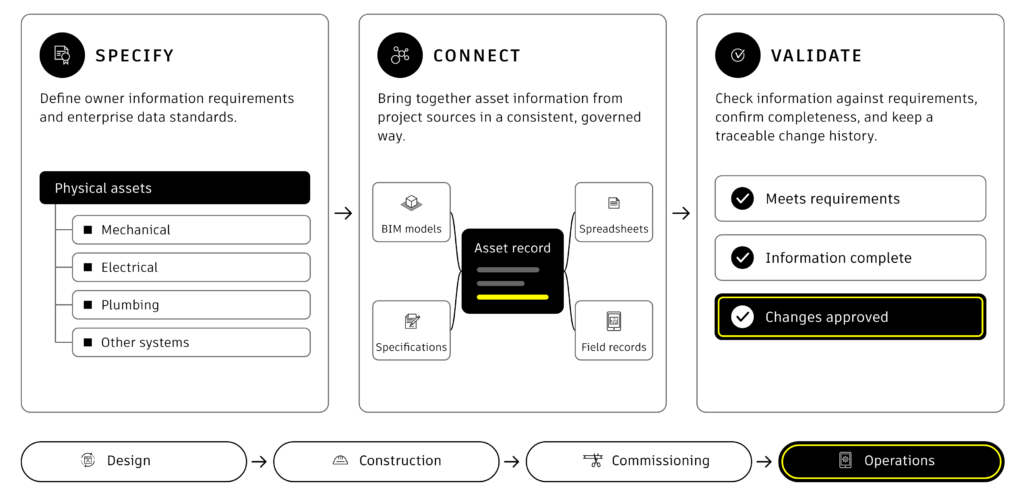
Within the AEC Data Model, Datum supports advanced, configurable project and asset information management workflows, especially for owner-operators and ESPs working on large, complex projects. It helps teams manage governed asset information from design through operations by specifying asset information requirements, connecting data from multiple sources, and validating completeness as a project progresses. Instead of relying on disconnected spreadsheets, isolated files, or late-stage manual checks, teams can work toward one governed record for each asset.
Connected asset information depends on both access and governance. Datum focuses on the governance side of that challenge. It brings asset information together around requirements, organizing it into governed records, validating completeness, preserving traceability, and managing controlled changes through the Engineering Information Change (EIC) engine so teams can review, approve, and track updates with confidence over time. For teams managing advanced project and asset information requirements, Datum helps answer these three questions that are difficult to manage manually at scale.
How are information requirements defined?
Datum helps teams keep owner requirements at the core of project delivery. Datum’s Class Library helps define enterprise data standards and map them to project-level information requirements. As part of the broader AEC Data Model, those requirements connect to a shared foundation for defining what information is needed, when, and by whom across the lifecycle.
This helps teams move away from treating requirements as static documents that sit outside delivery workflows. Instead, requirements become part of how project and asset information is structured, checked, and carried forward.
Where does the information come from?
Datum is designed to connect data from models and structured data sources into a more complete view of each asset. Autodesk’s Asset Information Connector (AIC) allows teams to bring asset information directly from Revit, AutoCAD, Civil 3D, and Plant 3D into Datum, creating and connecting governed asset records as designs evolve. This helps teams structure asset information earlier and maintain consistent standards throughout delivery.
Asset information often lives in many places. It may begin in a model, appear in a spreadsheet, be updated through a delivery workflow, be referenced in documents, or be captured through structured data sources.
Datum is designed to connect data from models and structured data sources into a more complete view of each asset. That helps teams move away from piecing together asset information across disconnected files and systems.
The goal is not simply to store more data in one place. It is to organize the right information around the asset record so teams can understand what each asset is, what information is required, where that information came from, and whether it is ready to support the next phase of work.
Is the information complete and ready to use?
Datum helps teams validate asset information against requirements before handover. By checking project completeness, teams can identify gaps earlier, reduce closeout surprises, and build greater confidence in the data that owners accept. That matters because asset information is not static. Requirements evolve, project data changes, and teams need to understand what changed, when it changed, and where it came from.
Datum also supports traceability through the EIC engine, which helps teams approve proposed updates and track changes across the asset information lifecycle. Together, these capabilities help teams maintain more complete, consistent, and traceable asset information as projects evolve. By managing information against defined requirements and tracking changes over time, Datum helps teams identify gaps earlier and prepare more reliance information for handover and operations.
Practical use cases
Datum can help address challenges in project and asset information for owner-operators, ESPs, and other teams involved in design, construction, and operations.
An owner-operator can define asset information requirements once and apply them consistently across projects and partners. Rather than discovering at handover that information is missing or inconsistent, the owner can work from a governed standard throughout the delivery process.
An ESP can map owner requirements into delivery rules and validate deliverables before client review. This helps reduce the need to reinterpret requirements on every project and can lower the risk of handover bounce-back.
A contractor can align model, field, subcontractor, document, and O&M information around asset records before closeout. This makes it easier to prove turnover while trades are still engaged and able to close gaps.
A project team working across multiple tools can connect asset data from different sources instead of relying on repeated exports, reuploads, and spreadsheet reconciliation.
A digital delivery or platform team can use connected project and model data as part of a governed asset information workflow, helping to ensure that information accessed through APIs is not only available but also aligned with owner requirements and ready for downstream use.
An operations team can receive asset information that is more complete, consistent, and traceable, helping reduce the time spent preparing handover data for operational systems.
From connected data to governed asset information
This series began with asset management because connected AEC data becomes most valuable when it supports real project and asset outcomes. Assets in Forma Build shows how asset information can become more connected and actionable across design, construction, handover, and operations. Datum addresses a related challenge for advanced information-management environments: how to govern complex project and asset information against requirements, validate completeness, and carry trustworthy data forward.
This is an important step in the shift from disconnected BIM files to connected AEC data. When project and asset information is governed, teams can spend less time searching, exporting, translating, reconciling, and rebuilding data at the end of a project. They can spend more time using trusted information to support design decisions, construction delivery, handover acceptance, operations, and future planning.
From here, the series turns to the granular data foundation that supports connected workflows at scale. AEC Data Model APIs help teams access model and project data beyond the file, while Content Catalog helps improve the quality of information created at the source. Together with shared definitions from Parameters Service, these capabilities help Autodesk support a more connected, trusted, and reusable data foundation for AEC.
Bring greater confidence to your project and asset information
Autodesk Datum helps AEC teams specify, connect, and validate governed asset information from design through operations.
Explore how Datum can help your team reduce handover uncertainty, improve confidence in asset data, and prepare more reliable information for downstream use.
Learn more about Autodesk Datum.