 Heather Miller
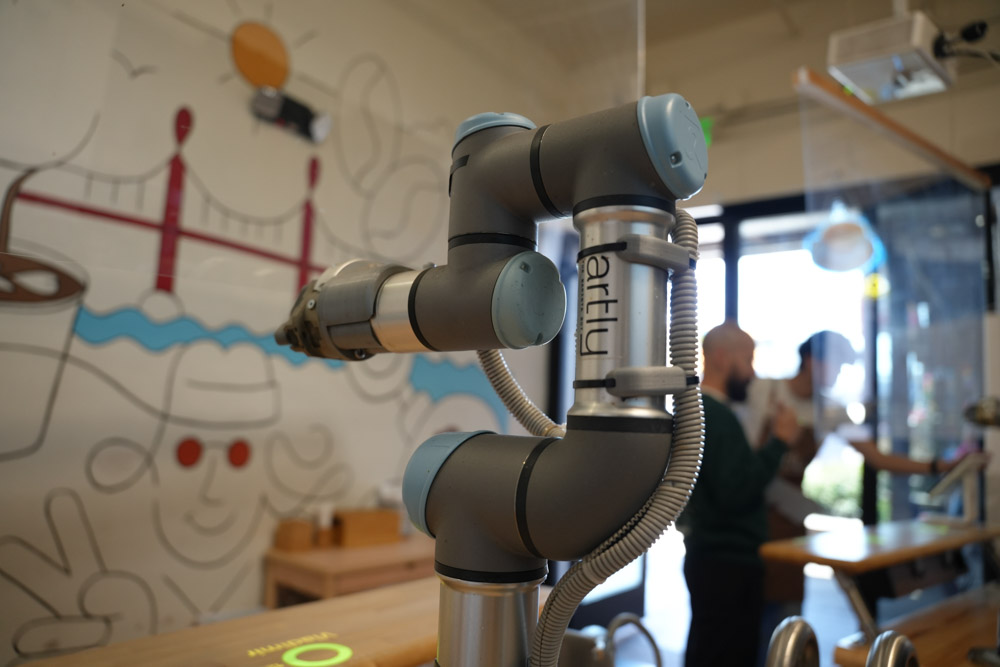
Artly’s Barista Bot is a physical AI-powered robotic coffee system to deliver specialty coffee in locations where a full-service café may not be practical. The team uses Fusion across the design and engineering process, from individual components to the complete robotic system. With Fusion, Artly can rapidly test and 3D print multiple prototypes in a single day, share design changes across the team, and move efficiently from prototype development toward mass production.
Elevate your design and manufacturing processes with Autodesk Fusion
Cream or sugar? Over the years, the simple cup of brewed coffee has certainly evolved. Specialty coffee is now a mainstay, whether it’s a cappuccino, latte, flat white, you name it. According to the National Coffee Association’s Specialty Coffee Report, 46% of American adults had espresso-based beverages in the past day, up 84% since 2011 and surpassing past-day traditional coffee consumption (42%).
“The United States is in the third wave of coffee,” says Meng Wang, co-founder and CEO, Artly. “The previous wave was led by big chains like Starbucks. Now we call it commercial coffee. But people are becoming increasingly unsatisfied with the quality of coffee at chain stores. They are really loving this next wave of specialty coffee.”
But sometimes you can’t always get that quality caffeine fix. In many locations, offering a true specialty coffee experience is simply impractical. Think doctor’s offices, banks, airports, hospitals, corporate offices, and retail stores where space constraints, inconsistent foot traffic, or long operating hours make it difficult to sustain a full-service café. As a result, these environments often have to settle for the next-best options: vending machines or self-serve coffee pots.
Artly has developed a solution that helps bring specialty coffee everywhere. The company has captured the craftsmanship and domain knowledge of a champion barista to deliver a high-quality, reliable, and engaging coffee experience where space is limited and standards are high. Artly has taken physical AI from research to reality, generating $7M+ in revenue across 40+ real-world deployments with customers such as NVIDIA, Microsoft, and MUJI. And they envision the Barista Bot as the first step in a much longer learning journey for their physical AI platform.
A caffeine jolt of innovation
Artly’s first commercial application was a bit of serendipity. Founders Meng Wang and Yushan Chen had already been hard at work building a physical AI platform. They didn’t realize it would soon become a barista.
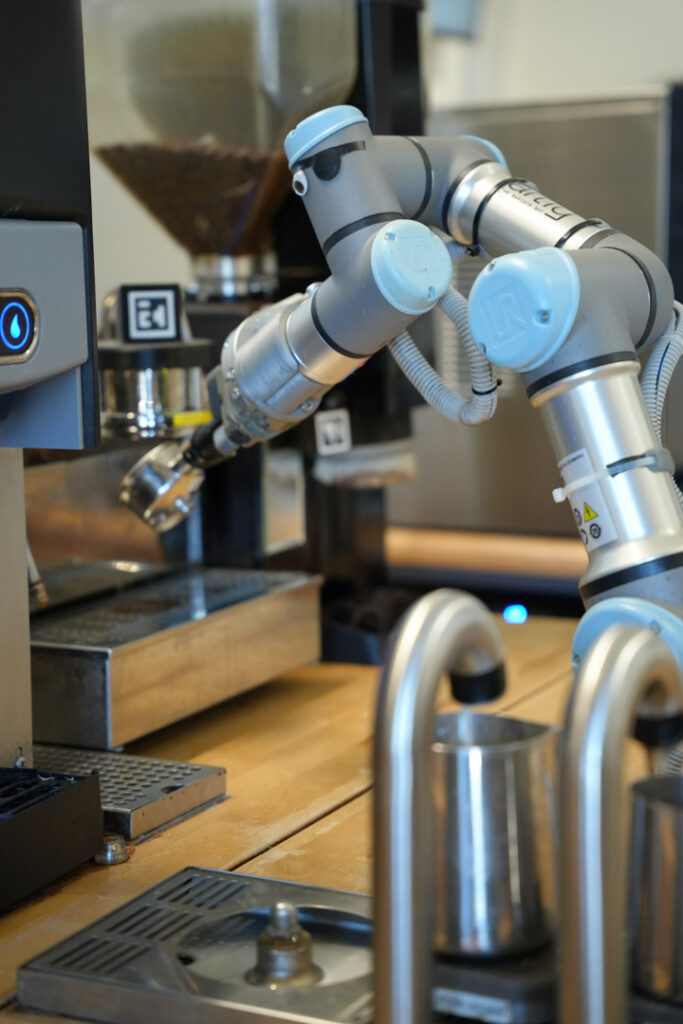
During the pandemic, Joe Yang, a specialty coffee professional and multi-year coffee champion, couldn’t find baristas to staff his establishments. He asked Wang and Chen to build a robot that could help. This simple request brought the market, technology, and mission together in one place, resulting in Barista Bot and Artly AI as the software powering it all.
Yang’s expertise helped train the Barista Bot. He wore gloves with motion trackers on his arms, while trackers were also placed on objects he handled. A body-mounted camera recorded the objects and environment from his point of view. Through that process, Barista Bot could learn both how an action is performed and determine whether it was done correctly.
Designing the Barista Bot with Fusion
Although Artly’s founders had extensive experience in software and AI with many years working for AWS AI services and an acquired AI startup, they entered robotics with limited hardware design expertise.
“We are a team of software or AI engineers,” Wang says. “Hardware design is not our forte. We know that traditional 3D modeling tools are very hard to use and normally take years to master. After trying Fusion with some online tutorials, I realized, ‘Hey, this is something I can do’ and picked it up really quickly. We all found it a very easy way to try different types of designs.”
Artly uses Autodesk Fusion across the design and engineering process, from individual components to the complete robotic system. The team has designed scales, grippers, robotic fingers, cable harnesses, plastic accessories, stainless-steel pieces, and aluminum components with Fusion.
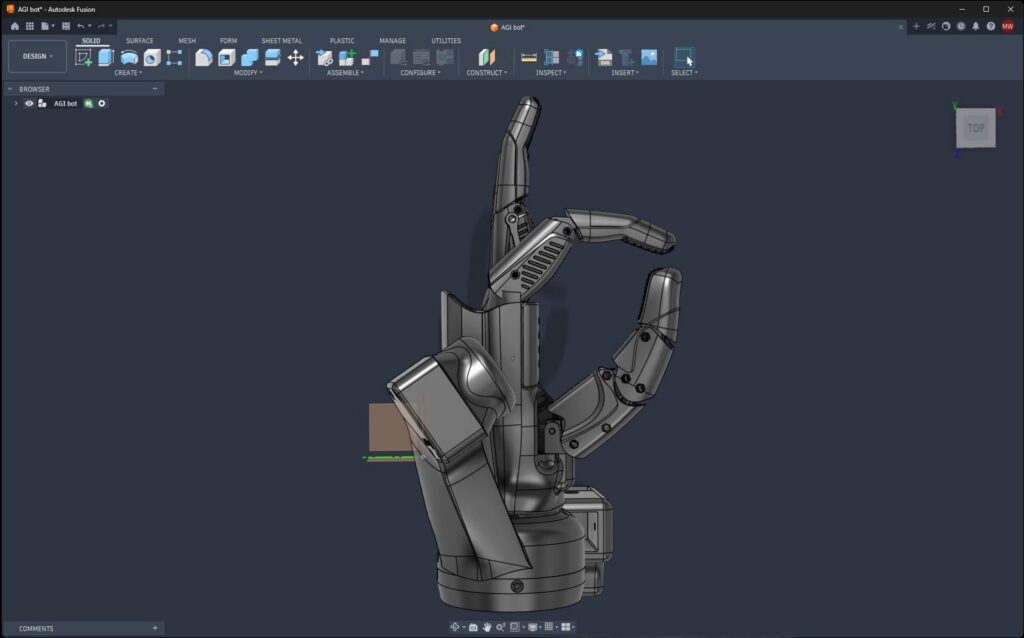
“We design everything in Fusion from component level all the way to the system level,” Wang says. “We just want to get a design that works and move on to the next task. We don’t have time to spend learning and using SolidWorks.”
One of Fusion’s most important benefits for Artly is the speed at which the company can iterate.
“We do tons of iterations for each part,” Wang says. “With Fusion and 3D printing we can iterate hardware components really, really fast. For certain components like the cup gripper, we had hundreds of iterations. Traditionally this cadence is unthinkable. But, with Fusion and 3D printing, we can do multiple iterations within a day.”
Elevate your design and manufacturing processes with Autodesk Fusion
Collaboration and productivity across the team
Fusion also supports collaboration among four Artly team members. Rather than exchanging disconnected files or waiting for someone to manually share the newest version, the team can work from shared projects and access design changes.
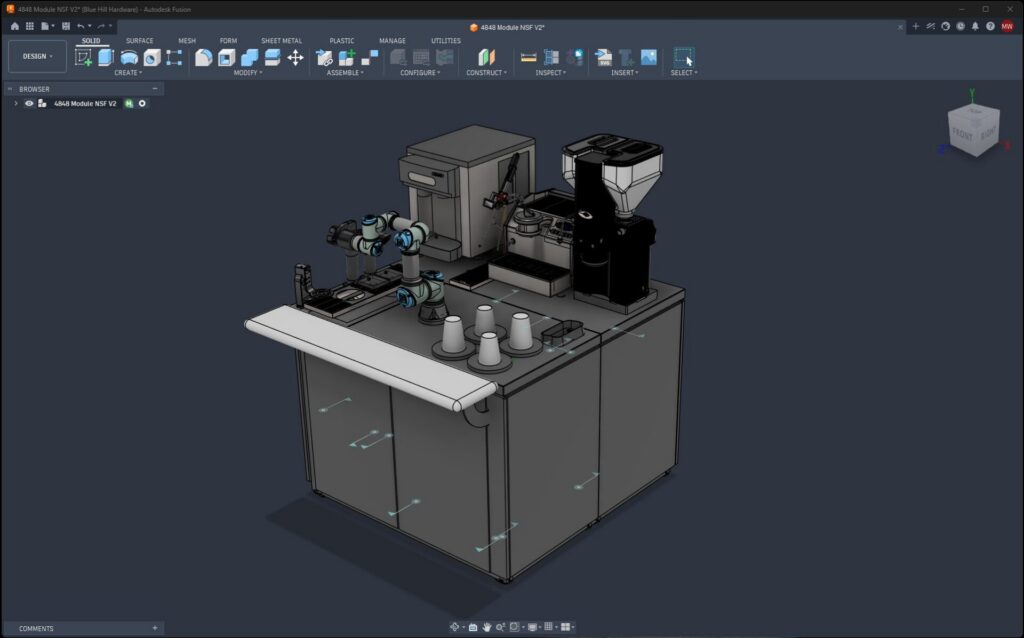
“If I update a feature or a design, another team member will pick that up almost immediately,” Wang says. “It makes our jobs so much easier with sharing and collaboration in Fusion.”
And it isn’t just the software that’s helping. Wang can’t imagine his own productivity without 3Dconnexion’s Spacemouse.
“Spacemouse is such a great tool to accelerate the design and visualization,” he says. “It is a perfect tool when you’re working in Fusion.”
From prototype to mass production
Artly is now preparing Barista Bot for mass production. The team is currently working through NSF certification requirements, selecting appropriate materials, and coordinating with manufacturing partners to ensure that components can be produced to specification.
“For the design, it’s pretty much locked down,” Wang says. “In terms of volume, we are talking about thousands of units in the next couple years. For us, this is just the beginning.”