 Hailey Wheeler
This article examines the importance of packaging design in the product development process, and how the right design software determines whether packaging meets its structural, aesthetic, and sustainability requirements. It explores how Autodesk Fusion equips packaging designers with the tools to validate and refine designs from concept through manufacturing.

Elevate your design and manufacturing processes with Autodesk Fusion
For many product designers, packaging is the last item on the brief. But in reality, even if the product is great, under-designed packaging can impact commercial success. A package that fails during transit, uses more material than sustainability targets allow, or looks misaligned with brand expectations can yield costs that show up long after designers sign off. Fortunately, Autodesk Fusion gives packaging designers a single environment to model, test, and refine packaging from early concept through production-ready output.
The complexity of packaging design
Packaging designers typically need to juggle several competing demands at once. They are expected to balance structural integrity in transit with material costs, brand aesthetics, and environmental responsibility, even when these priorities conflict.
Because of these competing demands, the tools a design team uses directly impact the quality of the final result. Designers working with general-purpose 2D drafting tools can sketch packaging outlines and dimensions, but they can’t evaluate how a design will perform in transit. Structural testing, which covers durability and the transfer of external forces to the product’s interior, is a key requirement in any capable packaging design workflow. Without that testing capability, designers have no way to verify structural performance before production begins.
To further complicate matters, consumers and regulators now require packaging that uses recycled materials, minimizes waste, and accounts for end-of-life disposal. This means that beyond structural integrity, designers need to evaluate material choices for load-bearing performance, carbon footprint, and recyclability. Without access to that environmental data within the design environment, teams end up over-specifying materials, adding unnecessary cost and environmental impact.
Getting all factors right requires software that can manage them together.
Why packagindg decisions have business consequences
Packaging decisions affect far more than product appearance. A package that is too weak can lead to product damage, returns, and customer dissatisfaction. A package that uses excessive material can increase production costs, shipping expenses, and environmental impact. Even minor design changes can create downstream manufacturing challenges when packaging teams lack visibility into how those changes affect production.
Because packaging sits at the intersection of engineering, manufacturing, sustainability, and branding, design teams benefit from software that helps them evaluate tradeoffs early. The earlier issues are identified, the less costly they are to correct.
Autodesk Fusion for packaging design
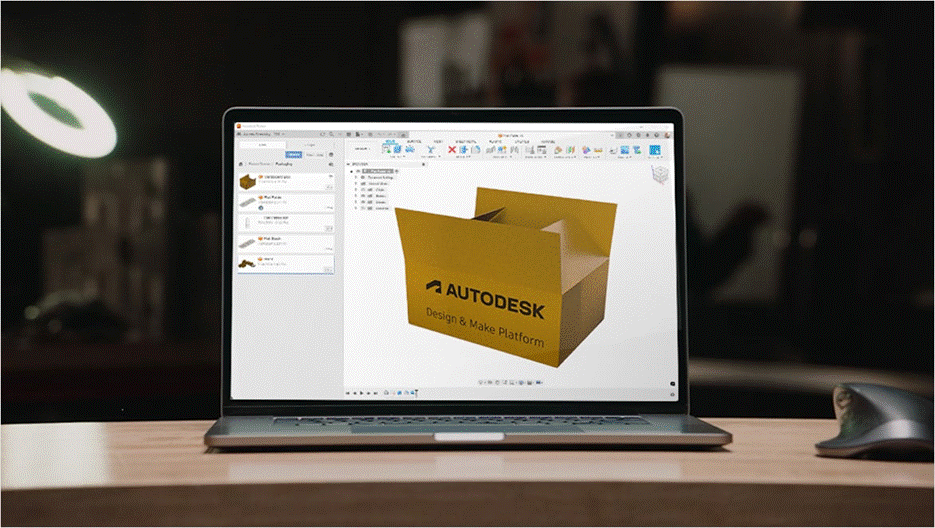
Autodesk Fusion delivers an all-in-one software solution that helps packaging designers manage all the aforementioned complexities.
For structural validation, designers can use Fusion’s simulation tools to run stress, buckling, and event simulations. These tests help designers model how packaging responds to compressive loads from pallet stacking, drop impacts, and the pressures of a long distribution cycle. Because designers can run simulations within the design environment, they can catch structural failures before building any physical prototype.
Building on that validation capability, designers can use Fusion’s parametric modeling tools to iterate without rebuilding from the start. When simulation reveals a weakness, designers can adjust the underlying parameters and re-evaluate the model. They can then extend this iteration process with Fusion’s configurations feature, managing multiple packaging variants within a single design file.
Meanwhile, Fusion’s sheet metal and flat pattern tools help teams manage the specific demands of folded-carton and rigid packaging. They can build packaging in its 3D folded form and then generate flat pattern layouts that feed directly into manufacturing. Using the nesting tools, designers can arrange those 2D patterns on material sheets to minimize off-cuts and reduce material waste during production.
Finally, packaging designers can access sustainability data through Fusion’s integration with the Makersite and Manufacturing Sustainability Index (MSI) plug-ins. With the Makersite plug-in, designers can view carbon footprint and recyclability metrics for thousands of material options directly in Fusion. They can then use the MSI plug-in to compare those options across multiple sustainability indicators.
What packaging teams gain with a connected workflow
By bringing modeling, simulation, material evaluation, and manufacturing preparation into a single environment, Autodesk Fusion helps packaging teams:
- Identify structural weaknesses before physical prototypes are built
- Reduce material usage without compromising package performance
- Accelerate design iterations and packaging variant development
- Improve collaboration between packaging, manufacturing, and product teams
- Prepare designs for production with fewer manual handoffs
- Support sustainability goals with better material visibility
Instead of switching between specialized tools, teams can make packaging decisions with a clearer understanding of cost, manufacturability, performance, and environmental impact.
Packaging that earns its place
Consumer expectations for packaging are rising in many areas, including physical protection, environmental impact, and brand experience. Teams that rely on disconnected tools will find it extremely difficult to optimize for all three. By using Autodesk Fusion, packaging designers can work in a single connected environment, basing every decision on analysis rather than guesswork. In a market where packaging has become part of the product’s story, that’s the difference between packaging that ships and packaging that sells.