 Kohei Ono
As work styles continue to diversify, offices and office furniture are undergoing major changes. Itoki Central Research Institute, part of the Itoki Corporation group with more than 100 years of experience in office furniture and equipment, is exploring how to innovate for this transformation. By combining generative design in Autodesk Fusion with additive manufacturing, Itoki aims to create an “agile office” where layouts can be easily and frequently reconfigured to transform the workspace.
Itoki is a global office furniture manufacturer that supports the creation of various spaces and environments surrounding people—from office spaces to public spaces and living spaces. Shunya Shimizu, an executive officer at the company, has been involved in office design for Japanese companies for many years and notes that we are now in an era where office values are shifting.
“Earlier Japanese offices were typically small, consisting only of workstations or meeting rooms—they were rather bland,” he says. “Now, however, there are more diverse rooms tailored to specific activities, and they have evolved into stylish, highly designed spaces.”

Elevate your design and manufacturing processes with Autodesk Fusion
Changes in social conditions also influence office design.
“Until recently, the basic unit of an office was the number of people, but with the spread of remote work, that has broken down, and I think the degree of confusion has increased,” Shimizu says. “The same is true for office furniture. As office spaces have become more diverse—shifting from individual desks to large tables that facilitate collaboration and incorporating a variety of colors rather than just white—these changes have also been reflected in office furniture.”
Shimizu describes this unique characteristic of office furniture as “a fusion of aesthetics and functionality.” Furthermore, as office furniture has become more fashionable, trend cycles have shortened and development competition has intensified, significantly impacting manufacturers.
“We’ve been focused on releasing new products every year—speeding up development, shortening lead times, and producing a large volume of items,” Shimizu says. “However, I sense a crisis in that we can no longer rely on mass production for future office furniture, and I believe that to survive, we must be able to produce items one by one.”
Looking to the future market
The Itoki Central Research Institute, headed by Shimizu, was established in 2023 as an organization dedicated to addressing future challenges in office and office furniture design from a long-term perspective. Its team of experts conduct research on the ideal form of offices and office furniture, materials, design methods, and production technologies, with a focus on how people will work 10 years from now.
“Even in standard product development, we think about five years down the line. But since social conditions will have changed by then, I think the office furniture industry often doesn’t plan that far ahead,” Shimizu says. “When introducing new technological innovations, it takes time to master them. The Central Research Institute aims to provide technologies that will be necessary in the world 10 years from now as viable options.”
“Amid the diversification of work styles and rapid changes in the business environment, it has become clear that a better office environment contributes to improved employee engagement and talent retention,” he adds. “In future office design, it will be crucial to continuously improve the office environment in line with corporate growth.”
Based on the hypothesis that offices will constantly evolve, the Central Research Institute has identified the “agile office”—where layouts can be frequently changed to transform the space—as a key research theme for the future of the market. Furthermore, Shimizu believes the industry must also tackle the challenge of plastic recycling.
“For us as an office furniture manufacturer, shaping plastic into free-form surfaces is now a core technology,” he says. “While we must preserve that technology to maintain our competitiveness, plastic recycling is essential to overcome the greatest weakness of plastic and its lack of biodegradability.”
Elevate your design and manufacturing processes with Autodesk Fusion
Closely examining technology
CAD has long played a major role in office furniture design. “Since introducing AutoCAD in the early 1990s, we’ve combined drawing floor plans in CAD with creating eye-catching sketches using CG,” Shimizu explains. “We also mastered 3D design and injection molding as essential technologies for chair manufacturing.”
However, he admits that the company was not always proactive in adopting the latest technologies.
“Looking at our company, Japanese engineers are diligent, so I believe they perform best and feel most comfortable when working earnestly within the given conditions and tools,” he says. “On the other hand, even if we fall behind on the latest methods and technologies, it’s difficult to recognize this through a bottom-up approach. The Central Research Institute has the role of presenting the options available for manufacturing 10 years from now, and I realized that keeping up with the evolution and innovation of tools is also a crucial part of that role.”
“I consider generative design, topology optimization, real-time CAE, visual programming, and lattice structures as examples of computational design that could be applied to office furniture,” Shimizu continues. “Since there are so many variations in office furniture, we need to pursue rational designs that can only be achieved through computers.”
Designing lightweight worktables for the agile office
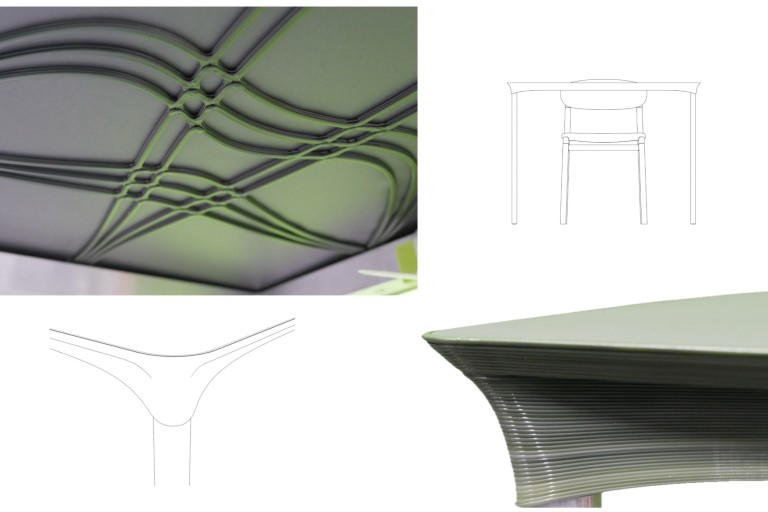
To realize the vision of an agile office, significantly lighter tables are required. The Central Research Laboratory recently prototyped a lightweight worktable for fluid offices, serving as a prototype model for next-generation office furniture.
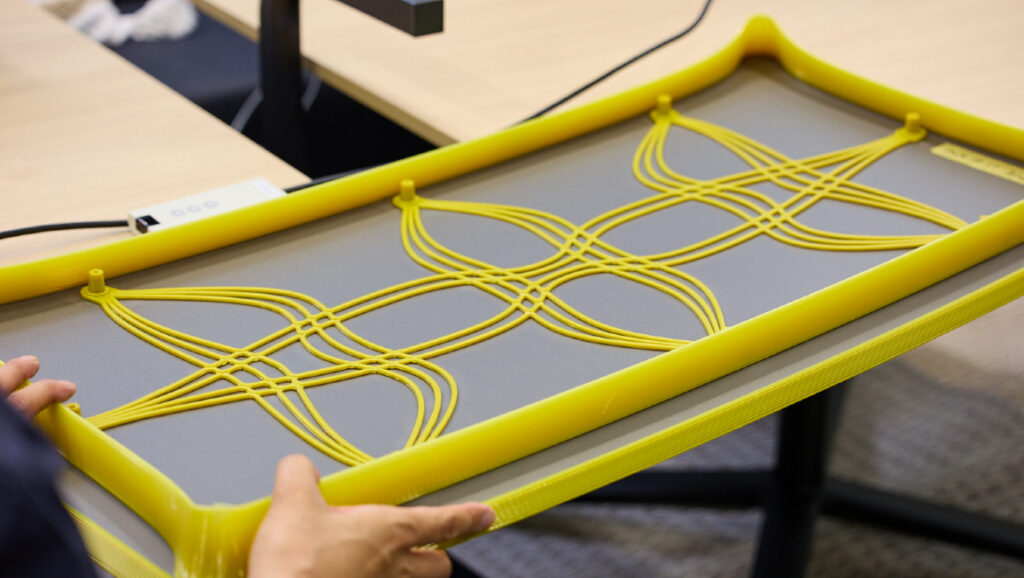
This table replaces the tabletop—which was traditionally composed of a wooden core and melamine-faced board with resin wrapped around the edges—with a single plastic material. For this design, the institute utilized the Autodesk Fusion Simulation Extension, which adds simulation capabilities to Autodesk Fusion. The tabletop itself uses commercially available 10mm-thick PP boards, while the resin for the edges and frame—designed using Fusion’s generative design capabilities to support the tabletop’s strength—is directly printed onto the tabletop using an FDM 3D printer.
“We aimed to use generative design to create a structure that reinforces the tabletop while keeping it as lightweight as possible,” Shimizu explains.
As intended, the weight has been reduced to approximately 50% of that of conventional designs.
“This design was conceived by humans to be a single-contour shape that can be produced by a 3D printer,” he says. “Since this combination of the tabletop and 3D printing results in an all-PP structure, there is also the possibility of crushing it and recycling it.”
The production of this prototype yielded various insights. “When printing directly onto a horizontally placed tabletop, warping occurs due to heat, but we were able to reduce that effect by adjusting the resin formulation,” Shimizu says, noting that such material development is also crucial for manufacturers.
“We’ll need to proceed while developing the resin formulations themselves,” he says. “This means we have to do the same thing our predecessors did 40 years ago when they introduced injection molding machines and worked hard to establish them as our core technology. I’ve come to realize once again that, as a furniture manufacturer, we must consider material development and fabrication technology simultaneously.”
Digital fabrication—the process of creating products based on digital data using digital fabrication tools such as 3D printers and laser cutters—has enabled even startups to engage in small-scale manufacturing, leading to the concept of the “democratization of manufacturing.” However, Shimizu emphasizes that for manufacturers of Itoki’s scale, the key lies in how to integrate these technologies into their existing production systems.
“Conventional plastics required molds, but if we could use 3D printers for small-batch production of even just a portion of those parts, combining them with other technologies we already use—such as piping, extrusion, and sheet metal—would make the process much easier.”
Proposing new options for office design and furniture
Offering flexible options is a key priority for future workstyles and office design, and it is also an essential element for the company’s own transformation. In addition to exploring innovative design methods using computers and applying additive manufacturing techniques, the Central Research Institute is also conducting research on visualizing the usage status of office furniture through IoT technology. This prototype has built-in IoT functionality, allowing usage patterns to be monitored via sensors.
This also offers new options for business. “By measuring pressure on a weekly or monthly basis with sensors, we can visualize, for example, how many more months a tabletop can be used, or when it’s time for replacement,” Shimizu says. “In the future, I believe we’ll even be able to proactively visit customers to handle replacements.”
Shimizu envisions a future where additive manufacturing extends beyond prototype production to actual products. “Business development will become even more important than product development, and that’s the challenge I want to take on,” he says. “If we have 10 years, we can create about three prototypes by then. I believe that will increase the sense of reality and attract supporters.”