 Casey Chaisson
A new white paper from Bluefield Research examines how climate pressure, tightening regulation, and constrained engineering capacity are forcing a rethink of drainage design and the role of integrated software.
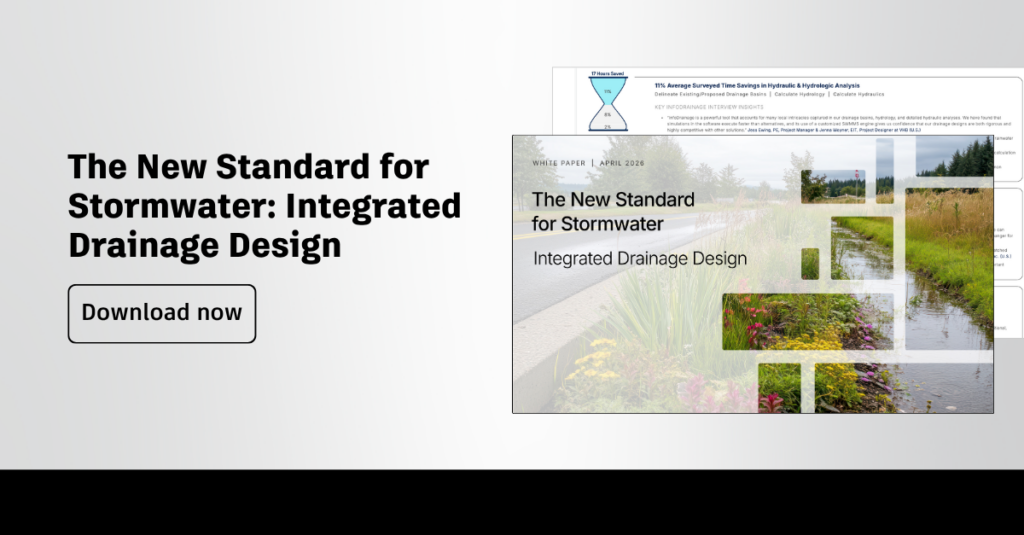
Stormwater is no longer just a drainage problem. It’s a growing financial, regulatory, and operational challenge, one that is reshaping how infrastructure gets designed and delivered.
From Hurricane Ida flooding New York City’s subway system in 2021 to record-breaking rainfall in Dubai in 2024, the evidence is clear: stormwater is not just an engineering challenge. It’s a mounting liability reshaping municipal budgets, constraining new development, and forcing a compliance reckoning across the global infrastructure sector.
Autodesk commissioned Bluefield Research, one of the leading water sector research firms, to investigate how the stormwater and drainage design landscape is evolving, and where technology can help. If stormwater is a multibillion-dollar liability that is being driven by more intense rainfall, expanding urban development, and aging systems built for a different era, how can engineers respond to those challenges?
The research shows that the most promising way forward is to shift from a fragmented, manual drainage design process into something more integrated, iterative, and data-driven – that has the added benefit of providing measurable results.
A problem that’s growing faster than the systems built to handle it
Two forces are driving the shift.
First, rainfall patterns are changing. In the US, average precipitation has increased by about 0.2 inches per decade since 1967, with some regions experiencing even sharper increases.
Second, urbanization continues to accelerate. Human-built areas have already tripled over the past 50 years and are expected to double again by the end of the century.
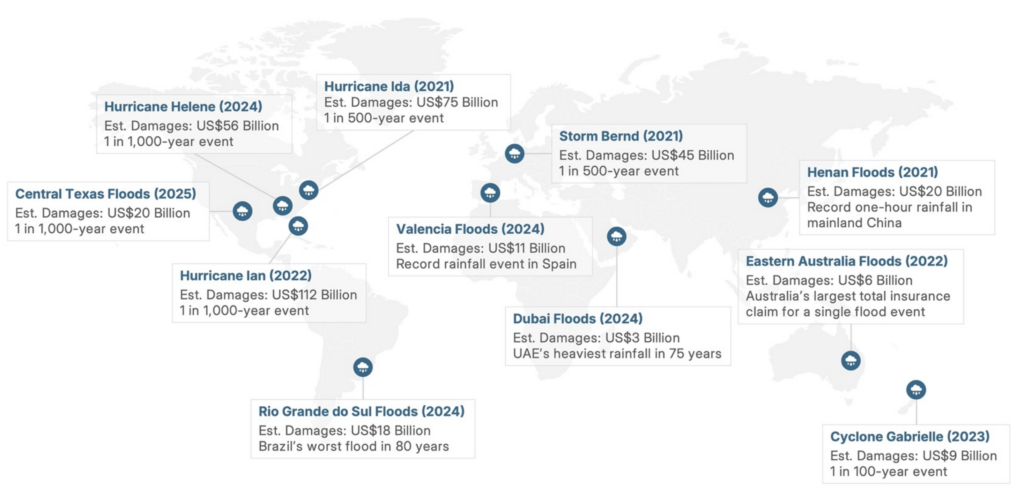
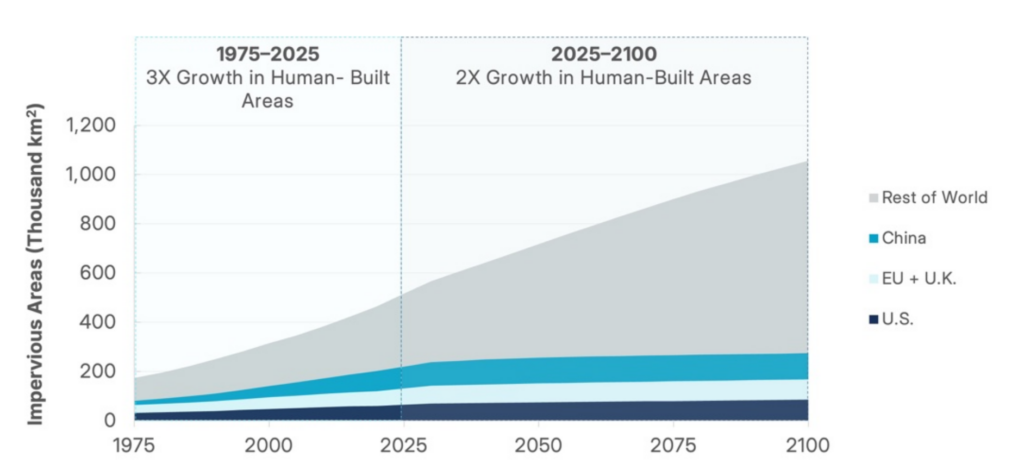
Source: Global Human Settlement Layer – World Urbanisation Prospect 2025 data, Bluefield Research
The combination is pushing drainage systems beyond their limits. What were once considered extreme events are now regular design considerations. We’ve seen this trend first-hand in our customers’ projects, who are innovating to meet the challenges, like Houston’s modern stormwater master plan and large-scale modeling efforts such as a city-wide flood model in Luxembourg.
This is why the white paper frames stormwater as a chronic crisis, not an occasional disaster.
More sustainable systems – and more complex design requirements
In response, cities and regulators are pushing for more sustainable approaches to stormwater management. That means moving beyond traditional gray infrastructure and incorporating nature-based solutions like swales, ponds, and permeable surfaces.
These approaches, which are often grouped under SuDS or low-impact development, are increasingly central to modern drainage design. When designing drainage sustainably with SuDS, these features play a critical role in reducing runoff, improving water quality, and meeting regulatory requirements.
But they also make design more complex – and slightly different across regions.
Across regions, the terminology for implementing sustainable drainage may differ, but the direction is consistent. In the US, it’s Low Impact Development (LID); in the UK, Sustainable Drainage Systems (SuDS); in the EU, blue-green infrastructure; in China, sponge cities; and in Australia, Water Sensitive Urban Design (WSUD). Each framework reflects local policy priorities, but all point toward the same outcome: reducing runoff, improving water quality, and delivering better flood resilience through integrated, nature-based approaches.
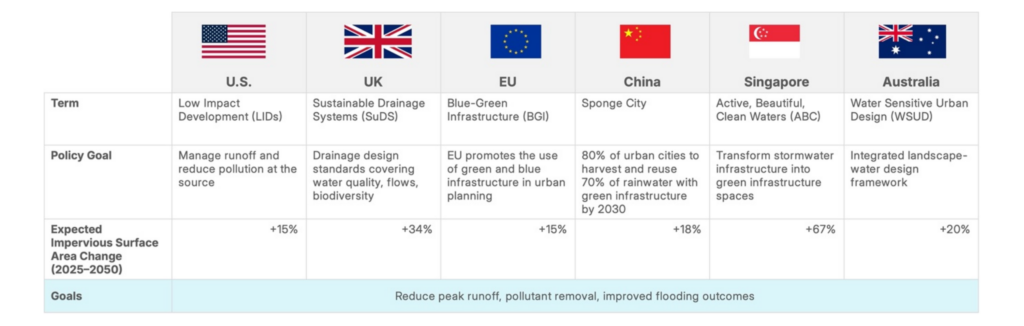
Source: Global Human Settlement Layer – World Urbanisation Prospect 2025 data, Bluefield Research
What’s notable is not just the alignment in goals, but the scale of change ahead. Many regions are projecting significant increases in impervious surfaces – ranging from roughly 15% to more than 60% in some cases — which will further intensify stormwater challenges and reinforce the need for more adaptive, site-specific drainage design.
Engineers now need to evaluate how green and gray systems interact across a specific site, often under tight regulatory constraints. Even something as straightforward as incorporating swales or infiltration featurescan require multiple iterations to validate performance and compliance.
The result is a design process that is undeniably more powerful – but also more demanding.
The hidden constraint: workflow fragmentation
Despite these changes, many drainage workflows still rely on disconnected tools.
Engineers often move between CAD platforms, hydrologic and hydraulic modeling tools, and spreadsheets, too often rebuilding the same design multiple times across systems. As the white paper explains, this creates a labor-intensive cycle of manually transferring data, where every iteration introduces new opportunities for delay or error.
We’ve explored this challenge before in our article how spreadsheets lock drainage designers into formulaic cells, where even small changes can trigger time-consuming rework across disconnected tools.
At the same time, firms are under increasing pressure to deliver. Industry data shows engineering teams often carry 8–12 months of backlog, with infrastructure projects making up the largest share. In that context, inefficiency isn’t just frustrating; it directly impacts project timelines, costs, and outcomes.
For many firms, the challenge isn’t recognizing the limitations of legacy tools but knowing how to move beyond them. For teams evaluating that transition, this overview of switching to InfoDrainage for drainage design outlines what a modern, integrated workflow looks like in practice.
What the data shows: 21% faster project delivery
This is where integrated drainage design begins to show its impact.
Based on customer interviews, Bluefield found that for a typical 80-hour drainage design project, engineers saved:
- 17 hours per project
- About 21% of total design time
More importantly, those savings are distributed across the workflow:
- 11% from hydrologic and hydraulic design
- 8% from integrated workflows and reduced handoffs
- 2% from automated reporting
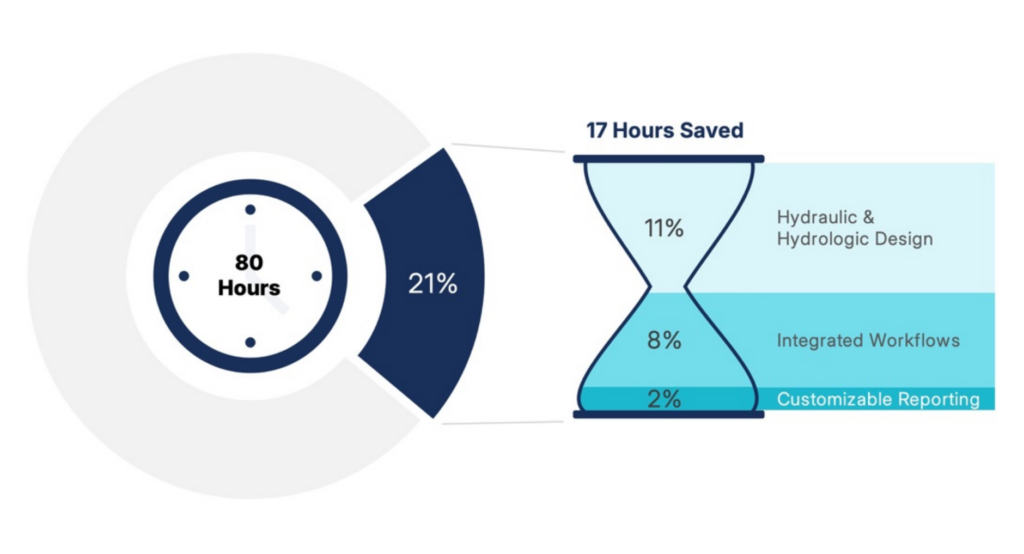
This breakdown highlights something important: Productivity gains are not coming from a single improvement. They come from removing friction at multiple points in the process, especially where data and design intersect.
Where those gains show up in real projects
In practice, these improvements show up in ways that go beyond raw time savings.
Engineers report being able to iterate more quickly, coordinate more effectively across teams, and reduce errors caused by manual data transfer. That last point is especially critical. Mistakes in translating designs between systems can lead to incorrect materials, construction delays, and costly rework.
At the same time, better visualization and reporting make it easier to communicate designs to stakeholders, from clients to regulators. This is one reason integrated workflows are proving valuable in complex projects and why firms like VHB and Project Centre have focused on streamlining their drainage design approaches.
In many cases, the biggest benefit isn’t just speed – it’s confidence in the design and fewer surprises downstream.
Why this matters now
A 21% time savings is meaningful on its own. But its real value is cumulative. Across multiple projects, those gains:
- Shorten review and approval cycles
- Increase overall delivery capacity
- Help firms manage growing demand
- Create room for more complex, higher-value work
In a market where both infrastructure demand and design complexity are increasing, that recovered capacity becomes a competitive advantage.
What comes next for drainage design
The trajectory is clear. Drainage design is becoming more integrated, more data-driven, and more connected to broader planning workflows.
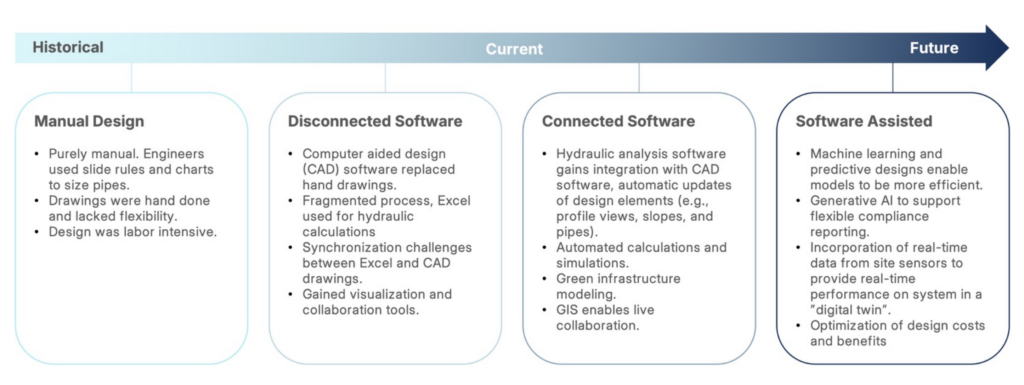
The white paper points to continued advances in:
- Integration between planning and detailed design environments
- Improved modeling realism and performance
- AI-assisted workflows and reporting
- Better alignment between site design and larger catchment systems
We’re already seeing early signs of this shift in areas like machine learning-driven flood mapping, where faster scenario analysis is changing how engineers evaluate risk.
Some of the efficiencies we are already seeing at Autodesk clearly comes from tighter integration between hydraulic modeling and site design. For teams already working in BIM environments, solutions like drainage design for Civil 3D users highlight how bringing these workflows together reduces rework and accelerates iteration.
The bottom line
Stormwater challenges are increasing. Design complexity is increasing. Expectations are increasing. What’s changing is the approach.
The data shows that integrated drainage design can deliver:
- ~21% faster project delivery
- Better coordination across teams
- More reliable, accurate designs
That combination is what defines the new standard for stormwater – and why the way we design drainage systems is evolving as quickly as the challenges they’re meant to solve.
Time to get integrated?
- Read the research: Grab a copy of the free report.
- Try InfoDrainage: Download a 30-day free trial, no credit card required.
- Get our guides: Read our hydraulic modeling and sustainable drainage guides.