 Eric Suesz
In many urban areas, rainfall doesn’t soak into the ground. It runs off hard surfaces, overwhelms drainage systems, and contributes to flooding and pollution. SuDS (Sustainable Drainage Systems) are designed to change that.
SuDS are designed to manage rainfall in a way that mimics natural processes – slowing, storing, and treating water close to where it falls. They are built using specific engineered components that work together to reduce runoff, improve water quality, and moderate peak flows.
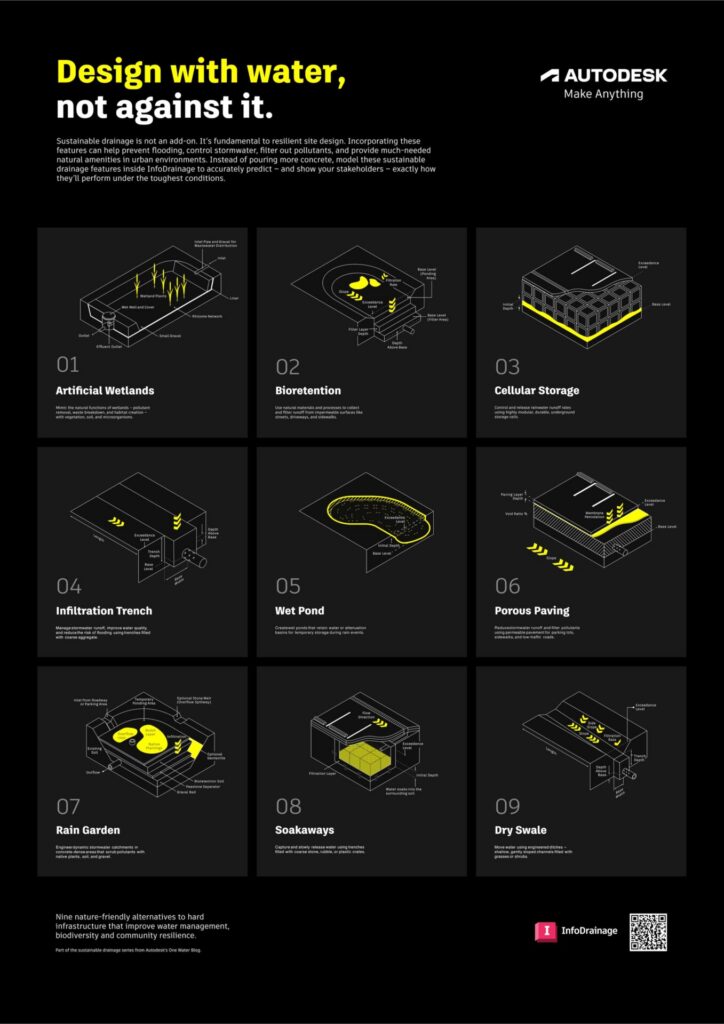
Sustainable drainage systems are made of engineered components – known as sustainable drainage features – that slow, store, infiltrate, and treat rainfall.
They form part of a structured drainage management train, integrating source control, conveyance, attenuation and water quality treatment processes to replicate natural hydrology and reduce downstream flood risk.
Across most UK developments, SuDS are required to meet national planning policy, satisfy Lead Local Flood Authority (LLFA) expectations, and achieve greenfield runoff rate targets including appropriate climate change allowances.
This guide, which includes high-quality illustrations of each SuDS feature available inside InfoDrainage, provides a structured overview of:
- A clear definition of sustainable drainage features
- A breakdown of their core hydraulic functions
- A structured overview of the main SuDS feature types
- Practical guidance on when each feature should be used
- International terminology comparisons
- Design and modelling considerations for compliance
Why are SuDS so important?
Sustainable drainage features are physical components within a SuDS strategy that manage stormwater through:
- Source control: managing runoff at or near its origin
- Conveyance: transporting flows safely across a site
- Infiltration: promoting percolation into underlying soils
- Attenuation: providing temporary storage to control discharge rates
- Water quality treatment: removing pollutants through sedimentation, filtration and biological processes
Unlike traditional piped drainage systems, SuDS aim to moderate peak flows, reduce runoff volumes and improve receiving water quality.
Core functions of SuDS features
Source control
Source control measures reduce the volume and rate of runoff entering downstream systems. Distributed features such as rain gardens and porous pavements limit network loading and support greenfield runoff compliance.
Conveyance
Conveyance features transport runoff while moderating velocity and encouraging pollutant removal. Proper longitudinal gradients and exceedance routing are critical to effective performance.
Infiltration
Infiltration-based features rely on verified soil permeability and appropriate groundwater separation. In the UK, infiltration viability is typically confirmed through BRE 365 testing and must satisfy drawdown requirements.
Attenuation
Attenuation features temporarily store runoff and release it at controlled rates via orifice controls, weirs or vortex devices. Critical duration analysis is required to confirm peak storage requirements.
Water quality treatment
Treatment is achieved through staged processes including sediment settlement, filtration through engineered media, and biological uptake. Treatment train design must satisfy pollution hazard indices where applicable.
The different types of sustainable drainage features
Sustainable drainage features can be grouped according to their primary hydraulic function within a SuDS management train. In practice, most developments use a combination of feature types to achieve runoff control, water quality treatment and regulatory compliance. All of these are available inside InfoDrainage. To go deeper into how these SuDS features are represented and modelled inside InfoDrainage, read our SuDS modelling workflow guide about SuDS modelling in InfoDrainage.
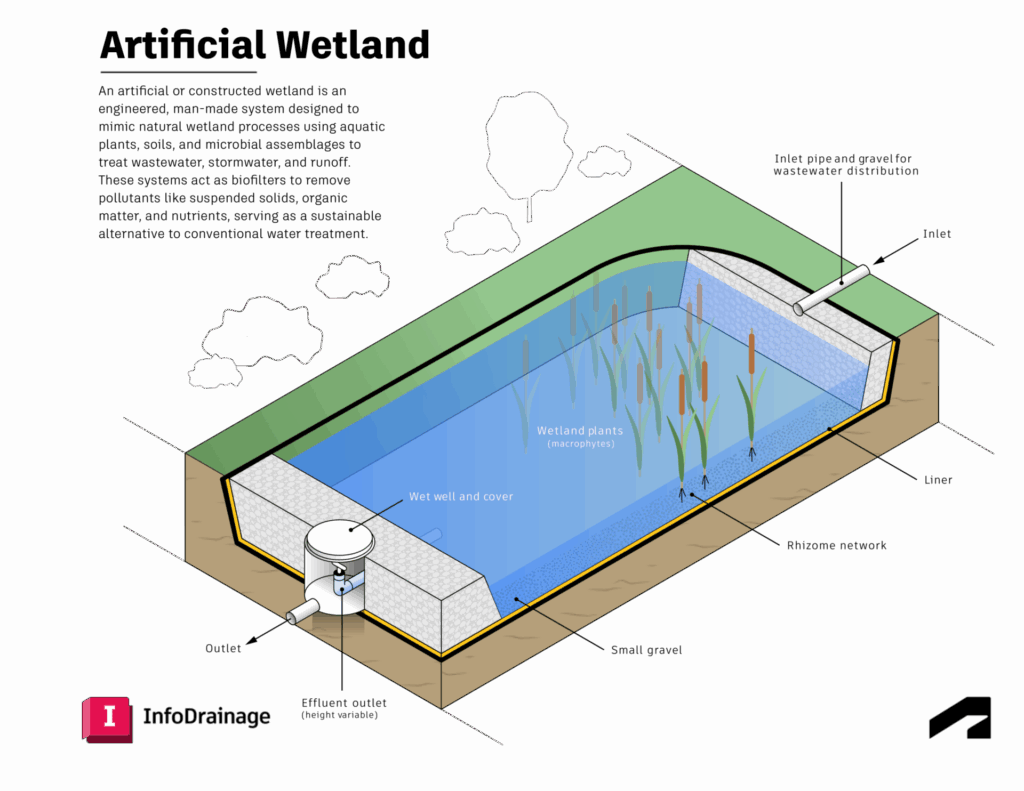
Artificial Wetland
Also called constructed wetlands, these are engineered systems that mimic natural wetlands to store, treat, and slowly release runoff within sustainable drainage systems.
Primary functions
- Water quality treatment
- Flow attenuation
- Temporary storage
- Sediment removal
- Nutrient and pollutant reduction
Typical applications
- Downstream SuDS features (end of management train)
- Urban catchments with water quality requirements
- Large-scale developments
- Sites with available land for storage and treatment
Constructed wetlands provide combined hydraulic and environmental benefits, improving water quality while reducing peak flows and downstream flood risk. Because they interact with the wider drainage system, their performance is often assessed using hydraulic modelling to verify storage, flow control, and exceedance behaviour.
👉 Learn more about Artificial wetlands.
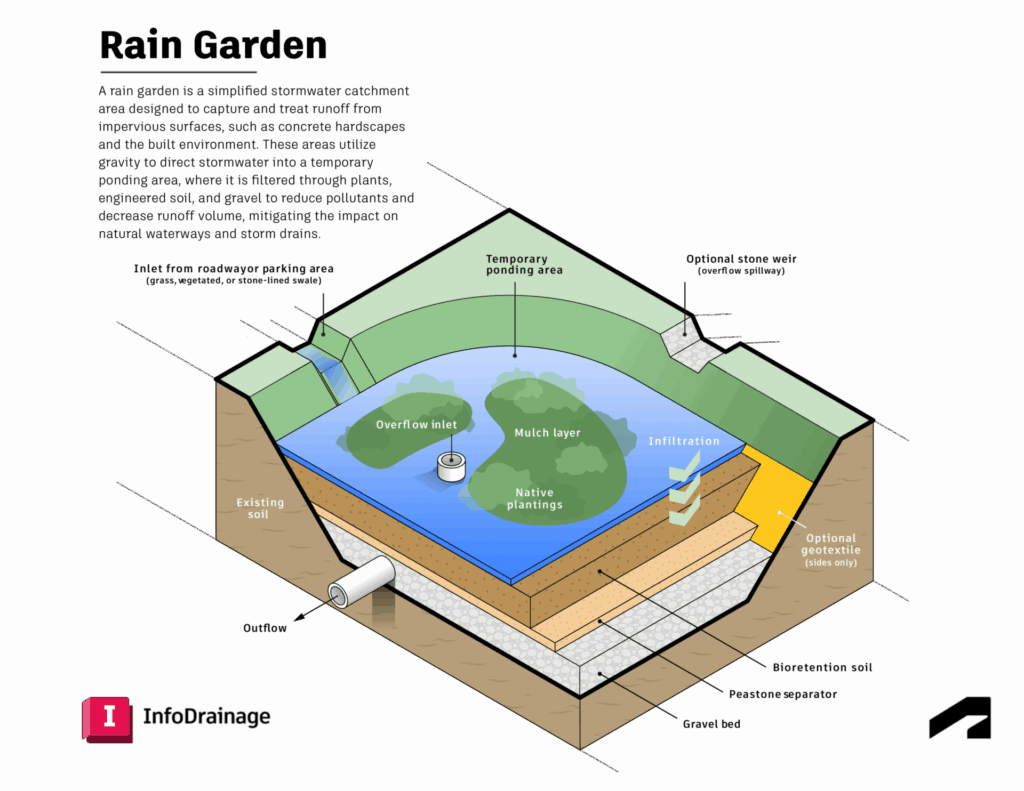
Rain Garden
Rain gardens are shallow vegetated depressions designed to intercept and temporarily store runoff from impermeable surfaces.
Primary functions
- Localised source control
- Surface attenuation
- Infiltration (site dependent)
- Pollutant removal via soil and vegetation
- Urban greening and biodiversity enhancement
Typical applications
- Residential developments
- Streetscapes and retrofit schemes
- Distributed drainage strategies
Hydraulic assessment must confirm storage depth, infiltration performance, overflow routing and compliance with design storm criteria. Digital hydraulic modelling tools such as InfoDrainage allow designers to simulate rainfall events, test exceedance pathways, and verify how sustainable drainage systems (SuDS) perform under different conditions.
Digital modelling environments such as InfoDrainage allow designers to simulate rainfall events, test exceedance pathways and verify discharge rates.
👉 Check out the full guide for Rain Gardens.
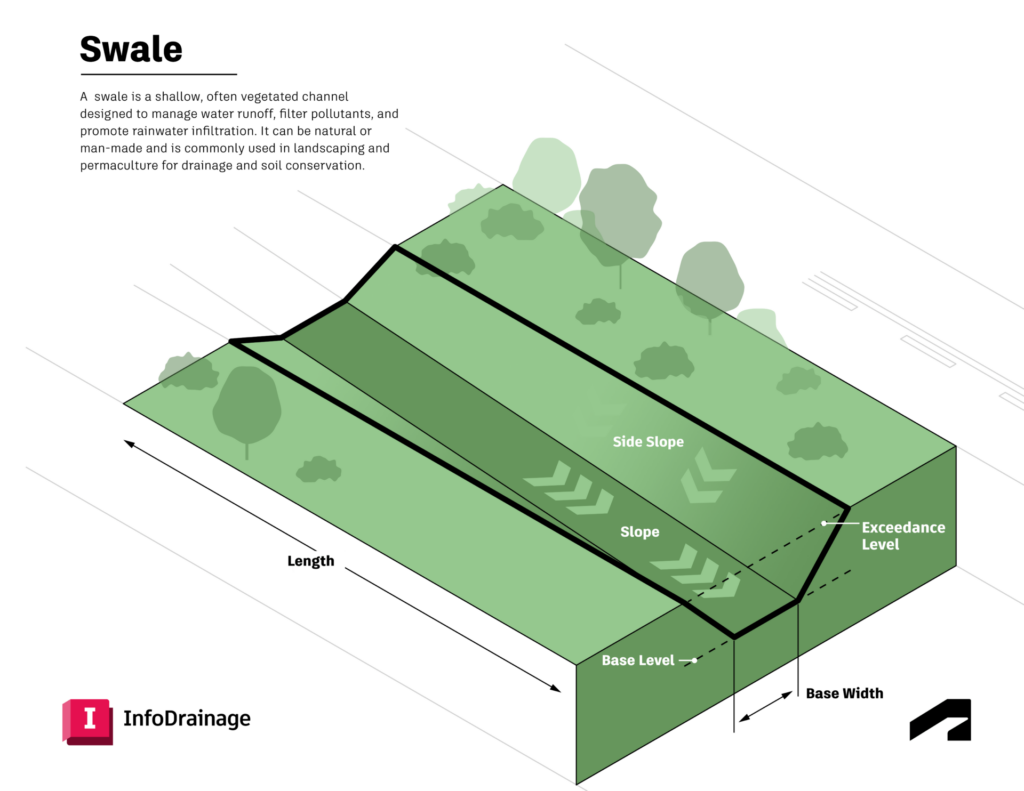
Swale
Swales are vegetated conveyance channels that slow runoff and facilitate sediment removal.
Primary functions
- Surface conveyance
- Flow attenuation
- Sediment filtration
- Partial infiltration (where soils permit)
- Landscape integration
Typical applications
- Road corridors
- Site perimeters
- Linear green infrastructure networks
Swales require assessment of side slopes, longitudinal gradients and storage capacity. Hydraulic modelling tools such as InfoDrainage enable verification of flow depths and downstream impacts across multiple storm durations.
👉 Learn all about Swales.
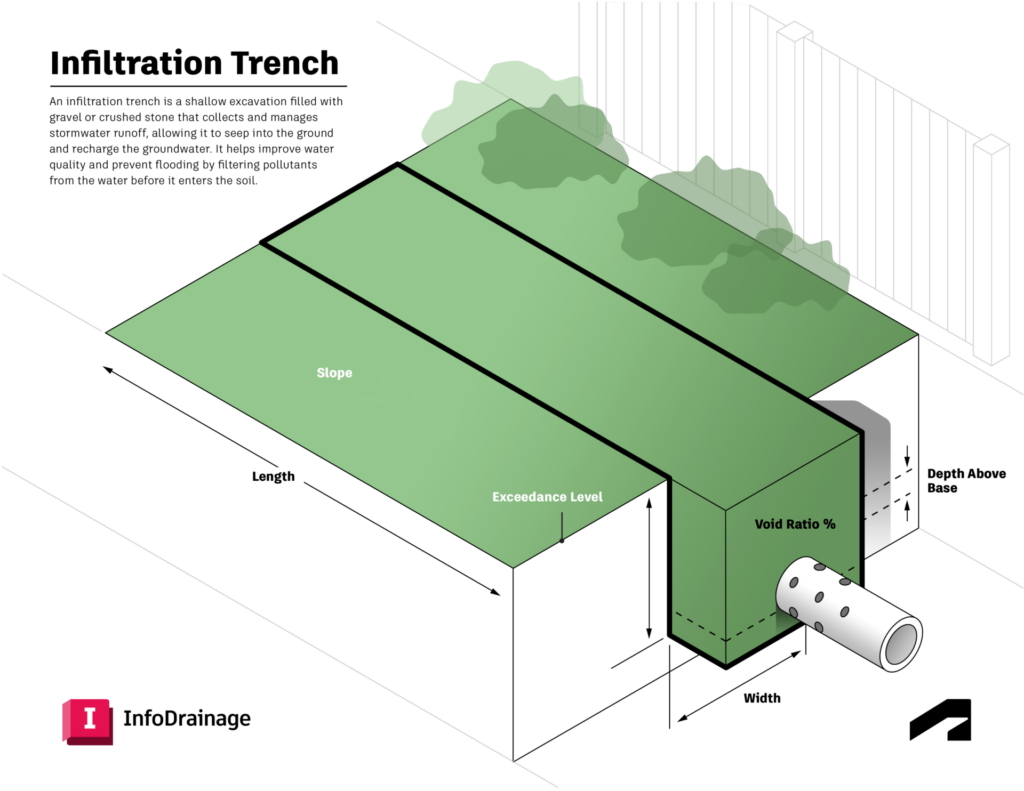
Infiltration Trench
Infiltration trenches are subsurface gravel-filled systems designed to store runoff temporarily and promote infiltration.
Primary functions
- Subsurface storage
- Volume reduction through infiltration
- Minimal surface land take
Typical applications
- Commercial developments
- Car parks
- Sites with confirmed permeable soils
Sizing depends on infiltration rates, groundwater separation and required return periods. Iterative modelling within platforms such as InfoDrainage supports compliance verification and drawdown assessment.
👉 Design guidance for Infiltration Trenches.
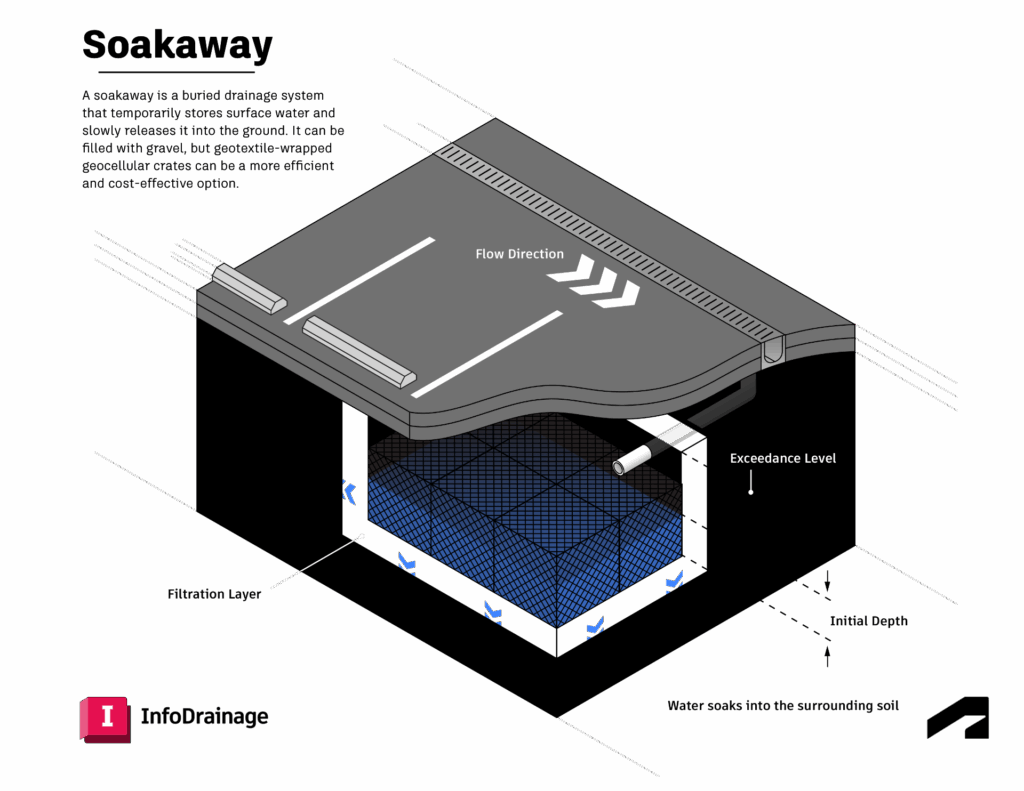
Soakaway
Soakaways are underground infiltration structures typically constructed using geocellular systems or traditional rubble fill.
Primary functions
- Roof runoff management
- Localised infiltration
- Reduced reliance on sewer discharge
Typical applications
- Individual dwellings
- Small residential developments
Design must incorporate BRE 365 test data and confirm adequate drawdown within 24 hours. Hydraulic modelling allows engineers to test storage performance under required return periods and climate change scenarios.
👉 Read our detailed article on Soakaways.
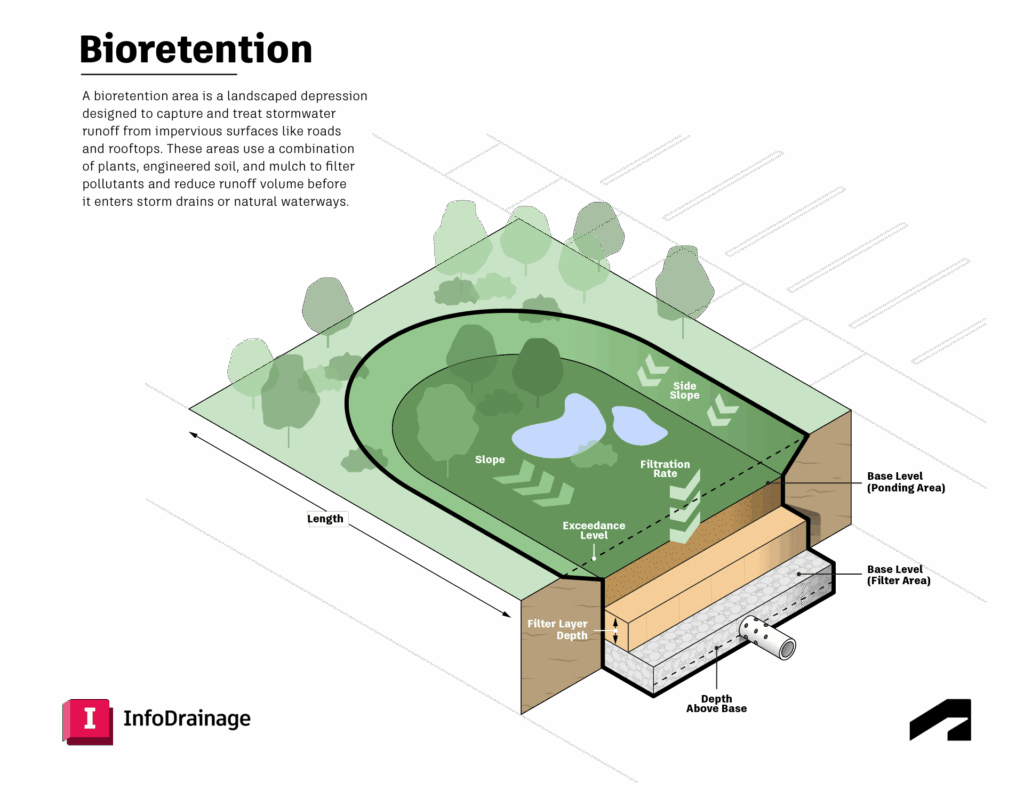
Bioretention
Bioretention systems are engineered soil-based systems providing enhanced water quality treatment and controlled discharge.
Primary functions
- High pollutant removal efficiency
- Temporary storage and flow regulation
- Controlled underdrain discharge
- Urban greening benefits
Typical applications
- Urban streets
- High treatment requirement sites
- Developments with pollution control objectives
Hydraulic modelling ensures appropriate storage depth, underdrain configuration and discharge control. Integrated modelling solutions such as InfoDrainage allow full network representation within a single drainage model.
👉 Full explanation of Bioretention Systems.
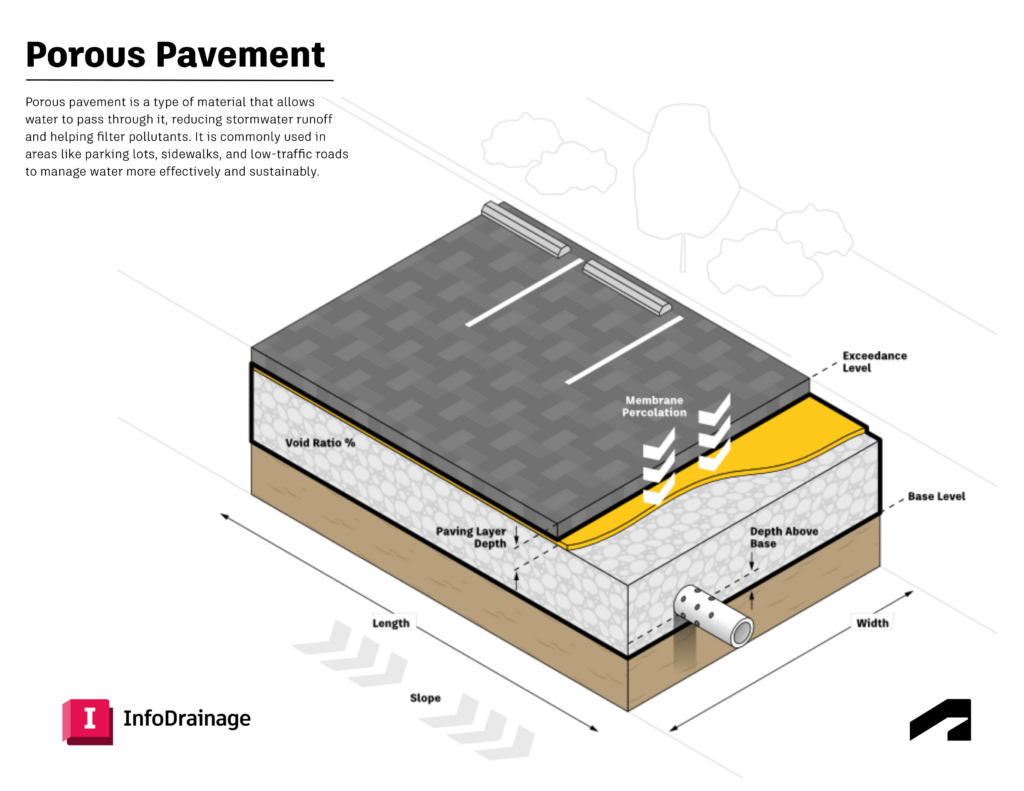
Porous Pavement
Porous pavement systems allow rainfall to infiltrate through the surface into an underlying storage sub-base.
Primary functions
- Distributed source control
- Sub-base attenuation
- Partial or full infiltration
- Structural load-bearing
Typical applications
- Car parks
- Driveways
- Low-speed roads
Performance assessment must consider sub-base void ratio, infiltration capacity and overflow routing. Hydraulic modelling within InfoDrainage supports integration with wider site drainage networks.
👉 Read more about Porous Pavement.
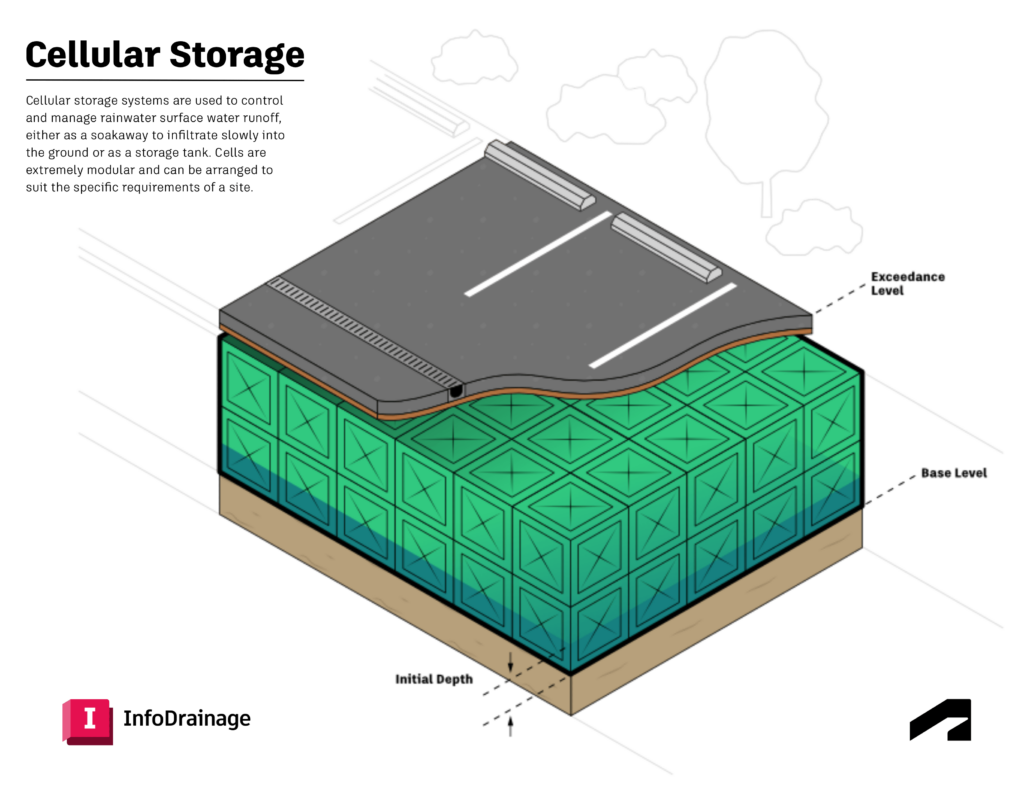
Cellular Storage
Cellular storage systems provide high-volume underground attenuation using modular crate assemblies.
Primary functions
- Attenuation storage
- Controlled discharge
- Minimal surface impact
- Modular scalability
Typical applications
- High-density urban developments
- Commercial sites
- Areas with low permeability soils
Accurate modelling of storage volume, discharge controls and critical storm duration is essential. Platforms such as InfoDrainage enable rapid iteration and regulatory reporting.
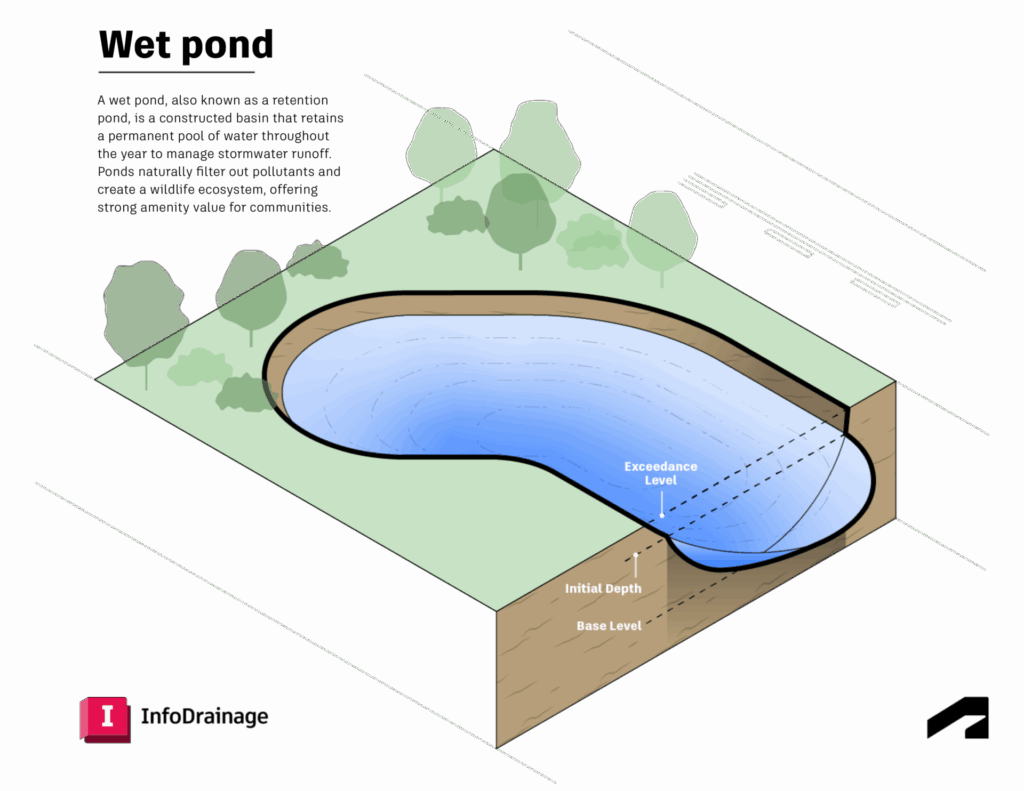
Wet Ponds and Infiltration Basins
Ponds and basins provide large-scale attenuation and staged water quality treatment.
Primary functions
- Peak flow reduction
- Sediment settlement
- Ecological enhancement
- Amenity provision
Typical applications
- Large residential schemes
- Masterplanned developments
- Sites with available land
Hydraulic modelling is required to test multiple return periods and climate change allowances. Integrated digital modelling environments such as InfoDrainage support scenario testing and discharge compliance verification.
👉 Learn more about wet (and dry) ponds.
Designing sustainable drainage features with confidence
Designing effective SuDS requires understanding how water moves across a site, through drainage networks, and into receiving systems. Engineers use hydraulic modelling to simulate these flows and test how SuDS features perform under different rainfall conditions.
Effective SuDS design requires:
- Critical duration analysis
- Verification of greenfield runoff rates
- Incorporation of infiltration testing results
- Representation of treatment stages within a management train
- Climate change scenario modelling
- Clear, auditable reporting for regulatory submission
Because sustainable drainage features operate as interconnected systems rather than isolated components, designers must assess hydraulic interaction across the full network.
Digital hydraulic modelling tools such as InfoDrainage provide an integrated environment for:
- Iterative sizing of attenuation and infiltration features
- Simulation of required return periods
- Exceedance flow assessment
- Discharge control verification
- Generation of compliant calculation reports
Robust modelling supports regulatory approval, reduces redesign risk and improves long-term drainage resilience.
When should each sustainable drainage feature be used?
Selecting appropriate sustainable drainage features depends on ground conditions, hydraulic requirements, spatial constraints and regulatory obligations.
The table below provides a high-level decision framework for typical UK development scenarios.
| Site condition / constraint | Most suitable SuDS features | Key considerations |
|---|---|---|
| High permeability soils | Soakaways, Infiltration Trenches, Rain Gardens | Confirm infiltration rates via BRE 365 testing and groundwater separation |
| Low permeability soils (e.g. clay) | Cellular Storage, Ponds, Swales (lined) | Focus on attenuation and controlled discharge rather than infiltration |
| Space-constrained urban sites | Cellular Storage, Porous Pavement, Bioretention | Prioritise underground or dual-function systems |
| High water quality treatment requirement | Bioretention, Swales, Ponds | Design treatment train to meet pollution hazard indices |
| Large residential developments | Ponds, Basins, Swales, Cellular Storage | Combine source control with downstream attenuation |
| Small residential plots | Soakaways, Rain Gardens | Verify infiltration and drawdown performance |
| Retrofit developments | Rain Gardens, Porous Pavement | Minimise disruption to existing infrastructure |
| High groundwater levels | Attenuation systems (lined), Ponds | Avoid infiltration-dependent features |
| Adoption by water company likely | Cellular Storage, Structured Attenuation Systems | Confirm local adoption standards early in design |
International terminology: SuDS, LIDs, WSUD, BMPs, and green infrastructure
While Sustainable Drainage Systems (SuDS) is the standard term used in the United Kingdom and Ireland, similar stormwater management approaches are implemented globally under different terminology.
Although the language varies, the underlying principles remain consistent: managing runoff at source, reducing peak flows, improving water quality and integrating drainage into the landscape.
| Region | Common Term | Primary Emphasis |
|---|---|---|
| United Kingdom & Ireland | SuDS (Sustainable Drainage Systems) | Surface water management and regulatory compliance |
| United States & Canada | LID (Low Impact Development) | Replication of pre-development hydrology |
| United States | Green Infrastructure (GI) | Nature-based urban stormwater systems |
| United States | BMPs (Best Management Practices) | Regulatory stormwater control measures |
| Australia & New Zealand | WSUD (Water Sensitive Urban Design) | Integrated urban water cycle planning |
| Europe (various regions) | Nature-Based Solutions (NBS) | Broader environmental resilience strategies |
Are all of these different ways of framing sustainable drainage the same?
The terms overlap significantly but are not identical:
- SuDS focuses specifically on sustainable surface water drainage in the UK planning context.
- LID is a design philosophy centred on maintaining natural hydrological processes.
- Green infrastructure is broader and may include non-drainage urban greening measures.
- WSUD integrates stormwater management into wider urban water strategy.
In practical engineering terms, features such as rain gardens, swales, permeable pavements, bioretention systems and detention basins are recognised across all of these frameworks.
For UK drainage designers, SuDS remains the regulatory standard. However, understanding international terminology is beneficial for multidisciplinary collaboration and global projects.
Go deeper into sustainable drainage
- Check out our articles for all of the SuDS features inside InfoDrainage. We encourage everyone to use the illustrations in these articles in industry presentations or whenever you want to show clients or community stakeholders how these features work – and why they are better than pouring more concrete.
- Download and try InfoDrainage – free for 30 days: Model, size and test sustainable drainage features with full hydraulic simulation and regulatory reporting. No credit card required.
- Read Our essential guide to the CIRIA 753 SuDS manual for water management. It’s a practical overview of how the CIRIA SuDS Manual influences drainage design, compliance requirements and treatment train planning.