 Trevor English
Cellular storage is a common feature of Sustainable Drainage Systems (SuDS) and are widely used in urban drainage design to manage stormwater and rainwater runoff, as well as promote sustainable drainage practices.
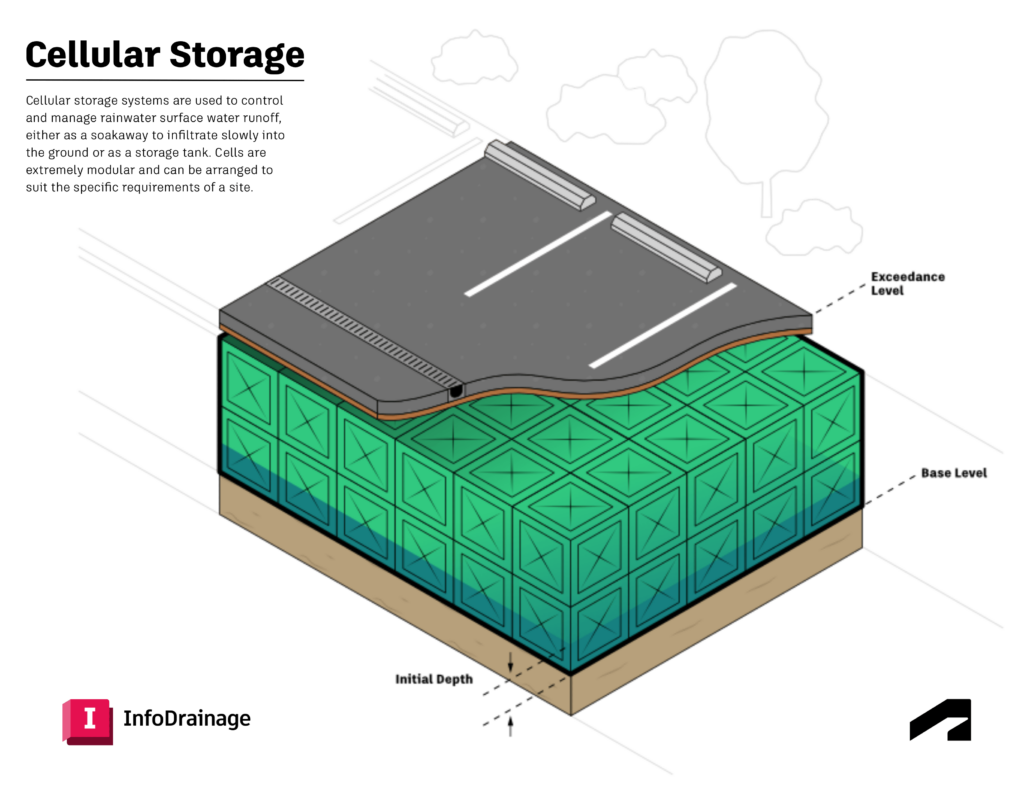
Certain stormwater controls are designed in ways that effectively divert water away from a site – but not cellular storage systems. Sometimes also called geocellular systems, geocellular attenuation tanks, or soakaway tanks, these Sustainable Drainage Systems (SuDS – aka LIDs/BMPs/WSUDs) capture stormwater in large underground containers that act as a reservoir for stormwater, temporarily storing excess water during heavy rainfall events for slow release. These systems are designed to capture and temporarily store excess water, helping to prevent flooding and manage runoff effectively.
But why utilize a stormwater control (SWC) method that simply captures the water and slows it down, rather than diverting it? Let’s explore cellular storage.
Before we get started, a quick note: Geocellular systems and geocellular attenuation tanks are sometimes referred to as soakaway crates in the industry, although some soakaways may actually be filled with gravel. We’re here to talk about the type with crates inside.
Why engineers use cellular storage for stormwater control
As cities continue to grow and expand, traditional drainage systems often struggle to cope with the increased volume of runoff. Cellular storage offers a practical and effective method to manage stormwater by providing underground storage that allows for gradual infiltration into the ground or controlled release into a drainage system.
Cellular storage systems are composed of modular plastic units that can be easily assembled to create a highly porous structure, often in modular, honeycomb-shaped design blocks. These units have standardized dimensions, including length, width, and depth, which are important for installation planning. The units are typically buried underground, creating a large void space that can temporarily store significant volumes of water during heavy rainfall events. The stored water can then either infiltrate into the surrounding soil or be released slowly to reduce the risk of flooding and erosion. They can function as either soakaways to slowly infiltrate into the surrounding soil or utilized as storage tanks for retention. Combined shallow and deep geocellular drainage solutions can be tailored to specific project needs. This approach not only helps manage stormwater but also promotes groundwater recharge and can help improve water quality.
These systems are a proven solution for stormwater management in a variety of site conditions. They can be engineered to be load-bearing for pedestrian and vehicular traffic. Geocellular systems are suitable for a wide range of applications, including areas with heavy traffic and non-trafficked zones. They are adaptable to various site conditions and are often used in new development projects to meet regulatory requirements and manage stormwater effectively. Geocellular attenuation tanks can be installed on contaminated sites and above vulnerable groundwater, providing flexible solutions for environmentally sensitive locations.
As you might be able to guess, having the ability to quickly store a large amount of stormwater can be vital in times of heavy downpour. So, as you’re thinking about implementing cellular storage in your drainage design, what are the pros and cons of these SWCs?
Benefits and downsides of cellular storage
Looking at the upsides of cellular storage, they mainly focus on this SuDS capability to handle large amounts of water quickly. Effective water management is a critical benefit, as geocellular systems play a key role in sustainable drainage by supporting stormwater retention, attenuation, and infiltration in urban environments.
The key ‘Pros’ to geocellular storage are:
- Efficient space utilization: One of the primary advantages of cellular storage systems is their ability to utilize underground space, making them an unobtrusive solution for urban areas where surface space is limited. Typically, they provide around 96% of void space for water retention or detention.
- Flexibility and scalability: Cellular storage systems are highly flexible and can be easily scaled to meet the specific needs of a project. Their modular design allows for customization to fit different site conditions and storage requirements.
- Dual-use, cost-effective, durable: These can be utilized for either retention or detention. They are also one of the most cost-effective options when compared to traditional drainage systems. They can potentially last a long time.
- Enhanced water quality options: The simplest versions may not offer much water quality enhancement. However, if you incorporate features like silt traps or treatment systems, it can help filter out pollutants and improve the quality of the water that eventually reaches natural water bodies.
- Flood mitigation: These systems are effective in reducing the risk of flooding by temporarily storing stormwater and controlling its release, thus preventing the overwhelming of drainage systems during heavy rain events.
- Groundwater recharge: Cellular storage promotes the natural infiltration of water into the ground, which aids in replenishing groundwater levels and maintaining the natural hydrological cycle.
- Long life: Geocellular systems have a long service life, typically exceeding 50 years, due to their construction from high-quality, durable materials.
However, as with all things, in certain scenarios there can be too many downsides to implement cellular storage systems. These largely orient themselves around the initial installation cost, maintenance requirements, and the structural integrity of the system.
The ‘Cons’ of cellular storage are:
- Maintenance requirements: Cellular storage systems require regular maintenance to ensure they remain effective. This includes inspections, cleaning, and occasional repairs to prevent blockages and maintain functionality.
- Initial installation costs: The initial cost of installing a cellular storage system can be relatively high compared to traditional drainage solutions. However, this cost is often offset by the long-term benefits and reduced flood damage.
- Structural integrity: Ensuring the structural integrity of the system is crucial, especially in areas with heavy traffic or load-bearing requirements. Proper design and installation are essential to prevent collapse or damage.
- Soil and site conditions: The effectiveness of cellular storage systems can be influenced by the soil and site conditions. Poorly draining soils or areas with high groundwater levels may require additional design considerations.
Utilizing SuDS in InfoDrainage
So, how do drainage designers decide when they can implement cellular storage systems and when they can’t? How do they calculate whether a proposed system will be able to effectively handle deluges of stormwater? They use an analysis tool like InfoDrainage.
InfoDrainage is a comprehensive software solution designed to aid engineers and designers in creating effective and sustainable drainage systems, including SuDS like cellular storage. The software provides a range of tools and features to support the design, analysis, and optimization of drainage systems, ensuring they meet regulatory requirements and performance standards. InfoDrainage also provides comprehensive details for planning, technical guidance, calculation methods, and regulatory compliance, helping users ensure proper system design and adherence to standards.
InfoDrainage supports the design of SuDS in many ways:
- Design flexibility: InfoDrainage allows users to design custom cellular storage systems tailored to the specific needs of their projects. The software supports the creation of detailed 3D models, enabling precise planning and visualization.
- Hydraulic analysis: The software includes advanced hydraulic analysis capabilities, allowing users to simulate the performance of cellular storage systems under various storm events. This helps in assessing the capacity and effectiveness of the design.
- Regulatory compliance: InfoDrainage ensures that designs comply with local and national regulations by providing built-in guidelines and standards for SuDS. This helps streamline the approval process and ensures designs meet necessary requirements.
- Optimization tools: InfoDrainage offers optimization tools that assist in fine-tuning designs for cost-effectiveness and performance. Users can evaluate different design scenarios and select the most efficient solution.
Cellular storage is a vital component of modern sustainable drainage systems, offering numerous benefits for urban stormwater management. While there are some challenges to consider, the advantages often outweigh the downsides. With the support of advanced tools like InfoDrainage, engineers and designers can effectively implement and optimize cellular storage systems to create resilient and sustainable urban environments.
Maintenance and upkeep of cellular storage systems
Proper maintenance and regular upkeep are essential for ensuring that cellular storage systems continue to deliver reliable stormwater control and support sustainable drainage systems over the long term. These geocellular attenuation tanks are specifically designed to manage surface water runoff, but their effectiveness depends on keeping the system clear of silt, debris, and other potential blockages. For example, build-up of silt in geocellular structures can reduce their porosity and storage capacity.
Routine inspections are a key part of maintenance. Engineers should check inlet and outlet points for any build-up that could restrict water flow, as well as examine the surrounding soil and system components for signs of wear, damage, or contamination. Early detection of issues such as cracks or compromised structural integrity can prevent more serious problems and protect both the storage tank and the surrounding ground.
The frequency and type of maintenance required can vary significantly depending on site conditions. For example, systems installed beneath car parks or in areas with heavy traffic may experience more rapid accumulation of debris and require more frequent cleaning. In contrast, installations in non-trafficked areas or sites with low contamination risk may need less frequent attention, but regular checks are still important to maintain storage capacity and system performance.
Incorporating features like silt traps or pre-treatment devices can help reduce the amount of debris entering the geocellular system, minimizing maintenance needs and extending the lifespan of the storage tank. The use of modular cells and flexible design options also allows engineers to tailor maintenance access points and cleaning strategies to the specific requirements of each project.
Design your own cellular storage
Ready to get designing? We have a full guide to sustainable drainage design principles, with articles that include detailed illustrations about swales, infiltration trenches, porous pavement, soakaways, rain gardens, and wet ponds and infiltration basins. We encourage you to use these illustrations in presentations or whenever you need to convince stakeholders why they should build green instead of pouring more concrete.
If you’re already an InfoDrainage user, our support docs can help you set every detail of your cellular storage system like inlets, outlets, soil type, infiltration rate, and pollution. Plus, these resources can help:
- Watch the Designing Cellular Storage section of our free Understanding SuDS design course.
- Grab a copy of our free Guide to Representing SuDS in InfoDrainage in accordance with the SuDS Manual Ciria 753.
- Want to try InoDrainage? We offer a 30-day free trial with no credit card required. Are you a student or educator? If so, we have some very good news for you.