 Christa Prokos
Scale PLM across your business with Autodesk Fusion. Learn how cloud‑based PLM makes it easy for teams to collaborate, manage change, and grow without complexity.

For many manufacturers, Product Lifecycle Management (PLM) is often seen as complex, expensive, and only for large enterprises with dedicated IT teams. As a result, adoption stalls, or never starts, leaving teams to rely on disconnected systems, spreadsheets, and email to manage product data.
Autodesk Fusion changes that by combining cloud‑native PLM with connected design and manufacturing workflows. Organizations of any size can scale PLM across the business, without the overhead traditionally associated with enterprise systems.
Why traditional PLM struggles to scale
Legacy PLM systems were designed for centralized, on‑premises environments. They often require lengthy implementations, heavy customization, and ongoing IT support. While powerful, these systems can become barriers to adoption, especially for small and midsize manufacturers or distributed teams.
Common challenges include:
- Long deployment timelines and complex infrastructure
- Limited accessibility for non‑engineering stakeholders
- High administrative overhead for IT and PLM specialists
- Difficulty extending PLM beyond engineering teams
As organizations grow, these constraints make it difficult to expand PLM usage across functions like manufacturing, quality, supply chain, and operations.
A cloud‑first approach to PLM with Fusion
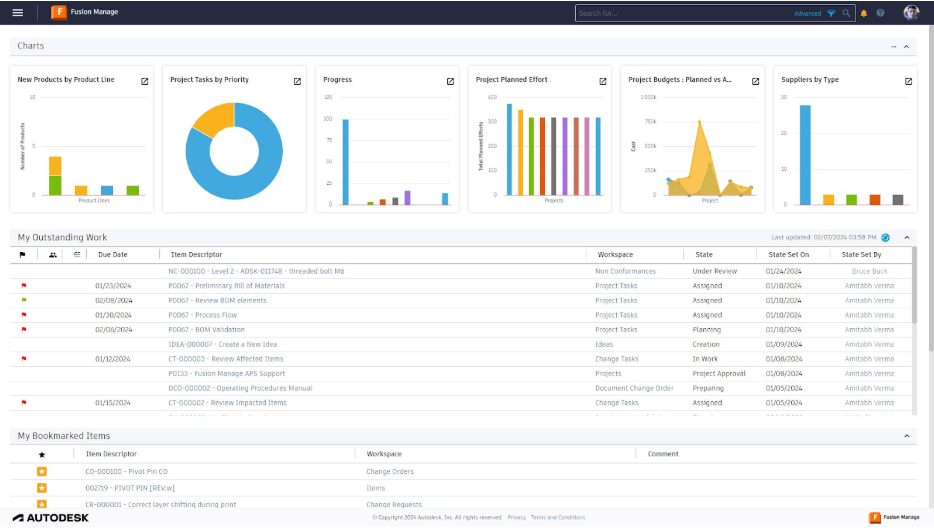
Fusion takes a cloud‑native approach to PLM that removes many of the traditional barriers to scale. With Autodesk Fusion Manage, teams can deploy structured lifecycle management without installing servers, managing upgrades, or maintaining complex infrastructure.
Because Fusion Manage is cloud‑based, organizations can:
- Get started quickly without heavy upfront investment
- Add users and capabilities as the business grows
- Support distributed and remote teams with real‑time access to data
- Reduce IT burden while maintaining governance and control
Designed for more than just engineers
One of the biggest obstacles to scaling PLM is usability. If a system is built primarily for engineers, adoption across the business suffers.
Fusion Manage is designed to support a wide range of roles, including:
- Engineering and product development
- Manufacturing and operations
- Quality and compliance
- Supply chain and sourcing
- Program and project management
By centralizing product data, workflows, and approvals in a shared system, Fusion helps everyone work from the same source of truth, without requiring deep PLM expertise.
Scaling PLM through connected workflows
PLM becomes truly scalable when it’s connected to everyday work. Fusion links lifecycle management directly to design, data management, and downstream processes.
With Fusion, teams can:
- Manage items, documents, and bills of materials (BOMs) in a governed environment
- Automate change processes like ECOs and approvals
- Maintain visibility across revisions and product stages
- Keep manufacturing and supply chain teams aligned with engineering intent
Because these workflows are connected, PLM doesn’t feel like a separate system—it becomes part of how teams already work.
Real‑time visibility without the complexity
Because Fusion Manage centralizes product information in the cloud, updates to designs, BOMs, and lifecycle status are visible in real time. This reduces delays caused by disconnected tools and manual handoffs.
Teams benefit from:
- Greater confidence in data accuracy
- Faster decision‑making
- Fewer errors caused by outdated information
- Improved collaboration across functions and locations
For growing organizations, this visibility is critical to maintaining speed and quality as complexity increases.
Making PLM practical, not painful
Scaling PLM isn’t about adding more process-it’s about enabling better collaboration, consistency, and control as the business grows.
By combining cloud‑native PLM with connected design and manufacturing workflows, Autodesk Fusion makes lifecycle management practical for more teams, more roles, and more stages of growth.
For organizations looking to move beyond spreadsheets and siloed systems, Fusion provides a scalable path, without the traditional barriers.