 Shannon McGarry
Siloed data quietly erodes productivity and increases risk in product development. Learn how integrated PLM in Fusion for Design connects teams, minimizes mistakes, and restores visibility throughout the product life cycle.

Intuitively, one might think that low productivity can result from a lack of talent or effort. But in many product development companies, it’s actually a function of organizational and structural issues that compound over time. Amongst the many possible perpetrators, siloed data is arguably the most damning.
When design files, bills of materials, and change records live in disconnected systems, teams lose visibility into the product as a whole. If decision-makers rely on partial information without clear ownership, they accumulate risk. While these silos are rarely identified as the root cause of delays or rework, they still lead to daily inefficiencies that undermine speed and confidence.
Why disconnected systems are an obstacle
Siloed data fragments the product definition at every stage of development. If design teams refine geometry in one system while engineering teams manage specifications in another, downstream groups (e.g., manufacturing and procurement) are forced to operate from their own versions of the truth. In total, each handoff is an opportunity for misunderstanding and lag. For example, a design update that fails to reach procurement in time can trigger incorrect orders or excess inventory. Or, a manufacturing team working from an outdated bill of materials may not discover discrepancies until production, when correction costs are significantly higher.
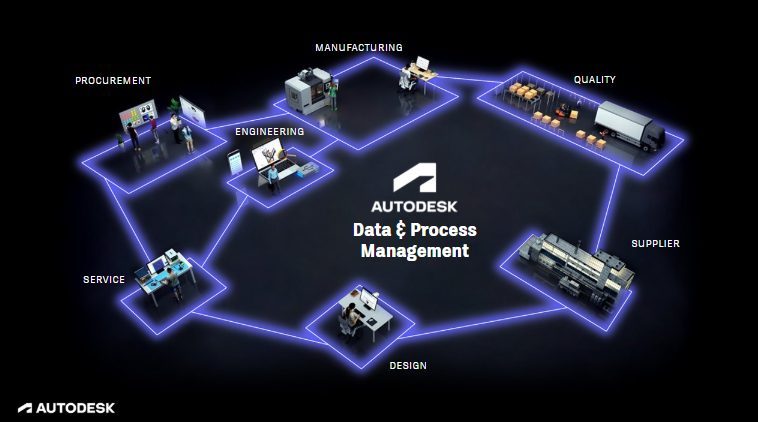
Beyond delays, silos cause considerable risk to the project. Without a shared record of product changes, organizations struggle to trace decisions back to their origin. Quality issues are harder to diagnose because teams store inspection results and design intent in separate repositories. Regulatory compliance suffers for the same reason. When auditors request proof of change control or material traceability, teams often have to scramble to assemble documentation from multiple systems, exposing gaps that should never exist.
These structural disconnects also impact behavior. Engineers might have to spend time recreating work they can’t find, while managers rely on meetings and spreadsheets to resolve contradictory data sets. Over time, teams compensate by building informal processes that depend on individual knowledge and only further deepen fragmentation. As a result, productivity declines, onboarding slows, and the organization becomes more vulnerable when key contributors leave. What started as a tooling problem eventually morphs into an existential risk for the organization.
Solving data silos with Fusion
Fusion for Design approaches this problem by treating product data as a shared asset. With built-in data management and integrated product lifecycle management Fusion delivers a single system where product definitions evolve in context. Design data, bills of materials, change records, and associated documentation stay connected during development for reduced ambiguity and shorter feedback loops.
Fusion is also valuable because it’s cohesive and easy to use. Teams can review design intent and document outcomes without exporting files or reconciling versions. With fewer tools and fewer file exchanges, teams experience less friction in daily work while improving audit and compliance traceability.
For design teams specifically, the benefit lies in less context switching. Engineers no longer have to treat data management as a downstream concern handled only after they complete a design. Instead, lifecycle awareness becomes part of the design process itself. Decisions mirror manufacturing constraints and sourcing realities in development, lowering the risk of late-stage surprises. Over time, the unification encourages faster iteration cycles without sacrificing control.
More transparency, better results
Teams rarely ever identify siloed data as a major risk, but it quietly impacts everything from timelines to costs. Fusion for Design lessens the impact by embedding integrated PLM directly into the design workflow. By unifying product data, change management, and collaboration in a single environment, it reduces friction while improving visibility and control. The result is not simply speedier delivery, but a clearer understanding of the product at every stage. In an environment where speed and certainty equate to competitiveness, organizations win when they eliminate data silos.