 Trevor English
Fire hydrants are all around us. These above-ground pipe fittings can supply flows upwards of 1,500 gallons per minute to save lives and put out fires across the world.
We all know what fire hydrants do – but how do they actually work? And why are they sometimes different colors?
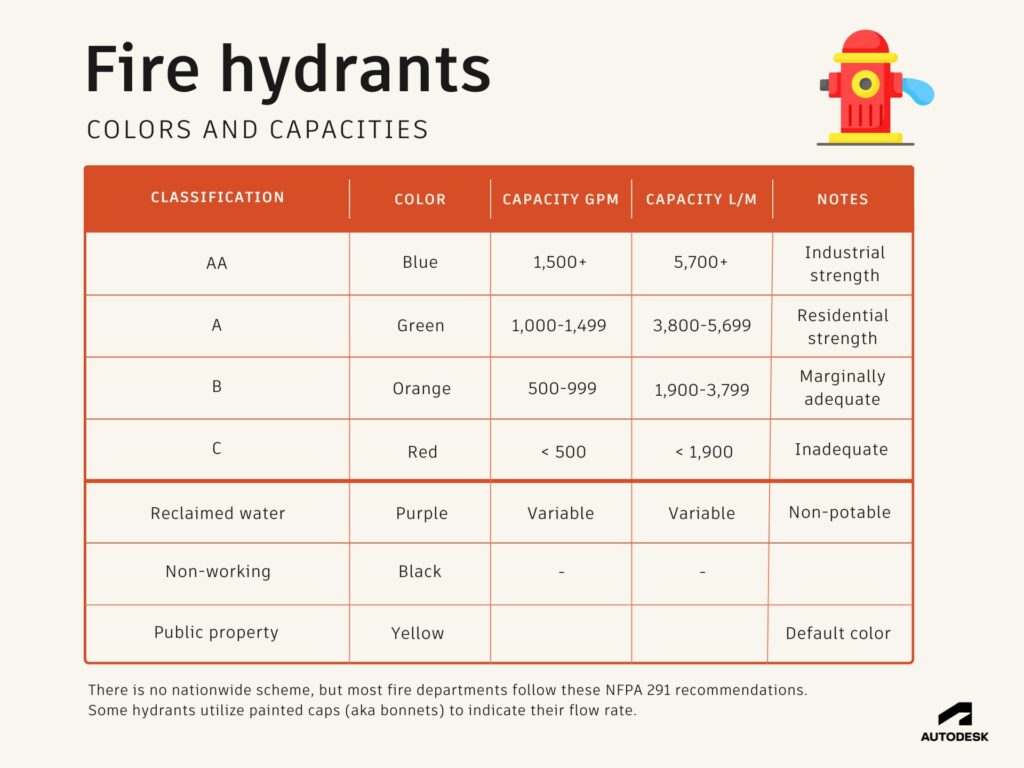
Hydrants may be painted different colors to indicate their water flow capacity, helping firefighters quickly assess what they’re working with during an emergency.
What is a fire hydrant, really?
At its core, a fire hydrant is simply a connection point to a pressurized water main. If you see one on the side of the road, there’s likely a potable water line running beneath your feet.
Hydrants don’t generate pressure or “boost” flow, they rely entirely on the existing water distribution system. In other words, they’re valves that allow firefighters to tap into whatever pressure and flow the network can provide.
That might sound simple, but the performance of a hydrant depends on a much bigger system. Engineers analyze and simulate these systems using tools such as InfoWorks WS Pro to understand how water moves through an entire network.
A quick history (and a few nicknames)
Called fireplugs, fire pumps, johnny pumps – or just fire hydrants – these life-saving fittings have been around since 1801.
Their designs vary by country, but most include:
- A connection point for hoses
- A valve controlled by a nut or operating bolt
- Internal components that regulate water flow
Wet or dry? Aren’t they all wet??
In the US, there are two main types of hydrants:
Wet barrel hydrants
Used where freezing temperatures are uncommon. These hydrants are always filled with water, and the valve that controls flow sits above ground. They’re simpler, easier to maintain, and quicker to operate.
Dry barrel hydrants
Used in colder climates. To prevent freezing, the valve is located below the frost line. When firefighters turn the operating nut, they’re opening a long internal stem that connects down to that buried valve.
How do fire hydrants work?
When a hydrant is opened, water flows from the underground main, up through the hydrant, and out through the hose connections.
But here’s the key point: A hydrant is either fully open or fully closed. It doesn’t “throttle” flow.
That means the amount of water available depends entirely on:
- System pressure
- Pipe size and condition
- Demand from nearby users
- Elevation and network design
Going with the flow rates
Common hydrant flow rates in the US range from less than 500 gallons per minute to more than 1,500 GPM. The highest-capacity hydrants can fill a backyard swimming pool in just a few minutes.
Higher-flow hydrants are typically found in:
- Dense residential areas
- Commercial zones
- Places with higher fire risk
To understand what a hydrant can actually deliver, utilities measure something called fire flow – the rate of water available during firefighting conditions.
Traditionally, this is done in the field using gauges and flow tests. But increasingly, utilities rely on fire flow analysis using hydraulic modelling tools like InfoWater Pro.
These tools allow engineers to simulate hydrant performance across an entire network – without needing to test every single hydrant manually.
Why pressure matters more than you think
Because hydrants depend on the surrounding network, pressure can vary significantly.
It changes based on:
- Time of day (peak demand vs off-peak)
- Network layout
- Pumps and storage systems
- Ongoing system conditions
If pressure drops too low – typically below 20 psi – it can even cause negative pressure in pipes, potentially drawing in contaminants. That’s one reason boil water notices sometimes happen.
Understanding and preventing these issues requires modelling the whole system, not just individual hydrants. Engineers simulate these conditions using tools like InfoWorks WS Pro to test how networks behave under stress. Simply put, the performance of a fire hydrant depends on the wider water distribution system. Engineers use hydraulic modelling to simulate pressure, flow, and network behaviour under different conditions.
Why are fire hydrants different colors?
In the US, hydrant colors often follow NFPA 291 guidelines to indicate flow capacity.
Typical colour coding looks like this:
- Blue – 1,500+ GPM
- Green – 1,000–1,499 GPM
- Orange – 500–999 GPM
- Red – < 500 GPM
The hydrant body is often painted chrome yellow, while the caps or bonnet indicate flow class.
This system helps firefighters instantly assess how much water a hydrant can supply – and plan accordingly.
That said, not every municipality follows NFPA exactly. Some use their own colr schemes, and visibility (including reflective paint) is just as important as standardization, especially at night.
How are hydrants tested?
Even rarely used hydrants need to be ready at a moment’s notice.
That’s why utilities regularly:
- Measure flow rate
- Check pressure (static and residual)
- Inspect valves and condition
Field testing provides valuable data, but it’s only a snapshot.
To get a complete picture, engineers combine real-world measurements with hydraulic modelling using tools like InfoWater Pro, allowing them to evaluate system-wide performance and plan improvements more effectively.
What are the parts of a fire hydrant?
Most hydrants share the same core components:
- Bonnet: the top housing, containing the operating nut
- Nozzle caps: protect outlets where hoses connect
- Barrel: the main body of the hydrant
- Stem: connects the operating nut to the valve
- Valve: controls water flow from the main
In rural areas without municipal systems, hydrants may even connect to ponds or other water sources.
There’s more to it than meets the eye
Fire hydrants might seem simple, but they’re part of a much larger, carefully engineered system.
Fire flow requirements, for example, are calculated based on building size, occupancy, and construction type to ensure adequate protection.
And while field testing is important, many utilities now simulate entire networks digitally. Tools like InfoWater Pro and InfoWorks WS Pro help engineers model pressure, flow, and hydrant performance under real-world conditions.
Raise a glass to hydrants
These metal pipe fittings might not look like much, but they’re lifesaving pieces of infrastructure that quietly stand ready – day and night – to protect communities.
Want to dig deeper?
- The NFPA method for calculating required fire flow is a great (and technical) place to start.
- Watch how Arcadis uses InfoWater Pro to map hydrants and simulate system-wide performance.
- Students and educators can access Autodesk water infrastructure tools for free.
Or, if you want to explore how engineers actually model these systems, check out the InfoWorks WS Pro learning course.