 Shannon McGarry
Examine how advanced analytics and cloud platforms turn manufacturing into digital factories with actionable insights for agility and flexibility. Learn how Autodesk Factory Design Utilities unifies design, simulation, and collaboration to optimize operations and stay resilient in a competitive and unpredictable market.
Manufacturing has reached a stage where traditional approaches are no longer viable. Instead, to keep up with demand for speed, customization, and quality, the industry has embraced the concept of the digital factory. Where advanced analytics, cloud computing, and connected data govern factory management, manufacturers gain real-time insights that facilitate faster, more confident decision-making. And, by linking physical processes with digital intelligence, operators unlock the flexibility needed to adapt operations as market conditions shift.
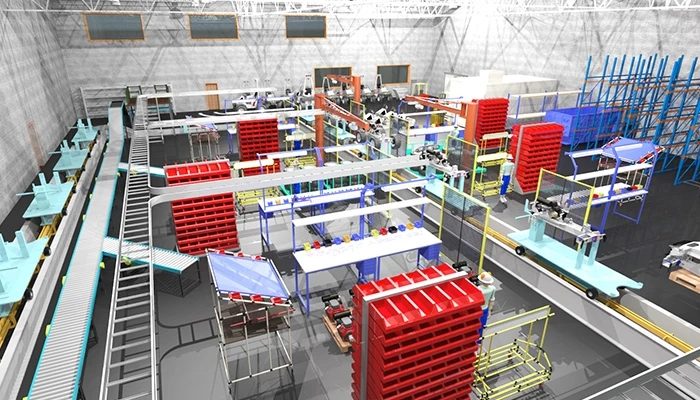
Advanced analytics and cloud platforms in the digital factory
At the highest level, the digital factory marries physical production with advanced digital systems. Where conventional plants keep data siloed and reactive, digital factories harness continuous streams of information from machines, sensors, and workflows. The system aggregates data in the cloud to provide a single source of truth that managers can access from anywhere.
Advanced analytics turn the firehose of machine signals (e.g., cycle times, scrap counts, motor temperatures) into decisions managers can use. For example, a model watching takt time drift can warn of a bottleneck before a queue forms, and a live dashboard makes it easy to pull a job forward or rebalance crews. Similarly, if gearbox vibration creeps above its baseline, the system can create a maintenance ticket and book a service window to prevent a surprise stoppage and keep the line moving.
The cloud is essential for scaling insights across sites. Shared platforms create a common data environment that eliminates silos and lets suppliers, contractors, and plant teams work from the same up-to-date information. This reach extends beyond the factory floor, linking the value chain into a responsive network. With that visibility, managers can move faster and strike a better balance between efficiency and resilience when supply problems or demand swings arise.
The result is an operational environment that is more adaptive, sustainable, and customer-focused.
Autodesk Factory Design Utilities
To get the most from a digital factory, teams need software that pulls design, analytics, and operations into one place. Autodesk Factory Design Utilities does exactly that, giving engineers a single workspace to plan layouts, simulate material flow, and manage commissioning through day-to-day operation in today’s plants.
Factory Design Utilities allow engineers and managers to create digital replicas of entire shop floors, placing machinery, conveyors, and workstations within a virtual environment. These layouts can be stress-tested with collision detection and process simulation so that operators can identify inefficiencies or safety risks before physical changes occur. When Factory Design Utilities is paired with other Autodesk solutions, such as AutoCAD and Inventor, teams can easily move between 2D layouts, 3D equipment models, and complete factory simulations.
Equally important is the platform’s ability to integrate cloud connectivity. Users can share digital models with all stakeholders so that the whole team is aligned and miscommunications are avoided. With a common data environment, every participant has access to the most current design and operational insights. The result is faster iterative abilities and more informed decision-making.
Autodesk’s approach stresses efficiency across the entire factory lifecycle. Factory Design Utilities gives teams one environment to plan, design, commission, and run facilities while driving continuous improvement. Managers can test “what-if” changes (i.e, a demand spike or a supplier hiccup) and see the impact before touching the floor. That foresight speeds daily decisions and helps keep operations both efficient and resilient.
A new approach to manufacturing
The move to a digital factory is a different way of running the plant. Pairing advanced analytics with cloud platforms puts live information in front of managers so they can act in the moment, absorb disruptions, and reconfigure lines as needs change. Autodesk Factory Design Utilities turns that approach into everyday practice by letting teams model a line, simulate options, and refine the plan before a single machine is moved. Connected to the broader ecosystem, these tools help organizations handle complexity while preserving the flexibility to adjust schedules and throughput on demand.