 McKenzie Price
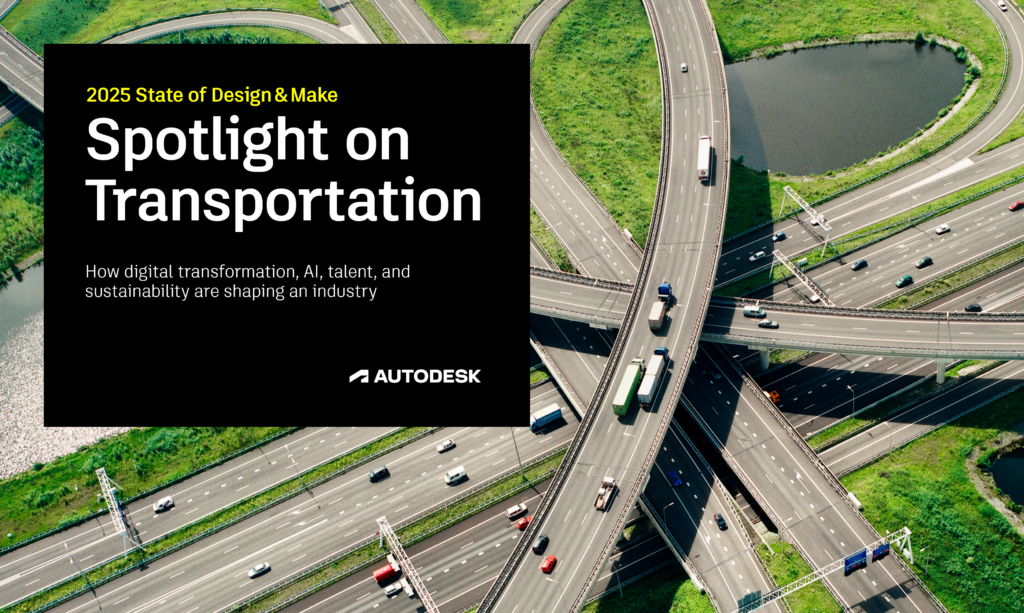
The transportation infrastructure that connects our cities, countries, and continents is experiencing unprecedented pressure—and undergoing rapid transformation.
Roads and highways, rail networks, bridges, tunnels, ports, airports: these systems form the connective tissue of modern life. Right now, the professionals responsible for planning, building, and maintaining them are navigating a convergence of forces unlike anything the industry has faced before. Aging infrastructure. Climate volatility. A shrinking talent pipeline. Tightening budgets. And on top of it all, a technological shift that is fundamentally reshaping how work gets done.
How are transportation leaders responding? The 2026 State of Design & Make: Spotlight on Transportation is a new industry report with net new focused data on real challenges in the industry combined with Autodesk’s annual global study of thousands of design and make leaders across architecture, design, engineering, construction, and operations.
This spotlight report focuses on the transportation sector specifically—infrastructure owners, engineering service providers, and construction firms—to surface the trends, challenges, and strategies that matter most to them right now.
2026 State of Design & Make: Spotlight on Transportation
From instant data to better insight
If there’s one theme that cuts across the transportation sector, it’s this: Data is no longer the problem, but making sense of it is.
Most organizations have already adopted a wide range of digital tools. But many are still struggling to connect and efficiently apply them. Siloed systems, inconsistent standards, and fragmented workflows continue to limit and lock the value of that data.
The impact is tangible. A significant portion of transportation leaders report ongoing challenges with interoperability—and many have experienced project rework as a direct result. Even when the technology exists, the ability to move information seamlessly across teams and partners remains a barrier.
Data security adds another layer of complexity. Transportation data often includes sensitive operational and asset information, requiring rigorous governance and compliance. Without shared standards and trust across stakeholders, data can become a bottleneck rather than a catalyst.
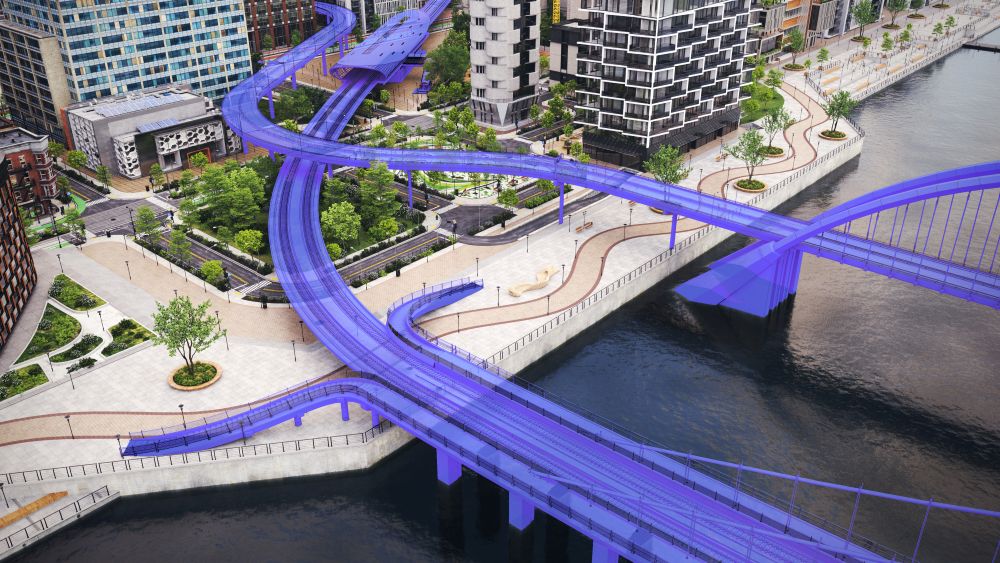
And yet, progress is undeniable. Many organizations report meaningful advancement in their digital transformation journeys, with foundational technologies like BIM and GIS now firmly in place especially with owners. The next frontier—digital twins, generative design, and more integrated ecosystems—is already coming into view.
AI moves from potential to priority
Artificial intelligence is no longer a future-state concept in transportation—it’s quickly becoming foundational.
Nearly every leader in the sector sees AI as essential to staying competitive. While use cases and implementation continue to emerge, adoption is accelerating, with many organizations actively piloting and scaling AI-driven workflows.
What’s driving that urgency? Efficiency and time.
Engineering and infrastructure teams are under constant pressure to deliver more with less. AI is helping to automate repetitive tasks, surface insights faster, and support better decision-making across the asset lifecycle. For many organizations, the most immediate benefit is simple but powerful: giving time back to focus on higher-value work. In an industry defined by complexity, that shift to freeing up teams to focus on higher-value work matters.
The talent equation
Talent remains a critical and increasingly constrained resource.
Transportation leaders are nearly unanimous in their concern about future workforce availability. Globally, a declining pipeline of civil engineering graduates is already being felt across the industry, affecting everything from recruitment costs to project delivery.
But the issue isn’t just quantity—it’s capability.
As digital tools and AI become more embedded in workflows, the skills required to fully leverage them are evolving. Organizations that can attract, develop, and retain talent with both domain expertise and digital fluency will be better positioned to scale transformation.
In many ways, the success of digital initiatives depends as much on the willingness of people as it does on platforms.
Resiliency is the new baseline
Asset resilience is no longer a parallel priority. It’s central to how infrastructure is designed, made and managed.
Transportation leaders increasingly recognize that resilience must be built into projects from the initial plan. Extreme weather events and shifting environmental conditions are already influencing design decisions.
Data plays a critical role here as well. Better access to reliable information enables teams to anticipate risk, model scenarios, and make more informed decisions earlier in the lifecycle.
Water-related risks are becoming a defining factor in transportation infrastructure planning. From flooding to drainage to long-term environmental impact, many organizations are turning to advanced technologies including AI to better understand and mitigate these challenges before assets are even built.
Complexity, creativity, and continued innovation
What the report ultimately reveals is not a portrait of an industry in crisis, but one amid a meaningful and necessary transformation. The firms and owners pulling ahead aren’t those that have somehow avoided new challenges—they’re the ones that have built the capabilities to respond to them faster and more effectively.
The Spotlight on Transportation offers a detailed look at where the industry stands, where it’s headed, and what distinguishes the leaders setting the pace.
Download the 2026 State of Design & Make: Spotlight on Transportation to benchmark your organization against peers, explore the full data, and gain the perspective you need to lead with confidence in a rapidly changing landscape.