 Emily Suzuki
Explore how the CD-ROM works, what “ROM” means, when the CD was invented, who invented it, and why the format gave way to modern storage.
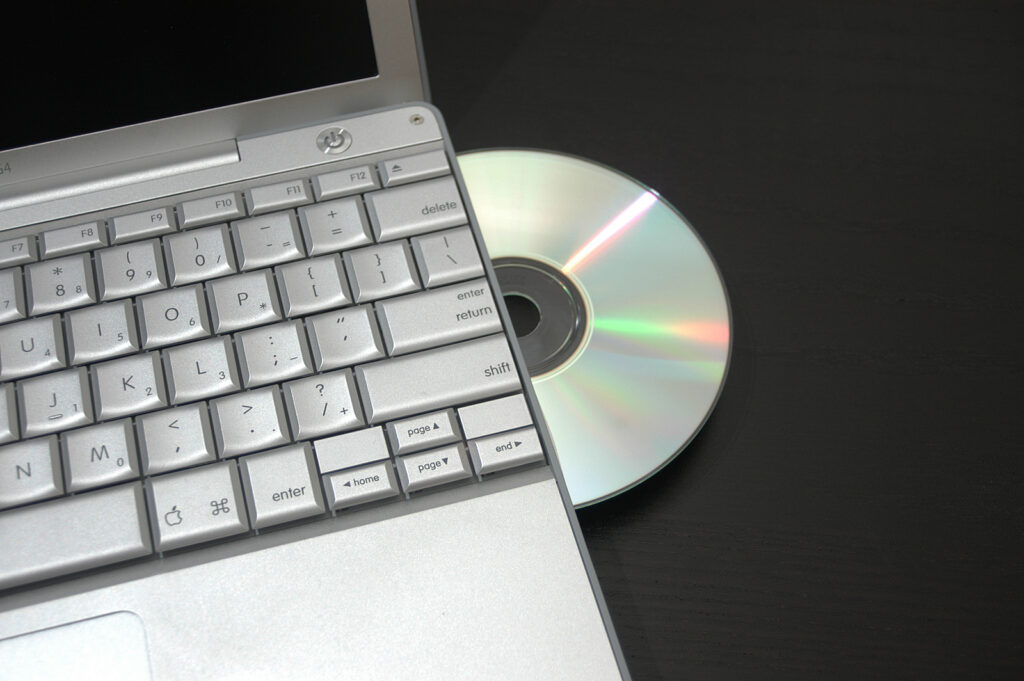
What is a CD-ROM?
A CD-ROM (Compact Disc Read-Only Memory) is an optical disc used to store digital data that can be read but not written or erased. It commonly stores software, music, and multimedia. Data is accessed by a laser in a CD-ROM drive, making it a popular medium for distribution before USB drives.
The History of the CD-ROM
If you ask anyone who was a teenager in the 90s and early 2000s about the CD-ROM, also spelled CDROM, their eyes will light up like the shiny underside of the object you’ve inquired about.
It was popular thanks to its low cost and higher storage compared to the floppy disc, making the format a household standard before DVDs and cloud storage took over.
However, the world didn’t get a disc player until 1980, when Philips and Sony licensed it as a CD-ROM, marking when the CD was invented for widespread commercial use.

Elevate your design and manufacturing processes with Autodesk Fusion
How do they work?
CD-ROM drives are read by optical means and use laser beams to read binary (digital) data encoded on little pits on the optic disc. The campaign gives the data to a computer, which then processes it.
Of course, as the name implies, they are limited, as they cannot record. They look just like audio CDs and store and receive data similarly. Thanks to a layer of aluminum, they’re reflective and are composed of 1.2mm polycarbonate plastic. While most are 120 mm, mini versions exist too.
When was the CD-ROM invented?
Though AOL created what is, at least nostalgically, the most memorable CD-ROM (the AOL free trial), they were not the first or the only. James Russell invented the earliest technology that resembled the CD-ROM while working for the Pacific Northwest National Laboratory at the United States Department of Energy.
Russell hoped to create a way to store information so it could be played back later and initially proposed digital preservation using photosensitive film. Russell wanted to replace vinyl records with a device that could work without physical contact between the system’s parts.
His optical digital recording (ODR) received several awards in 1974. However, the world didn’t get a disc player until 1980, when Philips and Sony licensed it as a CD-ROM. Since the industry neglected the invention in the 70s, the world thought they’d invented it in the mid-80s. Companies did little to dissuade this notion. In 1982, Japanese company Denon developed what we know as a CD-ROM and introduced it with Sony at a computer show in 1984.
A more modern approach

The new version of the digital preservation device came in what we think of as a CD-ROM format and stored graphics, text, and hi-fi stereo sound on a shiny CD that appeared in the Red Book, part of a line referred to as Rainbow Books, which outlined the specifications for CD-ROMs, by Phillips and Sony. The book outlined the specifications of the CD-ROM, which could hold 650 million bytes and soon became the standard.
In 1989, the CD-ROM became standardized with the ISO/IEC 10149 standard and ECMA-130 standard. The Green Book came out, which addressed the technology of CDs and worked to combine audio and data with full motion video. The technology belonged only to Phillips.
The rise of the CD-ROM

Microsoft launched the very first software in 1987 — Microsoft Bookshelf. It came on CD-ROM and was followed in 1991 by the Commodore Dynamic Total Vision, featuring a CD-ROM drive. Macintosh by Apple released the Macintosh IIvx in 1992 with a CD-ROM drive. Video video game manufacturers began using the technology to get their products to market in 1992.
Eventually, transfer speed increased from single speed 1x to 72x as the CAV drive took over in the 21st century. The CD-ROM quickly became the primary distribution method for software and video games. In the early 90s, the CD-R (for recordable) was released. And in 1995, the digital video disc—also known as the DVD.
What happened to the CD-ROM?

Sure, compared to a car, a CD-ROM is small. But compared to a laptop, they take up a lot of space. This also means that the disc drive that reads them takes up a lot of space — way too much for a tablet and modern laptops. Computers today simply don’t allow space for the CD-ROM. Instead, that space is used to extend battery life, improve performance, or boost graphics solutions for gaming.
For such a big object, the CD-ROM yields comparatively low storage next to more modern solutions. DVDs and then Blu-ray discs presented far more space, followed by terabyte drives and then hard drives and solid-state drives, which made the CD-ROM nearly obsolete.
Furthermore, the need to store and transport media has become largely obsolete. The smartphone has replaced the camera, video camera, DVD player, and digital music player, among other things. Software is digitally distributed, too, which is less expensive than sending out that shiny CD to mailboxes on a consistent basis—not to mention ongoing issues with compatibility. Thanks to the cloud, anyone can share data online, eliminating the need for additional hardware in most cases.
The legacy of the CD-ROM
We’re forever indebted to the CD-ROM, though music streaming has almost entirely replaced the technology. Younger generations may never know the feeling of buying a new CD at the mall or popping a CD into their car on the way to work. Maybe, like records, they’ll be deemed vintage and have a reemergence again one day. But for technology’s sake, the CD-ROM’s inability to change with time was its downfall.
Modern tools for modern engineers
What happened with the CD-ROM isn’t an anomaly, and Autodesk knows that. Technology moves fast, and engineers need to keep up. That’s why Autodesk Fusion is continuously evolving to meet the needs of modern engineers. As tools, technology, and even the larger industry change, we’re committed to providing software that meets the needs of the modern designer.
Take Fusion for a spin today to see what we mean.