 Lauren Frieband
This blog provides information for companies who are considering a transition from Oracle Agile Product Lifecycle Management (PLM) due to the end of life of Oracle PLM to Autodesk’’s PLM platform, Fusion Manage.
Autodesk Fusion Manage: Connect People, Processes, and Data
Streamline workflows, enhance collaboration, and gain real-time visibility with PLM.
Why migrate off Oracle Agile PLM?
With Agile PLM’s upcoming end of support and new security patches coming in December 2027, we are seeing an influx of demand for alternate PLM solutions like Autodesk, and likely for Propel, Aras, and others as well. The end of support for Agile PLM introduces compliance issues for organizations relying on the platform. The lack of updates and security patches can lead to IT compliance issues and security vulnerabilities.
Agile PLM once served over 2,000 manufacturers globally. However, the evolving market demands a solution that offers speed, flexibility, but most importantly, a smooth transition where a complete overhaul of business processes can be avoided. Maintaining legacy systems like Agile PLM is becoming increasingly difficult due to outdated technology and security standards. Organizations face several challenges during this transition, including data migration, user adoption, and process alignment.
Autodesk Fusion Manage provides enhanced collaboration, integration with various business tools, and advanced analytics capabilities, making it a superior agile product lifecyle management solution. These solutions help companies bring products to market fast and accelerate time to market by streamlining product development processes.
Similarities between Oracle Agile PLM and Autodesk Fusion Manage
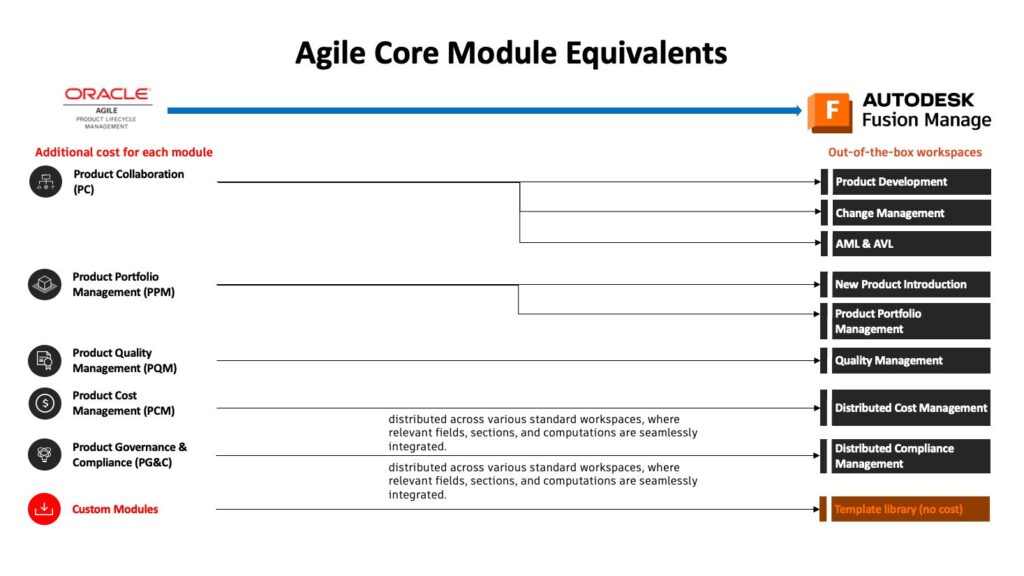
Both Agile PLM and Fusion Manage are comprehensive agile product lifecycle management solutions that supports the entire product’s lifecycle from concept to retirement. They focus on breaking down organizational silos, promoting cross-functional collaboration, and offering real-time visibility into the development process. Both platforms also facilitate supply chain collaboration across teams and partners. Fusion Manage offers industry standard PLM capabilities which will feel familiar to Agile PLM users, such as:
- Familiar workflows: Highly configurable through no-code/low-code administration
- List Views and Workspace Reports: Similar to Agile PLM’s Saved Searches.
- Dashboard and Homepage Reports: Bespoke to each user’s needs.
- Categories: Equivalent to Agile PLM’s “Subclasses.”
- Tabs for Item, Change, and Quality pages.
- BOM Management, Change Management, and Redlining: With the ability to reuse existing items and manage existing items efficiently to streamline product development.
- Pre-Built Templates: That align directly to Agile PLM core modules like Product Collaboration, Product Portfolio Management & more.

Benefits of transitioning to Fusion Manage for agile product lifecycle management
- Low & Predictable Total Cost of Ownership: Autodesk employs a simple subscription structure and implementers provide productized service offerings enabling businesses to accurately estimate total cost of ownership over a 5-10-year time horizon. Organizations can also evaluate the assessed value and resource needs of the transition to ensure it aligns with business goals.
- Infrastructure and Application: Fusion Manage is a native cloud-based SaaS PLM solution, accessible anytime, anywhere. There are no software version upgrades needed by users and updates do not require redeployment, regardless of how many modules are utilized.
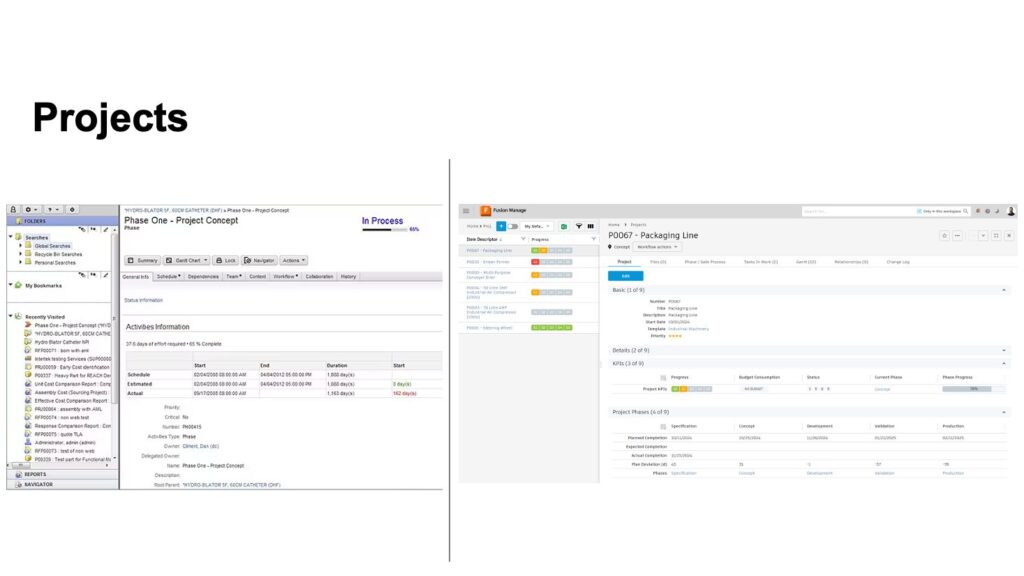
- User Interface & Experience: Fusion Manage’s user-friendly interface and configurable workflows make it easier for teams to adapt and scale their processes.
- Platform Maturity: Translates to more scalable integration capabilities through a robust API & SDK ecosystem.
- Advanced Analytics: Fusion Manage provides real-time visibility into project status, enabling informed decision-making and proactive management of potential roadblocks.
- New Product Introduction Risks: Fusion Manage helps organizations manage new product introduction risks by providing traceability and validation tools, ensuring all requirements, design, and validation steps are properly documented and linked.
Learn more about Autodesk Fusion Manage Cloud PLM
Key considerations for migration
- Evaluate current configuration and processes: Assess your current Agile PLM install to identify the effort required to replicate vs recreate business processes.
- Develop a data migration strategy: Plan for data migration by deciding which data should be migrated, archived, or discarded.
- Test and validate: Thoroughly test and validate the new system to ensure data accuracy before going live.
- Plan for training and user adoption: Employ an adoption strategy that leverages centers of excellence by enabling key individuals from each business unit to become internal champions.
- Be prepared to answer questions: Address stakeholder and user concerns by being ready to answer questions about the migration process, which helps ease anxieties and ensures a smoother transition.
Integration with other enterprise systems
A successful PLM transition goes beyond migrating data—it’s about creating a tightly integrated, collaborative platform that connects all facets of your business. Integrating your new agile product lifecycle management solution with other enterprise systems is essential for streamlining supply chain processes, accelerating time to market, and supporting efficient product development.
Seamless CAD integration allows your teams to manage product design, revisions, and document management within a single platform. This not only enhances agile product collaboration but also ensures that design changes are accurately reflected throughout the product’s lifecycle.
Connecting your PLM solution with ERP systems, enables real-time synchronization of production schedules, inventory levels, and supply chain activities. This integration supports best practice analysis, risk mitigation, and informed decisions across your operations.
CRM integration further enhances your ability to trace requirements, manage customer feedback, and monitor product quality and satisfaction. By consolidating customer insights and product data, you can drive continuous process improvement and innovation management.
Modern PLM solutions like Autodesk Fusion Manage offer advanced features and integration tools to help you build a single, unified platform. This approach not only reduces operational silos but also supports sustainable growth and a comprehensive view of your product lifecycle.
The value of partnering with Autodesk Implementers
- Expertise in both platforms: Autodesk Implementers knowledge of both Agile PLM and Fusion Manage ensures effective migration strategies and risk mitigation.
- Bespoke migration planning: Tailored plans that fit the specific needs of your business.
- Risk mitigation and problem-solving: Proactive identification and resolution of potential issues. 10% load & test approach.
- Training and user adoption: Sprint-based “train-the-trainer” approaches speed up time to value as well as reduce reliance on a small pool of admins that has historically been common.
- Post-migration support: Ongoing support to address any emerging issues, ensuring the new system functions optimally.
Driving user adoption and change management
The success of your PLM transition hinges on effective user adoption and proactive change management. Even the most advanced PLM solution will fall short if your teams are not fully engaged and equipped to leverage its capabilities.
Start by investing in comprehensive training programs tailored to different user roles. This ensures that everyone—from engineers to supply chain managers—understands how to navigate the new system, utilize advanced features, and follow defined workflows. Ongoing support resources, such as help desks and user communities, further empower your teams to resolve issues quickly and independently.
Clear communication is key to driving adoption. Articulate the benefits of the new PLM solution, such as improved collaboration, accelerated time to market, and enhanced innovation management. Highlight how the new platform supports efficient product development, reduces product introduction risks, and enables data-driven insights for better decision-making.
Address resistance to change by involving key stakeholders early in the process and providing opportunities for feedback. Demonstrate how the new PLM system aligns with organizational goals, supports process improvement, and enables continuous innovation.
Modern PLM solutions like Autodesk Fusion Manage offer a range of resources to support change management, from guided onboarding to best practice templates. By prioritizing user adoption and change management, you can maximize the value of your PLM investment and drive sustainable growth across your organization.
Switching from Oracle Agile PLM to Fusion Manage is a strategic move that offers significant benefits in terms of functionality and efficiency. With the right planning and partner, the transition can be smooth and highly beneficial.
Ready to learn more about Autodesk Fusion Manage?
Discover more resources for planning your PLM transition.
Consult with our experts
Chris Paradiso
Data Platform Sales Executive
chris.paradiso@autodesk.com

Chris has over 15 years of experience as a Product Lifecycle Management (PLM) Technical Specialist, first with PTC Windchill and Oracle Agile PLM, and now with Autodesk. He helps customers find the right PLM solutions to optimize their supply chain processes with cloud-based data platforms. He has a deep understanding of the challenges and opportunities facing the manufacturing industry in the digital era.
Tony Nguyen
Solutions Engineer
tony.nguyen@autodesk.com

Tony Nguyen has over a decade of experience in utilizing, implementing, and architecting connected data and process solutions, such as PLM and PDM. He has extensive knowledge of legacy PLM systems, including Oracle Agile PLM, Siemens TeamCenter, and PTC Windchill. Prior to joining Autodesk, Tony held various roles in the Aerospace industry, from system designer and PLM UAT Lead to people and program management. His broad expertise and practical experience make him a valuable asset in helping organizations adopt and integrate PLM solutions.
Emad Mian
PLM Product Specialist
emad.mian@autodesk.com

Emad Mian specializes in Product Data Management (PDM) and Product Lifecycle Management (PLM) solutions at Autodesk. He brings a wealth of experience in driving digital transformation and innovation. Emad is dedicated to helping businesses achieve growth through advanced data platform solutions.
Gus Quade
Solutions Engineer
gus.quade@autodesk.com

Gus Quade is a Solutions Engineer at Autodesk, specializing in data and process management. With a background in mechanical engineering, Gus has a passion for transforming business processes through innovative solutions. He is currently based in Denver, Colorado, and holds a Bachelor of Science in Biological Systems Engineering (Machinery Systems Emphasis) from the University of Wisconsin-Madison. Prior to joining Autodesk, Gus gained valuable experience at companies such as Mikron Automation and Ice-O-Matic. At Autodesk, Gus is dedicated to helping organizations optimize their product development and lifecycle management processes. He is also a knowledge seeker and actively contributes to the community through webinars and educational content.