 Eddy Krygiel

A new role appears to be taking shape across the AECO industry: The BIM Data Specialist.
While the role may seem niche, this role may signal a broader industry shift in how BIM is used and the direction firms are taking it. BIM is evolving beyond models into a valuable source of project and operational data, yet organizations struggle to capitalize on the outcomes.
This perspective reflects insights from industry leaders working across very different environments, from global event delivery at LA28 Olympic and Paralympic Games, to live operations at Denver International Airport (DEN), to large infrastructure projects at firms like Mott MacDonald. While their contexts vary, each organization is encountering the same underlying challenge: turning BIM data into something that can actually inform better decisions across the project lifecycle and drive better outcomes.
BIM is moving beyond model delivery
For years, BIM maturity was measured by geometry maturity. Was the model coordinated? Were clashes resolved? Was the digital deliverable complete and submitted?
That definition worked when the industry’s focus was on design coordination and construction efficiency. But owners are asking different questions for digital deliverables today.
Owners want to know whether the information inside their building models can support operations, planning, forecasting, maintenance, sustainability goals, and long-term asset performance. In other words, the conversation is shifting from: “Did we deliver the model geometry?” to “Can we actually use the project data?”
That’s a fundamentally different expectation, and it changes the role BIM plays across the lifecycle.
The problem owners are trying to solve
Most owners already have significant amounts of BIM data. It exists across projects and across models. It’s contained in object properties, asset attributes, and common data environments. In many cases, years of investment have gone into curating and creating it.
Yet the same frustrations continue to surface:
- Extracting consistent, usable information from models is still difficult
- Data lives across disconnected systems and formats
- Teams spend too much time validating or recreating information
- Non-technical stakeholders can’t easily interact with BIM data
- Even simple data requests often become manual and time-consuming exercises
As Brendan Dillon, Director of Digital Facilities & Infrastructure at DEN, explained, “we’ve had years of requests for information, but getting that data out has not been easy.”
The issue is not the presence of data but the ability to use it.
At the same time, expectations are increasing. Owners are under pressure to make faster decisions, improve operational performance, and manage assets more effectively.
Organizations are realizing that merely having BIM data is not enough. They must be able to derive actionable value from it to drive better decisions. That growing gap between data availability and data usability is what’s driving the emergence of new capabilities and, increasingly, new roles focused specifically on BIM data management and translation. At the same time, several broader industry shifts are accelerating the need for this expertise.
Why this role is emerging now
Several industry shifts are colliding at the same time.
First, BIM data is becoming more connected and accessible. APIs, cloud platforms, and integrated environments are changing how information moves between these systems. Brendan described the BIM data evolution as “a move away from BIM as a file to BIM as a database.” That distinction matters because files are static and databases are more akin to living systems.
Second, project complexity has exploded. Infrastructure and building programs now involve more stakeholders, more systems, more compliance requirements, more deliverables, and dramatically more data than a decade ago. Philip Storrs, Sr. Manager, Digital Project Delivery with LA28, summarized that the challenge is not simply one thing but “the volume of data, the speed of decisions, and the complexity of integrating everything together.”
Third, the audience for BIM data has expanded far beyond BIM teams. Operations leaders, finance groups, sustainability teams, executives, and asset managers all need access to information, but they don’t work inside BIM tools or models. As Brendan put it, “people are used to dashboards, they’re not used to opening up Revit.”
That’s where the friction starts to appear.
The real problem is translation
This challenge is often framed as a technology problem, but in reality, it is a translation problem. Different groups within an organization engage with data in different ways. BIM teams understand the model’s structure and intent. Data teams understand analytics and reporting. Business and operations teams focus on outcomes and decisions. The disconnect occurs when these perspectives are not aligned.
Philip compared it to an international forum where everyone relies on translators to communicate effectively. That analogy fits well, because the issue isn’t whether the information exists. The question is whether organizations can turn that data into operational understanding. This is the gap the BIM Data Specialist is beginning to fill.
The BIM Specialist role is evolving
Historically, BIM specialists focused on coordination, standards, and model delivery. That foundation remains important, but it is no longer sufficient.
As BIM becomes a source of operational data, the role is expanding to include:
- Structuring and validating model data so it can be trusted
- Connecting BIM data to operational and asset systems
- Ensuring data flows consistently across platforms
- Translating model data into insights for non-technical stakeholders
- Supporting dashboards, reporting, and digital twin strategies
Chris Sumner, Associate BIM Manager at Mott MacDonald, captured the shift clearly, where the value is no longer just in the geometry, but in “the data behind the model.”
That’s the real evolution taking place. The industry is moving from model management toward information management. And, eventually, toward decision management.
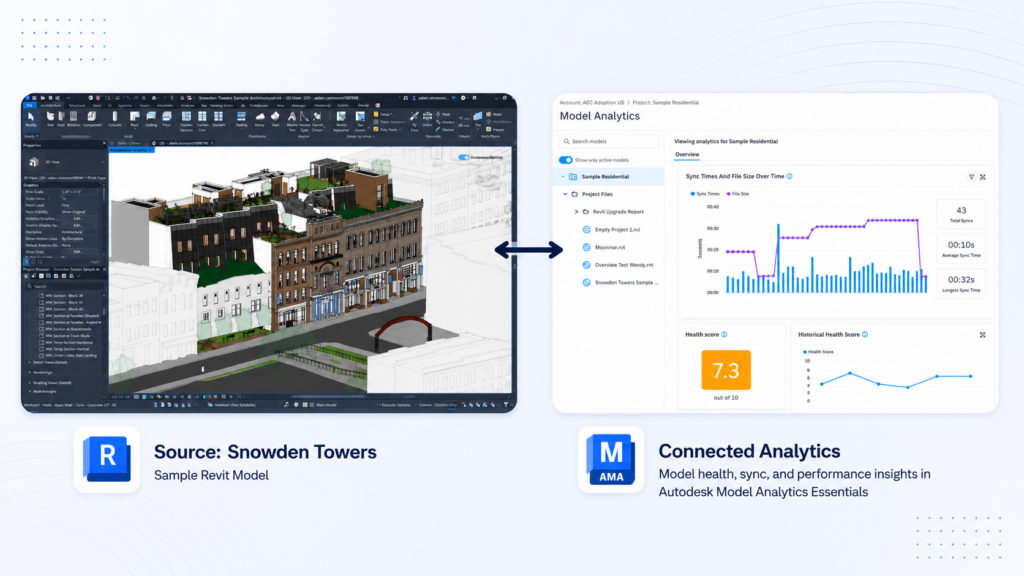
Why owners should care
For owners, this capability has immediate operational value. When BIM data becomes structured, connected, and accessible, organizations gain clearer visibility into:
- Asset performance
- Project risk
- Operational readiness
- Maintenance planning
- Capital forecasting
- Lifecycle decision-making
Decisions happen faster when teams trust the information in front of them. And, operationally, those impacts compound over time. Benefits may include:
- Less rework
- Smoother handovers
- Better alignment between design, construction, and operations
- Improved auditability and compliance
- Stronger foundations for digital twin initiatives
Without this capability, organizations often end up with fragmented information, duplicated effort, and data that becomes unusable shortly after project delivery.
Why it starts with data
Many organizations look to dashboards as the solution for data organization. In practice, dashboards only deliver results when the data behind them is structured, validated, and governed. Organizations cannot trust or use unstructured and unreliable data.
Those closest to the physical assets are often the first to recognize when data does not reflect reality. For this reason, teams must begin the real work upstream. They must ensure data quality, consistency, and governance before any meaningful use of BIM data can be realized.
This capability is becoming essential
Not every organization will hire a dedicated BIM Data Specialist. The structure will vary depending on scale and complexity. What is becoming consistent is the need for the capability itself.
Organizations that aim to operate in a data-driven way need to ensure that BIM data is accessible, understandable, and usable across the business. Whether one role or multiple teams take responsibility, this capability is becoming essential.
A signal of what comes next
The emergence of the BIM Data Specialist does more than introduce a new role. It reveals a deeper industry shift. BIM is evolving into a data platform that supports the full asset lifecycle. This shift demands new ways to create, manage, and use data.
It requires trustworthy information, connected workflows, and people capable of translating complexity into decisions.
Organizations that invest in this capability now are not just improving their BIM workflows; they are also advancing their overall capabilities. They’ll build stronger operational foundations for the next decade of digital delivery.
* Disclaimer: The views expressed are those of the individuals interviewed and do not necessarily reflect the views of their organizations. Customer examples are provided for illustrative purposes only and do not constitute endorsements.