Matt Arsenault
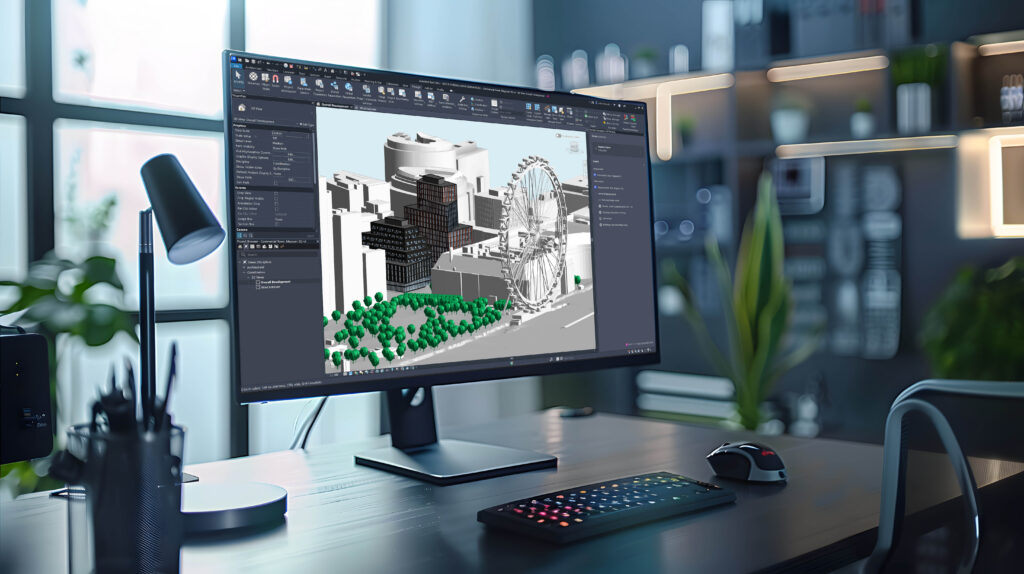
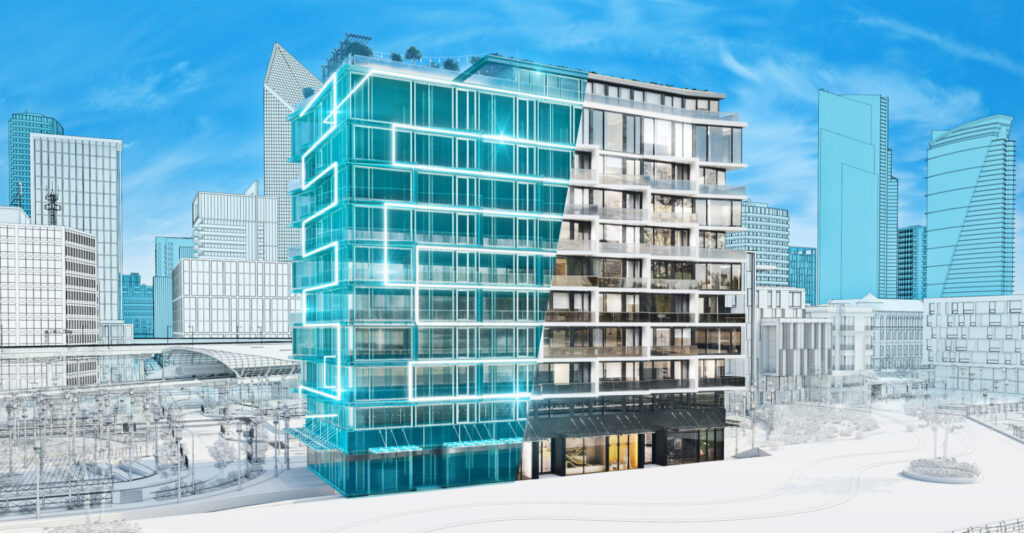
With Revit 2027, Autodesk is introducing a major step forward in connected design workflows: Revit is now the first Forma Connected Client, available in Tech Preview. This milestone brings the power of the Forma industry cloud directly into Revit, helping teams make better decisions earlier, reduce rework, and stay aligned across the entire project lifecycle.
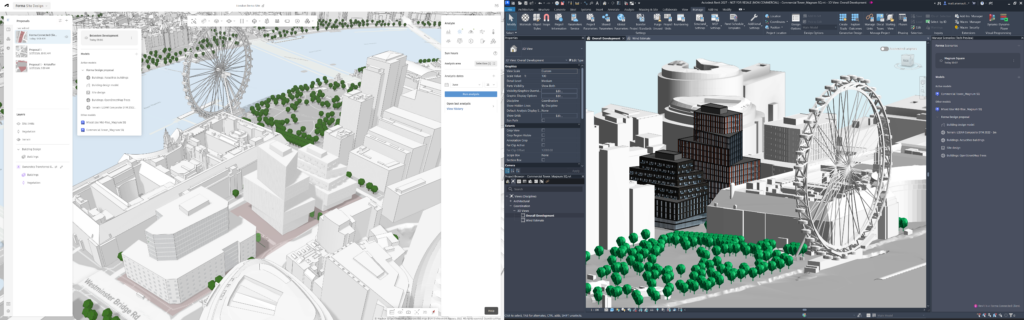
For years, BIM has transformed how buildings are designed and documented. But many project teams still struggle with disconnected tools, fragmented data, and manual workflows between project phases.
Forma Connected Clients are designed to help solve this.
Rather than replacing the tools you rely on, we are extending them—bringing deep connections between desktop applications, like Revit, to the Forma industry cloud, bridging desktop and cloud to redefine how collaboration happens throughout the project lifecycle.
With Revit 2027, this vision becomes real.
The result is a more unified experience—one where data flows more freely, insights and analysis are available when you need them, and decisions can be made with greater confidence from the very start.
Designing in Context, Not in Isolation
Every project begins with questions: What does the site look like? How will the building interact with its surroundings? What constraints will shape the design?
Traditionally, answering these questions has required gathering data from multiple sources, validating it, and manually bringing it into your model. It’s a process that takes time—and often introduces uncertainty.
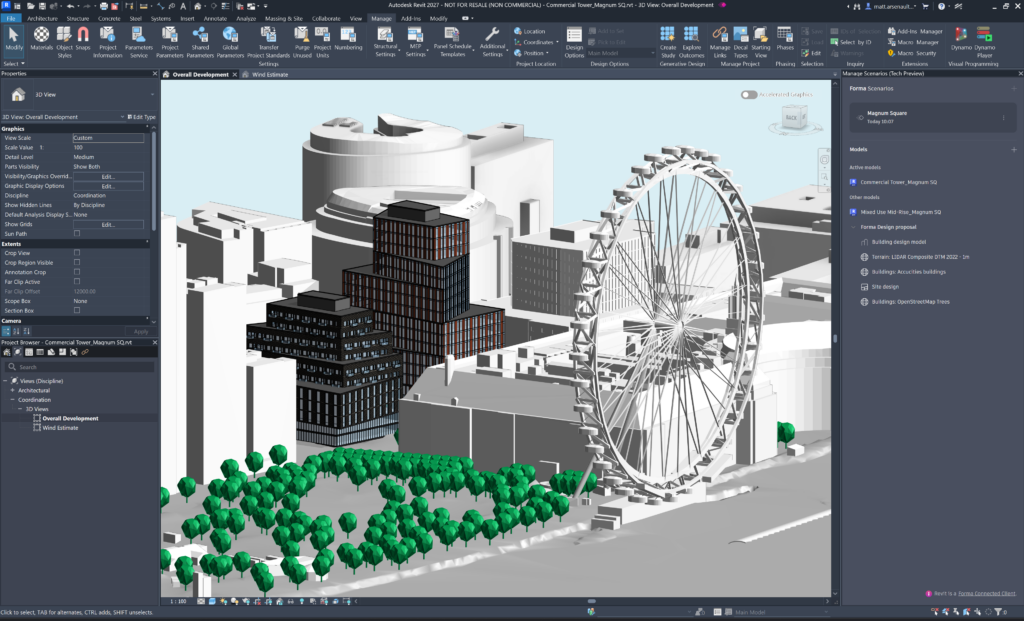
With Forma Contextual Data in Revit 2027, that process becomes dramatically simpler.
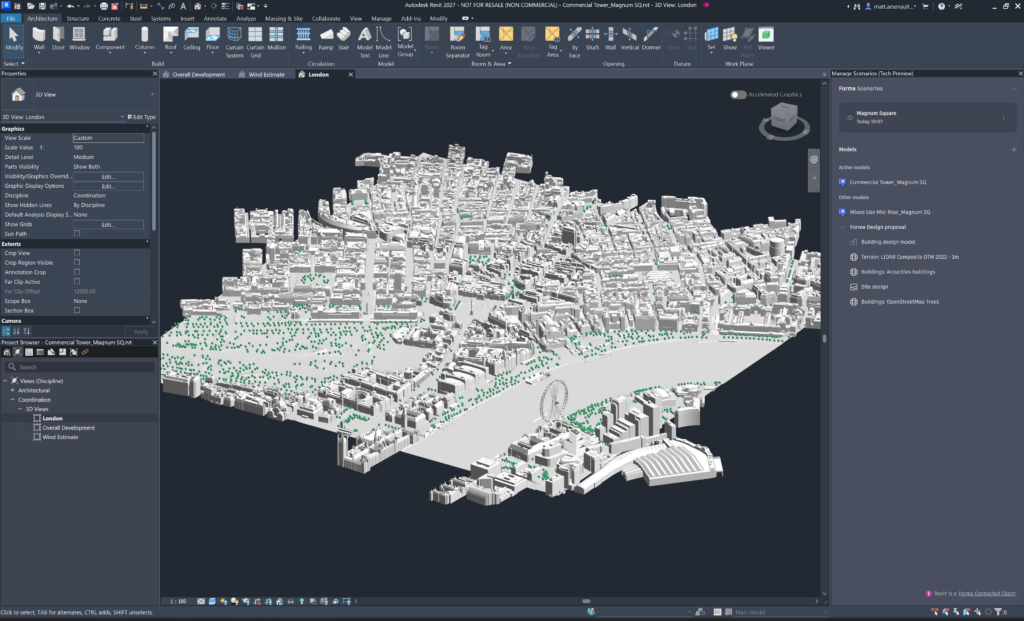
With direct access to the Forma Data Marketplace, you can bring real-world context—like terrain and surrounding buildings—into your project in just a few clicks. Instead of designing based on assumptions, you’re working with more accurate, location-based data from the beginning.
It’s a small shift in workflow, but a big shift in mindset: design decisions are now grounded in reality from day one.
Connecting Data Across Tools and Teams
One of the biggest challenges in complex projects isn’t creating models—it’s keeping them aligned, up-to-date and in sync. Projects span multiple disciplines, multiple tools, and multiple phases. Too often, that means exporting files, re-importing data, and constantly asking: Is this the latest version?
Forma introduces a different approach, available across Site Design, Building Design and Revit 2027.
By connecting your model to a Forma Scenario—a shared design container in your Forma Project—you can connect models, data, and context across applications without moving files around. Whether a model originates in Revit or a Forma design application, it becomes part of a connected system where everything stays more in sync and up to date.
But, it’s not just about keeping data up to date, it’s also about keeping data aligned. Forma Geolocation helps ensure that every model in the scenario is accurately located, so you no longer need to manually align models.
This removes friction from collaboration, allowing teams to focus less on managing data—and more on designing.
Insight at Any Moment During Design
Good design decisions depend on good information. But in many workflows, analysis comes later—after key decisions have already been made.
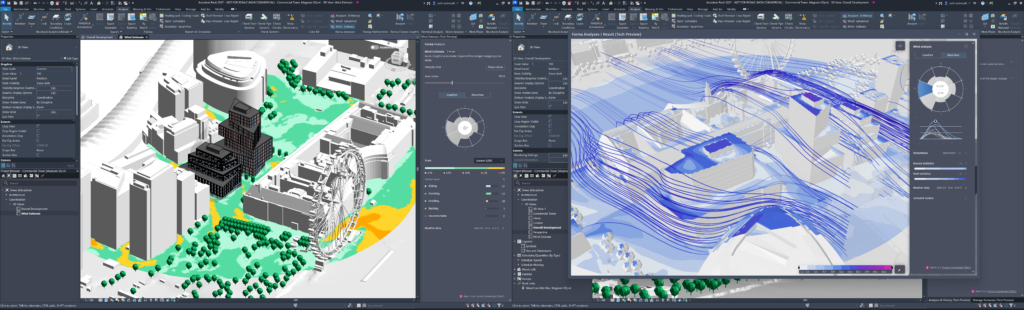
With Revit 2027, analysis becomes part of the design process itself, all powered through Forma Analyses.
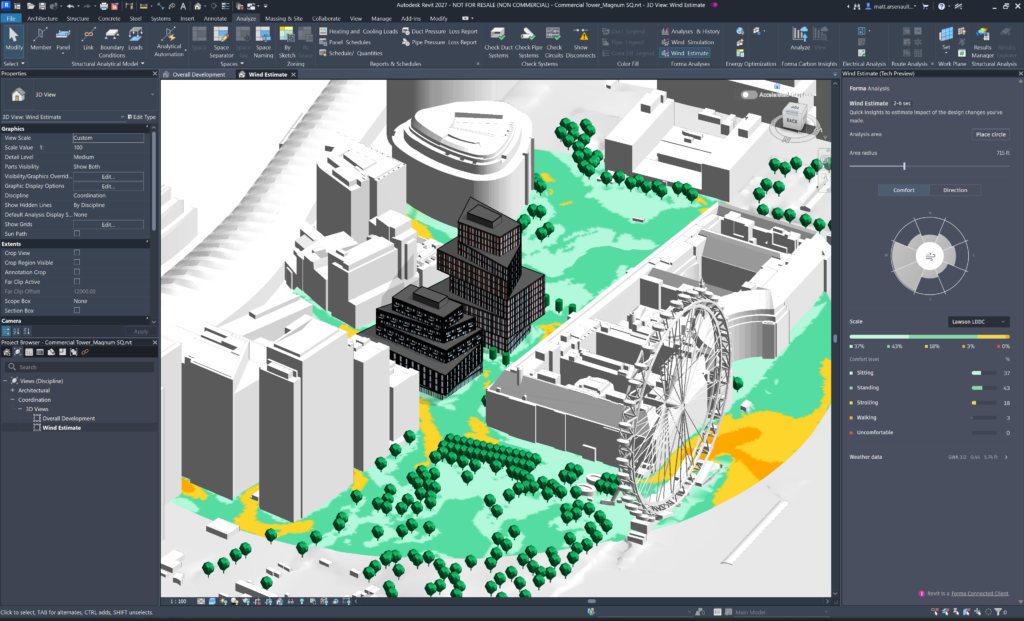
Forma-powered wind analysis is now available directly within Revit, giving you immediate feedback on how wind conditions will impact pedestrian comfort and contribute to the built-world around the project site. You can explore quick estimates through machine learning Wind Estimate analysis or run detailed simulations using Wind Simulation analysis. Use Wind Estimate while you’re designing to see the impact with each design move, or run a Wind Simulation in the cloud, while you continue designing.
Analysis doesn’t slow down the design process, it helps reinforce design decisions.
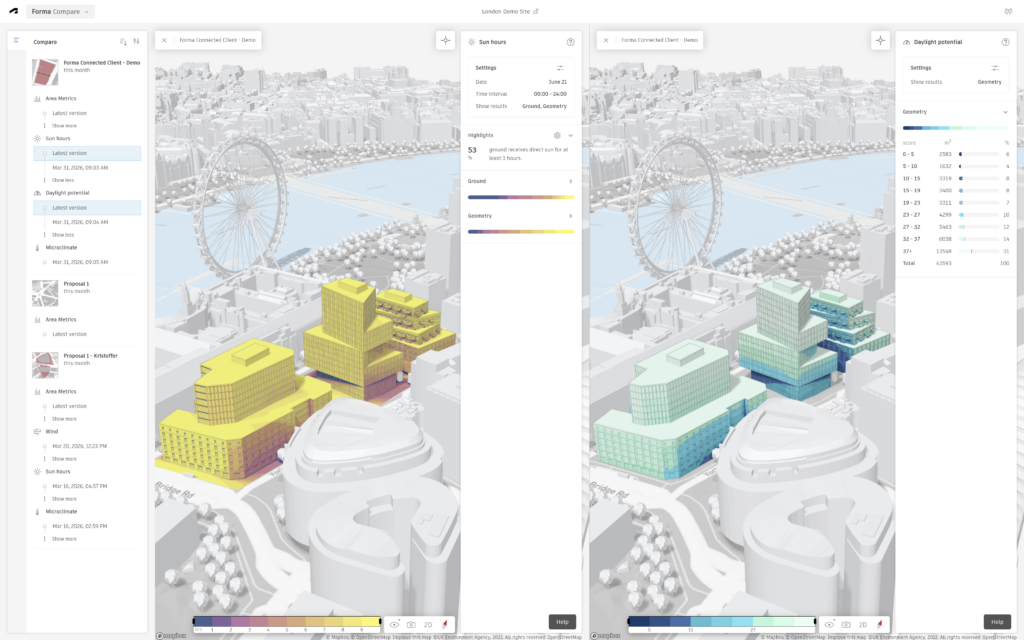
You can also transition to Forma Site Design with a single click, giving access to all your models together to continuing running additional analyses such as Daylight Potential analysis, Sun Hours analysis, or Microclimate analysis so you have a rich understanding of the full environmental impact of your project.
Instead of stopping to validate your design, you can evaluate it continuously—refining and improving as you go.
Less Rework, More Confidence
Behind all of these capabilities is a simple goal: reduce friction.
By bringing a deep connection between Revit and the Forma industry cloud, data no longer needs to be manually exchanged between tools. Contextual data, analysis results, and design models are all part of a shared ecosystem—accessible when and where you need them.
This means fewer errors, fewer duplicated efforts, and fewer moments spent reconciling differences between files.
It also means something more important: confidence. Confidence that your design is based on more updated data, that your analysis reflects real conditions, and that your team is working from the same foundation.
Available Now in Tech Preview
These new capabilities are available in Revit 2027 as a Tech Preview, giving you the opportunity to explore what’s possible and help shape what comes next. To join the Tech Preview, you can enable your Forma Project in Forma Data Management, so your entire project team can explore together. To learn more about joining the Revit 2027 – Forma Connected Client Tech Preview visit the Revit 2027 Documentation.
Revit is the first step. Over time, more Autodesk desktop applications will become Forma Connected Clients, expanding this connected ecosystem and unlocking even more powerful workflows across the industry.
But the impact starts now.
With Revit 2027 as a Forma Connected Client, design becomes more connected, more informed, and more aligned—from the earliest concept to the final details.