 Christa Prokos
This article examines how cloud PLM solutions support distributed product teams by improving accessibility, collaboration, and scalability. It also highlights Autodesk’s cloud PLM tools (Fusion Manage and Vault PLM) and how they facilitate change management to improve supplier collaboration and connect teams across the full product lifecycle.
The global design and manufacturing industry is more globalized and interconnected than ever before. As a result, the traditional approaches to managing product development have become largely inadequate. Dispersed engineering teams and supplier ecosystems spread across continents have contributed to a demand for more flexible, connected platforms. By migrating PLM systems to the cloud, cloud-based product lifecycle management (PLM) unlocks the ability to scale, adapt, and collaborate in unprecedented ways.
Cloud PLM is a catalyst for product development
The term “product lifecycle management” refers to the meticulously coordinated process of taking a product from ideation through production and beyond. Historically, PLM tools have existed as on-premise systems requiring substantial IT resources to deploy, maintain, and scale. However, the rise of cloud technologies has dramatically changed the way organizations implement PLM strategies. Today’s cloud-based PLM solutions are easier to adopt and inherently designed to support collaboration across distributed teams and extended supply chains.
Cloud-based PLM systems offer structural advantages that make them particularly suited for today’s distributed work environments. Compared to legacy solutions, they provide widespread access to centralized data and workflows, allowing teams in different regions and time zones to access the same real-time, up-to-date product information. Teams can eliminate communication silos and misalignments that often plague hardware design projects, especially those involving external manufacturing partners or tiered suppliers.
Scalability is another inherent benefit. As product complexity increases and as businesses expand into new markets, cloud PLM platforms scale without requiring a proportional investment in infrastructure. Organizations can add new users, processes, and integrations incrementally, growing their PLM capabilities only as needs evolve.
Critically, cloud PLM integrates easily with other enterprise platforms, such as ERP and CRM systems. With true ecosystem interoperability, organizations can create a true, transparent end-to-end view of the product lifecycle.
Perhaps the most powerful aspect of cloud PLM is its impact on change management. Managing engineering change orders, maintaining revision control, and tracking compliance across products and geographies are some of the most resource-intensive tasks in the product development cycle. Cloud platforms introduce automation and transparency into these workflows. The result is faster decision-making, fewer errors, and improved auditability.
How Autodesk supports cloud PLM adoption
Autodesk offers some of the industry’s most powerful cloud-based PLM tools with Fusion Manage and Vault PLM.

Autodesk Fusion Manage: Connect People, Processes, and Data
Streamline workflows, enhance collaboration, and gain real-time visibility with PLM.
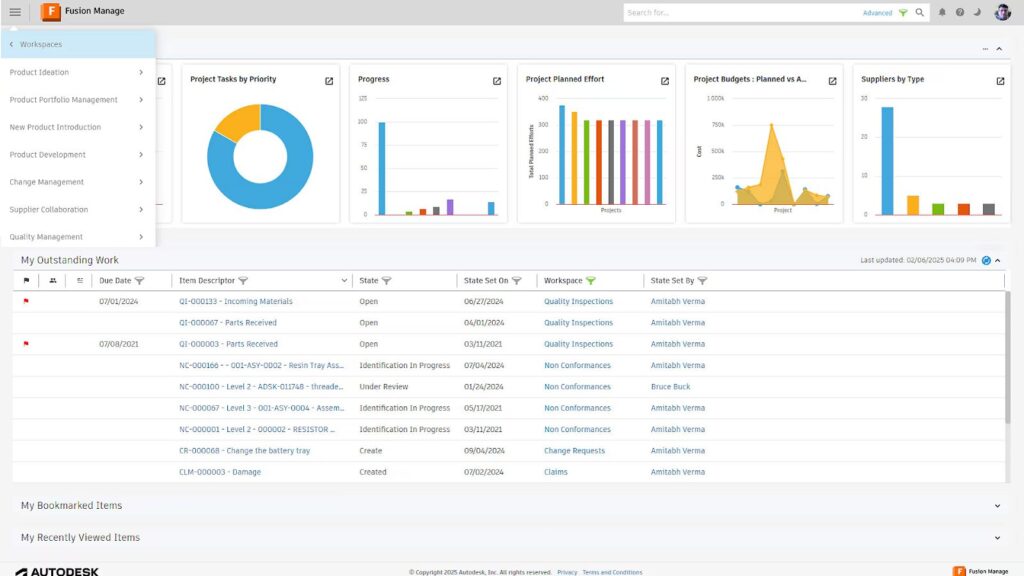
Fusion Manage is Autodesk’s flagship cloud PLM solution, built to empower cross-functional teams with real-time access to workflows and product data. The tool features a cloud-native architecture and highly configurable workflows that simplify submitting engineering change requests (ECRs), tracking engineering change orders (ECOs), and managing product development activities. Meanwhile, the tool automates notification and task assignments for stakeholders to stay informed and aligned throughout the product lifecycle.
For organizations already using Autodesk Vault for product data management, Vault PLM offers a hybrid solution that extends existing PDM capabilities into the cloud. This includes linking design data with broader PLM functions such as bill of materials (BOM) management, new product introduction (NPI), and supplier collaboration. The combined solution allows engineering teams to stay within familiar desktop tools while stakeholders in manufacturing and procurement gain access to structured, cloud-based processes.
Change management is one place where Autodesk’s PLM tools deliver measurable value. Through Fusion Manage, every design change is automatically documented, creating a clear audit trail of what changed, when, and by whom. With high transparency and traceability, companies can reduce rework and improve product quality over time. Similarly, PLM features like impact analysis give organizations the power to evaluate the downstream effects of design changes before implementation and minimize surprises late in the process.
Unlocking better product development
In this new world of complex products and geographically dispersed teams, Autodesk’s cloud PLM solutions offer improved agility and higher product quality. By combining powerful configuration options with user-friendly interfaces and enterprise-grade security, Autodesk is making PLM adoption practical for both mid-sized manufacturers and large enterprises.