 Jessica Porter
Evolving weather patterns and increasing rainfall lead to water and drainage challenges for homes, businesses, and infrastructure. Developers must incorporate drainage systems in their planning that can solve current water challenges and meet tomorrow’s unknown water management needs. Soakaways can create safer, more resilient communities while protecting the environment.
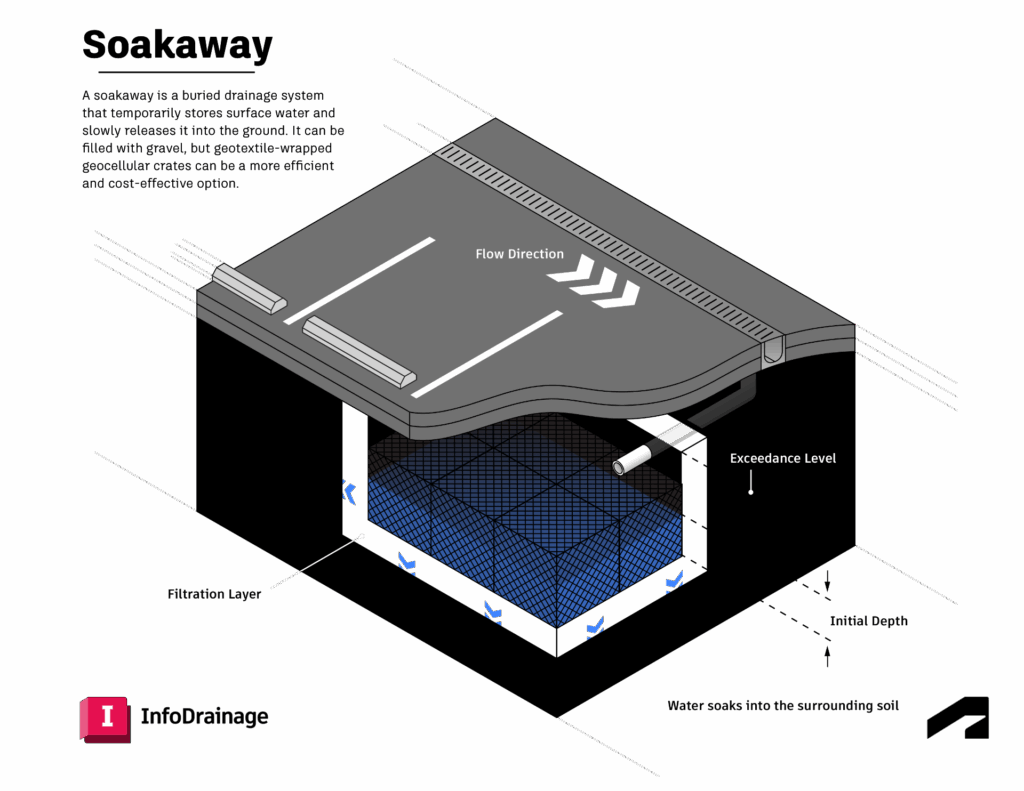
What are soakaways?
Soakaways reduce the impact of heavy rainfall and excess surface water on built environments by mimicking natural water management. They capture water run-off, store it, and then slowly release it back into the ground, much like natural vegetated areas. Soakaways are low-impact, cost-effective, and highly sustainable, providing an effective solution for green drainage design strategies.
Soakaways are Sustainable Design Systems (SuDS), also called Low-Impact Development (LID) systems or Best Management Practices (BMPs) in the United States and Water Sensitive Urban Design (WSUD) systems in Australia.
How do soakaways work?
Soakaways are pits or trenches that are either filled with porous materials such as coarse stone or rubble or with plastic soakaway crates. They may include a lining of brickwork, precast concrete, or polyethylene rings. During heavy rainfall, excess water filters through the porous material and slowly soaks into the soil.
Soakaway: rubble vs crates
Filling a soakaway with rubble may instinctively be seen as the preferred method, but crates actually offer some important benefits:
- Efficiency: Soakaway crates have an extremely high void ratio (up to 96%), so they can actually hold more water than rubble.
- Cost: Moving huge amounts of rubble can be time consuming and expensive, whereas plastic crates are lightweight, easy to transport, and easy to maneuver into their resting location.
- Compaction: Over time, rubble can shift and silt and dirt can clog open spaces, leading to compaction of the soil. Plastic crates are typically wrapped in a geotextile membrane, either on site by a crew or delivered pre-wrapped to a project site, which helps prevent clogging.
Stormwater management in dense areas
Soakways provide stormwater attenuation, reducing the impact of heavy rainwater and flooding on built environments. They are designed to accommodate anticipated water run-off from roofs, pavements, and other impermeable surfaces.
As storms occur with increasing frequency and impact, soakways can protect homes, businesses, and infrastructure in dense and urban areas from flooding.
- Versatility: Soakaways are cost-effective and highly customisable, allowing additional development in urban areas and those at capacity with existing drainage solutions.
- Strength: Soakaways enhance the effectiveness of other SuDS – including bioretention systems, infiltration trenches, cellular storage, porous pavement, and swales – by managing overflow water.
- Standards: They can help highways and roadways meet strict guidelines for drainage and regulatory compliance by connecting systems of soakaways.
Protecting the environment
Soakaways allow water to soak into the soil naturally while filtering contaminants, offering many environmental benefits:
- Reduce pollution: The porous material in soakaways acts as a filter. As stormwater runs through the system, sediment and pollutants are removed before entering natural waterways.
- Increase moisture: Soakaways allow excess water to soak into the soil instead of washing away, increasing soil moisture content and helping trees, plants, and wildlife stay hydrated.
- Retain water: Soakaways recharge groundwater, which replenishes aquifers and helps maintain the natural water cycle. This is particularly beneficial in drought-prone areas and those with decreasing groundwater levels.
- Prevent erosion: Because water slowly soaks into the soil, soakaways protect nearby water sources from erosion caused by rushing excess water.
Choosing soakaways for water management
Soakaways are commonly used in residential and commercial properties where space is limited and an effective drainage solution is needed to manage excess water sustainably. They are easy to retrofit and require minimal maintenance.
Not all locations are compatible with soakaways. Soakways work best in permeable soil that allows water to soak in slowly. They do not work in impermeable soils like clay or polluted soil. Because soakaways are backfilled pits, they do not work in areas with a high water table. Soakaways also should not be used in sites that may put structural foundations at risk.
Incorporating soakaways into drainage design
InfoDrainage is a design and analysis solution that helps developers, designers, contractors, engineers, and landscape architects create drainage systems. Users can create soakaways in a model to determine their effectiveness for each development based on simulations using real-time data.
InfoDrainage shows natural flow paths to identify overland flow patterns and includes hydraulic analysis for pipes, manholes, storage, and green infrastructure such as soakaways and other SuDS that help reduce the risk of flooding. Leveraging flexible reporting, cloud simulations, and AI flood calculations, users can create the right system, or combination of systems, for each job.
InfoDrainage integrates with GIS data and Civil 3D to provide a holistic design, allowing drainage and civil infrastructure design to work in tandem. InfoDrainage allows easy import/export across many types of workflows with Autodesk apps, like InfraWorks, and even apps outside the Autodesk family.
Try InfoDrainage on your next project to make a real difference in sustainable drainage solutions to create a safer, more resilient future for the built environment.
More about SuDS
In addition to this article on soakaways, we have articles on bioretention systems, swales, infiltration trenches, cellular storage, porous pavement, rain gardens, and wet ponds and infiltration basins – plus plenty of other sustainable drainage design resources:
- Read the SuDS manual: We have a comprehensive Guide to Representing SuDS in InfoDrainage in accordance with the SuDS Manual Ciria 753.
- Features and functionality: Our documentation can help you accurately model and size rain gardens, as well as all of the Stormwater Controls available inside InfoDrainage.
- Learn the basics: We offer an excellent video, “Fundamentals of Drainage Design,” for budding civil engineers, urban planners, or anyone interested in understanding how drainage systems work.
- Dig into the InfoDrainage Technical Information Hub and examine how InfoDrainage conforms to industry standards.
- Try it out: Don’t have a copy of InfoDrainage? We offer a 30-day free trial with no credit card required.
- Get it for free? Are you a student or educator? If so, we have some very good news for you.