The construction industry thrives on innovation—and one of the most exciting breakthroughs in recent years is mass timber. Long embraced in Europe for its sustainability and design potential, mass timber is now gaining traction in the United States.
From high-rise towers to community centers, this engineered wood product is reshaping what's possible in modern buildings.
Let's dive into the ins and outs of mass timber and how it's used in construction.
Table of contents
Mass timber is a category of engineered wood products made by layering and bonding pieces of wood together to create structural components strong enough to replace concrete and steel.
Beyond just being a material used in construction, mass timber is a movement toward sustainable, high-performance building. It's a low-carbon alternative to concrete and steel that showcases both strength and natural beauty.
"When discussing mass timber, we commonly refer to cross-laminated timber (CLT) or glulam—that is, glue-laminated timber," explains Ariana Cohn (in episode 84 of the Digital Builder podcast), Digital Construction Engineer at Timberlab, an employee-owned firm and subsidiary of Swinerton Incorporated that focuses on mass timber.
These products are already approved under modern building codes, including those that permit tall wood buildings, giving developers confidence in safety and compliance.
Aside from aesthetics, mass timber can deliver other tangible benefits: shorter construction timelines, less waste, and enhanced structural performance. For architects and builders alike, it's an opportunity to create spaces that are better for the planet—all while offering the warmth and versatility of wood.
Mass timber isn't one-size-fits-all, and it comes in a variety of forms. Here are some of the types to consider for your projects.
CLT panels are created by layering boards at right angles, giving them excellent dimensional stability and fire resistance. They're widely used in floors, walls, and even roofs.
Pros: Strong in two directions, quick to install, excellent fire resistance.
Cons: Heavier than some alternatives, may require cranes for placement.
Best for: Mid- to high-rise residential projects, office buildings, schools, and modular construction.
Glulam is made by bonding layers of lumber with adhesives, allowing for long spans and creative architectural shapes. It's often used for beams, columns, and trusses.
Pros: Flexible design possibilities, strong load-bearing capacity, ideal for exposed architectural features.
Cons: Requires careful detailing at connections; adhesives add to embodied carbon.
Best for: Large public spaces, stadiums, cultural centers, and buildings with wide open spans.
Nail laminated timber (NLT) stacks dimensional lumber on edge, fastening it with nails or screws. The result is a sturdy panel with a traditional look, often left exposed for visual impact.
Pros: Cost-effective, easy to source and fabricate, warm aesthetic.
Cons: Less airtight than CLT, requires additional detailing for soundproofing.
Best for: Floors and ceilings in office spaces, retail environments, and community buildings.
DLT is similar to NLT but uses wooden dowels inserted through CNC-milled holes instead of nails or glue. This makes it an all-wood, glue-free system.
Pros: 100% wood (no adhesives or nails), sustainable, precision-fit.
Cons: Limited availability in North America, requires specialized equipment.
Best for: Environmentally focused projects, schools, cultural centers, and wellness-oriented spaces.
LVL and SCL are made by bonding thin wood veneers or strands together, creating highly consistent, engineered structural members.
Pros: High strength-to-weight ratio, uniform quality, readily available.
Cons: Typically hidden from view (less aesthetic appeal), adhesives used in production.
Best for: Beams, headers, and framing in residential, commercial, and hybrid mass timber projects.
Mass timber can be adapted into a range of building systems to meet the needs of various structures, including residential homes, commercial areas, and industrial spaces. Let's break it down:
Post-and-beam systems use glulam or LVL columns and beams to support the structure, creating wide-open interiors free from obstructive walls. This approach is ideal for offices, schools, or event venues that require flexible, column-free layouts.
Panelized systems—using CLT, NLT, or DLT—create large prefabricated panels for floors, walls, and roofs. These panels arrive onsite ready to install, dramatically reducing construction time, labor needs, and waste. They also provide superior airtightness and structural performance, making them well-suited for multi-family housing and high-rise projects.
Mass timber also works seamlessly alongside concrete and steel, creating hybrid systems that maximize structural efficiency.
Concrete can be used for foundations, cores, or floor toppings, while timber provides warmth and sustainability. This pairing boosts acoustic and fire performance.
Steel connections combined with timber allow for longer spans and greater design flexibility, particularly in industrial or high-load environments.
Together, these hybrid approaches enable architects to balance cost, safety, and performance—while still delivering the aesthetic and environmental benefits of wood.
Mass timber delivers both environmental and performance advantages that come to life across the building lifecycle. Let's take a closer look at some of those benefits.
Mass timber construction helps reduce embodied carbon while promoting sustainable forestry practices. As Ariana points out, "Mass timber really has that element where you feel good about building it. It's good for the people, and it's good for the planet. The amount of embodied carbon is so much less than in a traditional construction."
By storing carbon instead of emitting it, responsibly sourced timber provides a renewable path forward for climate-conscious projects.
One project that's seen the environmental benefits of mass timber first hand is 1 De Haro in San Francisco, the city's first cross-laminated timber building and California's first multi-story mass timber structure.
Designed by Perkins&Will, this 134,000-square-foot mixed-use building offsets 15–20 years of operational energy through its embodied carbon savings.
1 De Haro was built from black spruce, which was supplied by Montreal-based Nordic Structures. Perkins&Will collaborated with Nordic Structures to fabricate CLT and glulam elements, using sustainably harvested timber and advanced prefabrication methods that reduced waste and paved the way for faster onsite assembly.
In addition to its positive environmental impact, mass timber also accelerates timelines and building processes.
"Due to the nature of prefabricated offsite construction, working with mass timber is so much faster. We can take six weeks or more off the schedule compared to a typical building," says Ariana.
Plus, the construction material's reduced weight means fewer foundation requirements. "It's so much lighter. So not only are we eliminating concrete in a big portion of the occupied building space, but we are eliminating a lot of the foundation needed just because of the nature of the lighter material."
Construction firms today face labor challenges, and fewer people on site can increase risks to safety. Mass timber helps alleviate these hurdles by reducing the need for extensive onsite crews.
"Since there is so much prefabrication involved, we implement offsite construction and ship parts to site," explains Ariana. "So, there's less onsite skilled labor needed, and less work being done, and it's so much safer. We see fewer accidents."
Despite its growing popularity, mass timber is still surrounded by myths that can hold back adoption. Let's set the record straight.
One of the most common myths about mass timber is that it burns quickly and compromises safety.
According to Ariana, that's not the case.
"Fire resistance in mass timber is a huge topic of research and debate, but it's really interesting because timber and wood, in general, actually have inherent fire-resistant properties. Wood forms this char layer, which slows the speed at which wood burns," she says.
One of the most common mass timber misconceptions is that it drives deforestation.
"When people think of mass timber, they think we're cutting down trees when that's not the case. Mass timber and lumber actually put an emphasis on forestry management and creating sustainable forests."
Ariana adds, "We're not harvesting old large trees. No one does that anymore. We're really looking for younger trees and it allows us to use those trees that previously, might have just been cut down and thrown away to protect against wildfires."
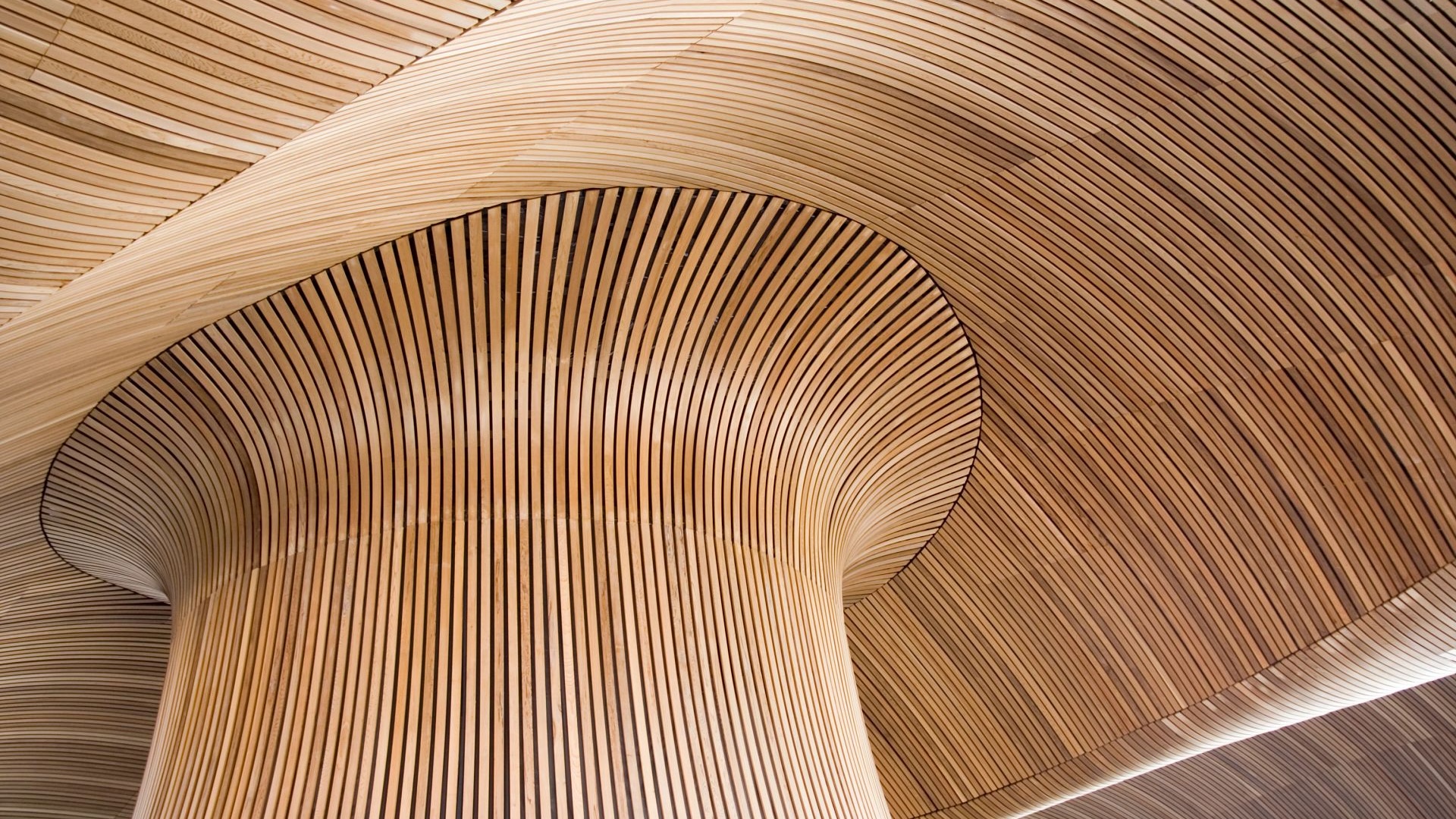
Some assume mass timber limits architectural creativity or results in a rustic, "cabin-like" look. In reality, mass timber offers incredible design versatility—whether left exposed to showcase natural warmth or combined with steel, concrete, and glass for a sleek, modern finish. Today's projects prove timber structures can be every bit as striking and polished as conventional builds.
A common myth is that timber can't match the strength of steel or concrete. In fact, engineered products like CLT and glulam rival, and sometimes exceed, the load-bearing performance of traditional materials. These systems are already approved for tall buildings in many regions, proving mass timber is more than capable of meeting stringent safety and structural standards.
As promising as mass timber is, it still faces hurdles that impact how quickly it can scale in construction projects.
Because mass timber is still relatively new in the US, building codes and permitting processes haven't fully caught up. "The biggest limitation we're seeing right now is code adoption because mass timber is a newer industry in the US," remarks Ariana.
While Europe has decades of experience with timber high-rises, US jurisdictions vary widely in their acceptance. This patchwork of regulations can slow down approvals and discourage developers who are unfamiliar with the process.
Fortunately, recent code changes at the national and state level are beginning to open the door for broader adoption.
According to Ariana, "A number of individuals, including those at Timberlab and outside, are conducting research daily to aid the process of adopting more codes in all jurisdictions and proving that mass timber can work in many different applications."
Mass timber performs exceptionally well in many areas, but seismic and lateral loads remain key considerations. Compared to steel or reinforced concrete, timber requires careful engineering and connection detailing to handle shear forces, wind loads, and earthquakes.
Advances in hybrid systems and performance testing are helping overcome these barriers, but seismic-prone regions like California still demand additional design scrutiny. For mass timber to expand into more diverse markets, continued research and rigorous testing are a must.
The key to driving adoption is a combination of championing the benefits of sustainable construction materials and addressing the challenges and concerns surrounding mass timber.
Education is key to building confidence in mass timber. We must showcase successful projects, host site tours, and share performance data. Doing so will help architects, engineers, and developers see what's possible.
Highlighting real-world case studies not only debunks mass timber misconceptions but also inspires the next wave of projects.
Mass timber thrives when integrated with other building systems and trades. That's why the industry should encourage collaboration between timber specialists, concrete crews, steel fabricators, and mechanical trades. When these teams are all aligned, they can ensure smoother projects and stronger outcomes.
It's all about showing, not just telling. Demonstrating how timber is designed, fabricated, and assembled can be a powerful tool for adoption. Factory tours and videos reveal the precision of CNC milling, the efficiency of prefabrication in construction, and the streamlined installation onsite.
Transparency builds trust. By listening to developer concerns around fire safety, cost, or regulations—and answering with data, testing, and open dialogue—advocates can reduce hesitation. Clear communication reassures stakeholders that mass timber isn't experimental, but a proven, evolving solution ready for today's construction challenges.
Mass timber adoption depends on building codes keeping pace with construction innovation. Here's a look at what's happening in this space.
Building codes like the International Building Code (IBC), developed by the International Code Council (ICC), serve as the blueprint for mass timber's legitimacy. These codes dictate safety, fire performance, and design standards nationwide.
Recent editions of the IBC (2021 and 2024) have dramatically expanded opportunities for mass timber projects. The introduction of construction types IV‑A, IV‑B, and IV‑C now enables buildings up to 18, 12, and 9 stories, respectively.
A key design update in the 2024 IBC: Type IV‑B constructions now permit 100% exposure of mass timber ceiling and beam surfaces, up from just 20% in 2021.
Also, states are catching up: WoodWorks reports that as of July 2025, multiple states "have adopted mass timber provisions of the 2021 and/or 2024 IBC, either whole or with local amendments." They include:
| State | Adopted Code | Notes |
| Alabama | 2021 IBC | |
| Alaska | 2021 IBC | |
| Arkansas | 2021 IBC | |
| California | 2021 IBC (via 2022 California Building Code) | |
| Colorado | 2021 IBC | |
| Connecticut | 2021 IBC | |
| Georgia | 2021 IBC | Tall Mass Timber Provisions in Appendix P |
| Hawaii | 2021 IBC | |
| Idaho | 2021 IBC | Includes Tall Mass Timber Provisions |
| Illinois | 2024 IBC | |
| Louisiana | 2021 IBC | |
| Maryland | 2021 IBC | |
| Massachusetts | 2021 IBC | |
| Michigan | 2021 IBC | Effective 2025 |
| Mississippi | 2024 IBC | |
| Montana | 2021 IBC | |
| New Hampshire | 2021 IBC | |
| New Jersey | 2021 IBC | |
| New Mexico | 2021 IBC | |
| North Carolina | 2021 IBC | |
| North Dakota | 2021 IBC | |
| Ohio | 2021 IBC | |
| Oregon | 2024 IBC | Includes Tall Mass Timber Provisions |
| South Carolina | 2021 IBC | |
| South Dakota | 2021 IBC | |
| Tennessee | 2021 IBC | |
| Texas | 2021 IBC | |
| Utah | 2021 IBC | |
| Virginia | 2021 IBC | |
| Washington | 2024 IBC | Includes Tall Mass Timber Provisions |
| Wyoming | 2024 IBC |
Governments, manufacturers, and universities are driving mass timber forward through bold initiatives and research. Consider the following:
British Columbia is advancing mass timber through proactive policy, funding, and regulation. The province's Mass Timber Action Plan brings together government, Indigenous partners, and industry to expand manufacturing, boost workforce development, and promote low-carbon construction.
Simultaneously, the Mass Timber Demonstration Program (MTDP) offers funding for pioneering timber projects, while the 2024 BC Building Code now allows mass timber buildings up to 18 stories.
North America is embracing mass timber innovation through expanding manufacturing networks and cutting-edge research hubs. According to the USDA's Mass Timber Strategy, as of May 2023, seven CLT plants exist across five US states, alongside 20 glulam manufacturers spread across 11 states.
Academic institutions are also advancing the field. For example, researchers at Auburn University added a powerful CLT press to their lab. This allows them to rapidly move from adhesive innovation to full-scale structural testing, accelerating the development of safer, more sustainable mass timber assemblies.
Mass timber isn't just about sustainability; it's built to deliver high performance, safety, and long-term reliability in real-world conditions.
Mass timber products like CLT and glulam are precision-engineered for strength, stability, and versatility. Prefabrication ensures quality control, reducing onsite errors while supporting everything from residential builds to high-rise towers.
Contrary to common myths, mass timber performs exceptionally under fire tests. Thick members form a protective char layer that slows burning, preserving structural strength longer than unprotected steel in many scenarios.
Engineered wood is designed to withstand heavy loads and long service lives. With proper detailing and moisture control, mass timber maintains its structural integrity for decades, rivaling traditional building materials.
Modern treatment processes and protective finishes enhance timber's natural defenses. By keeping elements dry through smart design, mass timber resists pests, mold, and decay—ensuring safety, strength, and beauty over the building's lifetime.
As mass timber projects grow in scale, insurers are adapting to balance risk with opportunity.
Mass timber's proven safety and fire resistance can help lower long-term risk, but projects may still require specialized coverage. Developers are increasingly working with insurers familiar with engineered wood to secure competitive rates and tailored policies.
Smart MEP design keeps mass timber projects efficient and safe. Here are some things to consider:
Mass timber buildings are designed with prefabricated openings and chases that accommodate MEP systems. Early collaboration between architects, engineers, and trades ensures smooth coordination, minimizing costly onsite modifications and preserving structural performance.
Integrating MEP requires careful planning to balance efficiency with aesthetics. Designers must consider routing, penetrations, and fireproofing requirements early in the process, ensuring systems complement exposed timber elements while meeting safety and performance standards.
Building with mass timber requires a different approach to planning, coordination, and project delivery compared to traditional materials.
Mass timber projects demand specialized expertise across the project team. From architects to contractors, everyone needs to understand the nuances of engineered wood products, prefabrication, and digital modeling.
Close collaboration with suppliers and fabricators is also essential, since components are often manufactured offsite with millimeter precision. Teams with experience in mass timber can better anticipate challenges, streamline decision-making, and keep projects on track.
Mass timber changes the project timeline. Prefabricated panels and beams can speed installation, but scheduling must account for longer lead times in design, fabrication, and shipping.
Budgeting also requires a shift in thinking: while upfront costs may be higher than conventional framing, savings emerge through faster assembly, reduced labor needs, and less waste. Proper planning ensures project owners realize both the cost and time efficiencies mass timber can deliver.
As mass timber adoption grows, technology and carbon-focused design tools are shaping what comes next for sustainable construction.
The future of mass timber lies in pairing sustainable construction materials with advanced tools that help teams collaborate better, measure the environmental impact of construction materials and make more informed decisions.
Consider the following:
Tools like EC3 are changing how firms evaluate material choices. Lake|Flato Architects, known for projects like the Austin Central Library and Hotel Magdalena, uses EC3 to measure embodied carbon directly from their design models.
Lake|Flato utilizes Tally, a lifecycle assessment app that measures the environmental impact of construction materials directly within Revit. Now part of Building Transparency, Tally integrates with the Embodied Carbon in Construction Calculator (EC3), a free database of Environmental Product Declarations (EPDs). Together, they streamline workflows and make it easier to compare materials and reduce embodied carbon.
This gives teams confidence in selecting timber over steel or concrete, quantifying savings of up to 38–58% in embodied carbon when biogenic carbon is included.
BIM is helping make mass timber projects more efficient, predictable, and collaborative.
Dura Vermeer's Alliander Westpoort project in the Netherlands is a prime example. Alliander Westpoort is an entirely timber made structure, and it was built with efficiency and transparency in mind.
The firm leveraged Autodesk tools to establish a common data environment across its supply chain.
Nearly 90% of the project's components were modeled in 3D, enabling better coordination and saving up to 25% in model review time. Prefabrication in construction and standardized document management further streamlined workflows, helping the team deliver the 23,000-square-meter project in just one year.
This kind of digital integration not only accelerates timelines but also ensures higher-quality, future-proofed timber structures.

Ongoing research is expanding the horizons of what mass timber can do.
One area that's drawing attention is timber bamboo. Companies like BamCore are transforming this fast-growing, carbon-sinking grass into engineered panels for multifamily, single-family, and commercial projects.
Unlike traditional wood, bamboo can mature in just three years, sequesters five to 10 times more carbon, and regenerates after harvest without killing the plant. Prefabricated bamboo systems also save time, reduce waste, and offer labor efficiencies onsite. Research suggests that hybrid bamboo-and-CLT systems could be stronger and thinner, opening up new opportunities for climate-positive construction.
Mass timber is more than a building material—it's a movement reshaping how we design and build. With stronger codes, smarter tools, and growing industry confidence, it's positioned to play a defining role in sustainable construction.Looking to use mass timber in your project?