Buildings and infrastructure generate valuable data long after construction wraps up. But how can organizations put that information to work?
In this episode of the Digital Builder podcast, I sit down with Stephen Hooper, Senior Vice President of Autodesk Operations Solutions, and Chris Turlica, Head of MaintainX at Autodesk, to discuss the growing importance of connected operations.
We explore how organizations can bridge the gap between construction and operations and better harness operational data.
We discuss:
The way we design, build, and operate assets is changing. And according to Stephen, several factors are pushing operations into the spotlight.
For starters, there's AI. While much of the conversation has focused on how AI is transforming software, Stephen believes its impact on the physical world could be just as significant.
"I think Chris and I share the view that it's going to be equally disruptive in the physical environment. So we're going to see physical AI, and that's going to happen when AI converges with more advanced forms of robotics and automation control."
Chris points to another major shift: equipment is getting smarter and generating more data.
"The equipment is starting to talk back to us. It's starting to tell us, 'Here's what's going on. Here's what you need to know.'"
With that, firms must find ways to capture that information and make it useful across the asset lifecycle.
Economic and workforce challenges also come into play
Beyond technology, organizations also face a host of economic and workforce issues.
“We have a series of macroeconomic shocks globally with tariffs and supply chain volatility, plus rising cost of energy. All of these things contribute to customers needing to control costs, improve operational efficiency, deploy their capital more effectively, and improve their overall employee satisfaction,” adds Stephen.
There's also the issue of knowledge loss as experienced workers retire.
“For every five people in the front lines that are retiring, only two are joining,” Chris warns.
That makes it even more important for organizations to document what their teams know and make that information easy to find. Otherwise, new employees spend valuable time tracking down answers or figuring out problems their predecessors have already solved.
Chris continues, “We just cannot have that wasted time or confusion with everybody having to relearn the same information. Seventy percent of critical information is about to walk out the door.”
There's a big difference between how an asset is designed to perform and what actually happens once people start using it.
Often, teams only discover what works, what doesn't, and what they could have done differently during operations.
Real-world operations reveal problems that design can't always predict
Chris points out that even the most carefully designed equipment can run into unexpected issues once it's put to work.
"Everybody has a plan until it faces reality. And when you face reality, you realize that in a high-vibration environment, something fails a certain way."
These are the kinds of lessons that are difficult to anticipate during design. Perhaps a component keeps failing under specific conditions, or a piece of equipment causes repetitive strain injuries for operators.
The problem is that these insights don't always make their way back to the people designing the next version.
Chris says manufacturers can end up producing third- or fourth-generation equipment that still has the same problems.
"It's breaking in the same way, and it's creating this repetitive stress injury for operators in the exact same way."
That's why it's so important to connect operational data back to design. Teams need to learn from how assets perform in the real world so they can avoid repeating the same mistakes.
Data silos make it difficult to connect the dots
So why hasn't the industry figured this out?
According to Stephen, much of the challenge comes down to how information moves, or doesn't move, between teams and organizations.
"The data's lived in different silos, and traditionally that's because it's been encapsulated by desktop products that have been used in isolation and often by different personas in the same organization, or it's actually been different organizations."
Consider an equipment manufacturer. The person designing a product isn't necessarily the one manufacturing it. Once that product reaches a building, another team takes over maintenance and operations.
Each group has valuable information, but they don't always have an easy way to share it.
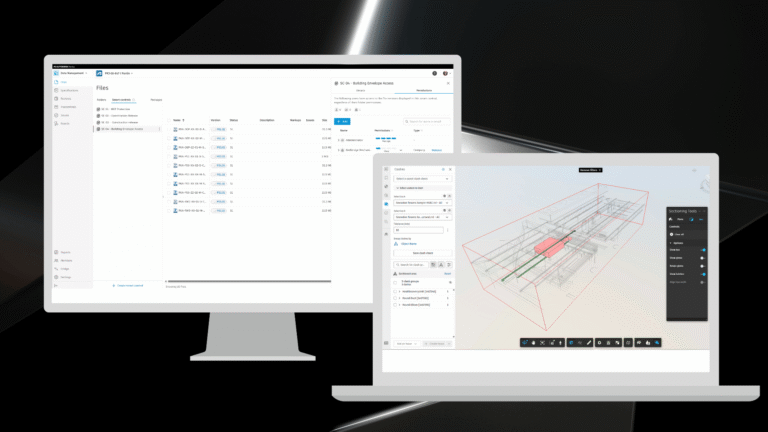
Stephen believes connecting tools across the Autodesk portfolio can help address this. By bringing together Autodesk Forma, Autodesk Tandem, and MaintainX, organizations can make information available across the asset lifecycle.
That could mean using maintenance data to improve a heat exchanger or analyzing how people move through a building to inform its next layout.
"You can't do that update on the architectural layout design unless you're able to capture the operational data," Stephen remarks.
He compares a building to a living organism, with operational data serving as its biometrics.
"Effectively, you need an Apple Watch that's telling you what's happening."
Owners need to push for better information sharing
Technology can help connect the dots, but Stephen also believes asset owners have a role to play in making sure information flows between project stakeholders.
He points to the automotive industry, where manufacturers routinely require suppliers to provide digital information in specific formats and standards.
AEC owners, he argues, could take a similar approach.
"Operators don't seem to leverage the economic buying power that they have to exercise over their supply chain when they're dealing with contractors."
That means setting clearer expectations around the information contractors and suppliers need to deliver, rather than treating data sharing as an afterthought.
Stephen acknowledges that this shift may feel uncomfortable, but he believes it's necessary to close the loop between design, construction, and operations.
Once owners see the business value of better operational data, they'll have more reason to push those requirements throughout their supply networks.
Connecting operational data to the rest of the asset lifecycle sounds great in theory. But what does it actually look like in practice?
Chris and Stephen shared a few examples of how organizations can use technology to make maintenance easier and get more value from their operational data.
Using real-time equipment data to speed up maintenance
Chris points to a construction materials company that's connecting its existing equipment and SCADA system to MaintainX through Ignition.
The firm wanted to give maintenance teams real-time information about what's happening with their equipment so they can respond faster when something goes wrong.
"One of the biggest issues they have is mean time to first action. Something goes wrong, how long does it actually take you for the right human who knows how to fix that exact problem to have the right tools and the right parts and be able to show up with a wrench in their hand to actually fix the thing?"
That's an important metric, especially when equipment downtime can cost hundreds of thousands of dollars.
But identifying the problem is only half the battle. Technicians also need to know how to fix it.
Chris notes that technicians can spend 60% of their time researching and troubleshooting. Having access to equipment histories, diagrams, and videos of previous repairs can help them find answers faster.
As he puts it, "There's so much wasted time just trying to figure out what it is that you need to do."
Making technical knowledge easier to access
Stephen shares a relatable example from his own experience. When his bicycle's electronic gear system needed a battery replacement, he turned to YouTube to figure out how to do it.
But maintenance technicians working on specialized equipment don't always have that option. They need accurate, equipment-specific instructions, and following the wrong guidance could even void a warranty.
Connected systems and AI can help by giving technicians access to approved instructions and past maintenance records. That way, organizations can make troubleshooting easier while preserving valuable knowledge.
Stephen also sees this as an opportunity to improve the employee experience.
"Being able to empower technicians to get access that quickly," he says, is a major benefit.
After all, no one wants to spend their day digging through outdated manuals or filling out paperwork.
"You want to be using the latest digital tools that make your job easier and more fun."
Technology plays a big role in attracting and retaining talent, especially as younger professionals enter the workforce.
Think about it. If you're choosing between a company that gives you modern tools to do your job and one that still relies on paper forms and outdated manuals, which would you rather work for?
Give frontline workers the tools they deserve
Chris believes organizations need to rethink how they equip frontline workers, especially when it comes to accessing information.
"These folks are actually knowledge workers. They deserve to be treated like knowledge workers. And we spend so much money and time giving all the tools for people sitting at a desk, but 70% of the workforce is frontline workers."
He points out that many technicians still spend their days doing manual and tedious admin work like data entry and searching for information. That's hardly an appealing work environment, especially for younger professionals who've grown up using intuitive digital tools.
"We all grew up wanting to play with robots, wanting to play with stuff in the physical world."
The next generation can drive technology adoption
The good news is that younger workers aren't necessarily waiting for their employers to modernize.
Stephen points to MaintainX as an example of how new technology can spread organically across organizations.
Young professionals discover tools that make their jobs easier, start using them, and eventually introduce those same tools to their next employers.
"They go somewhere else, and they want to be the hot new person that's coming in and shaking stuff up. And so they bring his stuff with them, and then this stuff grows like wildfire because people are taking it around," Stephen explains.
He compares this trend to the early days of 3D modeling, when younger employees introduced the technology to their workplaces and encouraged others to adopt it.
For Stephen, this enthusiasm is a promising sign.
"Young people have a passion for it. They find this energizing, and they feel that this is a way they can make a career for themselves."
AI is getting better at understanding instructions and performing complex tasks. But when it comes to the physical world, there's another piece of the puzzle: operational data.
As Stephen explains, the more context AI has, the more useful it becomes.
"Anyone who uses an AI knows that when you prompt an AI to do something, the more context you can give it, the better the response that you'll get."
That context becomes even more important when AI starts interacting with physical equipment.
Physical AI needs more than instructions
Stephen shares an example of a startup that's developing AI-powered robots capable of learning new tasks.
In one demonstration, a robot learned to fold laundry by finding and watching YouTube videos. It used cameras and a feedback loop to understand its movements and adjust its actions.
Chris clarifies just how little instruction the system needed.
"It wasn't fed a data set. What it was fed was 'fold laundry.' And it's like, okay, how do we do that? Here's what these humans are doing."
It's an impressive example, but Stephen points out an important distinction.
While anyone can find videos about folding laundry online, the information needed to operate specialized industrial equipment isn't publicly available.
"If I'm a company that makes heat exchangers, that information on the manufacture of my heat exchangers is not freely available on the web, and I don't ever want it to be freely. That's my IP."
That's why organizations need to start capturing and organizing their operational knowledge today. Without that information, they'll struggle to take advantage of physical AI as the technology matures.
Freeing people up for more meaningful work
Chris also sees physical AI as an opportunity to rethink how people spend their time.
He points to Cintas, a MaintainX customer that handles industrial uniforms, as an example of a business where robotics could help automate repetitive tasks like folding laundry.
Rather than having employees perform the same motion for eight hours, organizations could give them opportunities to learn new skills and take on more rewarding work.
"We need to get them to do something more exciting and they want to. And again, we need to have humans do human work. Sitting, doing something repetitive for eight hours a day, that's not human work."
Digital Builder is hosted by me, Eric Thomas. Remember, new episodes of Digital Builder go live every week. Listen to the Digital Builder Podcast on:
or wherever you listen to podcasts.