This is a hard reality to face, but many areas in the United States are facing a housing crisis. And if we keep building the way we’ve always built, we’ll keep getting the same results: slower timelines, higher costs, and fewer people served.
The good news is that there are folks in the industry committed to addressing the country's housing issues.
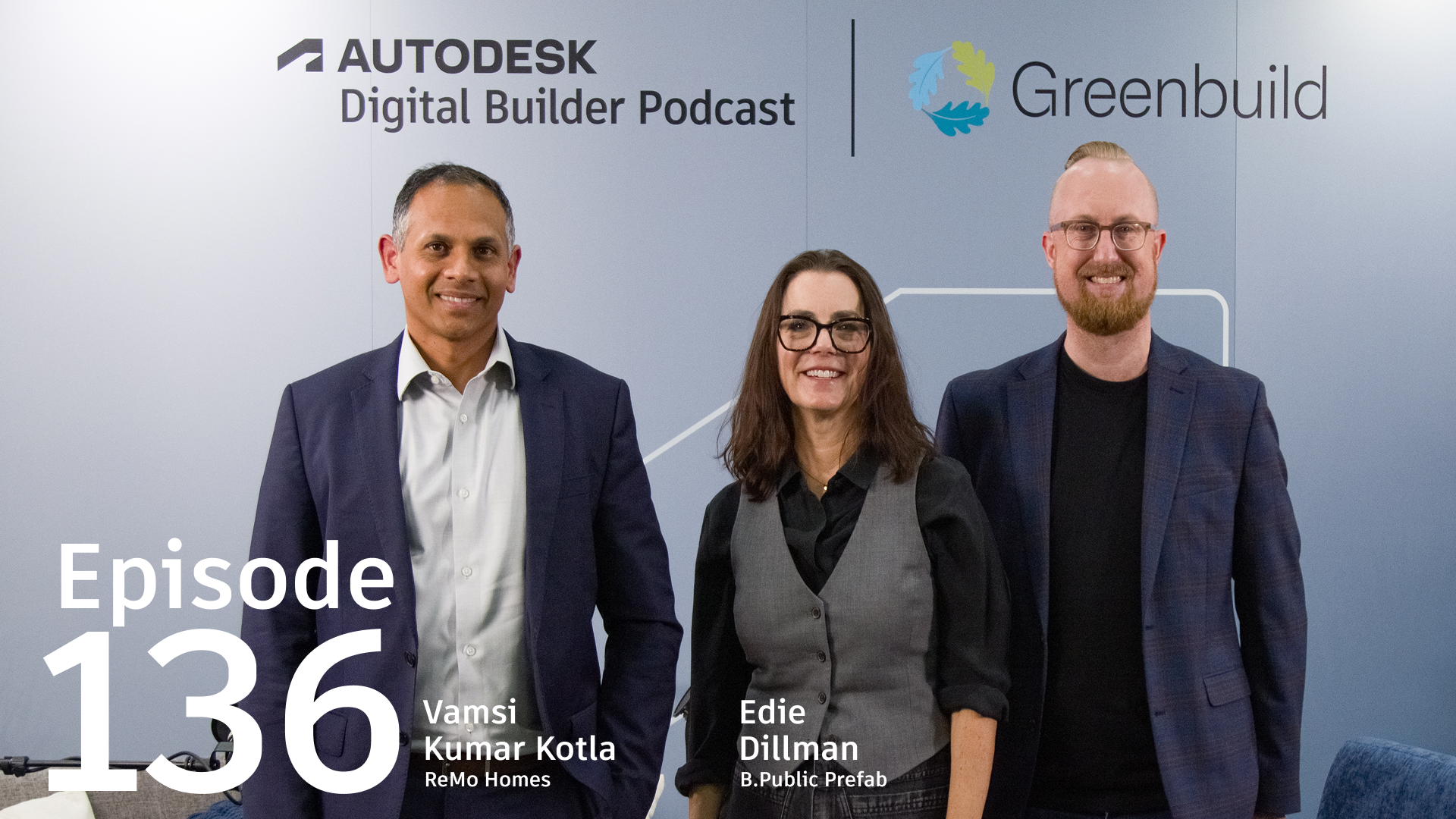
In this episode of Digital Builder, I sat down with Edie Dillman of B.Public Prefab, and Vamsi Kumar Kotla of ReMo Homes, to tackle one of the biggest challenges facing our industry: housing. From wildfire rebuilds to workforce shortages, we unpacked what it really takes to deliver affordable, resilient, and scalable homes. This conversation gets honest about what’s broken—and what’s possible when innovation, collaboration, and a little joy come back into how we build.
We discuss:
When asked about the residential housing crisis, Vamsi didn’t hold back: “Housing is broken in multiple ways,” he says. Here are the main factors driving that reality.
Build costs are outpacing reality
Let’s start with the math.
“Build costs all over the world are outpacing inflation. Operational costs are definitely outpacing inflation,” Vamsi says, and highlights California as an example. “Back in the day, the cost per kilowatt hour used to be 20 cents. Now in some peak times, it’s 50 cents per kilowatt hour—and people’s income didn’t go up by 150%.”
Natural disasters are shrinking supply
Beyond the rise and rise of today’s living costs, natural disasters play a role in the housing crisis.
Vamsi points to the 2018 Camp Fire in Paradise, California. “Only a third of the homes got rebuilt—and half the population is gone.” Years later, recovery still lags.
A more recent example would be the Southern California fires in early 2025. “It happened in places like Altadena,” he recalls. Families are underinsured or uninsured. Some don’t know how to navigate the rebuilding process.
Prices have surged, and it’s the people with the fewest resources who have the fewest options.
We’re not thinking holistically
For her part, Edie emphasizes that the housing crisis cannot be traced to a single cause. It is layered, systemic, and years in the making.
“It's a deeply complex problem. There are a lot of things that we can point to that have driven us to this point where we're not building nearly enough to house the people that we need to.”
She adds that housing affordability isn’t just about the price per square foot; folks must also consider the costs of actually living in their home over the long term.
“We’re thinking about maintenance, utilities, and health.”
All this to say: we need a holistic lens. That means considering build and operating costs, long-term durability, and even workforce capacity.
Because here’s another reality: we’re facing a 20% drop in trades as workers age out. And this comes at a time when demand is higher than ever.
These are challenging times for sure, but there’s still some good news. More communities, builders, and policymakers are waking up to it. And they’re asking for smarter, faster, more resilient solutions.
If you ask most construction pros (or even end-users themselves) whether they can have affordability, sustainability, and scalability at the same time, the answer is usually some version of “pick two.”
Vamsi and Edie don’t buy that.
It doesn’t have to be a tradeoff
“I feel it’s a false choice,” Vamsi says, speaking specifically about volumetric modular. “You don’t need to have a tradeoff. We can have it all. Sustainability, affordability, scalability.”
That doesn’t mean it works everywhere. “Not all sites are suitable for volumetric modular,” he explains. And yes, there are limits to customization before you have to retool a factory.
But for a large percentage of projects, especially standard low-rise multifamily, the model works. “If the developer or homeowner has some flexibility in customization,” he says, “we can do it all.”
The real opportunity is in soft costs
“A big part of construction is soft costs and labor,” Vamsi continues. These include engineering fees, architecture, permitting, etc. While material prices are harder to compress without scale, soft costs can be reduced when you standardize and repeat.
There’s a rule of thumb in modular: if you can do something in a factory, it’s three times more efficient than doing it in the field. Why? Because “the men and women, materials, machinery, and methods are a lot easier to control and optimize.”
Expanding who gets to build
There’s another upside that often gets overlooked.
“When you simplify and standardize your design and production methods,” Vamsi says, “can we open these jobs to women?” Construction has one of the lowest percentages of women in the trades.
Modular opens new doors, thanks to controlled environments and training pathways.
It also creates opportunities for people reentering the workforce. “You can easily teach and train them and bring them back into society,” he says.
We need all of it
Edie takes a broad view. “It’s not a silver bullet,” she remarks. “This is a shotgun approach.”
Some projects will use full modular. Others will rely on panelization. Some will remain site built. “We absolutely need all of them.”
The scale of the problem demands multiple solutions. For example, are you building for urban or rural? Is the environment fire- or flood-prone? Different climates have different constraints.
The path forward is not about choosing one method. It’s about using the right tool for the right project, sharing what works, and pushing beyond minimum code to create resilient, durable homes.
Offsite construction has a perception problem. If you’ve been in this industry long enough, you’ve heard the grumbling. It didn’t fit. It didn’t show up on time. It doesn’t work in the real world.
Changing that mindset starts with giving people more clarity and making sure they feel seen.
Start with components, not disruption
For Edie, it’s all about reframing what prefab actually is.
“Panelization is really like Legos made out of wood and cellulose,” she explains. Eight feet wide, up to 26 feet long. Each panel is engineered, repeatable, and designed to work on site, just like a brick or a window.
“We’re creating usable materials that just happen to be preassembled.”
Offsite is not replacing the builder. It’s delivering a high-performance component that integrates into light-frame, code-compliant construction. You still specify performance levels. You still control the finishes. You still build.
“We’re just taking a portion of the build,” Edie says. “That’s why we talk about it as a transitional offsite solution.”
She adds, “Nothing is hidden except for the cellulose.” The air-tightness layer, the weather barrier, and the thermal performance. Those come built in. Everything else stays flexible.
Precision in the factory, flexibility in the field
When components are standardized, crews know exactly what they’re getting. Instead of assembling a wall piece by piece, you install a structural, insulated envelope that already delivers air tightness and thermal performance. The rest of the work continues as planned. So it’s not a messy Jenga stack. It’s precision.
Of course, precision does not mean rigidity.
Vamsi makes that point from a modular lens. A home is deeply personal. “The homeowner wants to have a say,” he says. You can standardize structure and still offer wide latitude in cladding, windows, appliances, and finishes.
At the same time, you cannot ignore compliance or logistics. “When we say yes to the homeowner, we’ve thought through compliance, supply chain, shipping, and installation.”
Treat builders as partners
You can’t build trust offsite by dismissing field experience.
“Our process and R&D includes direct comments from the field experience of our builders,” Edie says. Every new release incorporates feedback from the people installing the product.
That partnership extends to training. According to Edie, builders come to the shop for building science sessions. They also get hands-on instruction and go through OSHA crane safety training. “It’s the brass tacks,” she says. “You’ve got a beautiful design. Let’s make sure it goes up very well.”
That approach does two things. Not only does it reduce friction, but it signals respect.
Remember, the fastest way to alienate a superintendent is to imply their experience no longer matters. The companies that succeed offsite understand the opposite is true. Technology works best when it complements the craft, not when it tries to replace it.
Technology in housing isn’t just about smart thermostats and apps. It starts much earlier and should last much longer.
Design beyond the project cycle
Vamsi makes a strong point about how we traditionally approach design.
“Some of the brightest people in the world are architects and engineers,” he says. But too often, they are compensated to work project by project, hour by hour. He shares an example of a large airport project that consumed roughly one million hours of engineering time. “That is more engineering hours than building the tallest tower in the world.”
That effort, while impressive, can also be inefficient when repeated from scratch every time.
“At ReMo, we should not be starting the process when the customer gives you cash and ending it when the customer gets to see the home,” he explains. Instead, they invest tens of thousands of hours upfront, through material selection, typologies, regulatory pathways, and more.
Extending care beyond handover
Technology also changes what happens after the keys are handed over.
“Home is one of the biggest purchases a person makes in their life, if not the biggest,” Vamsi says. And yet many builders provide warranty cards and manuals, then disappear.
“That’s not cool.”
His vision looks more like the EV industry. When his electric vehicle had a charging issue, the company diagnosed it remotely in seconds. “Why don’t we expect the same with the home?”
The answer, at least in part, is digital twins. Not just as-designed models, but as-built virtual twins that show plumbing, electrical, mechanical systems, fire suppression, and insulation. If something fails, you do not have to cut open drywall to find the issue. You know where everything lives.
Building resilience into the structure itself
Edie offers a complementary perspective.
Yes, monitoring matters. But resilience shouldn’t depend on an app.
“We’re really focused on not requiring those things to know how your house is doing,” she says. For her team, technology often means better materials and smarter envelopes. “Our technology is really wood and insulation. That’s permanent. Physics isn’t going to break.”
That conservation-first mindset prioritizes passive performance. Airtight construction. Thermal control. Materials that can be repaired decades from now with basic tools.
Smart sensors can prevent costly damage, of course. That said, long-term resilience also comes from building systems that work even when the power is out and the WiFi is down.
Technology in housing is not a single path. It is a spectrum that can go from digital twins and data feedback loops to craftsmanship and building science fundamentals.
The best solutions blend both.
Digital Builder is hosted by me, Eric Thomas. Remember, new episodes of Digital Builder go live every week. Listen to the Digital Builder Podcast on:
or wherever you listen to podcasts.