Upskilling for positive impact: How BDP is building a workforce ready to design a better world
BDP is transforming sustainable design by upskilling its global workforce, embedding sustainability into daily decisions, and using data-driven tools to improve business and project outcomes.
Shaelyn McHugh
7 min read
BDP scaled sustainability by democratizing skills—building internal champions, assessing workforce fluency, and embedding shared accountability across all projects.
A company-wide Climate Action and Social Impact Design Framework connects sustainability KPIs to everyday decisions from early design through delivery.
Integrated tools such as Autodesk Forma enable designers to act on sustainability insights early, improving outcomes, performance, and talent attraction.
Sustainable design is becoming the standard for companies thinking long-term about their business, projects, and employees. As the demand for sustainable design increases, new ways of working are required for those wanting to be ahead of the curve.
As architecture, engineering, construction, and operations (AECO) businesses go after sustainability goals, many face the same roadblock: too few people with the right knowledge to act early, decisively, and consistently. The responsibility is no longer on the client to drive—and afford—a more sustainable project lifecycle. There's an undeniable need to make green skills accessible to all that design and build.
BDP is one company that is demonstrating what scaling sustainable skills across a global workforce can look like in practice.
"There's an understanding across the industry that we all need to be better," says Alistair Kell, Principal and Chief Information Officer, BDP. "Simply having the ability to make more informed decisions will drive incremental changes for more sustainable design. And the way to do that is to democratize the knowledge and provide training to build those skills."
Over the last year, BDP has undertaken an ambitious, organization-wide plan to deliver a support system that connects sustainability to everyday decision-making for all employees across every project. From building an in-house team of experts to taking advantage of new tools and actionable insights, their progress highlights practical lessons for firms navigating similar challenges.
Taking an honest look at the organization
BDP’s approach didn’t start with one-off solutions. They knew meeting sustainability goals would require a shift from isolated expertise to global impact. To do this, they needed to equip every team member with not just knowledge, but a shared system for applying it.
BDP treated workforce development like a design exercise—beginning with intention, data, and insights. Recognizing that real impact requires widespread fluency, they set out to get a baseline assessment of where they were starting from before diving into training.
BDP kicked off with a skills survey across more than 1,300 employees. They then mapped interest, qualifications, and sustainability fluency. They engaged experts to form the “Sustainability Champions Network” where these experts would engage with local teams, answer questions, and help embed best practices in day-to-day work.
“We now have about 28 Sustainability Champions that can work locally in their own individual studios to manage and support the project teams,” Kell says. “They can help implement the knowledge sharing and impact on projects.”
Building the framework and accountability
The Sustainability Champions Network was just the first step. BDP began developing a “Climate Action and Social Impact Design Framework” tool for company-wide use. Built around the United Nations Sustainable Development goals (UNSDGs), this interactive tool helps teams assess their project’s sustainability potential at the earliest stages of design.
Now a required step for every project at BDP during their QA audit process, team members can click through topic areas, answer guided questions, and generate a report about a project and opportunities for improvement across key criteria.
“The Climate Action and Social Impact Design Framework isn’t an independent Excel spreadsheet locked in a file location somewhere,” Kell says. “It’s a central database that links back to our Enterprise Resource Planning system and captures information for every project. The intention is that by understanding the position of each project step by step, we can see what's improving or what needs intervention. We can do this for any sector or project and get sustainability upfront in the very early stage.”
With the Climate and Social Action Design Framework, BDP has embedded sustainability key performance indicators (KPIs) across the full project lifecycle – from business case to post-occupancy – using clear criteria to evaluate factors like energy use, material choices, and social impact. It also enables BDP to enhance performance tracking and communication and feedback with clients, design teams, and consultants to drive innovation even further.
“We wanted to elevate the thinking of sustainable design internally,” says Elliott Crossley, Digital Delivery Lead, BDP. “By benchmarking, monitoring the project over time, and measuring consistency across all our projects, we have the data and reports to raise the bar and accountability.”

Integrating design tools for more sustainable outcomes
Creating resilient, low-carbon, and high-performance buildings starts with the designers. And they need tools to be accessible, practical, and seamlessly integrated into their daily workflows.
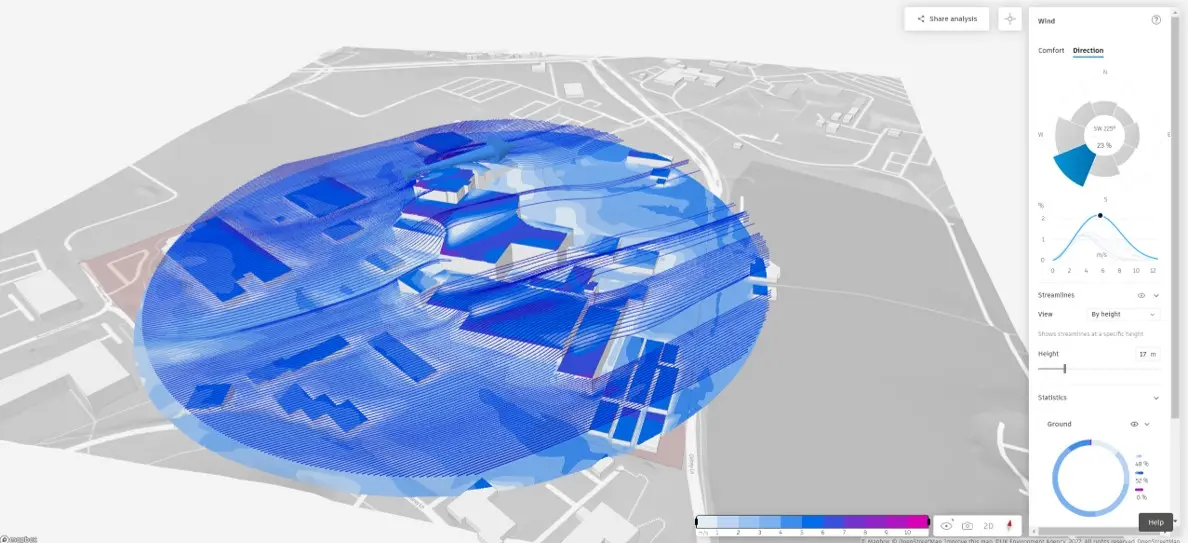
Autodesk Forma Site Design has become an integral part of BDP’s early-stage design process. It helps teams to confidently explore design options and, in parallel, assess environmental factors such as sun hours, noise, and embodied carbon from day one.
“With Forma Site Design, everyone now has access to an easy-to-use tool that lets them make better decisions in a flexible way, and that's hugely beneficial,” Kell says. “We can still go to our sustainability group and computational design and building physics specialists, but not every client needs this or can afford it. It gives our designers the ability to use sustainability insights without being specialists.”
To help teams get the most out of Forma, BDP co-produced videos with Autodesk that showed not just how to use the tool, but also how to apply it effectively and align with internal expectations and sustainability goals. Forma Site Design learning modules were also integrated directly into the company’s learning management system (LMS), allowing progress to be tracked and follow-up support to be tailored. This ensures that training isn’t one-size-fits-all and delivered when and where it is needed most.
Transforming the business
While BDP is still implementing this evolved way of working, they’re already seeing the buy-in and impact happening across the company. These initiatives aren’t only tracking valuable data and helping to meet sustainability goals, they’re also improving the projects and business itself.
"We now have the consistent data and analytics to answer the question, 'Is the business actually improving in the way we want it to?' and it will only get better as time goes on," Kell says. "We can define what good is and where improvement is needed.”
Investing in sustainability skills benefits both the current and future workforce by aligning career paths with evolving industry demands. Across industries, job seekers are looking for purpose-driven work, and sustainability is becoming a major factor in career decisions.
According to Autodesk's 2025 State of Design & Make report, 75% of leaders at digitally mature companies report their sustainability efforts help attract and retain talent. "Increasingly younger architects and engineers are coming into the business with sustainability top-of-mind. It's important to them," Kell says.
Growing recognition of sustainability's business value is prompting leaders to view it as an opportunity for better performance.
"Many funders and building owners look to sustainability goals as the benchmark of what good looks like," Kell says. "From the development of the Climate and Social Impact Design Framework to the use of Forma Site Design, we have had support from the top down."
Organizations like BDP are taking the reins on sustainability initiatives by incorporating them into long-term strategy rather than allowing external influences to guide decisions. "Having a dedicated team to drive the strategy, set measurable targets for the businesses, and reporting and seeing progress is key," Kell says.
BDP is one of the many companies that is recognizing the transformational potential of sustainability. All AECO firms have a unique opportunity to take advantage of this turning point, from integrating data into sustainable decision making, to intentional upskilling and attracting the next generation.
About the author

Shaelyn McHugh
Shaelyn McHugh is passionate about the positive impact technology can have on the world. With experience telling the stories of leaders across technology, construction, and architecture, she currently sits on Autodesk’s Impact team, helping scale global sustainability in the AECO industries.