Unlocking GIS-Powered Urban Design with Forma Site Design and Esri
Forma Site Design Guest Blog
Executive Summary
Authors:
Daniel Stine, Director of Design Technology, Lake|Flato
Erika Bocian, Principal Consultant, Esri This blog post is an excerpt from the AU 2025 session: From Data to Informed Design: Unlocking GIS-Powered Urban Design with Forma Site Design and Esri
The new ArcGIS extension for Forma Site Design integrates geographic information system (GIS) data directly into the live 3D massing model.
Forma Site Design's real-time simulation and massing tools, combined with robust GIS layers—from flood risk and green infrastructure to demographic data—can empower planning decisions that balance ecology, equity, and economy from the outset.
Lake|Flato’s real-world case study shows how a GIS-driven approach is used to optimize an existing design to improve livability and sustainability outcomes before breaking ground—saving effort, money, and time in the long run.
Forma meets ArcGIS
The ArcGIS extension for Forma Site Design is a direct result of the strategic alliance between Esri and Autodesk that integrates deep GIS insights directly into design workflows. What this alliance enables the two organizations to do is to truly collaborate and to co-innovate to share strategies, knowledge (like libraries and APIs), and resources to allow better integration between BIM and GIS.
Why does this matter? Why actually do this?
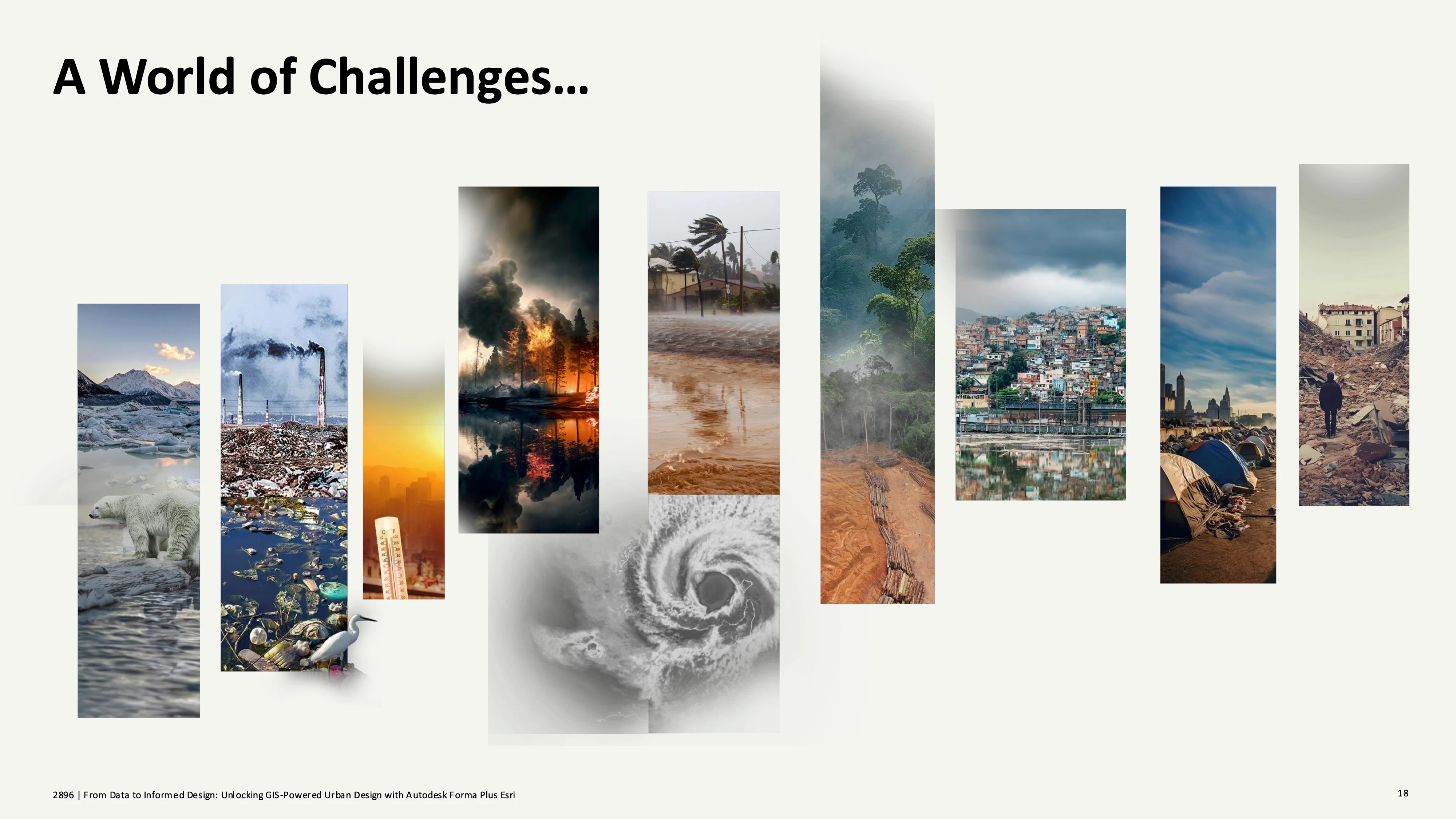
Because our world is changing rapidly. Our actions as humans are creating unintended consequences like climate change, severe weather, droughts, flooding, wildfires, decline in biodiversity, demographic shifts, inequities and more.
Our communities need many things to support their daily lives: housing, safe water, services, bridges, and roads. Some of this critical infrastructure is aging and crumbling around us. These civil assets we rely on need investment in renovations, retrofits, and, in some cases, new assets. And all this needs to be designed to withstand changing climate and societal needs. Facing these huge challenges together as global communities, we understand that we must do better. We believe that if we leverage the technology we have, intelligently, diligently and with purpose, we can create a sustainable future for ourselves and our planet.
The future of sustainable, equitable urban design hinges on access to actionable data at the earliest design stages.
At the beginning of a project , the questions we’re trying to answer are simple but high‑impact: Where should things go, how big should they be, and what will those choices mean for people and place? The ArcGIS extension for Forma Site Design lets us answer some of those questions with evidence instead of assumptions. We can stream authoritative layers—flood risk, bike infrastructure, zoning—and see them inside the live massing model, then immediately test daylight, sun hours, wind, noise, and microclimate as we iterate. We’re no longer bouncing between static maps and separate analyses; we’re designing with real-time context and performance side‑by‑side, so tradeoffs surface early, when they are cheapest to change and before commitments harden.
Lake|Flato: Site‑first, climate‑forward
Lake|Flato’s work is grounded in context, performance, and equity from the first sketch. Embedding ArcGIS in Forma operationalizes those commitments: we can test access, comfort, safety, habitat, and carbon implications while we’re still shaping blocks, streets, and open space—aligning decisions with our goals for net‑zero and regenerative outcomes.
The ability to run Forma’s analyses against future weather files means we can bring climate projections into massing and siting—before expensive details or infrastructure are locked in—then communicate options clearly with clients using compelling visuals backed by real-world data. That early, shared understanding is what turns data into better districts and parks, and it’s why this integration is so valuable at the outset of design. The result is a workflow that advances the way we practice: it’s integrated, transparent, and accountable to the communities we serve.
In short, these new tools and workflows will allow us to:
Bring spatial data into designs—so we might have a holistic view and understanding of projects and their impacts.
Evaluate outcomes before breaking ground—saving money and time. But really, it’s about finding the right fit for each project before it’s too late.
Increase project resiliency and sustainability of our projects throughout the project lifecycle.
Case study
In this case study we’ll compare two versions of a design for a mixed-use development in Texas: One is the existing concept (provided by the developer) and the other is the optimized design by Lake|Flato.
Lake|Flato’s urban team used early-stage building simulation in Forma to uncover opportunities that had not been addressed. As with any project, we start by understanding the site, surrounding environment, and climate context.
Site analysis
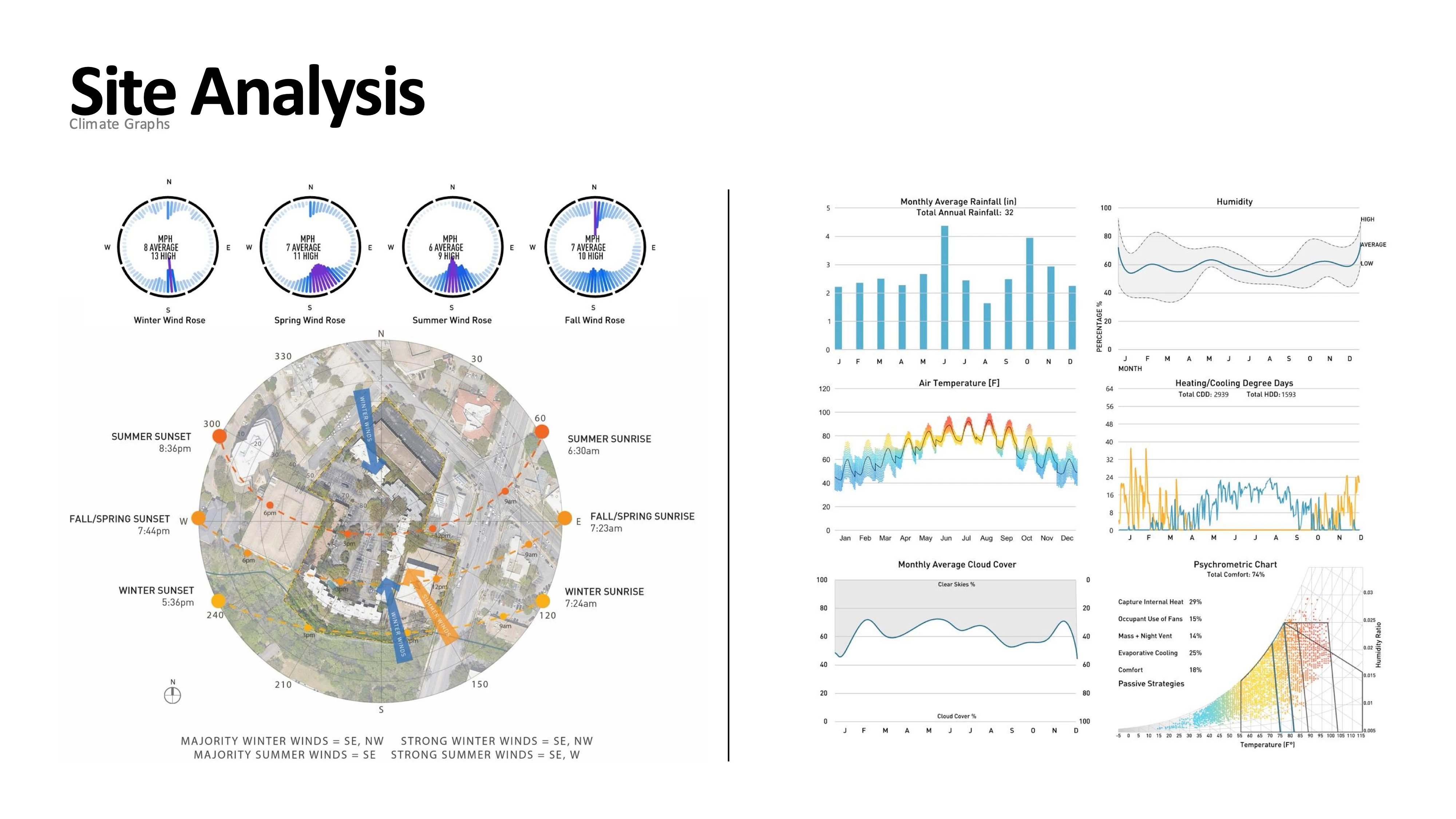
These climate graphs, built from historical weather files using Grasshopper in Rhino and formatted in InDesign, gave us a baseline understanding of the site. Since this project is in Texas, we focused on capturing southern breezes while mitigating colder northern winds, and we studied annual rainfall to plan for water collection and reuse.
Missed opportunities and comparing two designs with updated design
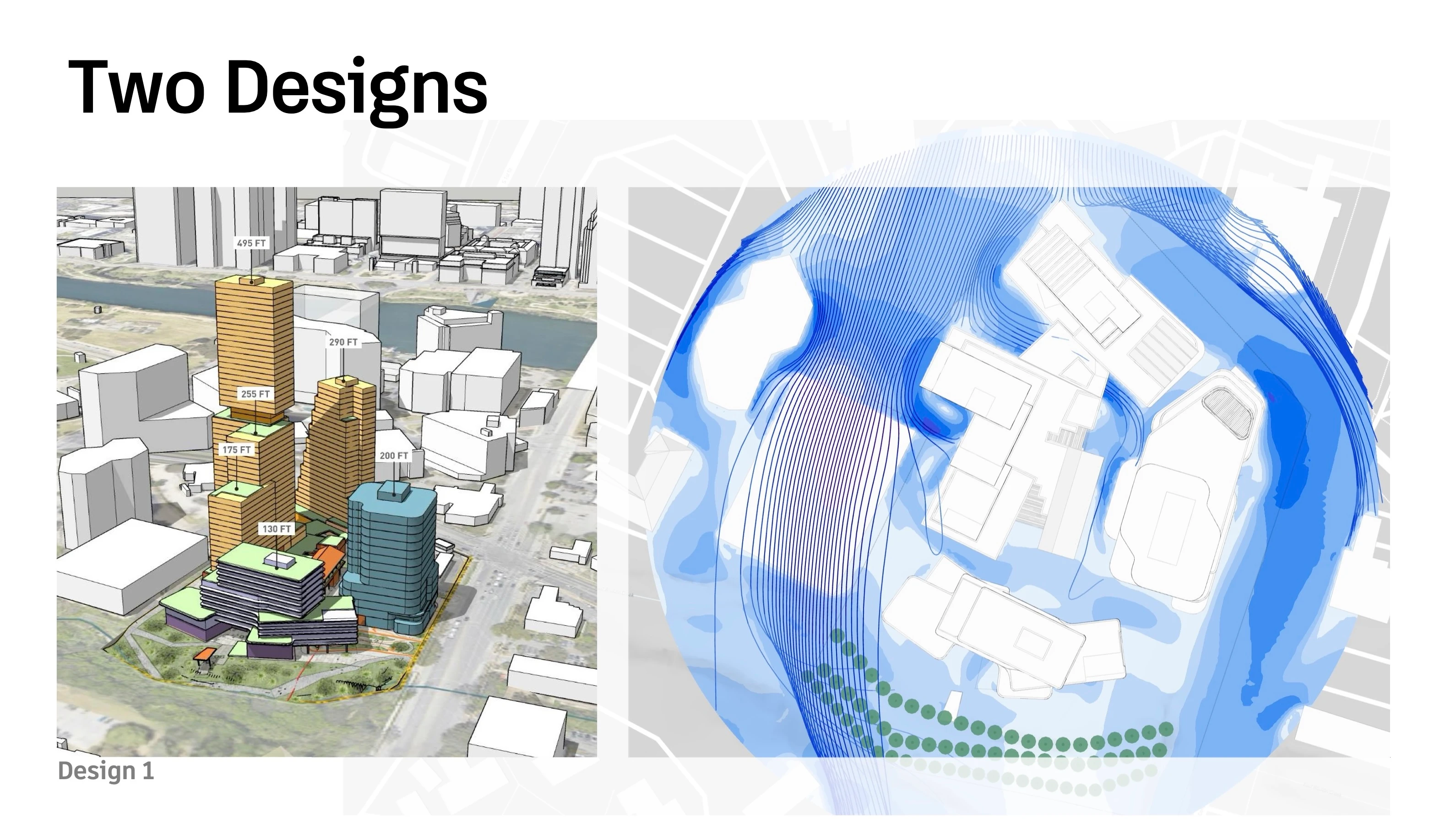
These diagrams show how the buildings interact with the prevailing northern and southern winds across the site. One key issue was that the southern building turned its back on a major opportunity—failing to connect with the beautiful creek along the south edge.
In the new design, we focused on user experience and reconnecting the site with nature. The layout is reconfigured to welcome southern breezes and allow natural ventilation across the project. This also created opportunities for plazas and balconies where people can gather, enjoy the outdoors, and feel connected to the landscape.
While the initial design did have some strengths, we also saw significant opportunities to improve—particularly its orientation. The layout blocked beneficial southern summer breezes while amplifying cold northern winds through a venturi effect. That building placement and site organization became a key area we revisited and refined in our own approach.
Rich 3D model
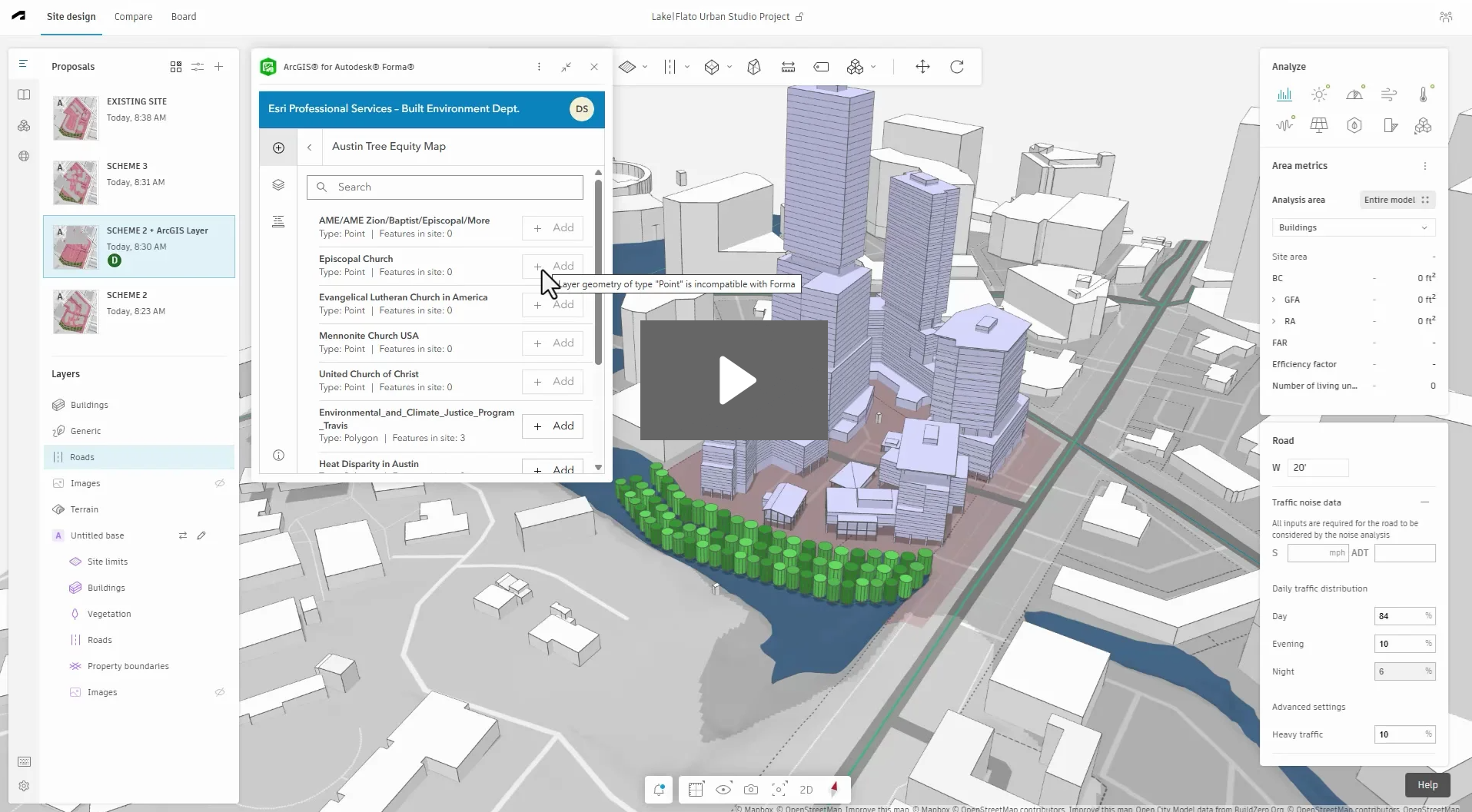
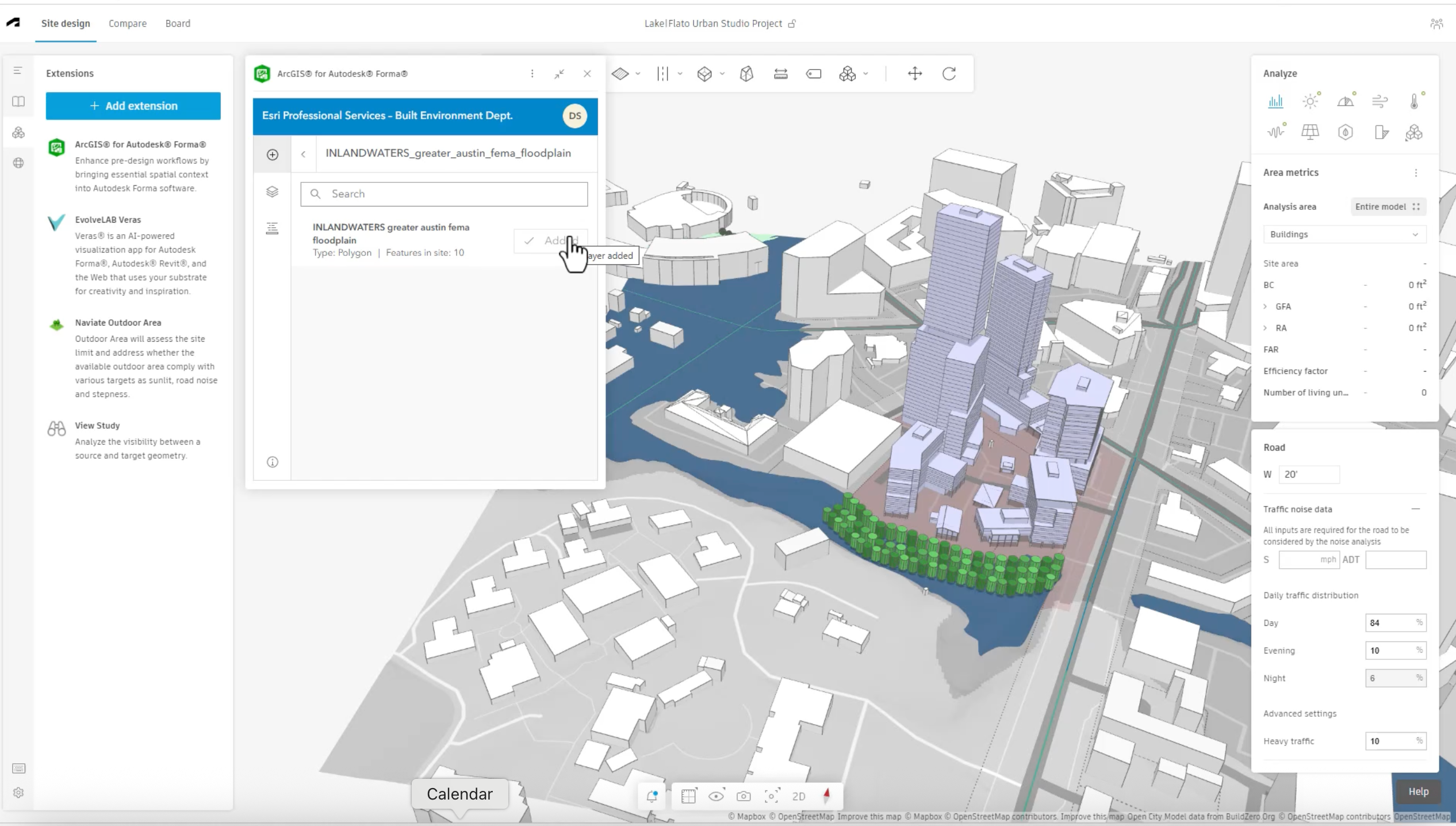
In this video, we show how the new Esri ArcGIS add-in for Forma Site Design opens a new world of rich, accurate geographic and socio-economic data that can be visualized directly within Forma and used to guide design decisions.
We’re able to pull in data like FEMA flood plain maps, Tree Equity Score, proposed protected bike lanes from the City of Austin, and zoning layers that can be selected and explored interactively inside Forma. Some of this information was curated by Lake|Flato’s Urban Design team in the ArcGIS desktop app, while other layers came directly from ArcGIS Online through Forma’s add-layers feature.
Sun hours analysis
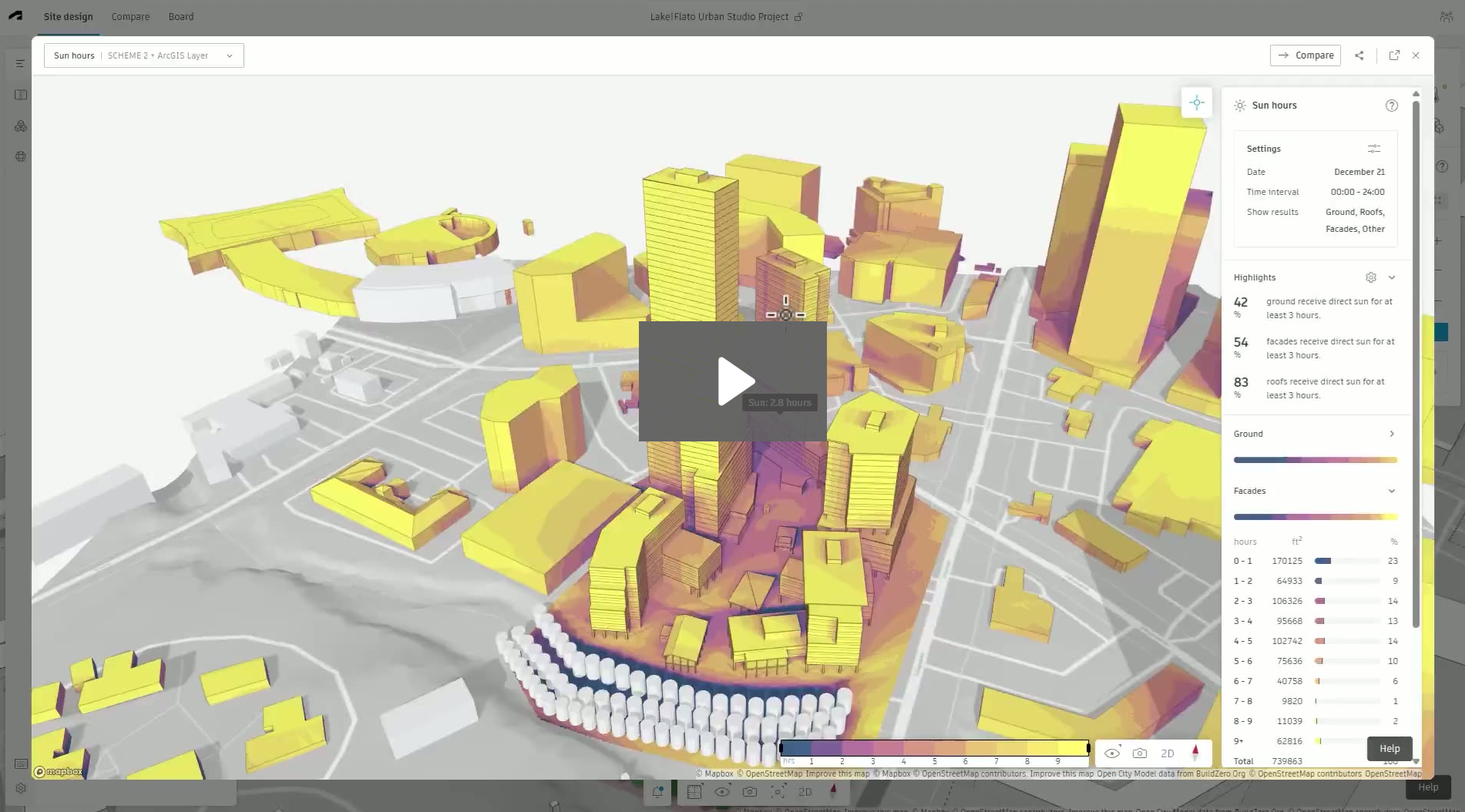
These sun studies gave us critical insight into how light interacts with the site. We wanted to avoid creating dark, underlit spaces during the day, so these diagrams helped us see how surfaces performed across different times of the year. They also provided data we could use to evaluate where solar panels would be most effective.
Noise analysis
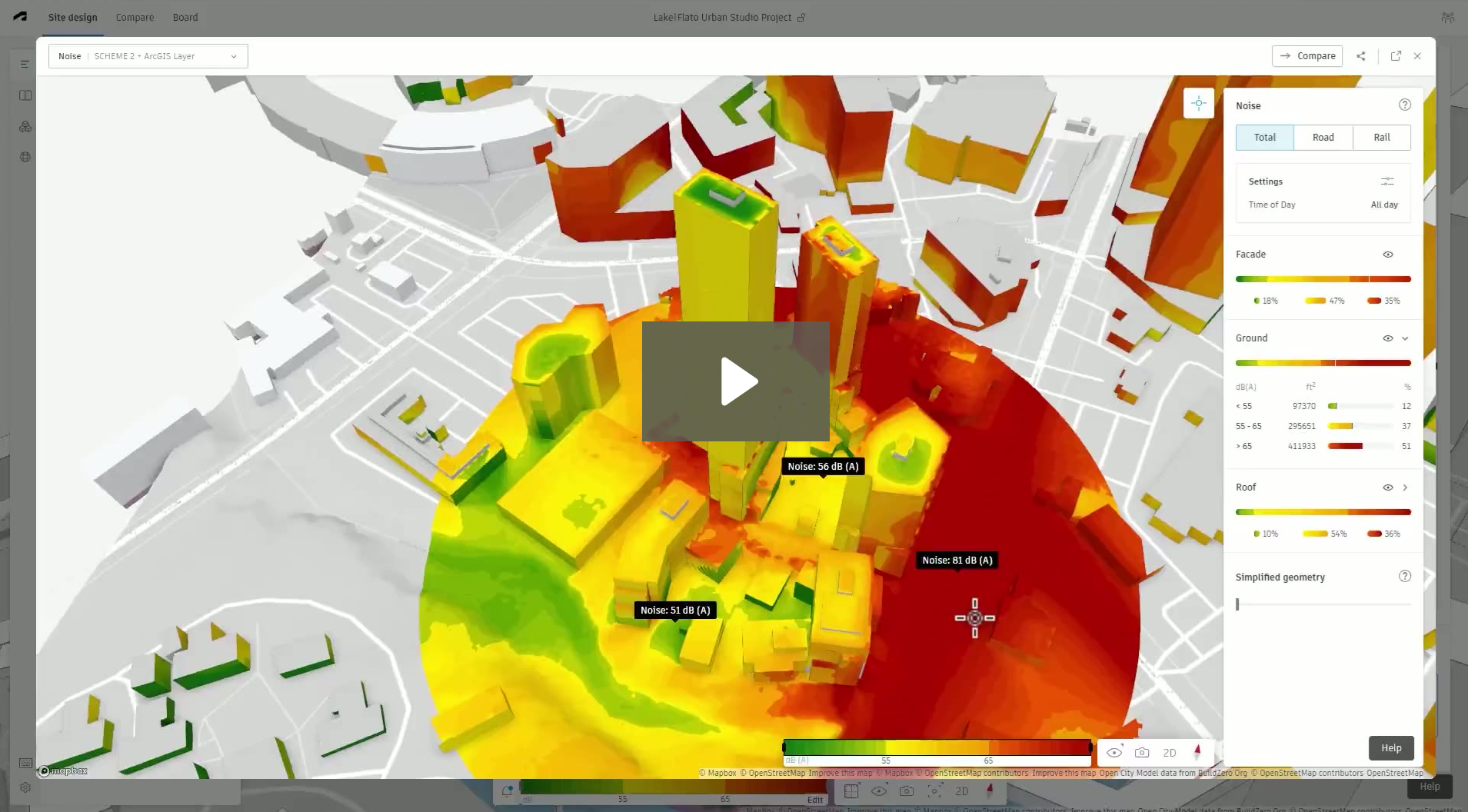
Next, we showed how sound affects our site with busy streets at intersections. We want to understand how the spaces in between were performing. We were glad to see that the communal areas showed low noise levels from the surrounding busy streets. It is worth mentioning that this noise analysis does not consider vegetation which is shown to reduce the dB by 10.
Microclimate analysis
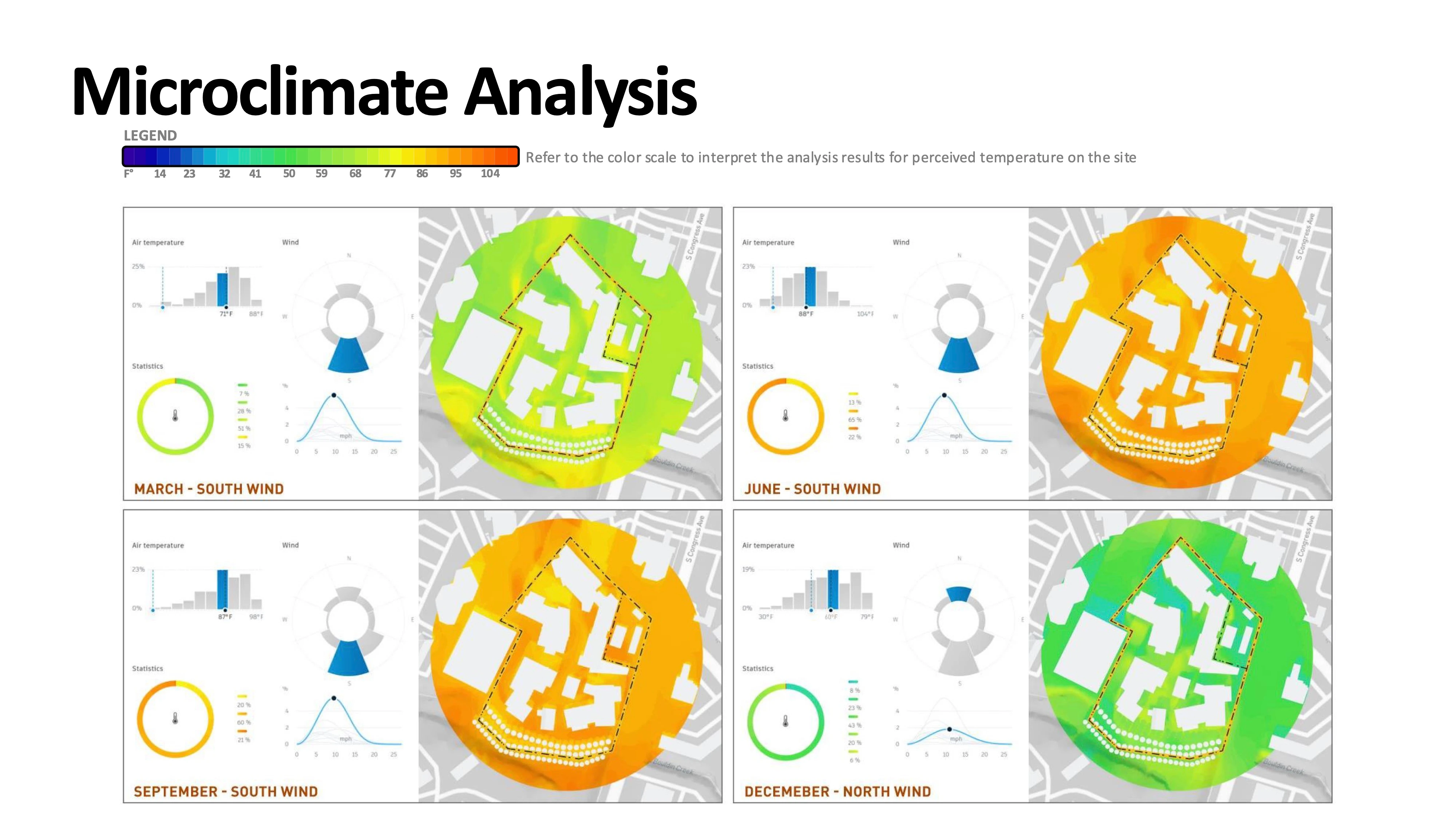
Using microclimate analysis, we were able to see how the site performs across the seasons, with southern winds dominating in March, June, and September, and northern winds in December. By leveraging historical weather data, these simulations confirmed the seasonal patterns we had previously identified with our scripting tools, but more visually and accurately. Forma can even use uploaded future weather data to consider climate change.
Wind analysis
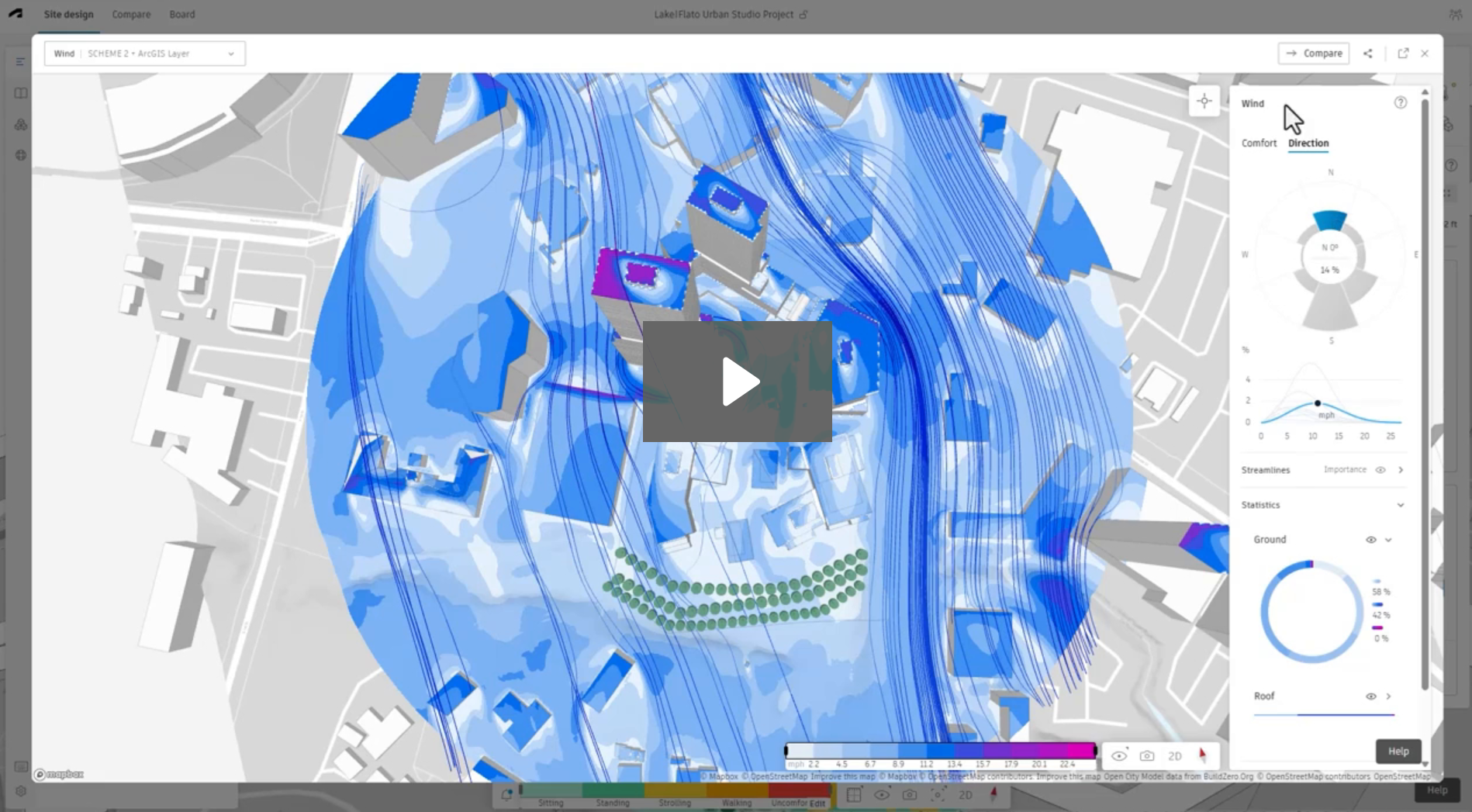
The wind analysis confirmed our expectations about how winds move through the site and, importantly, how the design could take advantage of the surrounding tree canopy to enhance comfort and strengthen the site’s natural connections.
Next, we analyzed wind comfort using the Lawson Comfort Scale within Forma Site Design to understand how the spaces between buildings performed. While most areas worked well, a few zones showed higher wind exposure. In response, we made sure not to locate outdoor seating or gathering areas in those less comfortable zones.
An integrated workflow with real-time insights in one platform
What makes this integration so powerful is that we no longer need to jump between platforms or rely on static reports. We can work with authoritative data in real time and immediately see its impact on our design. This creates a much stronger foundation for decision-making, whether we’re analyzing environmental risks, aligning with zoning requirements, or incorporating community infrastructure like bike lanes.
It also strengthens communication with clients and stakeholders, because we can show compelling visuals backed by real-world data. This workflow helps us design with confidence, ensures greater accuracy and compliance, and ultimately leads to more sustainable and resilient projects.
Learn more
Try Forma Site Design for free: autodesk.com/forma