 Mahtab Barazandeh
At Autodesk University 2025 Water Summit, water industry experts gathered around eight collaborative roundtables to discuss one defining question: How do we turn data into impact?
The AU 2025 Water Summit brought together utilities, engineering firms, and technology providers for eight collaborative roundtables focused on advancing intelligent water infrastructure. The conversations were candid, practical, and forward-thinking.
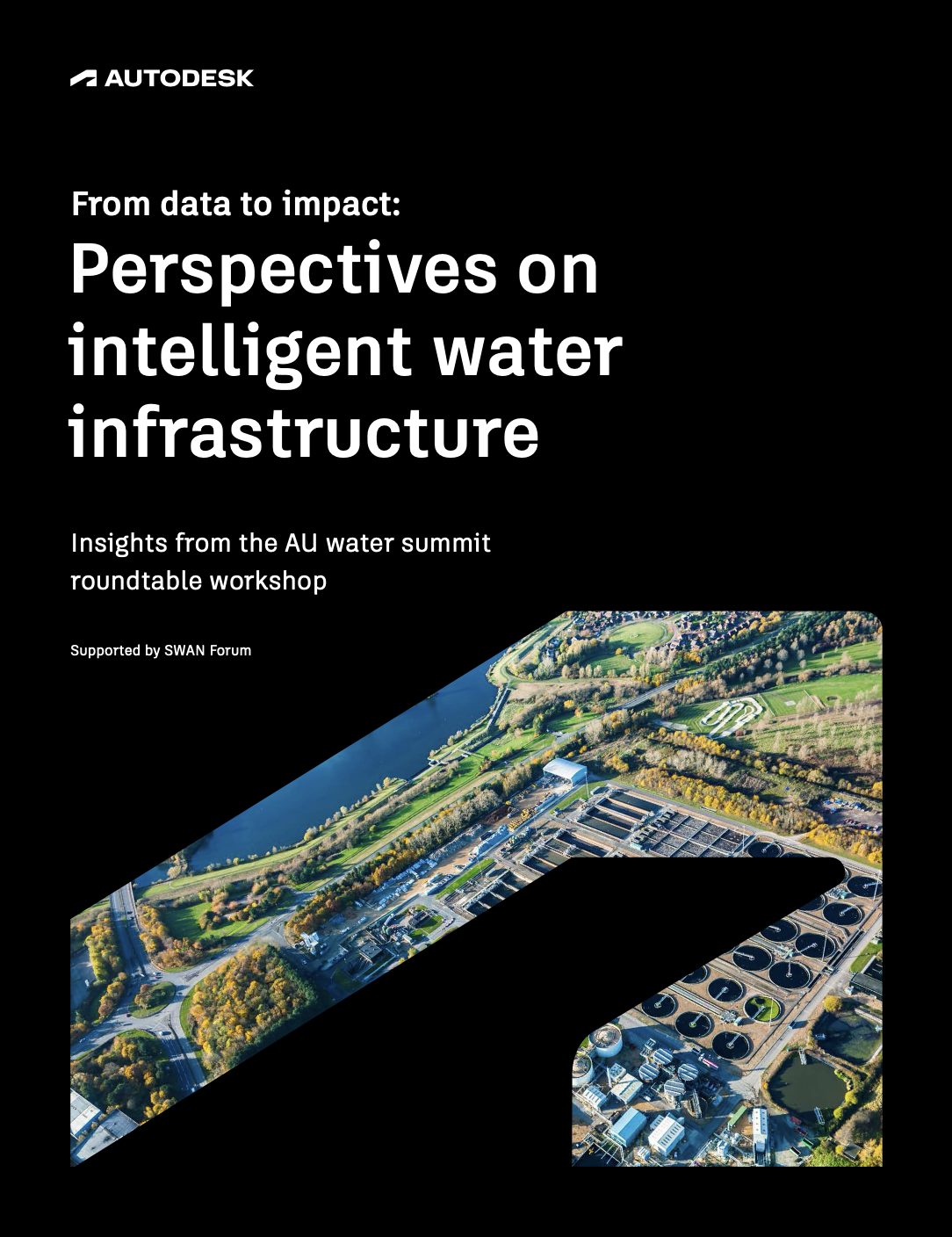
We captured the insights shared during the event in a new report, From data to impact: Perspectives on intelligent water infrastructure.
A sector at a turning point
Utilities today are operating in a complex environment shaped by aging infrastructure, climate volatility, and climate change as a driver of environmental and operational challenges, regulatory pressure, workforce transitions, and rising operational risk. At the same time, cloud computing, AI, advanced modeling, and digital twins are creating new possibilities for how systems are designed, operated, and maintained. There is increased demand and high demand for digital twin solutions as technological advancements and operational needs continue to grow.
The Water Summit, co-led with the SWAN Forum and supported by industry leaders – including Black & Veatch, Kimley-Horn, HDR, VAPAR, Transcend, SUEZ Optimatics, Esri, and Stantec – created space to move beyond theory and examine how digital transformation is unfolding in practice, emphasizing the importance of integrated data for effective digital transformation.
One theme echoed across the discussions: The future of water infrastructure will be data-driven, predictive, integrated, and collaborative, especially within urban water systems and the broader context of smart cities as key areas for digital innovation. The increasingly important role of digital twins and related technologies is shaping the sector and driving new approaches to water management. But getting there requires more than technology.
Across the eight roundtables, participants consistently identified five cross-cutting themes.
Five themes that shaped the conversation
1. Data is abundant, but alignment is not
Most utilities are not lacking data. They are struggling to unify it.
Information lives across spreadsheets, legacy systems, SCADA platforms, GIS environments, and departmental archives. Even when data exists, teams often see only fragments of the full picture. Managing the large volumes and big data generated by modern water systems presents a significant challenge, especially as sensor networks and digital monitoring expand.
The path forward is not simply collecting more data. It is about establishing inclusive standards, strengthening interoperability, and aligning governance across systems. Achieving this requires integrated data and seamless data integration to create a unified virtual representation or virtual replica of water infrastructure. Incorporating real-time data integration supports continuous system monitoring and improved decision-making.
2. Digital maturity is uneven
Digital transformation does not start from the same baseline everywhere.
Some utilities are advancing quickly with AI pilots, cloud-based workflows, and early digital twin implementations. Others are still building foundational capabilities such as metadata standards, cybersecurity protocols, and system integration. Many utilities are at different stages of adopting digital systems and digital twin frameworks, facing common challenges in integrating these technologies into their operations.
Even within a single utility, departments can operate at very different levels of digital maturity. Understanding the company structure is crucial for successful digital transformation, as it supports strategic planning and effective implementation across the organization. This uneven digital maturity journey shapes what is possible and reinforces the need for phased, practical roadmaps rather than one-size-fits-all strategies, highlighting the importance of a modeling perspective and the use of digital models to support utilities’ digital maturity journeys.
3. People drive digital transformation
Across all roundtables, one point stood out: Digital transformation is fundamentally a people transformation.
Shifting from paper-based processes to digital workflows, from CAD to BIM, and from experience-based decisions to data-informed strategies reshapes roles and responsibilities. Resistance is natural. Concerns about institutional knowledge loss are real. Engaging various stakeholders – including utility staff, community members, and organizational leaders – is essential for successful transformation, as collaboration among various stakeholders fosters transparency and sustainability.
Successful transformation requires communication, training, and leadership alignment as much as it requires new platforms or tools. Organizational and cultural change is often more challenging than technical transformation, making it crucial to address these aspects alongside technology adoption. It is important to understand that technology alone does not deliver impact. People do.
Future research should focus on the human and organizational aspects of digital transformation in water utilities, including strategies for effective stakeholder collaboration and managing cultural change.
4. ROI must be operational
Participants emphasized that utilities respond most strongly when digital investment is framed in operational terms. Reduced outages. Deferred capital spending. Improved crew productivity. Faster response times. Risk-based asset renewal. Digital twins provide real-time insights and actionable insights that support decision making and enable predictive maintenance, helping utilities optimize operations and proactively address issues.
When ROI connects directly to reliability and performance, the case for transformation becomes clearer and easier to fund.
5. Intelligent water systems are a journey
Digital twins, AI analytics, and cloud platforms are not one-time deployments. As a virtual model or virtual replica of physical systems, digital twins enable real time monitoring and resource planning, allowing utilities to optimize operations and respond quickly to issues. They require governance, iteration, calibration, and long-term commitment. Start small. Prove impact. Expand with purpose.
The big takeaway: A robust digital twin architecture is essential to support continuous improvement and ensure the digital twin system delivers ongoing value.
From reactive to proactive operations
Despite cost pressures, cybersecurity concerns, and cultural barriers, participants at the Water Summit described a sector steadily shifting from reactive to proactive management:
- Predictive analytics and real-time monitoring are helping utilities anticipate failures and extend asset life. Digital twins enable continuous monitoring, analysis, and optimization of water distribution networks by integrating real-time data from the physical environment and sensors, allowing for rapid detection of inefficiencies such as pressure drops, leaks, or equipment malfunctions.
- Improved data quality is enabling risk- and performance-based decision-making. Predictive modeling and making predictions with digital twins allow utilities to forecast water demand, detect leaks, and identify anomalies before they escalate, supporting proactive maintenance and operational efficiency.
- Shared digital platforms are strengthening collaboration between planners, engineers, and operators.
- Standardized data models and predictive systems can preserve institutional knowledge as experienced staff retire, helping organizations maintain continuity and resilience.
Ultimately, becoming proactive requires a systems-thinking approach, strategic alignment between business and information systems, robust business models, and – perhaps most importantly – the ability to overcome organizational inertia. The transformation underway is not about automation for its own sake. It is about building safer, more reliable, and more efficient systems.
Practical strategies for accelerating digital maturity
The roundtables also surfaced clear strategies for accelerating progress:
- Establish strong data governance before scaling AI or digital twin initiatives
- Avoid fragmented technology ecosystems through clear interconnected workflows
- Balance scalability and security through thoughtful cloud strategies
- Invest in workforce development across engineering, project management, and technology leadership
- Identify internal champions and maintain transparency to succeed in long-term adoption.
Read the full report
One of the most encouraging signals from the AU 2025 Water Summit was the level of cross-sector alignment. Utilities, consultants, and technology providers shared similar priorities: improve interoperability, strengthen governance, demonstrate operational ROI, and build workforce readiness. Ultimately, the the Water Summit reinforced that transformation does not happen in isolation; it happens through partnership.
This recap covers a portion of the insights shared during the AU 2025 Water Summit, but you can get a deeper dive into the roundtable discussions, detailed themes, and strategic recommendations by downloading the full report.