 Mike Maylone
Aging water and wastewater infrastructure presents a growing challenge for utilities: unexpected failures, costly emergency repairs, and uncertainty in long-term capital planning. Predicting which pipes are most at risk has often relied on incomplete inspection data or manual scoring, leaving asset managers with limited insight.
The new Deterioration Modeling feature in Info360 Asset tackles this problem head-on, using data-driven statistical models to forecast pipe condition, estimate remaining service life, and guide proactive maintenance – all in a secure cloud-based environment.
Predictive insights for smarter decisions
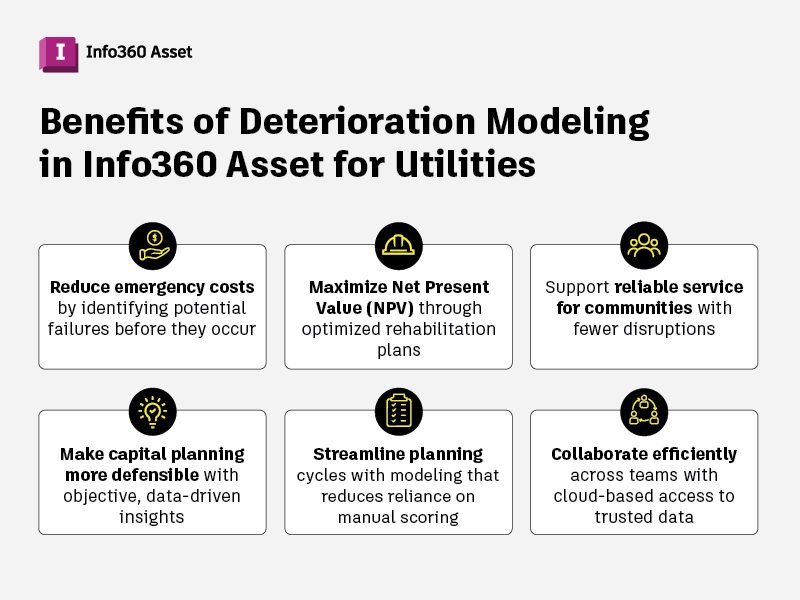
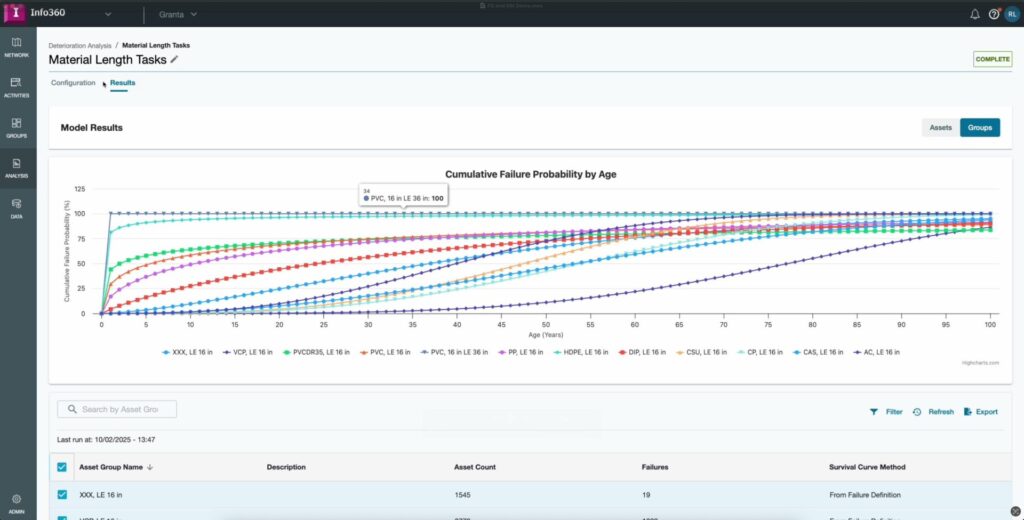
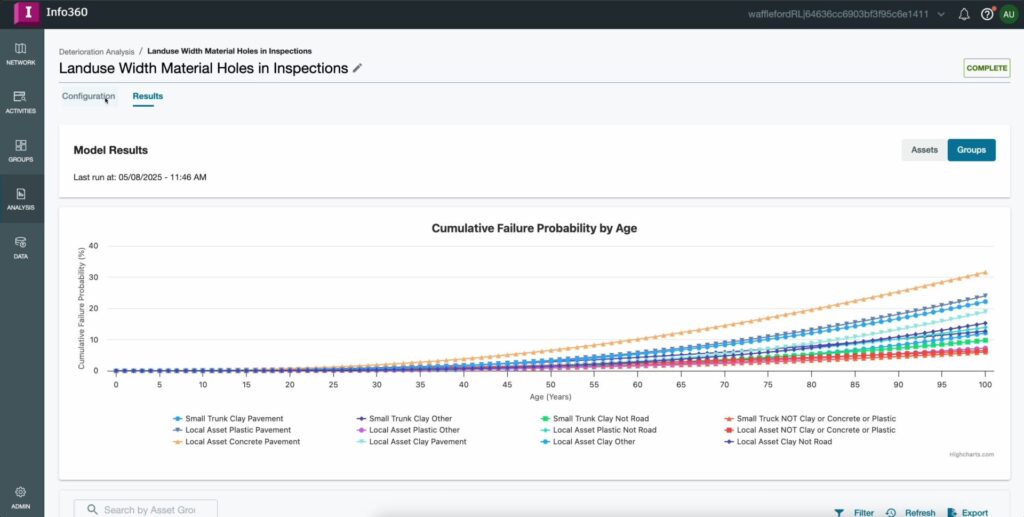
Deterioration Modeling uses a blend of asset attributes such as material, age, and size alongside condition inspection data to generate deterioration curves. These curves reveal how assets are likely to perform over time, helping utilities identify potential failures before they happen and prioritize rehabilitation strategies. The result is more reliable service, fewer emergency repairs, and higher returns on capital investments.
Whether you are an asset manager planning next year’s capital improvements, an engineer optimizing rehabilitation strategies, or a utility leader seeking to extend asset life, this feature provides actionable insights to support better decision-making.
How Deterioration Modeling in Info360 Asset works
The workflow is intuitive and built for efficiency. You start by loading your network data into Info360 Asset, then group assets into cohorts based on shared characteristics like material, age, or failure history.
Next, define what constitutes an asset failure, incorporating condition assessments, past repairs, or specific service events. The system then applies statistical deterioration models, such as Weibull distribution, to predict the likelihood of failure over time. When inspection data is available, the model automatically incorporates pipe condition to refine predictions.
Results are visualized through clear deterioration curves, making it easy to see how asset health evolves and when maintenance or replacement will be needed. From there, planners can test “what-if” scenarios and optimize rehabilitation plans to maximize return on investment.
In addition to deterioration curves built from data provided by the user, we’ve also added industry standard curves that have been developed based on data from the Sustainable Water Infrastructure Management (SWIM) Center at Virginia Tech, which collects data from 500 water utilities and 100 federal facilities across the US and includes pipelines of different materials, such as cast iron, ductile iron, prestressed concrete, reinforced concrete, steel, PVC, and HDPE – to name a few.
Turn uncertainty into actionable insights
With Info360 Asset, utilities can identify which assets are most at risk and plan interventions with confidence. The feature’s data-driven deterioration curves support objective, transparent capital planning, while optimized rehabilitation modeling helps maximize Net Present Value (NPV) and minimize unnecessary spending. Because the platform is cloud-based, teams collaborate from the same trusted data, eliminating manual scoring and streamlining planning cycles.
The result is fewer unexpected failures, more reliable service for communities, and smarter, proactive maintenance that extends asset life and improves both operational and financial outcomes.
A modern evolution of trusted technology
Deterioration modeling has long been a core capability for Autodesk customers through InfoAsset Planner, which used statistical models to forecast pipe condition and guide maintenance decisions. By fully integrating this capability into Info360 Asset, customers now benefit from cloud-based access, seamless collaboration, and more efficient workflows. The predictive insights they’ve relied on for years are now faster, more accurate, and easier to act on than ever before.
This launch also marks meaningful progress in Autodesk’s commitment to bringing InfoAsset Planner workflows to the cloud. Step by step, capabilities like condition assessment, risk analysis, rehab planning, GIS integration, and now deterioration modeling are being reimagined within Info360 Asset – offering utilities a more connected, accessible, and scalable platform for managing asset performance.
To see how these capabilities are coming together, explore the Water Infrastructure roadmap. It outlines the advancements already delivered and what’s ahead as Autodesk continues to evolve trusted desktop tools into a modern, cloud-based experience built for the future of water infrastructure management.
Getting started with deterioration modeling
Ready to get started with Deterioration Modeling? Follow our step-by-step help documentation on Deterioration Modeling. Want to learn more about our Info360 Asset next generation software?
- Read a case study: How GHD created a CCTV + GIS solution for Aqua Pennsylvania with Autodesk and Esri tools.
- Step through our Interactive tour.
- Watch our Get started with Info360 Asset YouTube playlist.
- Reach out to our team for a personalized demo or request a free trial today.