Industrialized construction has been on Autodesk’s radar for quite some time now. As a methodology that brings manufacturing principles and processes into the AEC industry, industrialized construction can enable teams to build more efficiently and at scale.
But in order for the industry to truly get value from industrialized construction, we must equip our people with the knowledge and skills to adopt different ways of working.
That’s why educational institutions play such a critical role in preparing the next generation of construction professionals and helping the industry navigate this shift.
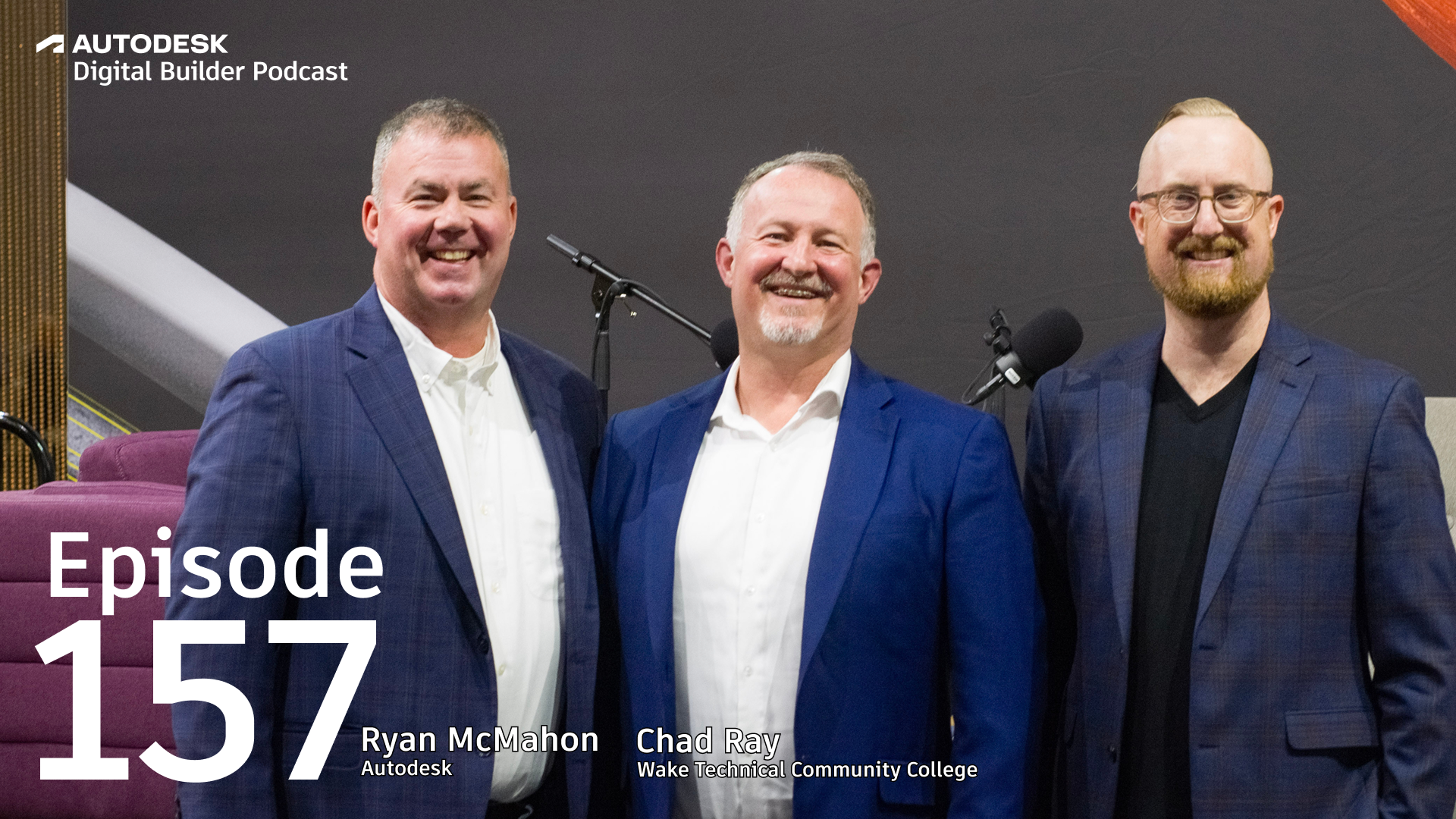
On this episode of Digital Builder, I’m joined by Ryan McMahon, Sr. Director, General Manager for Informed Design at Autodesk, and Chad Ray, Provost and Chief Campus Officer at Wake Technical Community College.
We discuss what’s driving the adoption of industrialized construction and why collaboration between industry and academia is essential to preparing students for the future of building.
We discuss:
Industrialized construction isn't new, but the industry is starting to take it more seriously.
Autodesk recognized its potential years ago and formed an industrialized construction group about seven years back. Today, Ryan and his team focus on bringing the company's AEC and manufacturing technologies together to help customers adopt these methods.
Meanwhile, Wake Tech is approaching industrialized construction from a workforce development perspective.
The college's interest started when its Dean of Advanced Manufacturing, Engineering and Design attended Autodesk University and saw opportunities to build on its existing Industry 4.0 initiatives.
"He was just blown away with everything that was going on," Chad recalls. "And he's like, 'Well, what would it look like if we had Construction 4.0?'"
That question sparked conversations with Autodesk and ultimately led Wake Tech to explore how it could prepare students for this emerging field.
"We're not having anybody knock on our doors today, but we know it's coming, we know it's gaining momentum, and we want to be there and have the workforce ready for our industry," Chad remarks.
The industry sees this need too: 81% of respondents say industrialized construction should be more integrated into degree programs, according to Autodesk’s State of Design & Make: Spotlight on Industrialized Construction.
Rising material costs, inefficiencies, and shrinking margins are putting pressure on construction companies to rethink how they operate. Add increasingly complex projects to the mix, and it's clear why industrialized construction is gaining traction.
As Ryan explains, "With margins getting thinner and projects getting bigger and more complex, every one of the participants is looking for ways that they can run a better business."
Manufacturing offers proven processes that construction companies can learn from. And as more organizations experiment with industrialized construction, they're finding opportunities to improve their operations.
The challenge now is making those methods accessible to more businesses.
"Part of that is not just the processes; it's the people," Ryan says. "Do we have the right talent to help us think about and solve these problems in a new way?"
Industrialized construction brings together design, manufacturing, and construction. But getting these disciplines to work together isn't always easy, especially when people are used to doing things a certain way.
"Convergence is slow and changing the status quo is really hard," Chad says.
He points out that educational institutions face many of the same challenges as the construction industry. Both have established disciplines that operate in silos, and breaking down those barriers takes time.
He explains that one challenge they're navigating at Wake Tech is figuring out how to bring different fields together before teaching students to work in new ways.
Ryan adds that education plays a critical role in helping the industry navigate these changes. We've seen similar shifts before, particularly with the adoption of BIM, which introduced new roles, skills, and processes.
"We're in a similar kind of change where we're taking something that we know from a different industry and applying it to AEC," he remarks.
Education can help identify the skills people need and prepare them to put new methods into practice.
Preparing students for the workforce starts with understanding what employers actually need. With that in mind, educational institutions must work closely with industry partners to shape their programs and curricula.
"Our industry partners, they're the ones that are going to guide what we're doing, how we're setting things up," Chad explains.
At Wake Tech, this approach has worked well in biotechnology, where industry partners helped identify necessary skills, select equipment, and even design facilities.
Chad believes industrialized construction should have the same level of collaboration.
"If we're going to reduce that gap between academia and industry, that partnership has to be super strong," he says.
As industrialized construction becomes more common, we'll likely see new roles emerge in AEC, particularly those that draw on manufacturing expertise.
Ryan points to the differences between how the two industries operate today. In construction, teams typically prefabricate components for individual projects. Manufacturing, on the other hand, focuses on producing products and components that can be used across multiple projects.
"We make those things, but across many different projects," Ryan explains. "So there's a mindset shift that needs to happen, and that needs to apply to all of the different kinds of roles that show up in the industry as it begins to embrace these new methods."
This shift could open doors for professionals from different backgrounds, including those without traditional construction experience.
"Anytime there's change, it creates opportunities for people," Ryan says.
He adds that employers will increasingly look for people with new skills, as well as those who are open-minded, comfortable with ambiguity, and able to learn on the job.
Preparing students for established industries is fairly straightforward. Employers know what skills they need, and educational institutions can build programs around those requirements.
But what happens when an industry is still taking shape?
That's the challenge Wake Tech faces with industrialized construction.
"We typically have fixed needs that we're responding to and defined skill sets. And here it's a little different with the industry evolving," Chad explains.
To better understand where things are headed, Wake Tech has been speaking with industry partners, universities, and Autodesk to identify emerging workforce needs.
Autodesk is taking a similar approach, working with institutions like Wake Tech, the University of Florida, and Oregon State University to explore new skills and develop curricula.
Ryan also sees universities as valuable research partners that can help the industry tackle problems in new ways.
"We seek help from education to help us identify where there are gaps," he says.
Ultimately, these partnerships can help schools prepare students for jobs that may not even exist yet.
A lot of groundwork is being laid right now to set up the workforce for success in industrialized construction. So, how do we know if what we're doing is working?
For Ryan, one of the clearest signs of progress would be more factories producing components for construction projects.
While some companies are already experimenting with prefabrication, it still accounts for a relatively small share of construction today.
"I think when you begin to see that 70% of the components that go into a building project were prefabricated and assembled on site, that's kind of an interesting measure," Ryan says.
He also expects new job titles and roles to emerge as industrialized construction becomes more widespread.
Technology will play a big part in making that happen. Ryan points out that advances in mass customization now allow manufacturers to produce components tailored to specific projects while still benefiting from repeatable manufacturing processes.
For Chad, success looks a little different.
"I really want to see that gap between academia and industry reduced, that communication really tight so that our programs are really well aligned," he says.
Beyond preparing students with the right skills, Chad hopes Wake Tech can create a model that other educational institutions can follow.
As he puts it, "It's going to take higher ed coming together to respond to the growth of industrialized construction, not just a college."
Looking ahead, 70% of respondents believe industrialized construction will become standard practice within the next three to five years. Explore the report’s findings on adoption and what it will take to scale.
Digital Builder is hosted by me, Eric Thomas. Remember, new episodes of Digital Builder go live every week. Listen to the Digital Builder Podcast on:
or wherever you listen to podcasts.