Too often, construction safety is seen as a checklist item or something to comply with. You fill out a form, tick some boxes, and then move on. But while the traditional approach may satisfy requirements, it still has shortcomings around keeping people safe—both physically and psychologically.
Real safety isn’t imposed from the top down. It’s owned in the field, shaped by culture, and reinforced every single day through action.
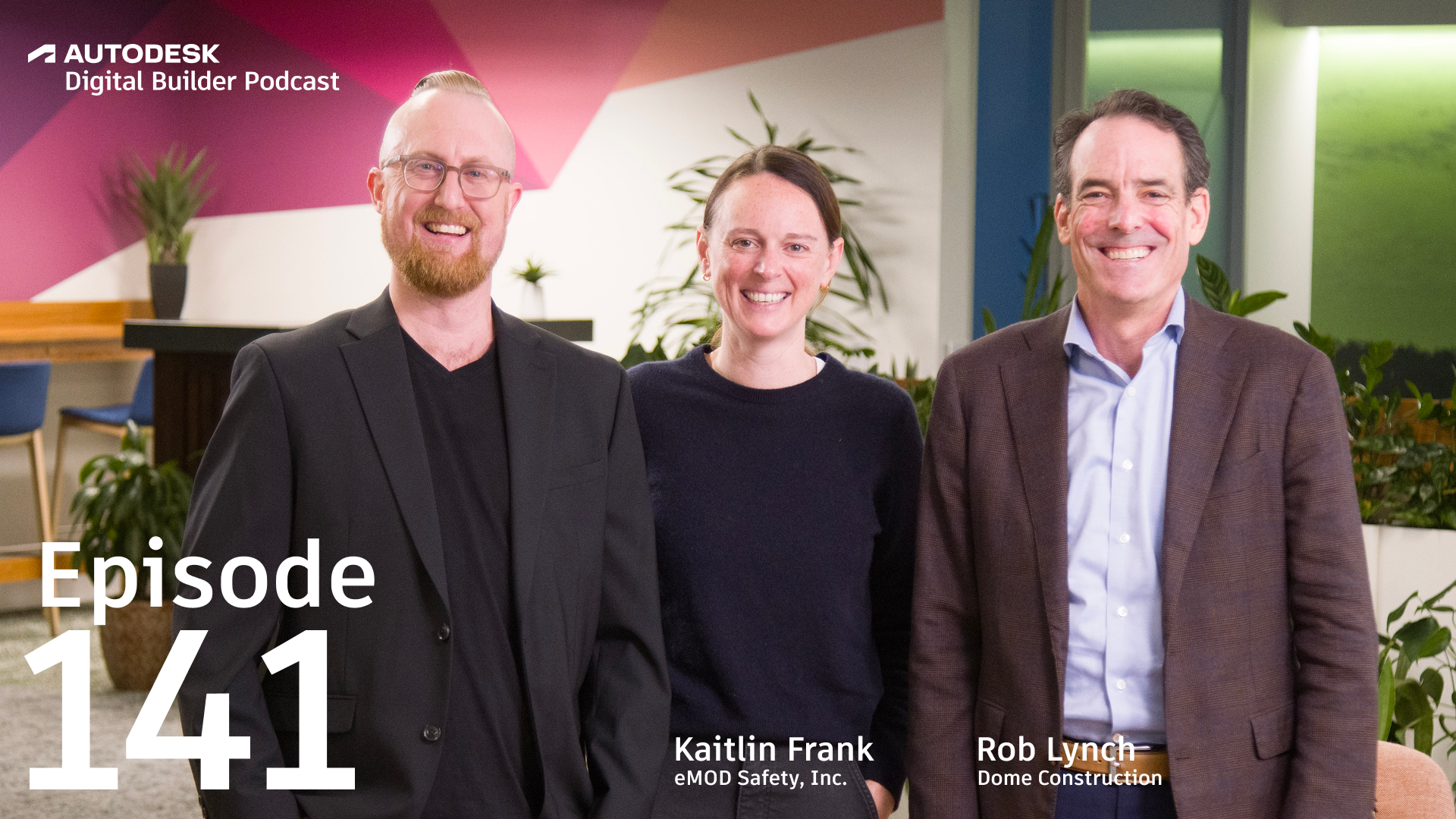
On this latest episode of Digital Builder, I caught up with Kaitlin Frank, CEO of eMOD, and Rob Lynch, CEO of Dome Construction. We explored how the industry can move beyond checklists toward something more meaningful, where safety lives in the field rather than just in policy documents.
We discuss:
In many cases, safety still gets treated as something you manage through compliance. As Rob explains, “Many folks think that safety performance can be imposed through a strict compliance mindset or compliance structures.”
This approach leads to several risks. “You can have compliance and not have good safety performance—that’s the biggest risk,” he explains. “And I also think just the fact that if you impose it on people, you don't get the buy-in. So, it won’t be sustainable either.”
That disconnect is clear in the field, and Kaitlin has seen it firsthand. “Safety always felt like a checklist,” she says. It’s something you complete, not something you live. But the reality on a jobsite tells a different story. “It was never ‘if’ an incident was going to happen. It was more ‘when’.”
Recognizing that it’s a question of “when” and not “if” matters. Because if incidents are inevitable, the goal can’t just be compliance. It must be prevention and mitigation.
As Kaitlin explains, the real question becomes, “How do we make sure those incidents aren’t happening, or how do we decrease the severity of them?”
Kaitlin and Rob are major advocates for modernizing the industry’s approach to safety. With that in mind, here are some of the outdated perceptions and myths they see about construction safety.
“We don’t have incidents, so we don’t have a safety problem”
This one comes up more often than you’d think. If nothing is being reported, it’s easy to assume everything is fine. But as Kaitlin puts it, “that is so far from the truth.” Just because something isn’t documented doesn’t mean it isn’t happening.
A lot of teams are focused on speed and cost. “They’re trying to get it done faster, less expensive… just do the job.” In that environment, issues get overlooked or ignored. Some teams even avoid data altogether. “We don’t want the data. There’s too much data out there. We don’t want to know.”
That mindset, says Kaitlin, creates a bigger problem. “If you don’t want to know what’s actually happening, you don’t want to actually solve the problem.”
“That just makes my skin crawl because at the end of the day, these are people. That is someone's father, son, daughter, or mother that we're talking about and not reporting. Not identifying the issue doesn't solve the problem.”
Safety has to be imposed on workers
Another common belief is that safety only works when it’s enforced from the top down.
Rob pushes back on this directly. “When folks get up in the morning, they want to go to work, they want to do a good job, they want to be safe.” The idea that workers don’t care about safety or need it forced on them is simply off base.
With the right culture and tools in place, “workers themselves will take ownership, for themselves and the people around them.” Moving away from a purely compliance-driven mindset opens the door to stronger engagement and better outcomes.
Safety takes too much time
This one sounds practical on the surface, but it doesn’t hold up. As Kaitlin says, “safety doesn’t take too much time. Incidents take too much time.”
When something goes wrong, everything slows down or stops. There are reporting, investigations, stand-downs... and that’s just what happens on site. Behind the scenes, it expands into operations, HR, insurance, and more. “There’s a whole other side of this that goes on for months and years,” she says.
Cutting corners to save a few minutes upfront often leads to much bigger delays later.
What does it take to shift an organization’s safety approach so that it truly impacts safety performance, and not just compliance? Here’s how Kaitlin and Rob see it.
Safety can’t be imposed; it has to be owned
One of the biggest shifts starts with mindset. As Rob explains, “there’s no amount of safety officers or procedures that can be deployed that can impose safety performance.”
At the end of the day, it comes down to the people doing the work. They’re the ones exposed to the risks, so they need to have ownership and not just have safety pushed onto them.
Make safety a shared responsibility in the field
One of the biggest breakdowns happens between policy and practice. Safety programs often live with leadership, but not with the crews actually doing the work.
Kaitlin sees that gap clearly. “Safety programs were stopping at operations. Yes, the superintendent would know what the program was, but if you started talking to carpenters and laborers and talking to all the field crews, there was a disconnect. They generally knew the expectations, but they needed help. It wasn't owned by them.”
Rob shares the same sentiment and says you can’t expect real safety outcomes if ownership stays at the top. It also has to live with the people doing the work.
“There's no amount of safety officers or procedures that can be deployed that can impose safety performance,” he remarks.
“At the end of the day, it's the individual workers who are exposed to the hazards, and they're the ones who have to have the tools, and ultimately the moment of pause to step away from a hazardous situation and fix it.”
Make safety part of every worker’s day
For safety to actually work, it has to show up daily. Not just in a form, but in how work gets planned and executed.
Rob breaks it down into the “four As”: attitude, awareness, actions, and accountability. “It needs to touch every worker every day.”
When you cover your bases across those four As, you move safety from something people complete to something they think about and act on in the moment.
“It creates an environment where now every single person on the job site is taking full ownership and accountability for not only their safety, but those around them,” says Rob.
Move beyond compliance to real outcomes
Compliance is just the starting point. “The first one is, are we doing it? That’s the compliance mindset.” But most teams stop there.
Strong safety cultures go further. They improve, adapt, and start catching risks before they turn into incidents. They become repeatable and sustainable.
And that’s where the industry is starting to move. Away from “check the box” and toward something that actually works in the field.
When safety improves, the ripple effects are seen everywhere, from project performance to profitability.
Safer teams and stronger culture
It starts with people. As Rob puts it, “you’re giving your workers the best chance to go home safe and those around them to go home safe.” That’s the baseline. If your people aren’t safe, nothing else really matters.
But when safety improves, you start to see a shift in how teams operate. There’s more trust, more accountability, and more consistency in how work gets done.
Ultimately, that leads to fewer disruptions, smoother execution, and more reliable project outcomes.
As Rob points out, “You're going to have more predictable schedule performance, budget performance, and quality performance. It’s not always directly measurable, but we know it's there.”
Measurable improvements in safety metrics
Now, the impact becomes even clearer when you look at the numbers.
Since implementing a more proactive approach, Rob shares that their “TRIR, DART, and EMR have gone down respectively 39, 37, and 31%.”
Lower insurance costs and real financial impact
Those improvements don’t just stay on paper. They translate into real dollars.
Insurance premiums dropped from about $1.1 million per year to roughly $450,000. “That’s $600,000 that goes to the bottom-line incentive pool for our employees every year,” Rob explains.
Even workers’ comp saw a major shift, going from $2.19 per $100 of payroll to $0.89.
Real-time visibility drives better decisions
For many teams, the biggest unlock is visibility.
As Kaitlin explains, results improve when teams can “see the issues, identify where they have gaps and jump on them right away.” Instead of sitting in a binder, safety data becomes actionable.
“Having the ability to see everything on one platform, address it in real time within minutes or hours and not days, weeks, months... that's really been what's been a difference for a lot of our customers,” she adds.
Digital Builder is hosted by me, Eric Thomas. Remember, new episodes of Digital Builder go live every week. Listen to the Digital Builder Podcast on:
or wherever you listen to podcasts.